

Reagent refill for iron Fe test
Regular price
¥1,900
Regular price
Sale price
¥1,900
Unit price
/
per
¥633 × 3 with no fees
Klarna.
This dropper bottle is the reagent for the iron test, giving approximately 50 measurements. It colours only the iron remaining in solution — the iron your plants can actually take up.
The reading ranges from 0.02 to 1.5 mg/L across nine steps. The two test tubes, the syringe, the comparator block, and the colour chart from your test kit remain in use.
 Customer support 7 days a week by email
 Delivery within 2 to 15 business days
100 % secure payment
The summary
- What it measures: dissolved iron, not iron that has precipitated to the bottom.
- What the box contains: 1 dropper bottle of Fe reagent.
- The reading range: from 0.02 to 1.5 mg/L, across nine colour steps.
- What you're aiming for: 0.1 to 0.2 mg/L in a planted water system.
- The step not to skip: rinse the test tubes several times before you begin.
- Refill or complete kit: the refill is sufficient if you have kept the comparator block and colour chart from the original kit.
The reagent bottle alone, approximately 50 measurements, from 0.02 to 1.5 mg/L of dissolved iron.
Water may have received a great deal of iron yet contain almost none in an absorbable form, because iron that is not protected by a chelate precipitates out. This dropper bottle is the reagent only for the drop-based iron test, and it colours only the portion remaining in solution, the part your roots can actually take up, for approximately 50 measurements.
🌿 Iron that is actually available
Iron is consumed continuously and remains stable in the water for only a limited time, even when combined with a chelate. In a planted aquarium, a level of 0.1 to 0.2 mg/L is already enough for good growth, a heavily planted tank being able to go up to 0.6 mg/L, whereas in seawater you stay below 0.05 mg/L. The vegetable crops of an aquaponic system are more demanding, and the FAO guide to aquaponics aims for around 2 mg/L: to read a value above 1.5 mg/L, the top of the colour chart, you dilute the sample in demineralised water and multiply the reading by the dilution factor. As tap water supplies almost none, your measurement tells you when to top up again, and a value that stays low just after a top-up points to a chelate unsuited to your pH rather than an insufficient dose.
Nine gradations
The colour chart runs from 0.02 to 1.5 mg/L, with graduations that become closer together at the lower end of the scale, where dosing decisions are made.
10 minutes
5 drops into just one of the two 5 ml test tubes, then 10 minutes' rest before reading in the block.
Rinse the test tubes after an ammonium test
Traces of ammonium reagent left in a test tube will give a higher iron reading than the actual value. Rinse both test tubes several times with the water being tested before you start, and set them aside specifically for this test if possible, especially if you are measuring ammonium on the same day.
🍃 Yellow buds and chelates
In aquaponics, fish feed covers the iron needs of crops poorly, so iron is almost always supplied as a chelate chosen according to pH: DTPA suits water close to neutral, EDDHA suits hard water. The deficiency shows first on the buds and young leaves, which take on a yellowish, glassy tint. Our guide to iron deficiency in aquaponics helps you tell it apart from a magnesium shortage, which the magnesium test settles in a single reading.
DTPA chelate for water close to neutral pH
Choose the 11% DTPA chelated iron with this refill if your pH stays close to neutral, since this chelate keeps the iron available to plants up to pH 7.5 without colouring the water. Measure just before the addition, then 24 to 48 hours afterwards, and the difference between the two readings tells you the dose that suits your setup.
💧 A dropper bottle
The reagent is classified Warning, with hazard statements H302, H317 and H319: harmful if swallowed, it may cause an allergic skin reaction and serious eye irritation. Wear gloves if your skin is sensitive and store the bottle tightly closed, in a dry place, at room temperature, in its original packaging. At the recommended rate, one measurement after installation and then one a week, the 50 measurements cover about a year of monitoring, and you add a measurement whenever green algae appear or your plants' growth slows down.
Technical specifications
What the refill contains
- Contents
- 1 dropper bottleFe reagent — hold vertical, tip dry and bubble-free
- Measurements
- Approximately 505 drops per measurement, for the same volume of reagent as in the original kit
- Colour chart range
- 0.02 to 1.5 mg/LNine graduations: 0.02, 0.05, 0.1, 0.2, 0.4, 0.6, 0.8, 1.0 and 1.5
- Target values
- 0.1 to 0.2 mg/L in a planted water environmentUp to 0.05 mg/L only in seawater. A heavily planted tank can tolerate up to 0.6 mg/L
- Manufacturer's reference
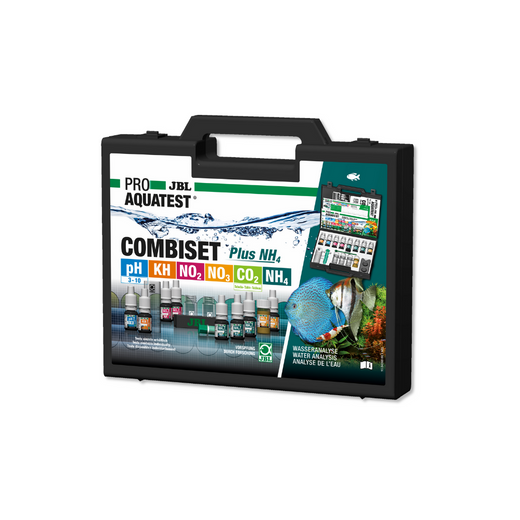
- JBL 2411700, PROAQUATEST rangeNot to be confused with 2411600, which is the complete test kit
- Hazard classification
- Please note, single bottleHazard statements H302, H317 and H319. Store in a dry place, at room temperature, lid firmly closed
To budget for separately
- Glassware and syringe
- Those from the iron testTwo are needed: one receives the reagent, the other remains untreated and serves as a control
- Comparator block and colour chart
- Those from the iron testThe block slides along the colour chart until the two shades match.
In the box
- 1 Fe reagent dropper bottle
Reference, EAN code, contents, protocol, number of tests, and hazard statements taken from the JBL data sheet and instruction manual on 07/10/2026. The range and nine-step scale are taken from a photograph of the colour card supplied. Dilution: JBL FAQ.
The bottle alone, or the iron kit?
A single reagent on both sides, and the same number of measurements. What changes is the glassware and the reading optics, which last for years.
Iron is read at the bottom of the scale
The first steps on the colour chart read 0.02 and then 0.05 mg/L. Refilling therefore requires a colour chart that still shows clear contrast, plus the block that holds both test tubes.
| Reagent bottles (bottles) | Possible readings (measurements) | Screw-top glass test tubes | Graduated syringe for 5 ml | Grey comparator block | Nine-step colour chart | Price | |
|---|---|---|---|---|---|---|---|
| Recommended Reagent refill for iron Fe testYour choice | 1 bottles | 50 measurements | No | No | No | No | ¥1,900 |
| Iron Fe water test in dropsYour choice | 1 bottles | 50 measurements | Yes | Yes | Yes | Yes | ¥3,000 |
Reagent refill for iron Fe testRecommended
What gets used up
Reagent bottles (bottles)1 bottles
Possible readings (measurements)50 measurements
What keeps well
Screw-top glass test tubesNo
Graduated syringe for 5 mlNo
Grey comparator blockNo
Nine-step colour chartNo
Budget
Iron Fe water test in drops
What gets used up
Reagent bottles (bottles)1 bottles
Possible readings (measurements)50 measurements
What keeps well
Screw-top glass test tubesYes
Graduated syringe for 5 mlYes
Grey comparator blockYes
Nine-step colour chartYes
Budget
Contents of the two columns taken from the manufacturer's data sheet and instructions, on 05/09/2026.
Help choosing
Is the reagent alone sufficient for your needs?
Estimate your
delivery time
Your estimate
Delivery
Estimated time
It covers preparing your order and then the transit time quoted by the carrier, counted in working days.
It is not a guaranteed delivery date: public holidays, peak periods, customs or a carrier delay can extend it. The exact amount, in your currency, is worked out in the cart once your address is entered.
0.08 kg parcel, dispatched within 48 hours by Colissimo or Chronopost to your home, as you choose at checkout. The bottle is sent in its original packaging. The exact shipping cost is shown in your basket.
Frequently asked questions
6 questions
6 key questions
You may also like


Related articles

Diagnosis
Iron deficiency in aquaponics
The symptom that leads to this test, and what to check before drawing conclusions.
Read the article

Guide
Identifying deficiencies in aquaponics
How to distinguish an iron deficiency from a magnesium or potassium deficiency.
Read the article

Growing
Growing tomatoes in aquaponics
A demanding crop where this element needs to be monitored throughout the season.
Read the article

Growing
What to grow in hydroponics, season by season
Periods of vigorous growth, when demand rises sharply.
Read the article

Season
Successful spring seedlings in aquaponics
Young leaves are the first to show a deficiency, and the first to recover.
Read the article

Guide
Aquaponics and hydroponics — what's the difference?
Two ways to feed a plant, and two ways to manage that particular element.
Read the article
Let us talk about your project
A question about this product or your setup? Our team will answer and advise you.

Interest-free instalment payments
Offered depending on the cart amount, at checkout.

Delivery in 2 to 15 working days
Depending on the products and shipping sites. Estimate by destination in the estimator on this page.

After-sales service 7 days a week by email or chat
Our team answers all your questions.

Shop responsibly
Become part of the change.
