



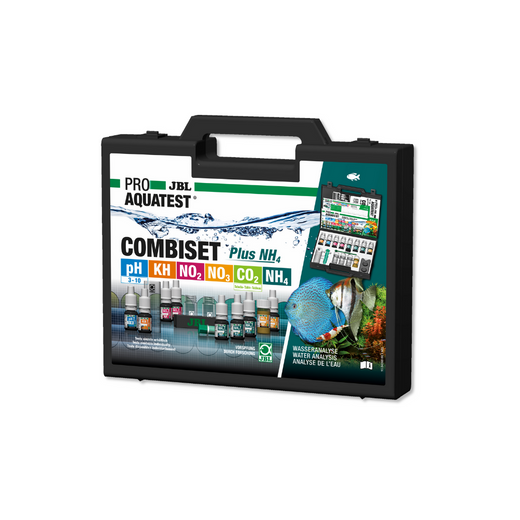


JBL PondCheck pH and KH test for ponds, drop-based
Regular price
¥2,200
Regular price
Sale price
¥2,200
Unit price
/
per
¥733 × 3 with no fees
Klarna.
This drop test checks in a few minutes the two values that keep pond water stable: the pH and the KH reserve. The kit allows about 50 measurements.
 Customer support 7 days a week by email
 Delivery within 2 to 15 business days
100 % secure payment
The summary
- What you receive: two reagents, two test tubes, a syringe, a colour chart and the instructions.
- How long it takes: 5 minutes for the two measurements, with no other equipment.
- How often: once a week in aquaponics, once a month for a stable pond.
- How it arrives: delivered to your door, by Colissimo or Chronopost.
Quick check of the pH and KH reserve of a pond
A pond can remain crystal clear while its chemical balance changes. This drop test answers two questions: does your pH stay within the right range, and does the water retain enough KH, the carbonate reserve that stops the pH from dropping? The two values go together, because it is the KH that buffers pH swings between day and night, after a thunderstorm or when the biological filter produces acidity. You draw 5 ml of water with the syringe, add 5 drops of reagent, and the colour gives the answer within a few minutes.
💧 Reading the two results
For pH, the colour obtained is compared with the colour chart, against a white background, after waiting 5 minutes. The pH of a balanced pond sits between 7.5 in the morning and 8.5 in the evening, because pH naturally rises during the day: plants and algae consume the dissolved carbon dioxide during photosynthesis. So always measure at the same time, preferably in the morning, to compare your readings from one week to the next. For KH, the reading is even simpler: the water turns blue when the buffer is sufficient, and orange-yellow when it is too low. In the latter case, your water no longer cushions variations, and the pH can drop sharply overnight.
pH from 7.5 to 8.5, blue KH
The water is balanced: note the value and repeat the test the following month.
Orange-yellow KH
The reserve is exhausted: recharge it before making any other pH correction.
pH above 8.5 in the morning
The water is too alkaline: look for the cause, new concrete or limestone rocks, before correcting it.
pH that drops after rain
The sign of a KH that is too low: rainwater, free of carbonates, has diluted the reserve.
🌱 In aquaponics
In an aquaponic system, the filter bacteria convert the ammonia excreted by the fish into nitrite, then into nitrate. This nitrification releases acidity, which the carbonates neutralise as they are used up. The KH reserve therefore falls continuously, all the faster when the tank is heavily stocked and fed. When it runs out, the pH drops in turn, the filter bacteria slow down and ammonia builds up. A check once a week tells you when to top up the reserve, before nitrification slows down. Plants also absorb iron and phosphorus less well when the pH rises, as the article on pH regulation in aquaponics explains: in aquaponics, the target is therefore a little lower than in an ornamental pond, between 6.4 and 7.5.
Measure before correcting
Never correct the pH by guesswork. A pH reducer poured into water that is low in KH can make the pH drop far lower than expected, and a pH raiser added to water that is already hard is pointless. Test first, correct afterwards, then test again the next day.
Rebuild the KH reserve with powdered buffer
If the test turns orange-yellow, the Aquatic Science KH+ pond KH booster rebuilds the reserve: 25 g per 1,000 litres raises the KH by 1 to 2 °dH, and the dose is repeated in stages, at least 24 hours apart. Retest the day after each addition, because the blue must have returned before any other pH correction.
🗓️ A simple testing routine
For a stable ornamental pond, one test a month is enough during the season, supplemented by a check after every heavy storm, every major refill or every treatment. In aquaponics, allow one test a week, and one every 2 or 3 days while a new system is starting up. At that rate, the kit covers several seasons of pond testing, or nearly a year of weekly monitoring of an aquaponic system. Keep a record of your readings in a notebook or on your phone: a slow drop in KH over several weeks is far easier to spot in a series of measurements than in a single one.
Technical specifications
The two measurements
- pH
- Reading against a colour chartCompare the colour against a white background, after 5 minutes.
- KH
- Blue is sufficient, yellow is too low
- Test sample
- 5 ml of water, 5 drops
- Number of tests
- Approximately 50
Markers
- Pond pH
- 7.5 in the morning, 8.5 at most in the evening
- pH in aquaponics
- From 6.8 to 7.5
To correct
- KH too low
- KH buffer for ponds
- pH too high
- pH reducer for ponds
Storage
- Storage
- Store dry, at room temperature
- Storage
- Sealed bottles, in their box
2 further specifications are available in the detailed view.
In the box
- 1 bottle of pH reagent
- 1 bottle of KH reagent
- 2 test tubes
- 1 syringe
- 1 pH colour chart and the instructions
Contents and instructions noted on 08/10/2026 from the manufacturer's product sheet and leaflet.
Estimate your
delivery time
Your estimate
Delivery
Estimated time
It covers preparing your order and then the transit time quoted by the carrier, counted in working days.
It is not a guaranteed delivery date: public holidays, peak periods, customs or a carrier delay can extend it. The exact amount, in your currency, is worked out in the cart once your address is entered.
Delivered to your home by Colissimo or Chronopost, as you choose during checkout. The exact amount is shown in your basket, according to the total weight of your order.
Frequently asked questions
6 questions
6 key questions
You may also like


Related articles

Understanding
Regulating pH in an aquaponics system
What makes the pH vary and how to bring it back.
Read the article

Understanding
The nitrogen cycle in aquaponics
The bacteria that convert ammonia into nitrates, and the effect of pH and temperature on their work.
Read the article

Guide
Getting started with an aquaponic system
The tests to carry out when starting up a system.
Read the article

Pond

Fish
Let us talk about your project
A question about this product or your setup? Our team will answer and advise you.

Interest-free instalment payments
Offered depending on the cart amount, at checkout.

Delivery in 2 to 15 working days
Depending on the products and shipping sites. Estimate by destination in the estimator on this page.

After-sales service 7 days a week by email or chat
Our team answers all your questions.

Shop responsibly
Become part of the change.
