



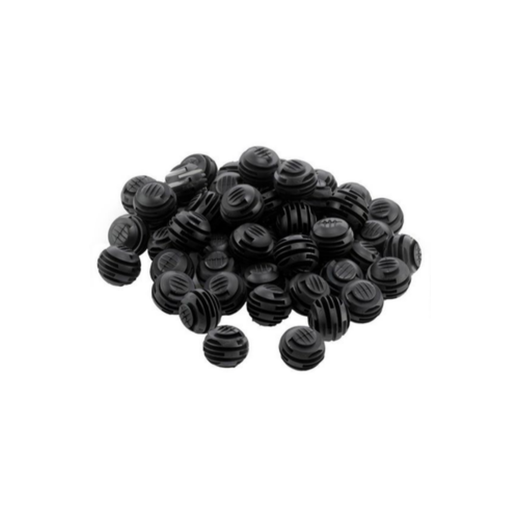


JBL SintoMec or CerMec filter media for aquarium filters
Regular price
¥3,800
Regular price
Sale price
¥3,800
Unit price
/
per
¥1,267 × 3 with no fees
Klarna.
These two JBL filter media fill the filter of an aquarium or a small aquaponic system: SintoMec, a highly porous sintered glass, houses the bacteria of biological filtration, and CerMec, a ceramic, serves as a pre-filter. Each bag, 450 g for SintoMec and 700 g for CerMec, comes with its own net.
100 % secure payment
The summary
- Which media: CerMec as pre-filter, SintoMec as biological media.
- The surface area: 1,200 m² per litre for SintoMec.
- The order in the filter: ceramic, foam, SintoMec, wadding.
- Maintenance: rinse in water taken from the tank.
Sintered glass or ceramic filter rings, supplied with their net
In the filter of an aquarium or aquaponic system, the filter media have two jobs: to retain particles and to house the nitrifying bacteria, which convert ammonia, which is toxic to fish, into nitrite and then nitrate. These bacteria live attached to the surfaces of the filter, so their numbers depend on the surface area you give them. CerMec handles the first job, at the filter inlet, and SintoMec the second, at the heart of the filter. Placed in this order, the two media keep your filter effective for longer between rinses.
🔬 Two rings, two roles
The SintoMec is made of white sintered glass rings, threaded with conical tunnel-shaped pores. This structure offers around 1,200 m² of surface area per litre, far more than a foam or an ordinary ceramic, and water passes through it without clogging it quickly. You place it after the pre-filtration stage, once the water has already been cleared of coarse waste, so that its pores stay accessible to bacteria. It can be used in freshwater and in seawater, and rinsing it before first use removes the glass dust.
CerMec is a pure ceramic media, in hollow rings of 17 mm. Placed first in the filter, it spreads the current and slows the waste, which protects the following stages from silting up too quickly. Its rings let a lot of water through, hence their place in high-flow filters, and they keep their shape after years of repeated rinsing. It also hosts bacteria, on a much smaller surface area than SintoMec, and its main role remains to prepare the water for the finer stages.
CerMec first
The CerMec spreads the water and slows the debris.
Foam afterwards
The foam traps suspended particles.
SintoMec at the core
SintoMec houses most of the bacteria.
Wadding last
The filter wool clarifies the water before it returns to the tank.
Rinse the rings in water from the tank
To rinse the SintoMec or the CerMec, shake the bag in a bucket of water taken from your tank. The chlorine in tap water and soap would kill some of the bacteria living in the pores, and the filter would lose part of its biological capacity. A nitrite drop test, carried out over the following days, confirms that the filtration has recovered.
🧽 Installing and maintaining
Both media suit almost all external filters, settlement filters and home-made filters: simply place the closed mesh bag in the chosen basket or compartment. In an internal filter too narrow for a bag, pour the rings in directly and hold them in place with a foam. If your filter is already running, add the SintoMec alongside the old media, then remove the old media a few weeks later, once the bacteria have colonised the new one. This gradual changeover avoids a spike in ammonia or nitrite, and you should test the nitrite during the 2 weeks following any major change in the filter.
On a 150-litre aquarium fitted with a 250 L/h external basket filter, a net bag of CerMec goes in the first basket, a bag of SintoMec in the middle basket and a layer of filter wool in the last. The SintoMec is then rinsed every 4 to 8 weeks depending on how clogged it gets, never on the same day as the pre-filter, so that some of the bacteria always remain intact. These mineral media do not wear out like a sponge: when rinsed properly, they stay in service for years. The brown film that coats them over time is bacterial biofilm, and it does not need to be removed.
🌱 In aquaponics
In an aquarium topped with a grow bed, or in the biofilter of a small garden system, the SintoMec fills the biological stage of the filter. The bacteria settled in its pores convert the ammonia excreted by the fish into nitrates, the form of nitrogen that your plants absorb, as explained in the article on the nitrogen cycle in aquaponics. The larger the colonised surface, the higher the fish load the filter can support without a nitrite spike.
In an aquaponic system of a few hundred litres, 2 or 3 sachets of SintoMec boost the biological capacity without changing anything else in the filter. A new filter takes 3 to 6 weeks to colonise, and EasyStart starter bacteria added as soon as you fill the system shorten this period. The CerMec keeps its place at the head of the circuit, where it traps solid waste before it reaches the SintoMec.
Technical specifications
SintoMec
- Material
- Sintered glass rings
- Surface
- About 1,200 m² per litre
- Capacity
- 450 g with net
- Rinsing
- Every 4 to 8 weeks
CerMec
- Material
- Pure ceramic
- Rings
- 17 mm in diameter
- Capacity
- 700 g with net
- Position
- First stage of the filter
In the box
- 1 bag of your chosen media, with its mesh bag
Materials, surface area and capacities taken on 10/10/2026 from the manufacturer's manuals and technical sheets.
Manufacturer and product safety
- Manufacturer
- JBL GmbH & Co. KG
- Postal address
- Dieselstraße 3, 67141 Neuhofen, Allemagne
- Contact
- info@jbl.de
- Website
- www.jbl.de
Information provided under Regulation (EU) 2023/988 on general product safety.
Which media for your filter?
The two media do not sit on the same level of the filter.
How much media?
Give one answer, and the table highlights the model that suits you.
| Function | Material | Position | Price | |
|---|---|---|---|---|
| Recommended JBL SintoMec or CerMec filter media forYour choice | Biological filtration | Sintered glass | At the heart of the filter | ¥3,800 |
| JBL SintoMec or CerMec filter media forYour choice | Pre-filter | Ceramic | First | ¥2,000 |
JBL SintoMec or CerMec filter media forRecommended
The role
FunctionBiological filtration
MaterialSintered glass
PositionAt the heart of the filter
JBL SintoMec or CerMec filter media for
The role
FunctionPre-filter
MaterialCeramic
PositionFirst
The two complement each other in the same filter.
Help choosing
A question about your filter
Estimate your
delivery time
Your estimate
Delivery
Estimated time
It covers preparing your order and then the transit time quoted by the carrier, counted in working days.
It is not a guaranteed delivery date: public holidays, peak periods, customs or a carrier delay can extend it. The exact amount, in your currency, is worked out in the cart once your address is entered.
Delivered to your door by Colissimo or Chronopost, as you choose during checkout. The exact cost is shown in your basket, based on the total weight of your order.
Frequently asked questions
6 questions
6 key questions
You may also like


Related articles

Understanding
The nitrogen cycle in aquaponics
The exact mechanism that turns fish waste into food for the plants, and the reason why a new system needs a few weeks before it reaches its working rhythm.
Read the article

Diagnosis
Understanding and correcting cloudy water in aquaponics
Cloudy water cannot be read by eye. What measurements reveal about a bacterial film, and what they cannot tell you.
Read the article

Start-up

Understanding
Common mistakes in aquaponics
The start-up mistakes that show on a test reading before they show in the tank, and the order in which to correct them.
Read the article

Aquaponics
Let us talk about your project
A question about this product or your setup? Our team will answer and advise you.

Interest-free instalment payments
Offered depending on the cart amount, at checkout.

Delivery in 2 to 15 working days
Depending on the products and shipping sites. Estimate by destination in the estimator on this page.

After-sales service 7 days a week by email or chat
Our team answers all your questions.

Shop responsibly
Become part of the change.
