


pH correction duo: pH- and pH+
Regular price
$32.00
Regular price
Sale price
$32.00
Unit price
/
per
A pair of liquid pH correctors: the pH-, a blend of three buffered acids, and the pH+, based on potassium carbonate, to keep a nutrient solution between 5.5 and 6.8 in both directions, whether using hard tap water or reverse osmosis water. Available in 500 ml or 1 L each, corrosive concentrates H314.

7/7 customer service by e-mail

Payment in instalments, free of charge
The summary
- What it is: both Terra Aquatica pH correctors together — one bottle of pH- and one bottle of pH+ — in the same size format.
- Why both: hard water pushes pH up, RO water pulls it down. Many setups encounter both situations over the course of a year.
- What they add: the pH- leaves a little phosphorus; the pH+ contributes potassium and silica. Neither is simply a DIY-grade acid.
- How much to use: there is no fixed dose — it depends on the buffering capacity of your water. The small-additions method is covered in the FAQs.
- Caution: both concentrates are corrosive, classified H314. Wear gloves and eye protection, and never pour one into the other.
- Sizes and delivery: 2 x 500 ml or 2 x 1 L, shipped together in a single parcel from France.
Both correctors in the range, to adjust pH in either direction
This duo brings together the two pH correctors from the Terra Aquatica range: pH-, a yellowish bottle at pH 1 that lowers the value of a nutrient solution, and pH+, a pale blue bottle at pH 12 that raises it. These are professional correctors designed for hydroponics, coco fibre, and soil, available here in 500 ml or 1 L each. They work with any fertiliser, not just those from the same brand.
pH does not feed the plant: it determines what the plant can actually absorb. Between 5.5 and 6.5, all nutrients remain available. Above 6.8, iron and manganese lock up and young leaves start to pale; below 5.0, calcium and magnesium are poorly taken up and roots suffer. This is the most common cause of a crop that stagnates even when the fertiliser dosing is correct.
Why you need two, not just one
pH-, for tap water
Hard water is rich in bicarbonates: the pH rises back on its own a few hours after each correction. This is the bottle you will use the most.
pH+, for RO Water
Water with no buffering capacity drops at the slightest drop of acid, and fertilisers themselves are acidic. It will not recover on its own.
Both, for most people
As soon as mains water is replaced with rainwater, or when the season changes, the drift reverses direction during the year.
These are not simple off-the-shelf acids and bases. The pH- is a blend of three acids combined with organic buffers: this buffering capacity means that an adjusted value holds for several days rather than a few hours, whereas vinegar or citric acid break down within one or two days. The pH+ is based on potassium carbonate and additionally provides a source of silica, which thickens cell walls and stiffens stems.
Which bottle you will use the most
| Your starting water | The bottle doing the work | How often |
|---|---|---|
| Hard water from the mains | pH-, almost exclusively | At every reservoir top-up, then a small adjustment every two to three days until the bicarbonates have been used up. The pH+ only comes out of the cupboard if you overcorrect. |
| Mains water blended with rainwater | pH- for part of the year, pH+ for the rest | The direction of drift shifts with the blend ratio, which changes with rainfall. Both bottles get used across the year, and neither runs out quickly. |
| RO water or pure rainwater | pH+, measured to a fraction of a millilitre | At every top-up, then as soon as the solution dips again, often within two or three days. The pH- is almost never needed: the fertilisers are already acidic and handle it on their own. |
Frequencies observed on a reservoir refreshed every two weeks. They depend on your water's buffering capacity, not on any general rule.
The conclusion is less of a sales pitch than a straight answer, but more useful for it: the duo only makes sense if your water changes throughout the year, or if you want to be able to correct an overcorrection. If you grow year-round on mains water in a hard water area, pH- alone will do the job, and you'll buy that bottle two or three times before you even start on the other. If you grow exclusively on RO water, it's pH+ alone that you'll need.
The price points in the same direction and deserves to be stated plainly. At prices as of 25 August 2026, the duo in 500 ml costs 18.90 euros, whereas the two bottles bought separately cost 19.80 euros: the saving is 0.90 euros, and that's not a reason to buy the duo. In 1 L, 28.90 euros versus 31.80 euros bought separately, a saving of 2.90 euros. What you're actually buying here is the certainty of never being stuck on the day your pH drifts the wrong way, when your solution is already mixed and waiting for a delivery would cost you a week's growth. To find out which way your water is likely to drift before you have to decide, our article on pH regulation explains what buffering capacity is and how to identify it in your own setup.
Two corrosives, and above all, never mix one into the other
Both bottles carry the same warning: H314, causes severe skin burns and eye damage. A strong base burns just as badly as a strong acid. Gloves and eye protection for both, no decanting into food containers, and never pour pH+ into pH-: the reaction is vigorous and both are wasted in the process. Each one is poured into water separately.
The method, the same for both
Adjust last, after adding the fertilisers, because each one shifts the value. Add in small amounts, stir for twenty minutes, then measure before repeating: the buffer takes time to act, and measuring too soon leads to overcorrection. With hard water, the first adjustments consume the bicarbonates; once that's done, the value holds for several days and subsequent additions become minimal.
The mistakes that send you back and forth
Four ways to waste both bottles for nothing
Correcting before adding the fertilisers. The three TriPart parts are acidic: they bring the value down on their own, sometimes by several tenths of a point. Correcting plain water means raising it with pH+ only for the fertilisers to pull it back down ten minutes later, then chasing it again with pH-. Add the fertilisers, mix thoroughly, and only then make your correction.
Measuring too soon after adding the corrector. A buffered corrector does not act instantly: the value keeps shifting for a good quarter of an hour. Measuring within the first minute gives a reading that is too high or too low, prompting you to add more, and the full correction overshoots the target. Stir, wait twenty minutes, measure, and only then decide.
Correcting a pH that would have risen on its own. In hard water, the value rises by itself over the following hours as long as the bicarbonates have not been neutralised. Chasing every tenth of a point in the first few days means fighting against the water. Holding a range of 5.5 to 6.5 is a perfectly adequate target, it is not a single fixed value to maintain.
Overcorrecting, then compensating with the other bottle. This is the costliest mistake, and not only in terms of product. Every back-and-forth leaves behind whatever the corrector introduces, phosphates on one side, potassium on the other: conductivity rises without anything extra reaching the plant, and the elemental imbalance takes hold. When you have gone too far, diluting with a little fresh water is better than correcting in the opposite direction. None of this is measurable without the right instruments, see the water analysis collection and our article on common mistakes.
Without a measuring instrument, these two bottles are completely useless
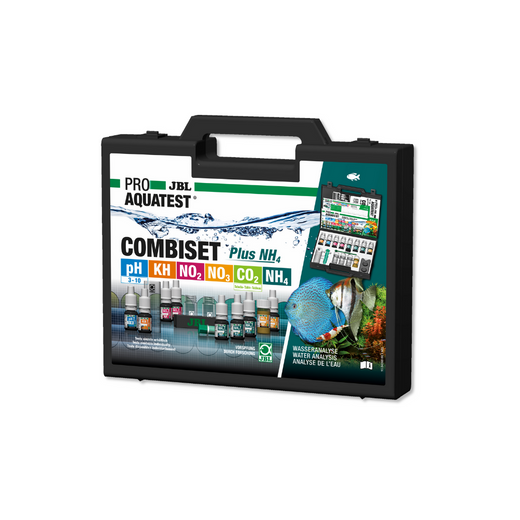
To the naked eye, there is nothing to distinguish a solution at 6.0 from one at 7.2, yet the difference in nutrient availability between the two is considerable. A calibrated pH meter or a colourimetric drop test kit is the essential companion to this duo: see the water analysis collection.
This duo naturally complements the TriPart system, whose feeding chart sets a pH target for each stage: 5.5 to 6.5 up to pre-flowering, then 6.4 to 6.8 afterwards. If you are setting up a complete installation, the full TriPart pack brings together all three fertilisers and the pH- in one litre. And to understand why water without a buffer is harder to stabilise than hard water, contrary to what you might expect, our article on pH regulation explains it in detail.
Technical specifications
What the duo contains
- pH- corrector
- 1 bottleBlend of three acids with organic buffers. Yellowish liquid, pH 1. Orthophosphoric acid at 5 to 10 per cent.
- pH Up corrector
- 1 bottlePotassium carbonate 10 to 20 per cent, silica source. Pale blue liquid, pH 12.
- Available sizes
- 500 ml or 1 LBoth bottles always come in the same size within the duo.
- Growing methods
- Hydro, coco and soilCompatible with any fertiliser, including those from other brands.
- Target pH range
- 5.5 to 6.5The range in which the plant takes up all nutrients. During flowering, the target rises to 6.4–6.8.
- Dosage
- Varies with waterNo dose per litre exists for a pH corrector: it all depends on the buffering capacity of the water being treated.
Safety and storage
- Classification of both
- Danger, H314Causes severe skin burns and serious eye damage. Corrosive category 1A for both.
- Required equipment
- Gloves and gogglesSafety precautions P264 and P280, identical on both bottles.
- Strictly prohibited
- Never mix them togetherA strong base and a strong acid react vigorously and neutralise each other. Each must be added to water — never to the other.
- If swallowed
- Do not induce vomitingRinse your mouth and contact a poison control centre.
- Storage
- Separate, upright, frost-freeDo not store them side by side on the same sloping shelf. pH+ crystallises in the cold.
- Manufacture
- Fleurance, FranceTerra Aquatica, formerly General Hydroponics Europe.
4 further specifications are available in the detailed view.
In the box
- 1 bottle of pH- adjuster in the chosen size, 500 ml or 1 L.
- 1 bottle of pH+ corrector in the same size.
- No pH meter, no colorimetric test kit and no calibration solution: see the water testing collection.
- No gloves or safety goggles are included. Please provide your own: both concentrates are classified H314.
- No pipette or dosing syringe included.
The H314 classifications, declared compositions, pH values, and densities of both concentrates are taken from their respective French safety data sheets — dated 22 November 2023 for pH- and 8 January 2024 for pH+. The descriptions of the blend of three acids and the silica source, along with the 5.5 to 6.5 range, are taken from the manufacturer's 2025 French catalogue, page 20. This duo is assembled by us from the two references sold separately: it is not a manufacturer's packaging.
The two correctors in the duo, side by side
The duo contains both. This table shows which one you will use most depending on your water, and what each one contributes beyond pH correction.
| Effect on the solution | Water affected | The one you'll use most with tap water | The one you'll use most with RO water | Active base | Concentrate pH | Liquid colour | Supplies phosphorus | Supplies potassium | Silica source | Classified corrosive H314 | Gloves and goggles required | Never mix with the other | |
|---|---|---|---|---|---|---|---|---|---|---|---|---|---|
| pH Down correctorYour choice | Lowers pH | Hard tap water | yes | no | Three buffered acids | 1 | Yellowish | yes | no | no | yes | yes | yes |
| pH Up correctorYour choice | Raises pH | RO or rainwater | no | yes | Potassium carbonate | 12 | Pale blue | no | yes | yes | yes | yes | yes |
pH Down corrector
What each one does
Effect on the solutionLowers pH
Water affectedHard tap water
The one you'll use most with tap wateryes
The one you'll use most with RO waterno
Active baseThree buffered acids
Concentrate pH1
Liquid colourYellowish
What it brings extra
Supplies phosphorusyes
Supplies potassiumno
Silica sourceno
Safety
Classified corrosive H314yes
Gloves and goggles requiredyes
Never mix with the otheryes
pH Up corrector
What each one does
Effect on the solutionRaises pH
Water affectedRO or rainwater
The one you'll use most with tap waterno
The one you'll use most with RO wateryes
Active basePotassium carbonate
Concentrate pH12
Liquid colourPale blue
What it brings extra
Supplies phosphorusno
Supplies potassiumyes
Silica sourceyes
Safety
Classified corrosive H314yes
Gloves and goggles requiredyes
Never mix with the otheryes
Both bottles in the duo are always in the same size, 500 ml or 1 L depending on your choice. The compositions, concentrate pH values and classifications are taken from the manufacturer's French safety data sheets. The description as a blend of three acids and as a silica source is taken from the French 2025 catalogue, page 20. Prices are not shown in this table: they are correct elsewhere on the page, in your currency.
Documents & manuals
Safety data sheet for pH-, in French
Version dated 22 November 2023. H314 classification, composition, protective equipment and procedure in case of contact.
Safety data sheet pH-, in English
Version 8 dated 22 November 2023. Same content as the French sheet: H314 classification, acid composition, protective equipment and procedure to follow in case of contact. Document in English.
Safety data sheet for pH+, in French
Version dated 8 January 2024. Same H314 classification, potassium carbonate content, and storage precautions.
Safety data sheet pH+, in English
Version 8 dated 8 January 2024. Same H314 classification, potassium carbonate content and storage precautions as the French version. Document in English.
TriPart application chart, with pH targets by growth stage, multilingual document
The pH and conductivity ranges to aim for at each stage of growth, which these two correctors help you maintain. A multilingual document with French and English side by side: no separate English-only version exists.
Document not showing? Some publishers block display inside a frame, so open it in a tab.
Estimate your
delivery time
Your estimate
Delivery
Estimated time
It covers preparing your order and then the transit time quoted by the carrier, counted in working days.
It is not a guaranteed delivery date: public holidays, peak periods, customs or a carrier delay can extend it. The exact amount, in your currency, is worked out in the cart once your address is entered.
Both bottles are shipped in the same parcel, avoiding two separate delivery charges. Approximately 1.1 kg for the 500 ml size, 2.2 kg for the 1 L size. Corrosive products under CLP classification, shipped in their original packaging. The exact shipping costs are displayed at checkout once your address has been entered.
Frequently asked questions
14 questions
6 key questions, 14 in the detailed view
No questions in this category.
Vous aimerez aussi


Related articles

Technical
Regulating pH in an aquaponics system
The article that tells you which of the two bottles you will actually get through: it all depends on the buffering capacity of your water, and it explains how to identify it.
Read the article

Getting started
How to get an aquaponic system off to a good start
At start-up, pH swings in both directions before settling. This is the period when having both correctors to hand prevents you from getting stuck.
Read the article

Diagnosis
Cloudy water in aquaponics: the causes
A white haze appearing after a correction is not algae but a precipitate. The article helps you tell the two apart before making another correction.
Read the article

Getting started
Common mistakes in aquaponics
Over-correcting in one direction then compensating in the other loads the solution with salts without providing any nutrition. The article lists the back-and-forth adjustments that cost the most.
Read the article

Understanding
The nitrogen cycle in aquaponics
Nitrification continuously acidifies the water: that is the underlying reason why pH drops on its own and why pH+ eventually becomes necessary.
Read the article

Diagnosis
Recognising micro-deficiencies in aquaponics
Most visible deficiencies stem from pH being out of range, not from an actual shortage. Read this before adding more fertiliser instead of correcting the value.
Read the article
Let us talk about your project
Une question sur ce produit ou votre installation ? Notre équipe vous répond et vous conseille.

Paiement plusieurs fois sans frais
Proposé selon le montant du panier, au moment du paiement.

Livraison sous 5 à 15 jours ouvrés
Selon les produits et sites d'expédition. Estimation par destination dans l'estimateur de cette page.

SAV 7/7 par mail ou chat
Notre équipe répond à toutes vos questions.

Faire un achat engagé
Devenez acteurs du changement.
