LED lighting for indoor growing

Written by Tristan Ulrich · October 24, 2026
Étagère de culture intérieure éclairée par des barres LED horticoles au-dessus de salades et de basilic

A horticultural lamp is chosen neither by watts nor by lumens, but by the amount of usable light it delivers to the leaves each day. This guide gives the figures you need to light salad leaves, herbs and seedlings properly indoors.

Getting the dose right with indoor LED lighting

Growing without direct sunlight means supplying the light energy the plants need yourself. It is the one resource that a soilless system cannot recycle, unlike water and nutrients. A poorly chosen lamp produces pale, leggy plants, while a lamp that is too powerful or too close bleaches the leaves and inflates your electricity bill without adding anything.

The problem comes mainly from marketing vocabulary. Watts describe power consumption, lumens describe what the human eye perceives, and neither tells you what the plant actually receives. This guide presents the three indicators that matter: PPFD, which measures the intensity of usable light reaching the leaves, DLI, which totals it over a day, and efficacy in micromoles per joule, followed by practical settings for the most common indoor crops.

Handheld PAR sensor measuring PPFD just above the foliage of young salad plants under LEDs

What PPFD really measures

PPFD, or photosynthetic photon flux density, counts the number of photons useful for photosynthesis that reach a given surface each second. It is expressed in micromoles per square metre per second, and it is measured at canopy level, never at the light's outlet.

For lettuce and basil grown under LEDs for sixteen hours a day, trials carried out by the universities of Bologna and Wageningen found the best compromise between harvest and energy consumption at around 250 micromoles per square metre per second. Raising the intensity to 300 did not increase the harvest, whereas at 100 growth remained markedly weaker.

Above all, remember that PPFD drops quickly as the light moves away. For a point source, intensity falls with the square of the distance, so doubling the gap divides it by four. With a bar or a panel placed close to the plants, the drop is less abrupt but still marked, and the same fixture may work at thirty centimetres and then prove insufficient at sixty.

Seedlings in terracotta pots near a window with an LED bar switched on to supplement daylight

The DLI, the light dose that decides

PPFD describes intensity at a given moment, whereas growth depends above all on the total amount of light received over a day. This total is known as the DLI, the daily light integral, expressed in moles per square metre per day. To obtain it, you multiply the PPFD by the lighting duration in seconds, then divide by one million. A PPFD of 250 for sixteen hours therefore gives a DLI of close to 14.4.

Purdue University classes as demanding those crops that require 12 to 18 moles per day, a category that includes lettuce. Cornell University's references suggest about 17 moles for a well-ventilated head lettuce, and rather 13 to 14 when the air circulates poorly, in order to limit tipburn. The same target can be reached in several ways, a powerful lamp for a few hours or a gentler lamp over a longer photoperiod, and the second approach often proves more energy-efficient.

The spectrum of LED lighting: blue, red and white

The first horticultural LED lamps combined only red and blue, hence their characteristic magenta glow. This choice was not aesthetic but technical: these two colours were the most efficient to produce and match the absorption peaks of chlorophyll. Red, at around 600 to 700 nanometres, directly drives photosynthesis. Blue, between 400 and 500 nanometres, has more influence on the shape of the plant and generally gives compact specimens with thicker leaves, often richer in phenolic compounds.

White so-called broad-spectrum luminaires appeared later. In principle they are slightly less efficient than red and blue combinations, because phosphor conversion causes losses. In return, they render colours properly, which makes all the difference day to day. Under a magenta lamp, it becomes very difficult to spot a deficiency, the first signs of aphids or a yellowing leaf. For domestic use in a living space, a full-spectrum LED panel or a white bar is almost always the most sensible choice.

Far-red light, beyond 700 nanometres, deserves a mention. On its own, it contributes little to photosynthesis, but combined with the rest of the spectrum it influences internode elongation, leaf expansion and flowering. Some manufacturers add a small proportion of it to increase the leaf area of lettuces. Without a reliable measurement, however, there is no point trying to optimise this parameter: overall intensity and duration matter far more than fine-tuning the spectrum.


Mechanical timer plugged into a socket to programme the photoperiod of a horticultural lamp Daily timer

How many hours of LED lighting per day

Photoperiod needs to be programmed, not improvised. The University of Minnesota advises 12 to 14 hours of light a day for lettuce and herbs in hydroponics, and 16 to 18 hours for seedlings, while many trials on leafy crops settle on 16 hours. A mechanical daily timer, fitted between the socket and the lamp, switches the lighting back on at the same times every day and spares you from forgetting in the evening. Keep a proper night, because continuous lighting can damage the foliage of some sensitive species, tomato above all, and spinach, rocket or certain lettuces bolt faster under very long days. If your crops flower prematurely, shortening the photoperiod is the first thing to try.

Plug-in power meter measuring the electricity consumption of an indoor horticultural LED light

Efficacy in µmol per joule

Here is the figure that lets you compare two lamps honestly. Photon efficacy is calculated by dividing the total flux of useful photons emitted by the lamp, the PPF, by the electrical power it draws. It is expressed in micromoles per joule and is sometimes called PAR efficacy. The higher the value, the more effectively the lamp turns electricity into usable light. The American DLC standard, often used as a benchmark in Europe, has required a minimum of around 2.3 micromoles per joule since its 2023 version, and well-made recent fixtures frequently exceed 2.5.

At equal power consumption, a lamp rated at 2.7 micromoles per joule delivers around 50% more useful light than a model rated at 1.8. Be wary, then, of data sheets that only quote an equivalent wattage or a lumen count. A reputable seller will state the PPF, the actual power and the efficacy, without which it is impossible to know what you are really buying.

Folding rule measuring the distance between a suspended LED bar and the foliage of the lettuces Barre LED horticole 24 V, 20 ou 40 W, quatre spectres

How far away to place the lamp

Distance is the most powerful adjustment you have, and the cheapest. The University of Minnesota gives 15 to 30 centimetres above the foliage for lettuce and herbs, and 10 to 15 centimetres for seedlings. These figures apply to a low-power horticultural LED bar, whereas a powerful panel should be set according to the manufacturer's instructions, generally higher.

Fine adjustment is then done by observation. Stems that lengthen and leaves that spread apart signal a lamp that is too high. Bleached or scorched leaves at the centre of the tray, on the other hand, betray a lamp that is too close. So allow for an adjustable hanging system, using ropes and self-locking pulleys or ratchet hangers, to keep pace with growth without taking the light down.

Think about coverage too. A bar lights evenly a strip whose width is of the same order as its hanging height. Beyond that, the edges of the tray receive noticeably less and the plants around the perimeter lean over. Two bars set apart are often better than a single, more powerful central light.

Calculating consumption and the real cost

Lighting is almost always the biggest running cost of indoor growing, far ahead of the pump and the nutrients. Fortunately, the calculation is straightforward. Multiply the actual power of the light in kilowatts by the number of hours it is used each day, then by the number of days, and finally by the price per kilowatt-hour shown on your bill.

Let's take a concrete example. A 40-watt light bar switched on for 16 hours a day uses 0.64 kilowatt-hours daily, or about 19 kilowatt-hours a month. Over a full year, that comes to roughly 234 kilowatt-hours. The cost then depends on the tariff in your contract, which varies widely from one European country to another, but the order of magnitude is that of a small household appliance used every day. Our guide to the electricity consumption of an installation details the calculation for all of the equipment.

A few measures can noticeably reduce the bill.

  • Choose a light with high photon efficacy rather than a cheap model of equal power.
  • Place white reflective surfaces around the tray to recover light that would otherwise be lost at the sides.
  • Concentrate the crops under the lamp rather than lighting empty areas.
  • Programme the lighting for off-peak hours if your contract allows it.

A plug-in power meter costs little and measures actual consumption, which is often different from the stated power. It is the most cost-effective accessory for properly managing an installation that is growing.

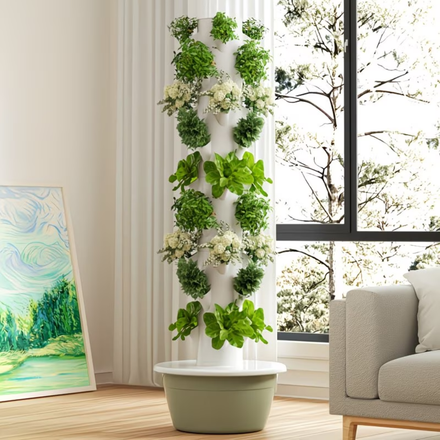
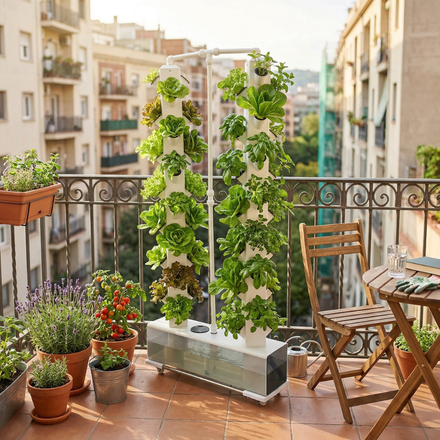
Trays of microgreens and dense salad leaves grown indoors under white LED lighting Hydroponic tower pack 30 sites with LED lighting

Salad leaves and microgreens under LED

These are the easiest crops to grow under LED lighting, and by far the most profitable indoors. A lettuce is content with a DLI of 12 to 17 moles per square metre per day, which is within reach of domestic equipment of reasonable power, and young leaves harvested early need a more modest dose. A hydroponic tower fitted with its own LED bars therefore lets you produce salad leaves and baby greens in a room where the sun barely reaches. Lighting that is too weak, on the other hand, gives soft, pale leaves that are more susceptible to disease and keep poorly.

One tip is worth knowing. Researchers at Purdue have shown that five to seven days of intense LED lighting, red, blue or mixed, just before harvest is enough to deepen the colour of red lettuces markedly. To build a complete rotation, our guide to what to plant through the seasons offers a detailed calendar.

Horticultural LED bar suspended above a tray of basil and lettuces grown indoors

Herbs, which are more demanding

Unlike lettuces, aromatic herbs do not simply have to grow, they also have to accumulate the compounds that give them their fragrance, and generous light generally encourages this accumulation. Basil grown under insufficient lighting grows tall but stays bland. In the Bologna and Wageningen trials, basil gave its best harvest at around 250 micromoles for sixteen hours, a DLI of about 14.4, with no further gain at a DLI close to 17.

Mediterranean herbs such as thyme, rosemary or oregano, used to full sun, deserve at least the same treatment as basil, and their growth remains slower indoors. Mint and chives cope better with moderate light, which makes them good candidates for a less well-equipped shelf. Pinch out the tops of your plants regularly to maintain a compact habit and prolong production.

Tray of stocky tomato and pepper seedlings under a horticultural LED lamp placed very close Barre LED de semis 6500 K, 26 ou 42 W, 50 ou 93 cm

Growing seedlings successfully under a lamp

This is probably the most worthwhile use of a domestic horticultural light. A seedling sown in February or March near a window generally receives far less light than the 12 moles per day up to which Purdue University still observes an improvement in seedling quality, hence the leggy, fragile stems. As soon as the seedlings emerge, place a low-power LED seedling bar 10 or 15 centimetres above the plants, then raise it as they grow. A week before planting out, take the trays outside for a few hours each day to harden them off gradually, and if your seeds are already struggling to germinate, the article on germination failures reviews the most common causes.

LED lighting and an aquaponic system: precautions

Adding a lamp above a system containing fish calls for a few precautions that are easily overlooked. The first concerns algae. Any water surface exposed to intense light turns green within a few weeks, which uses up nutrients intended for the plants and makes the dissolved oxygen level fluctuate. Cover the tank and the channels, and light only the foliage.

The second precaution concerns heat. Even though LEDs radiate far less heat towards the plants than the old discharge lamps, a light fitting placed right above a small volume of water can raise its temperature noticeably over the hours. Yet warm water holds less oxygen, and the fish suffer before the plants do. Check the temperature during the hottest hours of the day rather than in the morning.

The third concerns the fish themselves. They need a regular day and night cycle, and a bright light that switches on suddenly stresses them. If your installation combines a pond and a crop, offset the horticultural lighting where possible so that it does not shine directly on the area where the fish live. Finally, anything electrical above a body of water requires equipment suited to damp conditions and a residual current device on the circuit. This point is not negotiable.

Leggy seedlings with long, pale stems, a typical symptom of a lack of light indoors

The signs of a lack of light

Plants make it very clear when they are short of light, but you need to know how to read the symptoms. The most characteristic is etiolation: long, spindly stems carrying few leaves, often pale. The internodes lengthen excessively and the plant ends up toppling under its own weight.

Other signs follow. The leaves turn markedly towards the light source, a phenomenon called phototropism, and the lower leaves yellow and then drop as the plant concentrates its resources at the top. In coloured lettuces, the red fades and turns pale green.

Do not confuse these signs with a nutrient deficiency. A nitrogen deficiency yellows the older leaves evenly without lengthening the stems, whereas a lack of light almost always lengthens them. If you are unsure, the article on deficiencies in aquaponics will help you decide.

LED-lit grow rack in a Nordic flat in winter, with snow at the window Horticultural LED panel, 150 to 320 W, full spectrum

Depending on the country, varying requirements

The amount of natural light available varies enormously across Europe, which completely changes the role of artificial lighting. In southern Spain, Italy or Greece, a well-oriented conservatory covers a large share of needs even in winter, and the lamp is only a top-up for a few weeks. In Scandinavia or the Baltic countries, December days are so short that lighting becomes the main source for several months, and a full-spectrum LED panel, more powerful than a simple light bar, comes into its own there. France, Belgium and Germany have a lean season from roughly November to February, when lighting offers the best balance between cost and benefit. So adapt the installed power to your latitude, because a setting taken from a Finnish tutorial will be oversized on the Côte d'Azur.

Adjusting the cable suspension of an LED bar above seedling trays, with a reflector panel

Common installation mistakes

The first mistake is fixing the lamp permanently. Plants grow, the optimal distance changes every week, and a light screwed to the ceiling quickly becomes unusable. The second is ignoring the walls. Without a reflective surface around the tray, a large share of the light ends up illuminating the walls of the room, whereas a simple matt white panel or a sheet of mylar on three sides noticeably increases the light received at the edges, without a single extra watt.

The third concerns ventilation. An LED still produces heat, and a heat sink smothered against a shelf loses efficiency and ages prematurely. Leave a few centimetres of free air above the light and provide gentle air movement, which will also strengthen the stem sturdiness of your young plants.

Conclusion: light above all else

In indoor growing, light is the first limiting factor. You can perfect your nutrient solution, adjust your pH to the nearest tenth and choose the best grow medium, but nothing will make up for a DLI that is too low. Conversely, correctly sized LED lighting forgives many approximations in the rest of your growing routine.

The approach comes down to three steps. First identify the DLI target for your crop, around ten moles for seedlings and young shoots, 12 to 17 for salads and basil. Then choose a light fitting whose efficacy is known, ideally 2.5 micromoles per joule or more. Finally, set the distance and photoperiod to reach that target, then watch your plants, which remain the best measuring instrument at your disposal. Start modestly, with a single tray and a single light bar, because a few weeks of observation will teach you more than comparing data sheets.

Frequently asked questions

A genuine PAR sensor is expensive, but an estimate is still possible with an inexpensive lux meter or a light-metering app on a smartphone. The principle is to measure the illuminance in lux at the exact level of the foliage, then convert it to micromoles using a factor that depends on the lamp's spectrum.

The factors published by the sensor manufacturer Apogee are as follows.

  • Sunlight: divide the lux by about 54.
  • Cool white fluorescent tube: divide by about 74.
  • White LED: the factor varies with the colour temperature and is generally close to that of fluorescent tubes, and some manufacturers give it in their instructions.

This method remains approximate and becomes downright misleading under a magenta lamp, because the phone's sensor picks up deep red very poorly. It is nonetheless enough to tell whether you are in the right ballpark, which is already most of the work.

To keep a houseplant alive, yes. To grow vegetables, rarely, because a living-room bulb delivers far less usable light than a horticultural light and scatters it in all directions.

The distinction comes from the old discharge lamps, where sodium and metal halide offered genuinely different spectra. With LEDs, it is largely down to marketing for the crops you will be growing indoors at home.

A so-called growth lamp contains a higher proportion of blue, which produces sturdy plants and thick leaves. A so-called flowering lamp leans towards red and far-red, which encourages elongation and the onset of flowering. For lettuces, microgreens and herbs, which are harvested before any flowering, the growth version covers the entire cycle.

The second light only becomes worthwhile if you are growing fruiting plants through to harvest indoors, such as dwarf tomatoes or chilli peppers. In that case, many growers simply install the two bars side by side permanently rather than swapping them, which avoids handling equipment and evens out the spectrum received.

A horticultural light bar seen head-on really is dazzling, and it is best not to stare at it. Place it above eye level or add a side shield, and your evenings will be noticeably more comfortable. For cats and dogs, the issue is not the light but the cables within reach of their teeth. As for the fish in a neighbouring aquarium, bright light spilling onto their tank disrupts their rhythm; a simple opaque panel solves the problem.

Manufacturers often claim 50,000 hours or more, a lifespan most often expressed as L70 or L90, that is, the point at which the luminaire delivers only 70 or 90% of its initial output. At sixteen hours a day, 50,000 hours represent more than eight years of use, and the decline is so gradual that it goes unnoticed to the naked eye.

In practice, it is often the electronic driver that fails before the LEDs, especially in a damp room. A model whose power supply can be replaced separately is therefore better than a sealed unit. Remember also to dust the diffuser two or three times a year, as dust and splashes absorb some of the light without anything signalling it.

Yes, to a certain extent. Growth depends mainly on the total dose of light received over twenty-four hours, so two eight-hour periods give a DLI comparable to sixteen continuous hours.

The advantages are practical.

  • Take advantage of two off-peak periods instead of just one.
  • Limit the rise in water temperature in an aquaponic system.
  • Top up natural light only in the morning and evening.

The caveat concerns species sensitive to day length, such as spinach or rocket, which may interpret a broken night as a long day and bolt more quickly. For these crops, keep a proper, unbroken night of at least eight hours.

Read next

Pollinating Plants Indoors

Pollinating Plants Indoors

Indoors, far from bees and wind, many flowers remain sterile and drop without setting fruit. Replicating the pollinator's action by hand is simple, quick, and transforms the yield of a flat garden, greenhouse, or

Read the article
Growing tomatoes in aquaponics

Growing tomatoes in aquaponics

Hungry for nutrients and a lover of warmth, the tomato finds aquaponics an ideal growing environment. This comprehensive guide takes you from choosing a variety through to harvest, covering pH, hand pollination, and pruning,

Read the article
Growing peppers in aquaponics

Growing peppers in aquaponics

The pepper appeals to aquaponic growers for its long harvest and its nutritional richness, provided you give it suitable warmth and nutrition. This complete guide details every step, from seedling to harvest, to help

Read the article
Getting started with indoor hydroponics

Getting started with indoor hydroponics

Growing your own salads, herbs and fruit without soil, indoors, all year round and with accelerated growth is no longer the preserve of well-equipped enthusiasts. Indoor hydroponics opens up this possibility to any household,

Read the article
Growing without soil in hydroponics

Growing without soil in hydroponics

Hydroponics is not a trend but an agronomic revolution thousands of years old, using up to 90% less water and supporting faster plant growth. Understanding its principles, methods and limitations is becoming essential for

Read the article

Discover our aquaponics greenhouses and kits:

View all
Produits du rayon Kits d'aquaponie chez Univers Aquaponie

Aquaponics kits

Aquaponics kits ready to install in the garden, on a patio or in a greenhouse, with fish tank, grow beds and pump.

Discover
Produits du rayon Univers Plantes chez Univers Aquaponie

Plants

Seeds, grow media, fertilisers and aquatic plants for successful growing in aquaponics, hydroponics and the vegetable garden.

Discover
Produits du rayon Univers Équipements chez Univers Aquaponie

Equipment Universe

The equipment that keeps a system running: soilless growing, water circulation and aeration, filtration, temperature, plumbing and lighting.

Discover
Produits du rayon Serres d'aquaponie chez Univers Aquaponie

Aquaponics greenhouses

Greenhouses designed for aquaponics, supplied with their fish tank and grow towers.

Discover
Produits du rayon Univers Poissons chez Univers Aquaponie

Fish

Feed, monitor the water and care for your pond, aquarium or aquaponic fish.

Discover
Produits du rayon Univers Formation chez Univers Aquaponie

Learning

Books and practical courses on aquaponics, hydroponics and food self-sufficiency.

Discover