Growing tomatoes in aquaponics

Written by Tristan Ulrich · September 5, 2026
Tomates cerises rouges bien mûres prêtes à être récoltées en aquaponie

Hungry for nutrients and a lover of warmth, the tomato finds aquaponics an ideal growing environment. This comprehensive guide takes you from choosing a variety through to harvest, covering pH, hand pollination, and pruning, to produce flavoursome fruit throughout the season.

Growing tomatoes successfully in aquaponics

Tomatoes top the list of favourite crops among aquaponics growers, and for good reason. This fruit-vegetable thrives in the nitrate-rich water produced by fish, grows quickly, and rewards an attentive grower generously. When managed well, a single plant can deliver abundant harvests for many months.

That said, a few fundamentals specific to soilless growing must be mastered. Variety selection, pH balance, pollination in an enclosed environment, and removing side shoots make all the difference between a spindly plant and a truss bowing under the weight of fruit. Here is the complete method, step by step.

Clusters of cherry tomatoes ripening on clay pebbles in an aquaponic grow bed under glass

The tomato, queen of the aquaponic kitchen garden

If tomatoes work so well in aquaponics, it comes down to appetite. The tomato is a hungry plant, demanding large amounts of nitrogen during the growth phase and then potassium at fruiting time. A pond stocked with fish provides precisely that: a continuous, steady flow of nutrients, without sudden fluctuations.

The result is that plants benefit from regular nutrition that supports vigorous growth and abundant fruit. The tomato thus earns its place among the finest star crops of the aquaponic kitchen garden, alongside herbs and salad leaves. It does, however, also need warmth and light — its two other non-negotiable requirements.

A demanding fruiting vegetable that requires a mature system

Before sowing, it's worth understanding what a tomato truly needs. Unlike a lettuce that gets by on very little, it runs a long, energy-intensive cycle from germination to the ripening of trusses. Each stage has its own requirements, and neglecting them will cost you later in the form of flowers dropping or fruits that struggle to swell.

The first prerequisite is often overlooked, and it concerns the maturity of the system. Its demand for nitrogen, potassium and trace elements rises sharply at fruiting — a need that a young pond, still low in organic matter, struggles to meet. It's therefore best to avoid starting tomatoes in a setup that has been running for less than two to three months. If yours is recent, begin with leafy crops until the cycle has stabilised.

The second prerequisite is fish biomass. A commonly cited rule of thumb puts the requirement at around 60 to 100 grams of feed distributed per day to support a mature plant in full production. A few well-fed plants are far better than a forest of nutrient-deficient ones. The key point to remember is that the tomato is a crop that rewards patience and consistency — it's that regularity which separates good harvests from disappointments.

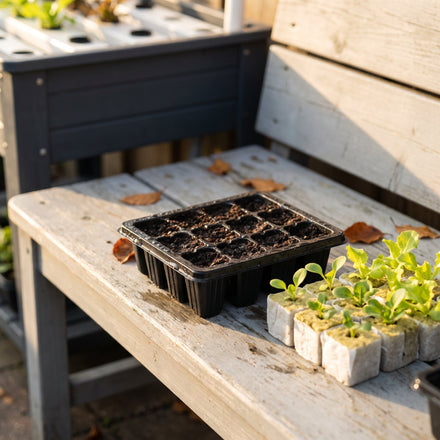
Young tomato seedlings grown indoors under a bright greenhouse Grappoli Corbarino Cherry Tomato Seeds

Choosing the Right Variety

The choice of variety determines the entire growing strategy. Determinate tomatoes are compact and bushy, require little pruning, and suit smaller spaces, whereas indeterminate varieties climb indefinitely and need regular staking and side-shooting.

For beginners in aquaponics, cherry tomatoes are often the most rewarding. Their short cycle, vigour, and tolerance of nutritional fluctuations make them ideal candidates. Compact varieties such as Roma, Tiny Tim, or Patio keep the footprint manageable. Large indeterminate tomatoes are delicious but temperamental, and are best left to mature, well-managed systems.

A selection of suitable seeds will give you a solid starting point, with open-pollinated varieties whose seeds you can save from one year to the next.

pH, conductivity, and nutrients — striking the right balance

In aquaponics, pH is the result of a permanent compromise. Tomatoes would prefer slightly acidic water, around 6.0, but the bacteria in the filter and the fish require a more neutral environment. In practice, targeting a range of approximately 6.4 to 7.0 keeps everyone reasonably happy and allows good uptake of iron and phosphorus. Dropping to 6.0 as in pure hydroponics is neither possible nor desirable here — it would stress the fish stock.

Conductivity provides a useful second reference point. During the vegetative phase, the solution generally sits at around 1.8 to 2.0 mS/cm. As soon as the first flowers appear, the balance shifts: the need for nitrogen falls while demand for potassium and phosphorus rises sharply — these two elements governing fruit set, size, and flavour.

This is the core challenge of growing tomatoes in aquaponics. Fish water is rich in nitrogen but often low in potassium, calcium, and iron. Corrections are made through measured additions — potassium sulphate, for example — or by alternating pH adjusters to cover calcium as well. Regular monitoring using reliable water tests remains essential, and our guide on iron deficiency will help you reach the right diagnosis when young leaves turn yellow while their veins remain green.

Temperature and light: the drivers of fruiting

The tomato is a warm-weather plant, and the thresholds matter more than you might expect. For water, the most commonly cited range is 18 to 24 °C. For air, the target is 22 to 26 °C during the day. These two ranges define the zone in which the plant works without stress.

The extremes exact an immediate cost. Below 13 °C at night, flower set drops sharply. Above 30 °C, pollen becomes sterile and fruits abort, regardless of how vigorous the plant is. In summer, the real challenge is therefore not cold but excess heat, which also depletes the water of oxygen and weakens the roots.

Light is the other decisive factor. A tomato needs strong, direct sunlight to produce sugars and well-coloured fruit. When growing indoors, full-spectrum horticultural lighting compensates for the lack of sunlight, particularly at the start and end of the season. Without sufficient light, plants become etiolated, stretch upwards, and flower poorly. Combining controlled warmth with generous light gives the tomato the conditions it needs to reach its full potential.

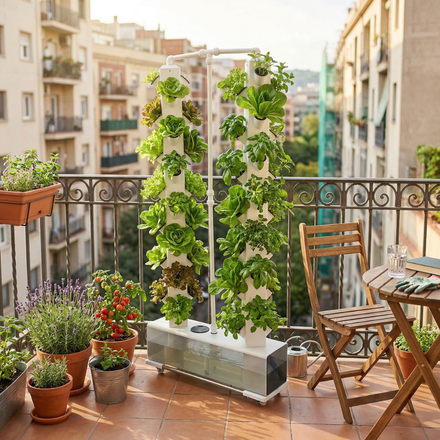
Cherry tomatoes growing in an NFT growing tube running the full length of a greenhouse

Growing tomatoes in a small space

You don't need a large garden to harvest your own tomatoes. A balcony, terrace, or corner of a conservatory is enough to accommodate a few plants, provided you choose suitable varieties and a vertical support. Cherry tomatoes and determinate varieties are particularly well suited to these smaller spaces.

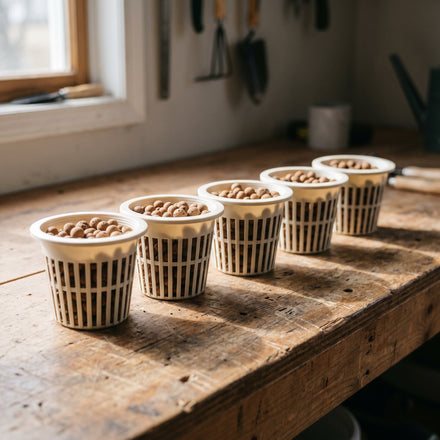
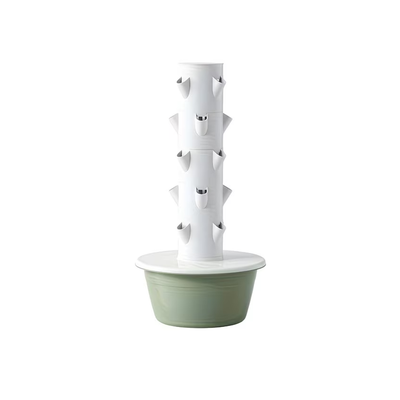
The choice of support matters too. Grow beds filled with clay pebbles anchor roots firmly and buffer fluctuations, but they take up floor space. The NFT growing tube addresses the opposite constraint. A single tube run along a wall, railing, or path accommodates a row of plants along its full length, with virtually no footprint. This is, in fact, how most professional greenhouse tomatoes are grown.

NFT does require a little more attention in return, since the nutrient film is thin and even a brief pump failure will dry out the roots quickly. A reliable pump and regular checks are all it takes to manage this, and vertical growing supports can then multiply your productive area considerably. A small, well-planned space often outperforms a large, poorly organised one.

From seedling to transplanting: getting your plants off to a good start

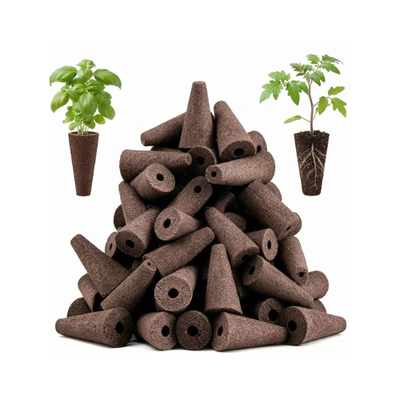
Sowing starts under cover, between February and April depending on your region, in a neutral, pre-rinsed grow medium such as rockwool or coco plugs. Potting compost should be avoided, as it would cloud the water and eventually clog the pumps. Maintain a temperature of 20 to 24 °C to achieve consistent germination within five to ten days.

Transplanting into the system takes place when the plant reaches 10 to 15 centimetres and nights no longer drop below 10 °C. Rinse the roots thoroughly before the transfer to avoid introducing any grow medium particles into the system, then bed the collar into the clay pebbles without burying the lower leaves.

This step is worth getting right, as a plant transplanted too early or too late suffers a setback it rarely fully recovers from. To refine your timing, consult our dedicated guide on spring seedlings.

The February-to-April window is based on a temperate climate. In southern Europe, sowing can begin as early as January; in Scandinavia and central Europe, it is better to wait until March or April unless you are using artificial lighting. The same benchmark applies everywhere: sow six to eight weeks before your last expected frost date.

Bumblebee on a tomato flower in the process of pollinating it, pollen suspended in the air

Pollination, the forgotten step

Here is the point that explains many disappointing harvests indoors. The tomato flower is self-fertile, but its pollen needs to be shaken loose to reach the pistil. Outdoors, wind and insects handle this — bumblebees in particular, whose vibration releases pollen far more effectively than a draught. In a closed greenhouse or a flat, that agitation disappears and many flowers drop without setting fruit.

The most effective method is to replicate that action and vibrate the flower truss. A daily flick of the fingers is enough on a handful of plants, but the go-to tool is an electric toothbrush: press the back of it against the stem for two seconds to release a cloud of pollen. Intervene preferably in the middle of the day, when the flowers are fully open.

Keep an eye on humidity too. Above 70 per cent relative humidity, pollen becomes sticky and fruit set fails — a critical issue in the warm, confined conditions of summer. Repeated every two days, this simple action quite literally transforms the number of fruits that set.

Fruit set and blossom end rot: understanding fruit disorders

Once the flower has been pollinated, the small fruit forms — this is fruit set. Several factors can compromise it, chief among them the extreme temperatures mentioned above and insufficient pollination.

The well-known blossom end rot is another classic problem. That brown, leathery patch at the base of the fruit is neither a contagious disease nor simply a lack of calcium in the water. It is a physiological disorder: calcium is not reaching the tip of the fruit regularly enough, as that part is always the last to be served by the plant. The most common causes are irregular irrigation, water or heat stress, excessive nitrogen pushing too much leafy growth, or a pH that is too low and blocking uptake.

Prevention therefore comes down to consistency, along with two useful numerical targets. Calcium levels are generally aimed at between 50 and 100 mg/L, with a calcium-to-magnesium ratio of around 4 to 1. In aquaponics, the key advantage is the steady supply of water, which naturally limits those fluctuations. Well managed, this approach makes the problem virtually disappear.

Diseases and pests: prevention above all

Tomatoes have their enemies, and the most feared is blight, the fungus that blackens leaves and fruit in humid conditions. The best defence is preventive. Good airflow around the foliage through proper training, watering that avoids wetting the leaves, and adequate air circulation all significantly reduce the risk. Powdery mildew lurks in the same conditions, as soon as the air becomes saturated.

On the pest side, aphids, whitefly and spider mites can take hold, particularly under glass. In aquaponics, conventional chemical treatments are out of the question, as even trace amounts of toxic compounds will end up in the fish water. The preferred approach is therefore biological control, using beneficial insects to keep populations naturally in check, a very dilute soft soap solution applied well away from the pond, or a simple jet of water.

The golden rule is observation. Regular inspection of the undersides of leaves allows you to act early, before a problem takes hold. Our guide on managing pests in aquaponics covers the strategies compatible with a living ecosystem.

Clusters of ripe cherry tomatoes on the plant in the garden Engrais naturel Aquaponic Mix

From flower to fruit, harvest and yield

Then comes the reward. Under good conditions, the first tomatoes are ready to harvest roughly 50 to 70 days after the young plants are put in place — slightly longer for larger varieties. Pick at full colour, when the fruit gives slightly under gentle pressure, ideally in the morning.

Regular harvesting encourages the plant to produce more, so it's better to check often rather than waiting for a bumper pick. A well-managed indeterminate plant will continue to fruit as long as light and warmth allow, sometimes right up to the first frost.

Yield depends on the variety and growing conditions, but a well-tended plant in aquaponics can produce generously over several months. To sustain this marathon, a regular supply of minerals during fruiting helps the plant go the distance without becoming exhausted.

Staking and pruning: supporting vigorous plants

A well-fed indeterminate tomato can reach several metres in height over a single season. Without support, the stem bends, snaps, or trails along the ground, encouraging disease. Staking is therefore not optional — it is a necessity to plan for at planting time. Several methods are available, from a simple spiral stake to a length of twine running upwards. The key is to tie loosely, without constricting a stem that will continue to thicken.

Pruning is the technique that most confuses beginners, yet it makes all the difference. At the axil of each leaf, a side shoot — the sucker — appears. On indeterminate varieties, remove these regularly between thumb and forefinger when they are a few centimetres long, in order to direct the sap towards the fruit. You should also gradually remove the leaves below the first trusses as they ripen, without stripping the plant too hard, since the leaves remain the plant's sugar factory.

Determinate varieties, on the other hand, require very little pruning, if any at all. Identifying your tomato type before reaching for the secateurs avoids many mistakes, as pruning a determinate variety like an indeterminate one would sacrifice a large part of the harvest. You will find everything you need to equip your plants in our range of horticultural accessories.
Extending the season and chaining crops

The great strength of aquaponics under cover is the ability to stretch the season well beyond what a traditional kitchen garden allows. By starting seedlings early indoors and protecting plants in late autumn, you can easily gain several weeks of production on either side of summer. A supplementary grow light and water kept at the right temperature do the rest.

To avoid ever leaving a bed empty, plan the changeover in advance. While your tomatoes are finishing their cycle, start young plants alongside them, ready to take over. This succession keeps the system both productive and balanced, since actively growing plants steadily consume the nutrients produced by the fish.

By varying varieties and sowing dates, you also spread your harvests and avoid large gluts followed by lean spells. That is the real beauty of a well-managed aquaponic kitchen garden: continuous production rather than a single season.

Conclusion: a crop that validates your system

Growing tomatoes in aquaponics is no small feat, and that is precisely what makes it such a rewarding challenge. The plant alone concentrates almost every skill an aquaponics grower needs: water balance, precise nutritional management, oxygenation, plant training and vigilance over health. Getting it right confirms that your setup is working as it should.

Keep the essentials in mind. A mature system of at least two to three months, a variety suited to your level, a pH maintained between 6.4 and 7.0, nutrition that shifts towards potassium at flowering, diligent hand pollination, and regular irrigation to prevent blossom-end rot. None of these steps is difficult in isolation — it is their consistency that makes the difference.

Start modestly, observe, adjust, and you will see your trusses become more generous season by season. The first tomato picked from a plant fed by your fish will be a genuinely proud moment, and the best encouragement to carry on.

Sources

Oregon State University Extension, Blossom-End Rot of Tomatoes: Causes and Prevention, Physiological origin of blossom end rot and the role of irrigation

Purdue University Extension, BP-13-W Blossom End Rot of Tomato Fruit, Excess nitrogen, salinity and water consistency

Mississippi State University Extension, Tomato Troubles: Common Problems with Tomatoes, Pollen sterility thresholds, flower drop, cracking

University of Maryland Extension, Growing Tomatoes in a Home Garden, Determinate varieties, side shoots, staking and harvesting

Frequently asked questions

Allow generous spacing rather than cramming plants in. A mature indeterminate plant easily occupies 0.4 to 0.5 m² of grow bed and takes up a large share of the available nutrients. In a domestic bed of around 1 m², two to three well-fed plants will almost always produce more than six crowded ones.

Partly, yes. A small oscillating fan set to low speed, directed towards the foliage for two to three hours a day, shakes the flower stems and noticeably improves fruit set in a closed growing environment. It also circulates the air around the trusses, which helps when humidity rises and makes the pollen sticky.

It is not sufficient, however, for large-flowered varieties, whose pollen adheres more and requires a firm vibration. The best compromise is to combine the two approaches — gentle background ventilation running continuously, with a manual pass every two days during peak flowering.

Everything depends on the pattern the yellowing takes.

  • Uniform yellowing of the lowest, oldest leaves — often simple senescence, as the plant draws its reserves back towards the fruit
  • Yellowing between the veins on older leaves — more likely a magnesium deficiency, a symptom that American extension services report very frequently on tomatoes
  • Yellowing of the young leaves at the top with veins remaining green — the classic sign of iron deficiency
  • Yellow lower leaves marked with concentric brown spots — suspect a fungal issue and remove them without delay

If in doubt, remove the affected leaves below the first truss currently ripening and observe the new growth for around ten days. A healthy plant bounces back to a rich, deep green.

Yes, with one condition. Your plants must come from open-pollinated varieties, also known as population varieties, and not from F1 hybrids. Seeds from a hybrid germinate perfectly well but produce heterogeneous offspring, often disappointing in both flavour and vigour. Heritage varieties, on the other hand, reproduce true to type from one year to the next.

Seed saving requires one small step that many people overlook: fermentation. Remove the pulp and seeds from a fully ripe fruit, then leave the mixture to sit for three to four days in a glass of water at room temperature. A whitish film forms on the surface, a sign that the gelatinous coating that inhibits germination is breaking down. Rinse thoroughly under clean water, keep only the seeds that sink to the bottom, and lay them flat on a plate to dry for a week.

Stored dry, away from light, and in an airtight container, they remain viable for four to six years. Always note the variety and the year, as tomato seeds all look identical once dry.

Far less so. Most cherry tomatoes are indeterminate but respond very well to being trained to two stems, which multiplies the trusses without exhausting the plant. Remove the lower side shoots above all, and let the plant fill out.

Splitting is almost always caused by a sudden resumption of fruit growth when the water supply becomes generous again after the skin has already started to harden. Horticultural extension literature cites three main triggers: irregular watering, excessively rapid growth, and large temperature swings between day and night.

In aquaponics, the continuous circuit naturally limits the first factor, which explains why the problem is less common there than in open ground. When it does occur, look first at a pump stoppage, a very cold night following a scorching day, or a fruit left on the plant too long.

  • Harvest as soon as the colour is well developed, without waiting for full ripeness on the plant
  • Provide light shading during the hottest hours in midsummer
  • Choose soft-skinned varieties if you are growing in a very sunny, enclosed structure

A split fruit is perfectly edible if consumed quickly, but the wound becomes infected fast — so do not leave it on the truss.

Read next

Growing pots for aquaponics

Growing pots for aquaponics

The net pot is an unassuming but decisive accessory in aquaponics: it supports the plant, houses the grow medium and allows water and oxygen to circulate freely. This guide explains how to choose the

Read the article
Growing lotus in aquaponics

Growing lotus in aquaponics

The lotus is an aquatic plant whose flowers are emblematic of the most beautiful ornamental ponds. In aquaponics, in an ornamental system (a pond with goldfish or koi carp) that does not need to

Read the article
What to sow in autumn in aquaponics

What to sow in autumn in aquaponics

Autumn is not the end of the growing season — it is the start of the most peaceful one. Here is what to sow, when to do it and how to achieve leaf harvests

Read the article
Aquaponics and Summer Holidays

Aquaponics and Summer Holidays

You're going away for two weeks in July and your aquaponics system will be running without you : this thought rightly makes you anxious, because heatwaves, evaporation, and fish feeding raise practical questions. Good

Read the article
Growing without soil in hydroponics

Growing without soil in hydroponics

Hydroponics is not a trend but an agronomic revolution thousands of years old, using up to 90% less water and supporting faster plant growth. Understanding its principles, methods and limitations is becoming essential for

Read the article