Vermiponics: worms in aquaponics

Written by Tristan Ulrich · September 19, 2026
Vers de compost Eisenia fetida circulant entre des billes d'argile humides dans un bac de culture aquaponique

Vermiponics involves introducing compost worms into the grow medium beds of an aquaponic system, where they break down fish sludge and plant debris that bacteria then convert into assimilable nutrients. This page covers suitable species, introduction densities, the conditions that must be maintained, and the configurations in which the method does not work.

What worms change in a grow bed

In substrate-based aquaponics, fish waste and root debris accumulate over the months between clay pebbles or gravel. This organic matter cannot be used directly by plants. It must first be broken down, then mineralised by the bacteria and fungi in the grow bed. Vermiponics involves delegating part of this work to compost worms installed permanently in the grow bed.

The idea is appealing because it applies to the grow bed a principle already well documented in vermicomposting. The published results are, however, more nuanced than the discussion circulating on forums, and above all they do not all say the same thing depending on whether one is talking about the quality of the vermicompost produced or the yield of the grow bed. You will find here what has been measured, what has not, and the practical conditions that separate a sustainable worm population from a failure within a few weeks.

Aquaponic clay pebble grow bed with lettuces and basil, adjacent fish tank inside a greenhouse

Vermiponics in practice

The term vermiponics refers to the deliberate introduction of compost worms into the grow beds of an aquaponic system running on grow medium. The worms do not live in the water — they occupy the moist, aerated zone of the bed, the part that remains in contact with the air between flood cycles.

The principle alters neither the nitrogen cycle nor the role of the nitrifying bacteria. It adds a link upstream. The worms ingest organic particles, break them down and excrete them as finer castings that are heavily colonised by micro-organisms. The surface area available for bacterial activity increases, which speeds up the release of nutrients.

Be careful not to confuse this with a conventional wormery installed beside the system, from which you collect the leachate. Here, the worms live directly in the grow bed, among the roots. The way it works, the constraints involved and the risks are not the same.

Fish sludge accumulated between the gravel of a grow bed, with a compost worm actively mineralising it

The role of sludge mineralisation

In a grow bed, solids from the fish tank gradually settle in the lower section, where water sits longest. Left unchecked, they form a compact layer over the course of a year or two that restricts water flow and creates oxygen-depleted pockets.

Worms work mainly in the top twenty centimetres, where moisture and air coexist. They break down debris before it compacts, and their burrows maintain a porosity that the grow medium alone eventually loses. The castings they leave behind, known as worm casts, host a dense microbial community and concentrate nutrients in plant-available forms.

A worm creates no new elements — matter does not appear from nowhere. What it does do is shift those elements on a large scale from locked-up forms into forms that roots can take up, and this can be measured precisely. A 2026 study compared vermicomposting and conventional composting of the same batch of fish-farm sludge, and found in the vermicompost 38% more available phosphorus, 50% more potassium, 64% more iron, and 14% more manganese. Given that iron and trace elements are the chronic deficiencies in aquaponics, that is no small detail.

What the studies actually say

The most robust synthesis is a French meta-analysis from 2019, aggregating 68 publications and 665 results. It finds an average 26% increase in commercial yield and a root biomass 57% higher. Two caveats accompany it, and they carry particular weight here. The effect is halved or worse as soon as the medium already receives fertilisation — which is precisely the situation in a bed fed by fish. The useful dose also plateaus at around 30 to 50% of the grow medium volume; beyond that, the benefit disappears. The authors also flag a publication bias, with trials showing spectacular effects being over-represented.

The mechanism itself is well described. Worm casts contain phosphatases — enzymes that break down organic phosphorus into directly absorbable orthophosphate — and a microbial population far denser than that of the starting grow medium. It is this activity that releases the elements, not any creation of matter.

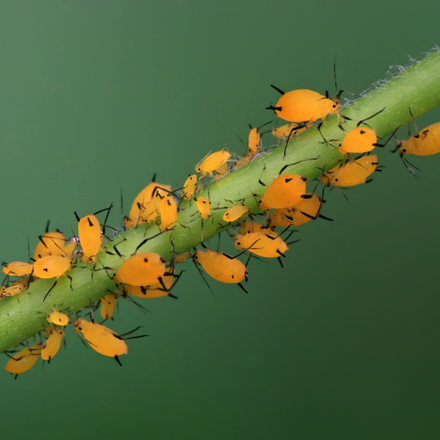
Effects also exist beyond nutrition. In trials where all plants received the same nutrient solution, conducted by Edwards' team at Ohio State University, a simple foliar drench with worm compost extract halved aphid and mite damage on tomatoes and cucumbers. The effect is clear; its mechanism remains hypothetical.

On vermiponics specifically, however, research is sparse and often tests several variables simultaneously — for instance, freshwater renewal at the same time as worm introduction — which makes it impossible to attribute any gain to the worms alone. Here is what practitioners observe, and which aligns with the known biology of these species.

  • A growing bed that clogs less quickly
  • Fewer visible plant residues on the surface
  • A layer of worm casts in the deposit zones
  • More branched roots in colonised areas

One final point to establish the limits. A university trial compared worm compost tea used alone against a commercial fertiliser, on lettuce in a raft system, with statistically comparable nutritional profiles, and harvested seven times less. Worm compost complements fertilisation — it does not replace it.
Eisenia fetida red worms with their characteristic pale bands on moist compost

Eisenia fetida, the red worm

Eisenia fetida, commonly known as the red wiggler or brandling worm, remains the most widely used species, accounting for around 80 to 90% of worms used in vermicomposting. It measures five to seven centimetres, displays an alternating pattern of dark red bands and lighter segments, and is easily recognised by its lively reaction when handled.

It is an epigeic species — meaning it lives in the surface litter rather than deep in the soil. This behaviour makes it particularly well suited to a grow bed, where it stays within the top few centimetres of grow medium rather than burrowing deeper. It tolerates crowding and reproduces quickly, allowing the population to self-regulate according to the food available.

Its other advantage is availability. Sold widely for vermicomposting, it acclimatises without any particular difficulty as long as moisture and temperature remain within its comfort range.

Comparison of larger Dendrobaena veneta worms alongside small red compost worms on moist bedding

Two other usable species

Eisenia andrei closely resembles Eisenia fetida — so closely, in fact, that the two are often sold under the same commercial name. Its colouring is a more uniform deep red, without the distinct pale banding. Both species frequently coexist within the same culture and behave in a comparable manner in a grow bed.

Dendrobaena veneta, sold under the name European nightcrawler or dendro, is considerably larger, at twelve to seventeen centimetres. It reproduces more slowly but tolerates low temperatures better, which makes it genuinely useful for a grow bed kept outdoors or in an unheated greenhouse.

Then there is the question of worms collected from the garden. The act of collecting them isn't the problem — the location is. Under a pile of manure or dead leaves you'll find true epigeic species, Lumbricus rubellus for example, which is among the species commonly used. A spadeful of vegetable garden soil, on the other hand, yields mostly burrowing species — anecic or endogeic — that need mineral soil and a permanent burrow. Without either, they don't disappear overnight, but university extension services agree on one point: they stop growing and reproducing, and no viable population becomes established.

Handful of compost worms and vermicompost held above a clay pebble grow bed Live earthworms for worm composters and composters

What stocking density to start with

Guidelines from vermiculture provide a useful starting point. Allow approximately 500 grams of worms per square metre of bed surface, which equates to roughly one thousand adult Eisenia fetida individuals. For a domestic bed measuring 1.2 metres by 0.6 metres, this works out to around 350 grams.

There is no need to aim higher. A population self-regulates according to the food actually available. If you introduce too many worms into a new bed where little sludge has yet accumulated, some will die within the first few weeks. It is better to start low and allow the population to grow, which it will do naturally if conditions are suitable.

A recently established system, running for less than three months, does not yet contain enough organic matter. Wait until the bed has been running for a full season before introducing worms, or plan to add a starter quantity of organic material beforehand.

Humidity, temperature, oxygen and pH

Worms breathe through their skin, which must remain constantly moist without being waterlogged. The comfort range is around 75 to 85 per cent humidity within the bedding. In a flood-and-drain bed — one that fills and empties alternately — this condition is met naturally in the intermediate zone: the area that stays damp after the water drains away without ever being permanently submerged.

On the temperature side, Eisenia fetida lives and reproduces between roughly 13 and 29 degrees, with an optimal rearing range of 16 to 27 degrees. Above 30 degrees, activity drops sharply and mortality rises. Below 10 degrees, worms stop feeding and cluster deeper in the bed. Dendrobaena veneta tolerates the cold somewhat better, which remains a point in its favour in continental climates.

Oxygen is the critical factor, and it is what needs monitoring rather than the water itself. A worm can survive for a long time submerged in well-oxygenated water; what kills it is anoxia. A bed left permanently flooded, with no fill-and-drain cycle, starves the root zone of air and wipes out the population. This is precisely what a well-adjusted bell siphon prevents. Finally, pH must remain close to neutral, between 6 and 8 — a range that coincides with what aquaponics systems require for both nitrifying bacteria and plants.

Three grow media side by side — clay pebbles, pumice, and rounded gravel — with particle sizes compared

Compatible grow media

Not all grow media are equal. Worms need gaps wide enough to move through and a surface that won't abrade their skin. Expanded clay pebbles of 8 to 16 millimetres work well: their porosity retains moisture and their surface stays gentle.

Pumice also works, ideally in a particle size of 10 to 20 millimetres. Its rougher surface is sometimes cited as a drawback, though this doesn't prevent a stable worm population from becoming established. Rounded, non-calcareous gravel of 8 to 16 millimetres remains the budget-friendly option, provided you check that it doesn't push the pH up.

Two grow media should be avoided. Sand and particle sizes below 5 millimetres compact and block movement. Rockwool and synthetic foams offer no usable structure for worms.

DWC aquaponic system with floating rafts, lettuces in pots suspended above clear, aerated water

DWC and NFT, incompatible systems

Vermiponics requires a grow medium. In a floating raft system, the roots hang freely in the water and there is no moist, aerated zone where worms could establish themselves, nor any organic matter for them to ingest.

The same is true of nutrient film techniques. NFT channels contain only a thin film of water a few millimetres deep flowing continuously, with no colonisable substrate. The worms would be swept towards the pump or become lodged in the pipework.

In a hybrid system combining a grow bed and rafts, only the grow bed section can host worms. Fit a mesh screen or filter at the grow bed outlet to prevent individuals from drifting into the aquatic section.

Introduction of a clump of moist bedding containing compost worms into a hollow in the grow bed

Setting up step by step

First, check that the bed has been running for at least three months, that the flood-and-drain cycle is stable, and that the pH is holding between 6.5 and 7.5. A properly established system is a prerequisite — vermiponic additions cannot compensate for a flawed design.

Next, hollow out one or two pockets roughly ten centimetres deep in the grow medium, away from the planted areas. Place the worms in these pockets along with their original bedding rather than rinsing them off, as this limits stress during the transfer. Cover them with a thin layer of damp organic matter, then replace the grow medium without compacting it.

Leave the system to run normally. The worms will make their way down to a suitable zone on their own within a few hours. Avoid disturbing the bed during the first two weeks, giving the population time to settle in.

Thin layer of vermicompost and plant debris spread across the surface of a clay pebble grow bed

Inputs and their timing

In a bed already loaded with sludge, food is present and no additional input is needed. In a new or lightly loaded bed, a supplement helps the population establish itself. A handful of mature worm castings spread over the surface every three to four weeks is more than sufficient.

Spent leaves, roots from harvested plants, and pruning offcuts can be placed directly on the grow medium. They disappear within one to three weeks when the population is active. This rate of disappearance is, in fact, the best indicator of the condition of your worms.

Exercise restraint. Too generous an input raises the oxygen demand in the bed, clouds the water, and can cause ammonia to rise. Small, regular additions are far preferable to a single large deposit.

Recognising a healthy population

A visual check every two months is sufficient. Gently move the grow medium aside over around twenty centimetres in a deposition zone, away from the roots. You should find several active worms that retract as soon as they encounter light, along with cocoons — small amber capsules roughly the size of a pin head. The presence of cocoons indicates active reproduction and therefore satisfactory conditions.

The texture of the grow medium is just as informative as the worms themselves. A dark, crumbly, light layer in the lower zones corresponds to worm castings. Conversely, a smooth, compact mud that gives off a sulphurous smell indicates an oxygen-depleted zone where worms do not venture.

Also keep an eye on the leaf symptoms of your crops. They will tell you nothing about the worm population directly, but a gradual improvement in vigour in the months following introduction often accompanies more consistent mineralisation. Do not look for a dramatic effect — vermiponics works on long cycles.

Compost worms drowned on the surface of a waterlogged grow bed, illustrating a common mistake

The most common mistakes

The most common mistake is leaving the grow bed permanently flooded. Without a drain cycle, air can no longer penetrate the grow medium and the worms migrate upwards and die at the surface. A pump running continuously on a grow bed without a siphon produces exactly this result.

Next come treatments. Many products used against fish parasites, particularly those containing copper or formaldehyde, are toxic to worms. Salt used in therapeutic baths causes the same problem beyond certain doses. Always check compatibility before treating the fish tank.

Two other pitfalls come up regularly. A large input of fresh organic matter causes oxygen levels to drop and triggers temporary cloudy water. An unventilated greenhouse in summer, meanwhile, pushes the grow medium above 30 degrees, which the worm population cannot tolerate for long.

Fish in an aquaponic tank attracted by a worm drifting just below the water surface

Worms and Your Fish

A worm that drifts into the fish tank will be eaten, with no ill effect on the fish. Eisenia fetida does, however, secrete an unpleasant-tasting fluid when stressed, which is why some fish spit it back out. This is neither a danger nor a health concern.

Using worms as a dietary supplement is a recognised practice, particularly for trout and carp. Their protein content is notable, but they are not a complete food and do not replace a balanced ration. Treat them as an occasional addition, not a staple.

One precaution is necessary if you take worms from the grow bed to feed to the fish: rinse them in system water and avoid transferring organic matter at the same time, as this would increase the tank's loading.

Open parcel containing a breathable bag of live compost worms delivered to a kitchen

Depending on the European Country

Availability varies little across the continent, but commercial names differ and cause confusion. In France the species is called ver rouge du fumier or eisenia, in the UK tiger worm, and Dendrobaena veneta is known as the European nightcrawler, while Germany uses Kompostwurm and the Netherlands and Belgium refer to mestworm.

Eisenia fetida and Eisenia andrei are frequently sold under a single label with no distinction made between them. For a grow bed this makes no practical difference, as both behave identically. Dendrobaena veneta is more common in northern Europe, where it is also widely used as fishing bait.

Climate matters more than geography. In a Mediterranean greenhouse, the main summer constraint is substrate overheating, which calls for ventilation. In Scandinavia or at altitude, winter is the limiting factor, and a population of Dendrobaena proves more resilient under those conditions.

Conclusion: a slow but genuine benefit

Introducing compost worms into a growing bed is neither a gimmick nor a miracle solution. It is a practice whose effects become apparent over several seasons, and which works on two distinct levels. It preserves the structure of the grow medium by breaking down organic deposits before they form the compacted layer that eventually smothers the bottom of the bed. It also accelerates the availability of the elements that the fish are already producing, most notably iron, where a comparison between vermicomposting and composting of fish sludge has put a figure on the gain.

Its success depends on a few conditions, but those conditions are not negotiable. The bed must operate on a grow medium, with a flood-and-drain cycle that ensures air reaches the roots — which rules out floating rafts and nutrient film systems. The grow medium temperature must remain between fifteen and twenty-five degrees for most of the year. The worms introduced must be surface-dwelling species, not burrowing earthworms dug from the garden. No treatment applied to the fish tank should be used without first checking its compatibility.

It is also important to be clear about what can realistically be expected. Vermiponics will not transform your harvests, and vermicompost does not replace any fertilisation programme. What it delivers is more subtle and more lasting: a growing bed that ages well and a more consistent mineralisation. For a system intended to run for several years, that amounts to a few hundred grams of worms, invested just once.

Sources

Blouin M., Barrere J., Meyer N., Lartigue S., Barot S., Mathieu J., Vermicompost significantly affects plant growth, a meta-analysis, Agronomy for Sustainable Development, 2019, Average effect of vermicompost on yield and root biomass, optimum application rate, and the diminishing effect when the growing medium is already fertile

Hleibieh M., Hanc A., Michal P., Hrebeckova T., Composting and Vermicomposting of Fish Sludge, Agronomy 16(4):473, 2026, Comparison of vermicompost and compost on the same batch of fish-farming sludge, with measured gains in available phosphorus, potassium, iron and manganese.

Domínguez J., Earthworms and Vermicomposting, in Earthworms, The Ecological Engineers of Soil, IntechOpen, 2018, Ecological categories of earthworms and the reasons why only epigeic species are suited to a soil-free environment

Sherman R., Raising Earthworms for a Commercial Enterprise, NC State Extension, AG-641, 2021, Behaviour of anecic species deprived of their burrow, and temperature ranges for rearing Eisenia fetida

Angima S., Noack M., Noack S., Composting with Worms, Oregon State University Extension, EM 9034, Distinction between surface-dwelling and burrowing worms, and why the latter are unsuitable for a vermicomposting bed

Edwards C.A., Arancon N.Q., Vasko-Bennett M. et al., Suppression of green peach aphid, citrus mealybug and two-spotted spider mite attacks by aqueous extracts from vermicomposts, Crop Protection, 2009, Effect on pests measured at equal nutrition between batches, isolating a non-nutritional effect

Frequently asked questions

A few individuals do stray, particularly after an addition of fresh material or during a very wet period. The consequences are limited.

  • A worm swallowed by a fish is simply eaten
  • A worm drawn into the pump is broken up without damaging the unit
  • A collective migration to the surface, however, indicates poor aeration or excess moisture

It is this last situation that needs to be recognised: a mass escape is a symptom, never a mere accident.

The available data calls for modesty. What is established is that mineralisation of sludge releases a portion of the elements it holds, with recovery rates that vary considerably depending on the process — in the order of ten to sixty per cent for mineralisation alone. Worms accelerate fragmentation upstream of this process, but no published work currently allows a specific yield gain to be attributed to them alone. Consider the primary benefit as maintenance of the growing bed rather than an additional fertiliser.

Yes, it is actually the best source. The species used in domestic worm composting are precisely those suited to a grow bed, and very few species lend themselves to this purpose. Transfer them with a handful of their original bedding rather than rinsing them.

No, let the cycle run normally. The worms will find their preferred depth on their own within a few hours.

They slow down, then stop feeding altogether. Extension data sheets place useful activity within a temperate range, with an optimum around twenty degrees and a marked drop-off once the bedding falls below about ten degrees. Three precautions are generally enough.

  • Deepen the grow medium so that the lower zone stays frost-free
  • Cover the bin with a thick layer of mulch or a winter fleece
  • Suspend feeding until the population has recovered

A population that has become invisible at the surface is not necessarily lost — cocoons are far more frost-resistant than adults and will restart the colony in spring.

A healthy grow bed smells of forest soil, nothing more. A sour or sulphurous odour signals an excess of fresh material or an airless pocket — and it is that excess, not the worms, that attracts fungus gnats. Reduce inputs and check that the drain-down is complete at each cycle.

Read next

What to sow in autumn in aquaponics

What to sow in autumn in aquaponics

Autumn is not the end of the growing season — it is the start of the most peaceful one. Here is what to sow, when to do it and how to achieve leaf harvests

Read the article
Aquaponics in businesses and schools

Aquaponics in businesses and schools

We picture aquaponics in a garden or a greenhouse. Rarely in a school playground, a hospital's shared garden or the lobby of a corporate headquarters. And yet, that is where it produces some of

Read the article
Aquaponics and Summer Holidays

Aquaponics and Summer Holidays

You're going away for two weeks in July and your aquaponics system will be running without you : this thought rightly makes you anxious, because heatwaves, evaporation, and fish feeding raise practical questions. Good

Read the article
Recognizing deficiencies in aquaponics

Recognizing deficiencies in aquaponics

In aquaponics, plants can show signs of weakness even when the system appears balanced. Pale leaves, slowed growth, or deformities are often linked to subtle yet critical micro-deficiencies. These deficiencies involve essential elements such

Read the article
A practical calendar for success in aquaponics

A practical calendar for success in aquaponics

In aquaponics, the success of a season depends mainly on good upstream calendar management : periods of sowing, planting, ramp-up… and times when it is better not to intervene. Unlike a traditional vegetable garden,

Read the article
Controlling pests in aquaponics

Controlling pests in aquaponics

Aquaponics has a reputation for being a clean, ecological, and naturally protective method of cultivation. However, like any living system, it can be affected by pests : aphids, gnats, mites, invasive algae, or unwanted

Read the article