Salmonponics: aquaponics in cold water

Written by Ulysse Hay · April 1, 2026
Élevage de truites en eau froide associé à des cultures

Aquaponics is often associated with pond fish like goldfish and koi. However, there is a variant perfectly suited for our temperate regions, cool climates, and winters : salmoponics. Trout, char, brook trout, these iconic species have everything to gain from a well-designed system. Here's what you need to know before getting started.

Do you live in a region where winters are long, rivers are cold, and the idea of raising tilapia in a heated pond seems both expensive and out of sync with your environment ? Then salmo-aquaponics might be exactly what you're looking for without even knowing it yet.

It's a form of aquaponics that relies not on tropical species, but on salmonids : trout, char, brook trout. These are robust, tasty fish, perfectly adapted to the cold waters of our latitudes, and they have their rightful place in a well-designed aquaponics system. Less known than classic aquaponics, salmoponics is nevertheless gaining ground among European aquaponists who seek consistency between their system and their region.

What exactly is salmoponics ?

Salmoponics refers to an aquaponics system in which the fish raised belong to the salmonid family. The principle remains identical to classic aquaponics : the fish produce nitrogenous waste which, transformed by bacteria, nourishes the plants, which in turn filter the water. What changes is the species at the heart of the system, and with it, all the parameters to be managed.

Where tilapia aquaponics operates in water at 26-28 degrees, salmo-aquaponics operates in cold water, between 10 and 18 degrees depending on the species. This is not a constraint: it is precisely what makes it relevant in our temperate latitudes, where maintaining warm water all year round represents a significant energy cost. In salmo-aquaponics, the European climate becomes an asset.

Demanding species, but well suited to our climates OXYPRO 150 Bubbler

Demanding species, but suited to our climates

Salmonids have a reputation for being difficult to raise. This is not entirely unfair : these fish are sensitive to water quality, lack of oxygen, and sudden temperature variations. But this demanding nature also reflects a biology very well adapted to conditions that we can reproduce naturally in much of Europe.

A trout living in clean, fresh, well-oxygenated water is a vigorous animal that grows well and rarely gets sick. The difficulty of salmon farming is not maintaining extraordinary conditions : it is maintaining stable conditions. And stability, in aquaponics, can be learned. Aquaponists who have already managed a classic system already have the right instincts. Salmon farming simply requires applying them with even more rigor.

Brown trout, an emblematic species of salmonoponics

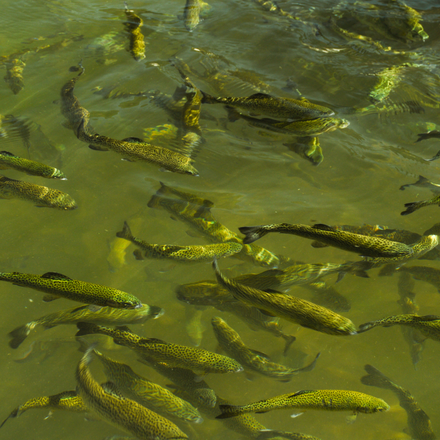
Brown trout, or river trout, is the most symbolic species of salmonoponics in Europe. It is an indigenous fish, naturally present in our waterways, recognizable by its red and black speckled coat. It appreciates cold water between 10 and 16 degrees, very well oxygenated, with a stable pH around 7 to 7.5.

In an aquaponics system, brown trout is more demanding than rainbow trout : it tolerates parameter variations and high densities less well. It is therefore more recommended for experienced aquaponists, or those who have a cold natural water supply system. On the other hand, it produces exceptionally high-quality flesh, much appreciated by gourmets, which makes it a relevant choice for a high-end food autonomy project.

Rainbow trout, the most suitable for farming

If you are new to salmonoponics, rainbow trout is the species to turn to first. It is the most farmed salmonid in aquaculture worldwide, and for good reasons : it is robust, tolerant to higher densities, and its growth is fast. It can reach 300 to 400 grams in less than a year under good conditions.

It prefers water between 12 and 18 degrees, with sustained oxygenation. Below 8 degrees, its metabolism slows down significantly. Above 20 degrees, it begins to suffer. It is therefore a species that adapts perfectly to an outdoor or cold greenhouse system in most French, Belgian or Swiss regions, provided that summer heat peaks are monitored. Its firm and tasty flesh makes it a very valuable product, whether for personal consumption or for local marketing.

Brook trout, for well-controlled systems

Brook trout, also known as fontaine char, is a North American species that has perfectly acclimatized in Europe. Despite its name, it is not a salmon but a char, close to trout. It is distinguished by very fine pink flesh and a delicate taste, often compared to that of wild salmon.

It is a species that requires particularly cold water, ideally between 10 and 14 degrees, and impeccable quality. Its tolerance to parameter variations is low. For this reason, it is advisable to introduce it into a salmonoponic system only once it is perfectly run-in and stable. The reward is commensurate : a rare, tasty, and high value-added fish, which few amateur breeders produce today in France.

Temperature: the parameter that changes everything Floating pond thermometer

Temperature, the parameter that changes everything

In salmonponics, temperature is not merely one parameter among others. It is the central parameter around which the entire system is organized. Each species has its comfort range, and straying outside this range doesn't just cause stress : it can lead to rapid mortality.

The golden rule is simple : never let the water exceed 18 degrees for rainbow trout, and 16 degrees for brown trout and brook trout. In practice, this means carefully choosing the location of your system, prioritizing shade in summer, avoiding unventilated glass greenhouses, and daily monitoring of the temperature with a reliable, continuously immersed thermometer. In some warm regions, a water cooling system may be necessary during the summer months.

You can also organize rotations with fish better suited to warm climates in the summer. Be careful, however, to maintain a similar biomass so as not to disrupt the system.

What is often underestimated is the effect of temperature on dissolved oxygen content. The colder the water, the more capable it is of retaining oxygen. This is a natural advantage of salmonponics : water at 14 degrees contains almost twice as much dissolved oxygen as water at 28 degrees, all other things being equal.

Oxygenation more demanding than in classic aquaponics

Salmonids are fish with a high metabolism. They consume a lot of oxygen, much more than carp or tilapia of an equivalent surface area. A salmoponic system must therefore be designed from the outset with enhanced oxygenation : air diffusers, venturis, water return cascade, or a combination of several systems.

The ideal dissolved oxygen level for salmonids is between 8 and 12 mg/L. Below 6 mg/L, the fish begin to suffer and rise to the surface to gasp for air. This is an alarm signal that should never be ignored. An oximeter, even an entry-level one, is an essential investment in salmoponics. It will give you a real-time reading of one of the system's most critical parameters.

Stocking density adapted to salmonids

In domestic salmoponics, it is recommended not to exceed 25 kg of fish per cubic meter of water, with optimal oxygenation. This is below the standards of large-scale aquaponics, but it is the condition for maintaining sufficient water quality and avoiding chronic stress in a small system.

Unlike some gregarious species, salmonids tend to establish hierarchies and can be aggressive towards each other, especially in confined spaces. A too sparse stocking is also not ideal : it promotes territorial behavior and injuries. The range of 20 kg per cubic meter allows for a satisfactory social balance while preserving water quality. For well-equipped professional systems, one can go up to 35 kg per cubic meter, but this requires rigorous daily monitoring and very efficient filtration.

Which plants to associate with cold water ? Green Lamb's Lettuce Seeds from Cambrai

Which plants to associate with cold water ?

It's one of the most frequent questions asked by beginners in salmon farming : do plants grow as well in cold water as in a warm water system ? The answer is yes, provided you choose the right species.

Leafy greens are the big winners in salmon farming : lettuces, spinach, arugula, lamb's lettuce, watercress, chives, parsley. These plants enjoy cool temperatures, grow quickly, and are very well utilized daily. Aromatic herbs such as mint, chervil, or coriander also adapt very well.

Conversely, tomatoes, peppers, and cucumbers are less suited to this water temperature, although it can still work.

Essential equipment to get started

A basic salmoponic system does not fundamentally differ from a classic aquaponic system in its structure: a fish tank, a grow bed, a pump, a biological filtration system. What changes is the level of monitoring and oxygenation equipment.

A continuous immersion thermometer is non-negotiable. An oximeter is highly recommended. A complete water analysis kit (pH, ammonia, nitrites, nitrates) remains essential as in any aquaponic system. For regions with hot summers, plan from the outset for a shading system or a heat exchanger to maintain the temperature within the acceptable range. A buried kit is also an option. Regarding the minimum volume, a 500 to 1,000 liter tank is a reasonable starting point for a first domestic salmoponic system. Below that, the margin of error is too small for demanding salmonid species.

Mistakes to avoid from the start

The first mistake in salmoponics is underestimating the importance of temperature. A system installed in direct sunlight without summer protection can see its temperature dangerously climb in a few hours during a heatwave. Plan for shading before summer, not during.

The second mistake is overpopulation from the start. The temptation is great to want to quickly make a return on investment, but an overpopulated salmonid tank quickly degenerates : degraded water quality, stress, diseases, mortalities. It is better to start with fewer fish and gradually increase density as the system stabilizes.

The third mistake is neglecting the biological start-up phase. Like any aquaponic system, a salmoponic system needs several weeks for its biological filtration to be fully operational. Introducing salmonids into an uncycled system exposes them to ammonia spikes that can be fatal in a few days.

Salmoponics : an ethical and local choice

Salmoponics : an ethical and local choice

Beyond the technical aspect, salmoponics offers a coherence that few other farming systems can claim. Raising trout or brook trout in cold water, without chemicals, in a closed circuit, with vegetables produced in parallel : this is a form of food autonomy that fully aligns with the values of permaculture and local consumption.

These species are those that our ancestors fished in the rivers of our regions. Raising them in salmoponics is, in a way, reconnecting with this link to the land, while adapting it to today's constraints and tools. In a context where intensive fish farming is increasingly questioned, salmoponics offers a serious, human-scale alternative, whether for feeding one's family or for developing a larger-scale local production project.

Conclusion : Salmoponics, an adventure that starts with good fundamentals

Salmoponics is no more difficult than classic aquaponics. It is different. It requires particular attention to temperature and oxygenation, a choice of species adapted to one's climate and experience level, and patience in scaling up the system. But in return, it offers fish of remarkable taste quality, consistency with local ecosystems, and a rare satisfaction : that of producing at home species usually found in mountain rivers.

Sources

New Mexico State University, CR-680 Water Quality for Aquaculture, Minimum dissolved oxygen levels, nitrogen thresholds and the distinction between coldwater and warmwater species.

SMIDAP, Programme OPRA 2, rapport final, French field experience on seasonal management, trout in winter and temperate-water species in summer.

SRAC 453, Recirculating Aquaculture Tank Production Systems, A Review of Current Design Practice, Principles of recirculating system design, solids management and aeration sizing.

UF/IFAS HS1252, A Practical Guide for Aquaponics as an Alternative Enterprise, Daily ration expressed as a percentage of body weight and water renewal rate.

ITAVI and APIVA, Regulations and aquaponics, Salon Aquaponie 2020, French fish farming regulatory framework and the production threshold that triggers classified installation requirements.

EFSA, Fish welfare, European opinions covering trout and the factors used to assess welfare in farming.

Frequently asked questions

No. A properly oxygenated and well-filtered closed circuit is sufficient, provided the temperature is kept low. Moving water makes things easier; it is not a requirement.

Aquaponics guides recommend a daily ration of around 1 to 3% of body weight, split across two or three feeds. In cold water, trout eat less and digest more slowly, so stay at the lower end of the range and remove any uneaten pellets after five minutes. Uneaten feed is not just wasted money — it is an additional nitrogen load on your biofilter.

Everything hinges on what you do before a heatwave, not during it. Thermal inertia is your greatest ally, so a generous water volume, a sunken or well-insulated pond, shade netting fitted from spring onwards, and a greenhouse that's genuinely ventilated at night will make a bigger difference than a chiller bought in a panic. On the hottest days, let the cool night air do its work and close up during peak heat.

The second reflex concerns oxygen. The warmer the water, the less dissolved oxygen it holds — yet the fish's metabolism speeds up at the same time. Aquaculture guidelines put the safety floor at around 5 ppm of dissolved oxygen, and trout require considerably more than that. Boost aeration before the heatwave arrives, and cut feeding rates significantly for as long as temperatures stay high, since digestion consumes oxygen.

Finally, if your site really cannot stay within the comfort range in July and August, seasonal management is a serious option worth considering. Feedback from the French OPRA 2 programme run by SMIDAP describes a rotation between a cold-water species in winter and a temperate-water species in summer. This means planning the removal of trout before the hottest weather arrives and maintaining a comparable biomass to avoid destabilising the biofilter.

For a home system intended for your own consumption, you remain well below the thresholds that bring a fish farm under the classified installations regime, set at around 20 tonnes of annual production according to the ITAVI presentation on aquaponics regulations. As soon as you sell, even locally and in small quantities, the framework changes and a declaration becomes necessary. Check with your local authority before any commercial activity.

Oxygen depletion sets in quickly and shows up first in behaviour, even before the oximeter reading drops. Watch for these signs, especially in the early morning, when dissolved oxygen levels are at their lowest.

  • Fish clustered at the surface or near the water return.
  • Rapid breathing, with gill covers held wide open.
  • A sudden refusal to feed when nothing else has changed.
  • Individual fish remaining motionless, slightly tilted, no longer fleeing at your approach.

If you observe any of these, increase aeration immediately and stop feeding.

It is rarely a good idea. Trout are predatory and will readily swallow fry and smaller fish, and they require colder, more heavily oxygenated water than most aquaponics species. Keeping them together means imposing an uncomfortable compromise on everyone. Seasonal rotation — one species at a time depending on the time of year — gives far better results than a permanent mix.

Read next

Is aquaponics suitable for animal welfare ?

Is aquaponics suitable for animal welfare ?

We often talk about what aquaponics produces. But rarely about what the fish that make it work experience. Are they simply tolerated in a system designed for production, or can aquaponics truly respect their

Read the article
Aquaponics and Summer Holidays

Aquaponics and Summer Holidays

You're going away for two weeks in July and your aquaponics system will be running without you : this thought rightly makes you anxious, because heatwaves, evaporation, and fish feeding raise practical questions. Good

Read the article
Green pond water: 5 solutions

Green pond water: 5 solutions

In the middle of summer, the water in your pond turns an opaque green and you can no longer see your fish. Good news : five natural solutions, well combined, are enough to restore

Read the article
Watering your plants with an olla

Watering your plants with an olla

The Olla, also called an Oya, is a microporous clay pot buried near plants. It slowly releases water according to the roots' needs, allowing for deep, economical, and consistent irrigation. Increasingly popular, this system

Read the article
15 plants to grow in aquaponics

15 plants to grow in aquaponics

Aquaponics is ideal for growing a wide variety of plants, both indoors and outdoors. Some varieties adapt particularly well to this soilless growing method, with a constant supply of nutrient-rich water.

Read the article