

Compacted coconut fiber
Regular price
$10.00
Regular price
Sale price
$10.00
Unit price
/
per
| Volume | Prix | Prix au L | vs 15 L |
|---|---|---|---|
| 15 L | $10.00 | $0.67 | — |
| 70 L | $23.00 | $0.33 | −51 % |
UGro Rhiza coco fibre, double-washed in fresh water and factory-buffered: it comes out of the bag at pH 5.5 to 6.5, with an EC below 0.6 mS/cm.
The 15 L growing bag can be used straight from the bag for seedlings and row plants; the 70 L compressed block rehydrates to fill pots, baskets and growing beds. In aquaponics, allow for a commissioning rinse.

7/7 customer service by e-mail

Payment in instalments, free of charge
The summary
- What you receive: a washed and buffered UGro Rhiza coco block, in a 15 L bag or a 70 L block.
- Rehydration time: 2 to 3 minutes of expansion for the 70 L block, a soaking period for the 15 L bag.
- What you will need: 6.5 L of clean water for the 15 L, 18 L for the 70 L, and a container for the final volume.
- Before use: a rinse with clean water, the runoff from which should not go back into the fish tank.
- Maintenance: none for the grow medium itself, only watering or fertigation of your crops.
- How to choose: the 15 L bag can be planted into directly, while the 70 L block is used to fill your own pots.
Washed and buffered coco coir for seedlings, pots and grow beds
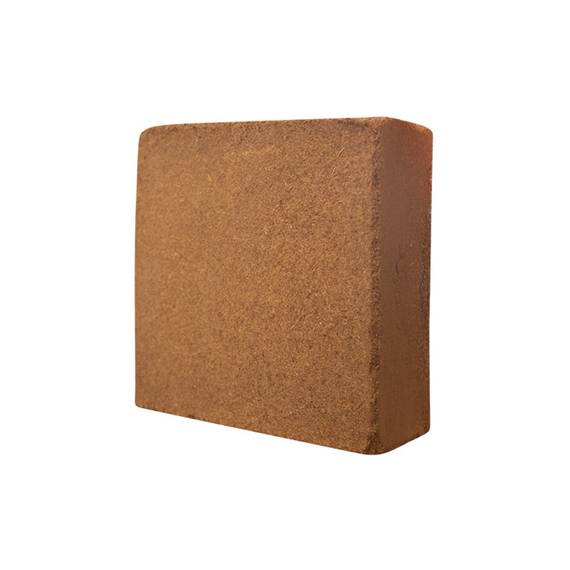
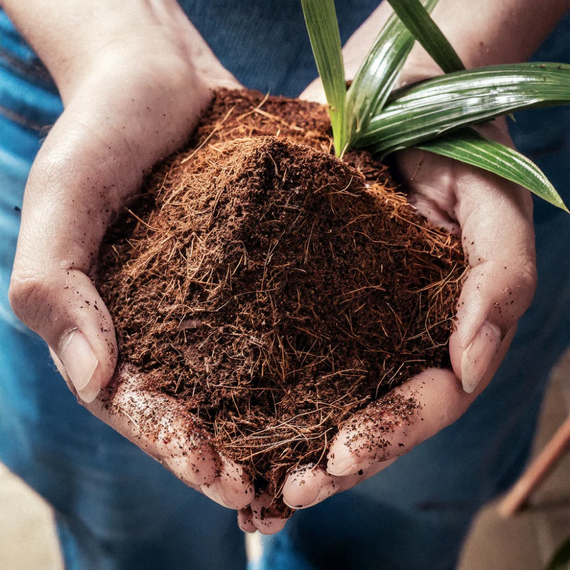
A UGro coco brick weighs 1.6 kg and fits on a shelf. After a few minutes in a bucket of water, it yields fifteen litres of grow medium ready for planting. That is the principle of compressed coco: you store a dense block all year round and produce the volume of growing medium on the day you need it.
The raw material is the fibrous husk of the coconut, an agricultural by-product that was once discarded as waste. Simply Organic, the Spanish manufacturer based near Barcelona that publishes the UGro brand, has it produced in India, on plantations deliberately located inland to limit salt content, before washing, buffering and compressing it.
Washing, carried out twice in fresh water, removes the soluble salts that accumulate during retting. Buffering, which the manufacturer refers to as true buffered, saturates the coco's exchange sites so that it releases less sodium and potassium during the growing cycle. Simply Organic does not publicly detail the minerals used in this exchange process, but it does publish the resulting values: conductivity below 0.6 mS/cm in a 1:1.5 extract, pH between 5.5 and 6.5. Full details can be found in the technical specifications.
Coco, clay pebbles or sphagnum: which one for which purpose
Compared with clay pebbles
Clay pebbles drain very quickly and retain almost nothing: they are designed for a flood-and-drain bed with short cycles and for bottom drainage. Coco, on the other hand, holds moisture between waterings.
With sphagnum moss
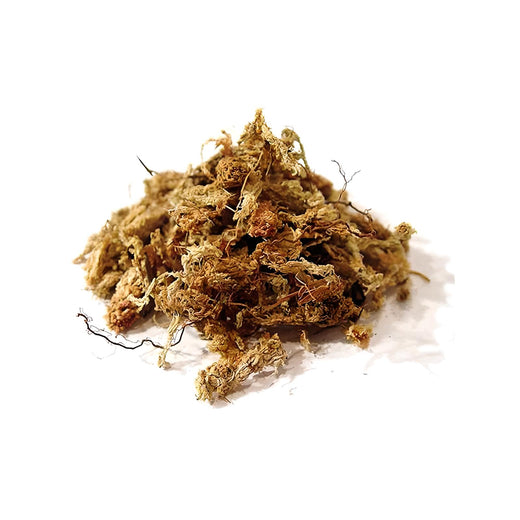
Sphagnum moss retains considerably more water and holds its structure for a long time, but it is expensive per litre and is used mainly for cuttings, orchids and carnivorous plants. Coco is the choice for volume.
Compared to perlite and compost
Perlite is not a complete grow medium: it is added to coco to lighten it. Compost, on the other hand, introduces nutrients you cannot control, which is a drawback in soilless growing.
Preparation requires no special tools, but the method differs depending on the volume. The 70-litre block requires 18 litres of clean water and expands within two to three minutes in a large tub or wheelbarrow. The 15-litre grow bag is prepared differently: cut one of the four marked openings on the top, pour 6.5 litres of clean water through the opening, then allow the coir's strong capillary action to distribute the moisture before planting. One side of the bag may appear wetter than the other at first, the manufacturer confirms this is normal.
Choose carefully before ordering
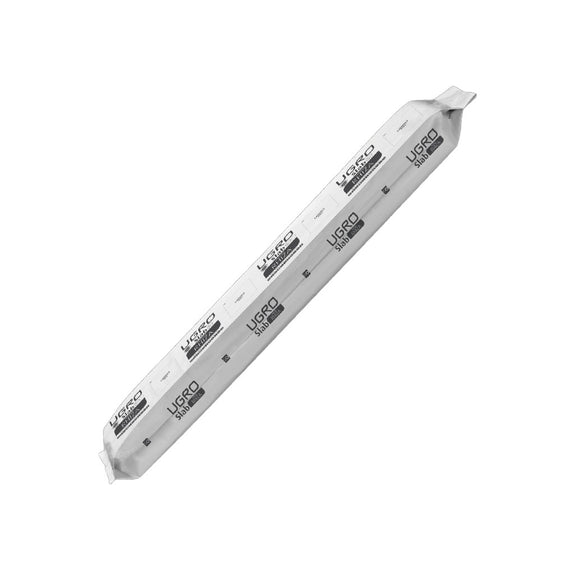
The 15-litre version is a flexible grow bag approximately one hundred centimetres long, UV-treated, with four pre-marked cut-out positions on the top. It sits directly on a growing table or in a gutter and can be planted without any decanting.
The 70-litre version is a standard compressed block that needs rehydrating in a container: this is the format to choose if you are filling your own grow pots, baskets, and beds, and if you want to be able to prepare only a portion at a time while keeping the rest dry.
In aquaponics, coco is used primarily as a planting medium, in pots and net cups, rather than as a full fill for a flood-and-drain bed, where its fine texture would eventually compact the grow medium and impede drainage. It holds the root ball, keeps things cool around the roots, and provides a surface that bacteria can colonise. The key concern is chemical: even washed and buffered, coco releases a proportion of the potassium and sodium still bound to its exchange sites as soon as it comes into contact with soft, low-mineral water. Our guide on choosing a grow medium for aquaponics compares each option one by one.
Common mistakes to avoid
Skip the commissioning rinse. UGro's instructions don't mention it, but in aquaponics it prevents the first leachate from reaching the fish tank. Rinse the rehydrated grow medium under clean water and drain it away separately.
Over-saturating the block. Beyond the quantities stated by the manufacturer, the coco loses volume and compacts instead of staying aerated.
Using it at the bottom of a flood-and-drain bed. It's too fine, it migrates towards the strainer and the pump.
Relying on it to feed your plants. It provides virtually no nutrients: fertilisation remains entirely your responsibility.
What happens to it after harvest
Healthy coco can be reused. At the end of a crop, remove the larger roots, re-moisten the material and let it rest: its fibrous structure will generally hold for a second season in the pot, provided the previous crop did not suffer from root disease. Once it becomes too fine and retains too much water, it works very well in a compost heap or as a mulch around the base of a border. Both sizes belong to the Rhiza range, which the manufacturer states is enriched with endomycorrhizae, the symbiotic fungi that colonise the roots and improve uptake of mineral nutrients.
Technical specifications
The essentials
- Volume once hydrated
- 15 or 70 litresDepending on the size chosen, volume stated by the manufacturer
- Rehydration water
- 6.5 or 18 litresDo not exceed this level: beyond it, the coco compacts rather than staying aerated
- Grow medium pH
- 5.5 to 6.5Range at which most vegetables absorb minerals most effectively
- EC conductivity
- Below 0.6 mS/cm1:1.5 extract on fresh grow medium, before any fertiliser application
Grow medium analysis
- Water retention
- 40 to 65 % depending on size40 to 45% for the 15 L bag, 60 to 65% for the 70 L block
- Dry matter
- 79 to 85 %79 to 85 % on the 15 L bag, 82 to 85 % on the 70 L block
- Organic matter
- 95 to 98 %Expressed as a proportion of dry matter
- Chlorides
- 70 to 80 mg/LLow value, a result of double rinsing with fresh water
Format and packaging
- Net weight
- 1.6 or 5 kg5% tolerance as stated by the manufacturer
- Compressed volume
- 4.3 to 11.3 litres4.27 to 4.72 L in 15 L, 10.26 to 11.34 L in 70 L, storage footprint
- Dimensions of the 15 L bag
- Approximately 100 x 15 x 3 cmPrices gathered from retailers, not published by the manufacturer
- Dimensions of the 70 L block
- 32 x 32 x 14 cmStores flat on a shelf, film with a handle
Processing and origin
- Rinsing
- Two times in fresh waterFlushes out the soluble salts that build up during retting
- Buffering
- Labelled true bufferedTerm used by the manufacturer, who does not detail the minerals used in the exchange
- Enrichment
- Endomycorrhizae, Rhiza rangeThe manufacturer states neither strain nor dosage on these two grow medium references
- Coco structure
- Medium Coco, Fibres and ChipsCoco blend, long fibres and chips in 15 L; medium coco with an average fibre content in 70 L.
- Stated purity
- Free from pathogens and rootsManufacturer's declaration, with no published third-party certification on these references
- Origin
- India, brand UGroCrops grown inland, Simply Organic packaging, Spain
10 further specifications are available in the detailed view.
In the box
- 1 UGro Slab Professional Rhiza growing bag, 15 litres hydrated, with 4 marked planting positions ready to cut, drainage holes on the underside, and a UV-treated film (15 L variant)
- 1 compressed UGro XL Rhiza block, 70 litres when hydrated, 32 x 32 x 14 cm, shrink-wrapped with a carrying handle (70 L variant)
- Nothing else in the parcel: the rehydration container, water, pots and fertilisation remain your responsibility.
Values published by Simply Organic for references UGS15R-1 and UGXLR-1. Water retention and dry matter differ between the two; details are given under each line. The dimensions of the 15 L bag come from retailers, and no RHP or OMRI certification is claimed for these references.
15 litres or 70 litres: which one is right for you
Both sizes contain the same washed and buffered coco, but they are not prepared in the same way and are not suited to the same use.
Not sure whether to go for 15 or 70 litres?
Answer three quick questions and we'll highlight the size that suits your needs.
| Volume once hydrated (L) | Clean water required (L) | Weight of parcel to carry (kg) | Packaging | Coco structure | Water retention | Enriched with endomycorrhizae | Prepared in several stages | Ready to plant with no repotting needed | Fills your own pots and baskets | Price | Best volume-to-price ratio | |
|---|---|---|---|---|---|---|---|---|---|---|---|---|
| 15 L grow bagYour choice | 15 L | 6,5 L | 1,6 kg | Flexible bag, marked slots to cut out | Medium coco, long fibres and chips | 40 to 45 % | yes | no | yes | no | $10.00 | no |
| Recommended 70 L compressed blockYour choice | 70 L | 18 L | 5 kg | Block in film, 32 x 32 x 14 cm | Medium coco with an average fibre content | 60 to 65 % | yes | yes | no | yes | $23.00 | yes |
15 L grow bag
Format and rehydration
Volume once hydrated (L)15 L
Clean water required (L)6,5 L
Weight of parcel to carry (kg)1,6 kg
PackagingFlexible bag, marked slots to cut out
Grow medium behaviour
Coco structureMedium coco, long fibres and chips
Water retention40 to 45 %
Enriched with endomycorrhizaeyes
Prepared in several stagesno
In use
Ready to plant with no repotting neededyes
Fills your own pots and basketsno
Price$10.00
Best volume-to-price rationo
70 L compressed blockRecommended
Format and rehydration
Volume once hydrated (L)70 L
Clean water required (L)18 L
Weight of parcel to carry (kg)5 kg
PackagingBlock in film, 32 x 32 x 14 cm
Grow medium behaviour
Coco structureMedium coco with an average fibre content
Water retention60 to 65 %
Enriched with endomycorrhizaeyes
Prepared in several stagesyes
In use
Ready to plant with no repotting neededno
Fills your own pots and basketsyes
Price$23.00
Best volume-to-price ratioyes
The prices shown are those of the two variants on this page. Technical values taken from the Slab Professional Rhiza and XL Rhiza data sheets.
Help choosing
What capacity do you need for your setup?
Product videos
Documents & manuals
Catalogue UGro Coco, Tree of Life 2024
Full range of UGro coco grow media and the characteristics of each product. English and Spanish.
UGro 2022 range leaflet
Detailed compositions of the Slab 15 L and XL 70 L, weights and volumes. English and Spanish.
UGro product catalogue
Condensed datasheets for the full range, dimensions and pack sizes. English and Spanish.
Rhiza 1200 instructions, the mycorrhizal inoculant
Manufacturer's document on endomycorrhizae in the Rhiza range. In English.
Document not showing? Some publishers block display inside a frame, so open it in a tab.
Estimate your
delivery time
Your estimate
Delivery
Estimated time
It covers preparing your order and then the transit time quoted by the carrier, counted in working days.
It is not a guaranteed delivery date: public holidays, peak periods, customs or a carrier delay can extend it. The exact amount, in your currency, is worked out in the cart once your address is entered.
The 70-litre block weighs 5 kg; the 15-litre block approximately 1.5 kg. The exact delivery cost is calculated in your basket based on the total weight of your order.
Frequently asked questions
11 questions
6 key questions, 11 in the detailed view
No questions in this category.
Vous aimerez aussi




Related articles

Grow media
Which substrate should you choose for aquaponics ?
Clay pebbles, coco, pumice: what each grow medium brings to your roots.
Read the article

Seedling
Germination failure: causes and solutions
Grow medium too wet, too compacted or too cold: diagnosing a seedling that won't emerge.
Read the article

Seedling
Successfully sowing seeds in spring aquaponics
The timing and techniques that get your seeds germinating first time.
Read the article

Seedling
Creating your indoor seed-starting setup
Light, heat and grow medium: setting up a seedling corner that actually works.
Read the article

Fertilisation
What fertilizer should I use in aquaponics ?
Coco contributes nothing: here is what actually feeds your plants.
Read the article

Plants
What plants can be grown in aquaponics ?
The species that establish best in a coco grow medium.
Read the article

Soilless
Aquaponics and hydroponics, what's the difference ?
Two ways to grow without soil, and what the grow medium changes.
Read the article
Let us talk about your project
Une question sur ce produit ou votre installation ? Notre équipe vous répond et vous conseille.

Paiement plusieurs fois sans frais
Proposé selon le montant du panier, au moment du paiement.

Livraison sous 5 à 15 jours ouvrés
Selon les produits et sites d'expédition. Estimation par destination dans l'estimateur de cette page.

SAV 7/7 par mail ou chat
Notre équipe répond à toutes vos questions.

Faire un achat engagé
Devenez acteurs du changement.
