





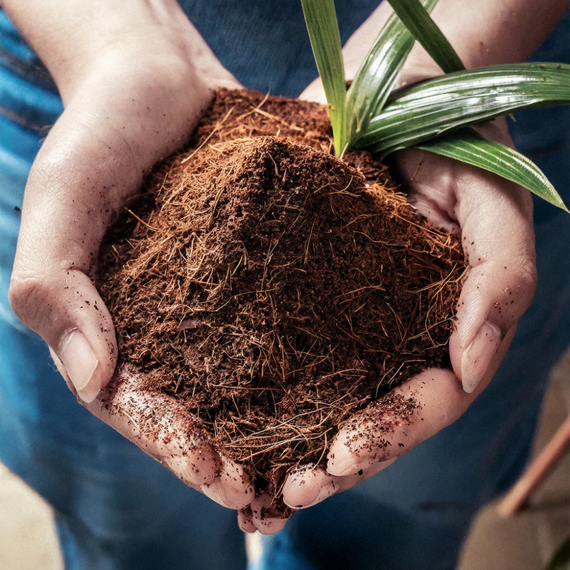
UGro XL compressed coir, 3 blocks for 210 L
Regular price
$59.00
Regular price
$64.00
Sale price
$59.00
Unit price
/
per
$19.66 × 3 with no fees
Klarna.
These three blocks of compressed coco coir make 210 litres of grow medium once rehydrated. The coir provides a natural, airy support for your plants' roots in aquaponics.
 Customer support 7 days a week by email
 Delivery within 2 to 15 business days
100 % secure payment
The summary
- What you receive: three blocks of compressed coconut fibre, 15.2 kg in total.
- The volume obtained: 210 litres of grow medium once the three blocks are hydrated.
- The water you will need: 18 to 20 litres per block, or around sixty for the three.
- The time: 20 to 30 minutes of expansion per block, then crumbling by hand.
- The container: a wheelbarrow or a mixing tub, wide enough for 70 litres.
- How it arrives: a compact, heavy parcel that travels dry.
Three blocks to rehydrate, 210 litres of grow medium to equip an installation
UGro XL compressed coco fibre, sold as 3 blocks, yields 210 litres of grow medium once rehydrated, or 70 litres per block. Each block needs 18 to 20 litres of water and 20 to 30 minutes to expand. Washed and buffered, it serves as an airy support for plants in aquaponics and is enough to equip an entire installation.
You receive three blocks of compressed coco fibre, 15.2 kg in all, which fit on a single shelf, and 210 litres of grow medium once rehydrated. When compressed, a block takes up only a fraction of the volume it will yield, and it is this compression that lets 210 litres of grow medium arrive in a single parcel. This format is meant for fitting out a whole system, or for covering a season of repotting, rather than a single pot.
🫗 Rehydrating a block
Each block needs 18 to 20 litres of water and 20 to 30 minutes to expand. Place it in a container wide enough, pour in the water, then break up the expanded material by hand or with a claw until you have an even grow medium, which then goes straight into your pots or baskets. Adding more water will not give you more grow medium, since saturated fibre loses volume and compacts. Nor do you have to prepare everything on the same day, because unopened blocks keep dry and compressed, away from frost, from one season to the next.
The final volume of a block, before pouring
A swollen block takes up 70 litres, the volume of a large gardening tub, even though it comes from a brick that fits in a crate. So check that your container can hold this volume before you begin, because a household washing-up bowl will overflow well before the end. A wheelbarrow or a builder's tub will do, and it is better to prepare one block at a time rather than all three at once, unless you have somewhere to put them.
🧪 A washed and buffered fibre
The fibre in these blocks is washed in fresh water and then buffered at the factory. Buffering saturates the fibre with calcium and magnesium, which take the place of the potassium and sodium naturally bound to it; without this treatment, the fibre would hold back some of the calcium and magnesium in your nutrient solution at your plants' expense. The grow medium therefore comes out at a pH of 5.5 to 6.5, with a conductivity below 0.6 mS/cm before any fertiliser is added, which leaves your feeding programme in charge of nutrition. It holds 60 to 65% water while staying airy, and it contains natural trichoderma, microscopic fungi that colonise the root zone.
In aquaponics, coco coir serves as a planting support in pots and net baskets: it holds the plug, keeps the roots cool and offers a surface that bacteria colonise. Keep it for this purpose rather than for filling a flood-and-drain bed, where its fine texture ends up migrating towards the strainer. Rinse it in clean water before commissioning and dispose of this first rinse water somewhere other than your fish tank, because the coir still releases a share of the salts bound to it on contact with fresh water. The guide on which grow medium to choose in aquaponics compares the options one by one.
The fertiliser and baskets for 210 litres
Coco fibre provides almost no nutrients, so in soilless growing without fish, it is the complete fertiliser that feeds your plants from the very first watering. In aquaponics, the grow baskets take the fibre directly and sit in the holes of your beds: each plant keeps its root ball, and you can replace it without disturbing its neighbours.
📦 What three blocks will equip
The 210 litres produced fill around twenty 11-litre pots, enough for a full season of plants, or around sixty 3-litre pots for young plants. In growing baskets, they fill several dozen positions with room to spare for replenishing during the season. On a grow bed, they top up a bed that is already built rather than filling it completely.
♻️ The second season
Used fibre does not necessarily have to be thrown away. After a healthy crop, shake it to remove the larger roots, rinse it thoroughly and rewet it, and it can serve a second season in pots, with a slightly finer structure. After a root disease, however, it should go to the compost rather than into the next pot, because a fibrous grow medium holds on to spores far better than a mineral one. Compost remains its natural end of life, since coco fibre breaks down slowly there while improving the structure of heavy soil.
Technical specifications
The essentials
- Blocks
- 3 compressed blocksCan be prepared one at a time, the others keep dry.
- Volume after hydration
- 210 L in totalThat makes 70 litres per block, once the water is spread through and the material crumbled.
- Water to be added
- 18 to 20 L per blockAbout sixty litres to prepare all three.
- Expansion time
- 20 to 30 minutesOne block at a time, in a container wide enough for the final volume.
- Parcel weight
- 15.2 kgThe three blocks together, before any hydration.
- Material
- Washed and buffered coirpH of 5.5 to 6.5 and conductivity below 0.6 mS/cm before any fertiliser.
To budget for separately
- One large container
- Wheelbarrow or builder's tubA household washing-up bowl cannot hold 70 litres of expanded grow medium.
- Fertilisation
- A complete fertiliserThe fibre provides almost nothing: all the nutrition comes from what you pour in.
In the box
- 3 compressed coco fibre blocks to rehydrate, 15.2 kg in total
Number of blocks, volume after hydration, water, swelling time, weight, pH, conductivity and retention: UGro data taken on 10 and 19/09/2026. The equivalents in pots and baskets are orders of magnitude calculated from the 210 litres.
Estimate your
delivery time
Your estimate
Delivery
Estimated time
It covers preparing your order and then the transit time quoted by the carrier, counted in working days.
It is not a guaranteed delivery date: public holidays, peak periods, customs or a carrier delay can extend it. The exact amount, in your currency, is worked out in the cart once your address is entered.
15.2 kg parcel, compact because the fibre travels compressed: here it is the weight that determines the cost, not the volume. The exact charges and final delivery times are shown in the basket once you have entered the address.
Frequently asked questions
8 questions
6 key questions, 8 in the detailed view
You may also like




Related articles

Grow media
Which grow medium to choose for aquaponics?
Clay pebbles, gravel, pozzolan, coco fibre: the strengths and limits of each medium.
Read the article

Assembly
Setting up your aquaponic system
Flood-and-drain bed, NFT or deep water culture: the equipment for a first system.
Read the article

Start-up
Getting started with an aquaponic system
The basics of a first system, step by step, from the starter equipment to the first fish.
Read the article

Fertilisation
Which fertiliser should you use in aquaponics?
What really feeds the plants in aquaponics, and the supplements to plan for without harming the fish.
Read the article

Plants
Which plants can be grown in aquaponics?
The species that do best in aquaponics, from leafy greens to fruiting vegetables.
Read the article

Diagnosis
Understanding and correcting cloudy water in aquaponics
Suspended particles, bacteria or algae: the causes of cloudy water and how to remedy them.
Read the article
Let us talk about your project
A question about this product or your setup? Our team will answer and advise you.

Interest-free instalment payments
Offered depending on the cart amount, at checkout.

Delivery in 2 to 15 working days
Depending on the products and shipping sites. Estimate by destination in the estimator on this page.

After-sales service 7 days a week by email or chat
Our team answers all your questions.

Shop responsibly
Become part of the change.
