Herbs in aquaponics

Written by Tristan Ulrich · October 18, 2026
Bouture de menthe installée dans un panier ajouré garni de billes d'argile, au cœur d'un lit de culture aquaponique

Quick, generous and undemanding, herbs are among the most rewarding crops for getting started in aquaponics. Basil, mint and chives grow fast, can be harvested continuously and readily forgive small imbalances in the system.

Growing herbs successfully in aquaponics

Herbs are often the first crops people try in aquaponics, and for good reason. Basil, mint and chives are happy with a modest supply of nutrients, grow quickly and regrow after every cut, which gives you a near-continuous harvest over a long period.

They are simple to grow, but a few habits make all the difference between a spindly clump and a generous plant. The choice of varieties, water temperature, the way you harvest and the management of invasive plants such as mint are what set them apart. Here is how to get the best from this essential trio of the aquaponic garden.

Basil plant in full growth in herb cultivation Genovese basil seeds

Basil, the star of the herb bed

Basil is probably the most widely grown herb in aquaponics, and it thrives there. It is a heat-loving plant that likes warm water and air, ideally above 20 °C, with plenty of light. When the temperature drops, its growth slows markedly and the foliage stays sparse. Frost is fatal to it.

Its nutrient demand is modest, though not negligible. Trials carried out at Purdue University measured much lower levels of potassium, calcium and magnesium in aquaponic water than in hydroponics, with a lower basil yield. Foliage that turns pale therefore calls for a check of the pH and of the iron and magnesium supply.

Well established and harvested regularly, a basil plant will provide leaves for several weeks. To get off to a good start, a selection of suitable seeds such as green Genovese basil or the purple Dark Opal paves the way for fine, fragrant harvests.

Why herbs thrive in aquaponics

Culinary herbs have an ideal profile for soilless growing. Their nutrient needs are modest, far lower than those of a tomato or a pepper, so the nitrate-rich water of a balanced system is usually enough for them, sometimes with an added iron supplement. They also tolerate small fluctuations, which forgives a beginner's mistakes.

Another advantage is that their root system anchors easily in a light grow medium such as clay pebbles. The roots enjoy a medium that is both moist and well oxygenated, a condition for fast, healthy growth. This gives you vigorous plants without synthetic fertiliser, simply by letting the fish and the bacteria do the work.

Finally, the scent of many herbs may put off some pests. The effect is modest and variable, but tucking them in among your other crops fits well within a preventive approach to pest management.

Fresh mint leaves, a vigorous herb in aquaponics

Mint, vigorous but needs containing

Mint grows with remarkable vigour in aquaponics, to the point of becoming invasive if left to its own devices. Its underground stems and stolons quickly colonise an entire bed and smother neighbouring crops. The wisest approach is therefore to give it a dedicated pot or area, where its roots will stay confined, as horticultural extension services recommend.

As for propagation, it roots very easily from cuttings. A single sprig placed in water quickly develops roots, ready to be planted. The more you cut it, the more young shoots it produces, which gives an almost continuous harvest for infusions and summer cooking. Trials carried out in Switzerland also show that it responds more to a shortage of trace elements, such as iron, than to a shortage of major nutrients.

What water parameters suit herbs in aquaponics?

Herbs cope well with the compromise that is inherent to aquaponics. Most would prefer a slightly acidic medium, whereas the filter bacteria and the fish need a more neutral pH. In practice, the FAO guide recommends keeping the pH between 6 and 7, a range that suits almost everyone and promotes good nutrient uptake, iron in particular.

Temperature also plays a decisive role, and it is the water temperature that has the greatest effect on the plants. Most vegetables tolerate water between 18 and 30 °C. Basil sits in the warmer half of this range, while mint and chives tolerate cooler conditions. Regular monitoring with reliable water tests allows you to adjust gently, because a correction that is too rapid stresses the plants and the fish alike.

Bear in mind that consistency matters more than perfection. Stable water, even if slightly off the theoretical ideal, is better than a perfect parameter achieved at the cost of sudden swings. To find out more, our dedicated guide explains how to regulate the pH gradually.

A clump of chives with fine green stems, growing well Common chive seeds

Chives, hardy and generous

Chives are among the easiest herbs to live with. They form clumps of hollow stems that keep regrowing after cutting and tolerate cool conditions well, even though they do best in the sun. They are a safe choice for filling a corner of a grow bed over a long season.

They are easily propagated by dividing the clump every two or three years, which lets you multiply your plants for free. Allow about a month after planting out a young plant, and nearly two months from sowing, before the first cut, when the stems reach about fifteen centimetres. A simple packet of chive seeds is enough to start a lasting supply.

The right grow medium for healthy roots

The growing support largely determines whether your herbs thrive. In grow medium beds, clay pebbles remain the benchmark. Light, porous and reusable, they hold just the right amount of moisture while letting air circulate around the roots, a good compromise between retention and drainage.

Before first use, a thorough rinse removes the dust that would cloud the water. The pebbles work equally well in deep beds and in vertical towers, where compact herbs do particularly well. To make an informed choice, our guide to choosing a grow medium reviews the options.

Whichever support you use, the key is to avoid root suffocation. Deprived of oxygen, roots die and eventually rot. This is why aquaponics, with its moving, well-oxygenated water, offers such a favourable setting for fresh herbs.

Sowing and starting your young plants

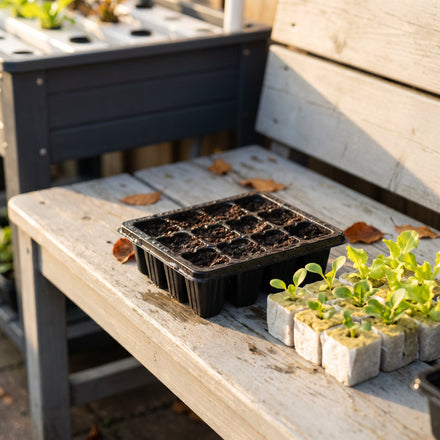
Most herbs are easy to start from seed. Basil germinates quickly in a grow medium kept warm, whereas chives take longer. So as not to disturb the system, seeds are often started separately, in biodegradable pots or germination plugs.

Once the first true leaves have formed and a small network of fine roots is visible, the seedlings move to the grow bed. At that point, gently rinse all soil from the roots, because an organic medium has no place in an aquaponic circuit. Our guide to sowing seeds successfully covers each step in detail.

Harvesting fresh aromatic herbs in the vegetable garden

Harvesting to encourage regrowth

Harvesting herbs is not just picking, it is also a pruning technique. By regularly pinching out the tops of basil stems, just above a pair of leaves, you trigger branching and get a bushy plant rather than a single stem that runs to flower. Mint and chives tolerate a hard cut and come back stronger, and chives can be cut back to a few centimetres from the base. Harvesting often, even in small amounts, is better than one big occasional cut that exhausts the plant.

Preventing bolting

The main enemy of flavour in leafy herbs is flowering. When basil bolts, it concentrates its energy on seeds and its leaves become smaller, more bitter and less fragrant. Regular pinching out of the tips delays this shift and extends the useful harvest period.

Excessive heat and water stress speed up bolting. In aquaponics, the steady conditions of the water already limit this stress, but scorching exposure in midsummer can precipitate the problem. Light shading during the hottest hours helps keep the foliage tender for longer.

With chives, on the other hand, the flowers are edible and decorative. There is no need to remove them, but cutting them redirects energy towards new stems. It is up to you to weigh appearance against yield, depending on how you use the plant.

Diseases and pests of herbs to watch out for

Even though they are hardy, herbs have their weak points. Basil is susceptible to downy mildew, caused by a micro-organism closely related to fungi, which shows up as yellowing foliage and a dark, grey to blackish fuzz on the undersides of the leaves. According to the Swiss Research Institute of Organic Agriculture (FiBL), the disease spreads mainly in late summer and autumn, when the air stays very humid at night and the foliage remains wet for several hours. Good air circulation, well-spaced plants and healthy seed are the best prevention, and resistant varieties exist, though they do not offer total protection. Fusarium wilt, another basil disease, is best prevented by tolerant varieties and rigorous hygiene of tools.

As for pests, aphids and whiteflies can make an appearance, especially indoors or in a greenhouse. In aquaponics, chemical treatments must be avoided because they end up in the tank and endanger the fish. We therefore favour biological control, using beneficial insects that regulate populations naturally, together with regular inspection of the undersides of the leaves so that you can step in early.


Fresh aromatic herbs ready for the kitchen

From harvest to plate

The whole appeal of home-grown herbs lies in their freshness. Picked just minutes before they reach the kitchen, they keep aromas that shop-bought herbs rarely match. Basil on a tomato salad, mint in a summer drink, chives snipped over an omelette: the uses are endless.

To prolong the pleasure, surplus herbs keep easily. Basil can be turned into pesto or frozen in a little oil, while mint and chives can be dried or frozen chopped. Growing your own herbs is also a practical step towards everyday food self-sufficiency.

Beyond the trio, other herbs to try

Basil, mint and chives make an excellent starting point, but the herb family is a large one. Parsley and coriander also thrive in aquaponics, preferring slightly cooler conditions that limit bolting. Dill and celery stalks can also be grown there successfully.

Woody herbs such as thyme, rosemary or sage are more delicate, as they dislike constantly wet roots. It is best to keep them for the best-drained areas of the system, or to grow them separately. Experimenting remains the best way to discover what does well in your setup.

Growing a variety of herbs enriches your cooking as much as the biodiversity of the bed. To widen the range, our selection of must-have plants offers plenty of ideas to explore.

Vertical aquaponic towers planted with salad leaves and herbs, lined up in a glazed greenhouse

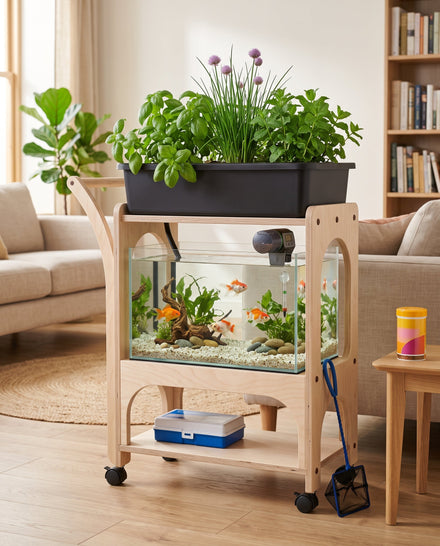
Positioning your herbs well in towers or in a trough

Placement matters as much as the crop itself. Basil, which is hungry for light, takes the sunniest spots, while mint, which tolerates light shade, can make do with the edges of the tank. Compact crops also suit vertical supports very well, which multiply the productive surface on a small footprint. In a greenhouse, an aquaponic kit with vertical towers lets you fill every tier with herbs at hand height, which simplifies the daily harvest and creates a true wall of edible greenery.

Conclusion: herbs, an ideal way into aquaponics

Basil, mint and chives offer everything you could want from a first aquaponic crop. Easy, quick and generous, they reward the beginner within the first few weeks, provided a few simple principles are respected: stable water at a pH of around 6 to 7, a temperature suited to each species, a well-oxygenated grow medium, mint kept apart from the others, and regular cuttings that stimulate regrowth.

By progressing species by species, you will soon widen your palette of fresh herbs.

Sources

FAO, Small-scale aquaponic food production, Fisheries and Aquaculture Technical Paper 589 (2014), A compromise pH between 6 and 7, water at 18 to 30 °C for most vegetables, and oxygen essential for the roots.

Purdue University, Water (MDPI), Characterizing Nutrient Composition and Concentration in Tomato-, Basil-, and Lettuce-Based Aquaponic and Hydroponic Systems, Lower potassium, calcium and magnesium than in hydroponics, and a lower basil yield in aquaponics.

Zurich University of Applied Sciences, Agronomy (MDPI), Nutrient Management in Aquaponics: Comparison of Three Approaches for Cultivating Lettuce, Mint and Mushroom Herb, Mint in aquaponics, more sensitive to shortages of trace elements and iron than to shortages of major elements.

FiBL, Schwitter and Hauenstein, Agri Hebdo n° 18 (2023), basil downy mildew, Basil downy mildew in Europe, favourable humid conditions, prevention and the limits of resistant varieties.

University of Illinois Extension, Herb Gardening, Mint, Mint spreads aggressively by its rhizomes, so pot cultivation is advised; tolerates light shade.

Utah State University Extension, Chives in the Garden, First chive harvest about 30 days after transplanting and 60 days after sowing, with division every 2 to 3 years.

University of Maryland Extension, Chives, Edible chive flowers, cut at around 15 cm in height, full sun recommended.

New Mexico State University, Water Qualities in Aquaponics, Chelated iron supplement of 2 mg/L roughly every three weeks, or as needed.

Frequently asked questions

Yes, provided you accept different rhythms. Parsley and coriander cope better with cool conditions and bolt as soon as the heat sets in, whereas basil only performs at its best in warm surroundings. Place them rather at the edge or in a slightly shaded area of the grow bed.

This yellowing that leaves the veins green points first of all to iron lock-out, rather than a lack of nitrogen. In an aquaponic system, iron is one of the most frequently limiting elements, because it becomes poorly available as soon as the pH rises.

The first step is therefore to measure the pH before adding anything. Around 7, the upper end of the compromise range between fish, bacteria and plants, mineral iron becomes hard to absorb. University technical sheets recommend a supplement of chelated iron at around 2 mg/L, repeated roughly every three weeks or as needed.

If the pH is correct and the symptom persists, a supplement of chelated iron suited to your pH range generally corrects the problem within a few weeks, with new leaves regaining a healthy colour while the older ones stay marked.

It depends on what you want from the plant.

  • On basil, pinch out the flower buds without hesitation, because bolting toughens the foliage and weakens its aroma.
  • On mint, a clean cut just above the flowering zone encourages tender young shoots.
  • On chives, the flowers are edible and decorative, so you can keep a few flower stalks and cut the others.

For everyday kitchen use, three to four basil plants, a pot of mint and a clump of chives are generally enough for two people. Because mint and chives keep regrowing after cutting, there is no point in growing more of them, whereas basil tires more quickly with repeated cuttings and benefits from being renewed by staggered sowings.

Bear in mind, too, that herbs are low-demand crops in terms of nutrients compared with fruiting vegetables. They slot easily into free spaces in a grow bed without taking up a significant share of the system's load.

Foliage pests, aphids and red spider mites above all, pose no danger to the fish. The real risk comes from the products one might be tempted to use against them, because an insecticide that reaches the water endangers life in the pond as well as the biofilter.

The answer therefore lies in gentle methods: a jet of water, releases of beneficial insects, or simply removing the affected parts by hand. Releases of beneficial insects carried out early, as a preventive measure, generally give better results than an intervention launched once the population is established.

It is possible, but rarely ideal. These pots actually contain many crowded young plants, produced for quick use rather than for lasting, and their compost must be rinsed off completely before they go into a system, so that no organic matter or synthetic fertiliser gets into the water.

If you do try it, gently separate the young plants into small clumps of three or four, rinse the roots in lukewarm water, then settle them in a net pot filled with inert grow medium. Expect a marked recovery phase, with leaves that wilt for a few days.

For a crop meant to last, a home-grown seedling or a cutting remains far more reliable, and you start with a plant whose variety and history you know.

Read next

Aquaponics with children

Aquaponics with children

Setting up a small aquaponic system at home gives children a complete ecosystem to observe every day, with fish, bacteria and plants all at work. This guide brings together ages, species, fast-growing crops and

Read the article
Solar aquaponics, a self-sufficient system

Solar aquaponics, a self-sufficient system

The sun can do far more than power a pump: it oxygenates the tank, circulates the water, cooks the fish and dries the herbs from the harvest. Here is how to make a small

Read the article
What to sow in autumn in aquaponics

What to sow in autumn in aquaponics

Autumn is not the end of the growing season, it is the start of the most peaceful one. Here is what to sow, when to do it and how to achieve leaf harvests through

Read the article
Growing tomatoes in aquaponics

Growing tomatoes in aquaponics

Hungry for nutrients and a lover of warmth, the tomato finds aquaponics an ideal growing environment. This comprehensive guide takes you from choosing a variety through to harvest, covering pH, hand pollination, and pruning,

Read the article
Growing peppers in aquaponics

Growing peppers in aquaponics

The pepper appeals to aquaponic growers for its long harvest and its nutritional richness, provided you give it suitable warmth and nutrition. This complete guide details every step, from seedling to harvest, to help

Read the article

Discover our aquaponics greenhouses and kits:

View all
Produits du rayon Kits d'aquaponie chez Univers Aquaponie

Aquaponics kits

Aquaponics kits ready to install in the garden, on a patio or in a greenhouse, with fish tank, grow beds and pump.

Discover
Produits du rayon Univers Plantes chez Univers Aquaponie

Plants

Seeds, grow media, fertilisers and aquatic plants for successful growing in aquaponics, hydroponics and the vegetable garden.

Discover
Produits du rayon Univers Équipements chez Univers Aquaponie

Equipment Universe

The equipment that keeps a system running: soilless growing, water circulation and aeration, filtration, temperature, plumbing and lighting.

Discover
Produits du rayon Serres d'aquaponie chez Univers Aquaponie

Aquaponics greenhouses

Greenhouses designed for aquaponics, supplied with their fish tank and grow towers.

Discover
Produits du rayon Univers Poissons chez Univers Aquaponie

Fish

Feed, monitor the water and care for your pond, aquarium or aquaponic fish.

Discover
Produits du rayon Univers Formation chez Univers Aquaponie

Learning

Books and practical courses on aquaponics, hydroponics and food self-sufficiency.

Discover