Maintaining your hydroponic tower

Written by Tristan Ulrich · September 19, 2026
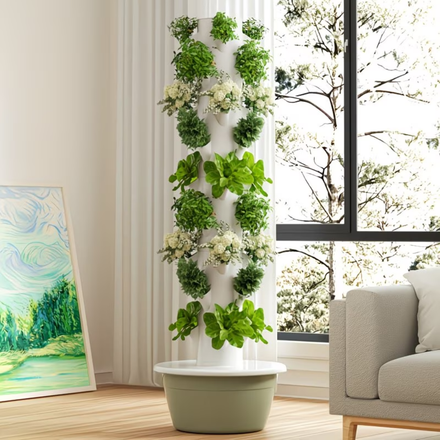
Tour de culture hydroponique garnie d’aromates et de salades en pleine production hors sol

The output of a hydroponic tower almost never drops off suddenly — it drifts slowly, through small deviations that nothing flags at first glance, and which can end up costing an entire crop. This guide sets out the weekly routine that prevents these drifts, then covers the correction protocols that come up most often for home growers.

The routine that keeps a tower going

A hydroponic tower rarely deteriorates in any dramatic way. The reservoir water level drops, salts concentrate, pH drifts, green algae appear at the bottom of the tank, the pump strainer furs up. Six weeks later, leaves are yellowing for no obvious reason and the column is producing half what it did at start-up. None of these issues is serious in isolation — it's their accumulation that brings yields down.

The good news is that maintaining a domestic column takes around fifteen minutes a week, plus a more thorough check every fortnight. This article sets out that routine step by step, then gives corrective protocols for the most common situations — from a pH that's hard to stabilise and brown roots, to a weakening pump flow rate and two weeks away from home.

Electronic pH and conductivity probe immersed in a container of water beside a growing tower Amtra electronic pH meter

The Monday five minutes

A well-executed weekly check takes five minutes and prevents virtually all of the situations described below. It comes down to four steps, always in the same order and preferably at the same time of day, since Oklahoma State University notes that pH and conductivity must be recorded at a fixed time to remain comparable from one week to the next.

Start with the water level in the reservoir, before adding any top-up water. Note how much it has dropped — this is the best indicator of what the system is actually consuming. Then immerse the pH meter in the water in the tank, never in the run-off water, and record the pH and then the conductivity. Finally, lift two or three baskets — one from the top, one from the middle, one from the bottom — and inspect the roots. White or cream, firm and odourless, they are a sign of a healthy system.

This last step is the most informative and the least practised. Roots respond several days before the leaves do. By the time the foliage is yellowing, the root disorder is already a week ahead of you.

Limescale deposits on a pump, a sign of salt build-up in the reservoir

Top-up water and what it concentrates

Every litre that evaporates leaves its salts behind. If you top up the reservoir with plain water, you dilute; if you top up with nutrient solution, you concentrate. In either case the composition drifts, because plants don't take up elements in the same proportions as they appear in the tank. Oklahoma State University points to one specific culprit: sodium chloride, present in small quantities in most tap water, which plants don't consume and which accumulates with each top-up until it becomes toxic.

The practical rule follows from this. Between full changes, top-ups should be done with plain water, since evaporation involves water only. Nutrient salts should only be added when an EC reading justifies it — never out of habit, and never as part of the same action as a top-up. No correction will remove sodium that has already built up; only a complete solution change resets the system to zero.

The maintenance schedule, from daily tasks to seasonal ones

Effective maintenance is not intensive maintenance — it's regular maintenance. Here is the rhythm that works for a domestic tower of twenty to sixty plants, as drawn from university recommendations and common practice.

  • Every day, a ten-second check: is the pump running and is water reaching the top?
  • Every week, water level, pH, conductivity, root inspection and removal of damaged leaves.
  • Every two weeks, a complete solution change, as recommended by Oklahoma State University.
  • Every month, disassemble and descale the pump, rinse the discharge pipe.
  • Between crops, thorough cleaning and disinfection of the tower and the net pots.

This schedule has one clear advantage: it makes anomalies easy to identify. When a symptom appears, you know exactly what has changed since the last intervention, which reduces the diagnosis to two or three hypotheses rather than ten. A tower that has been maintained regularly can be brought back on track in an evening; one left unchecked for two months requires a complete restart and costs you an entire crop.

Renewing the nutrient solution in a hydroponic system, a container poured into a clean reservoir

Renewing the solution quickly and properly

The twice-monthly renewal puts a lot of growers off, usually because they go about it the wrong way. Done properly, it takes around twenty minutes without dismantling the column or removing the plants. Switch off the feed, let the tower drain for five minutes, take out the pump and use it to push the old solution into a watering can — it makes an excellent fertiliser for your potted plants. Rinse the reservoir with clean water, wipe the bottom with a cloth, then fill it up and make up the fresh solution before reconnecting. Never pour a fresh solution into an unrinsed reservoir; the residue at the bottom concentrates the bulk of the accumulated salts.

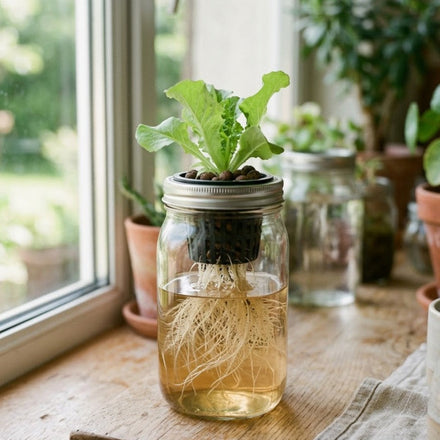
White roots of a young lettuce dipping into an amber nutrient solution pH correction duo: pH- and pH+

A drifting pH: what to do

The pH in a tower never stays still. Plants acidify or alkalise the solution depending on which forms of nitrogen they take up, evaporation concentrates carbonates, and the small volume of a domestic reservoir amplifies everything. Some drift is therefore perfectly normal — only its extent is worth worrying about.

The targets published by Oklahoma State University give 6.0 to 7.0 for lettuce and spinach, 5.5 to 6.0 for basil, and 5.0 to 5.5 for cucumber. On a mixed-foliage column, aim for 6.0 to 6.5 — this is the compromise that keeps iron, manganese and phosphorus available at the same time.

Correct slowly, never more than half a unit per day. There are pH correctors formulated for soilless growing — a buffered pH-down that brings hard tap water into range and a pH-up that raises a solution that has dropped too far — both dosed to hold the useful range without sudden swings. Add drop by drop whilst stirring, never all at once, and wait a full day before assessing the result. Finally, calibrate your pH meter every two months with a calibration kit, otherwise you are correcting blind.

Pale lettuce on clay pebbles, a symptom of an overly dilute solution and low conductivity

The EC, compass of the solution

Conductivity measures the total quantity of dissolved salts. It does not identify which salts are present, but it tells you whether the solution is too weak or too concentrated — and that is already the essential information. Reference values from Oklahoma State University give 1.2 to 1.8 mS/cm for lettuce, 1.0 to 1.6 for basil, 1.8 to 2.2 for strawberry, and 2.0 to 4.0 for tomato. The University of Florida narrows the range for lettuce to 1.4 to 1.8.

A conductivity that rises without you having added anything indicates strong evaporation and a concentration of salts — the answer is plain water, and certainly not more fertiliser. A conductivity that drops quickly, on the other hand, signals plants in full growth, and the solution needs topping up. The symptom of an EC that is too low is a plant that is pale, limp, and slow-growing. The symptom of an EC that is too high is more deceptive: deep green leaves, scorched edges, and a plant showing signs of thirst even though it is sitting in water. When in doubt, a complete water change resolves the question within twenty minutes.

Healthy white roots cascading in a well-oxygenated growing column

Water temperature and oxygen

This is the most decisive parameter and the least monitored. The University of Florida places the ideal nutrient solution temperature between 18 and 27 °C, while Cornell narrows the optimal root-zone range to between 20 and 24 °C. Beyond that, oxygen solubility drops at precisely the moment roots need it most.

The thresholds are well established. Cornell considers that a dissolved oxygen level below 6 mg/L significantly increases the risk of root infection, with the comfortable range sitting between 8 and 9 mg/L, while the University of Florida uses 5 mg/L as the minimum floor for lettuce. The link between these values and a reservoir sitting at 28 °C in full July sun is direct.

Three measures are usually sufficient. Insulate or shade the reservoir, since that is what heats up rather than the water column. Add an air stone during hot spells. And shift the pump's operating window towards the night, when the water trickling through cools on contact with the air.

Growing channel blocked by a dense root mass causing waterlogging

Brown roots and a blocked column

Brown, soft roots that fall apart between your fingers leaving only a central strand are the hallmark of root rot. Cornell describes this symptom precisely under the name "rat's tail": the outer layer detaches and only the inner cylinder remains. The culprits are neither bacteria nor true fungi but oomycetes — aquatic micro-organisms of the genus Pythium that travel through the water in the circuit. Two species predominate in hydroponics: Pythium aphanidermatum, which thrives in warm conditions, and Pythium dissotocum, which is more active in the cold.

The correction is mechanical before it is chemical. Remove affected plants without hesitation — they cannot be saved and they contaminate the circuit — then replace the solution, clean the reservoir, bring the water temperature back down, and increase oxygenation. Do not confuse this presentation with simple waterlogging: an overly dense root mass can trap water in one zone and mimic the same symptoms. In that case, the response is to harvest earlier and trim the longest roots at the time of solution change.

Comparison between a transparent container with algae-greened water and an opaque container that remained clean

Algae in the reservoir, biofilm in the pipe

Algae don't attack plants — they compete with them, and more importantly they consume oxygen at night in an already limited volume of water. Their appearance always follows the same rule: light plus nutrient-rich water equals algae, and the fix is therefore physical. An opaque reservoir, a properly fitting lid, unused holes blocked with an empty basket, and they disappear within a few days without any product whatsoever. Biofilm, on the other hand, can't simply be rinsed away — it needs scrubbing, and a bottle brush run through the return pipe once a month is enough to keep the flow rate consistent.

A pump clogged with plant debris removed from the system for maintenance

The pump, ten minutes a month

The pump is the only moving part in the tower, and therefore the only component that truly wears out. Monthly maintenance takes ten minutes. Unplug it, remove it, open the strainer, and clear away the root fragments and grow medium particles that accumulate inside. Dismantle the impeller, rinse it, remove limescale with diluted citric acid if necessary, then reassemble.

The warning sign is a flow rate that weakens. If water no longer reaches the top of the column with any force, the upper levels dry out first and symptoms appear from the top down — the opposite of the classic deficiency pattern. Before suspecting nutrition, always check the flow rate first.

Finally, keep a spare pump in reserve, with the same flow rate and the same head height as the original. It stores in a drawer and turns a pump failure during your holiday into a five-minute fix. On a drip-feed tower, a pump that stops for thirty-six hours in summer is enough to lose an entire crop of lettuce.
Quick diagnosis: seven symptoms and their causes

When something goes wrong, the temptation is to change everything at once, which makes it impossible to identify what actually worked. Here are the most common associations, to be checked in this order.

  • Yellow young leaves with green veins: iron unavailability, almost always caused by a pH that is too high.
  • Yellow lower leaves: nitrogen or magnesium deficiency — mobile elements that the plant relocates upwards.
  • Scorched leaf edges: conductivity too high or reservoir temperature too warm.
  • Pale, limp plants: solution too weak or insufficient light.
  • Upper growth showing stress: inadequate pump flow rate before any other hypothesis.
  • Muddy smell from the reservoir: stagnant zone, biofilm or the onset of root rot.
  • Growth stopping abruptly: water temperature outside the correct range — check this before adjusting fertiliser.

One rule accompanies this list: change only one parameter at a time and allow three days. Plants respond slowly, and corrections stacked on top of one another produce an unreadable picture in which nobody can tell what is having an effect. This is the most costly mistake in domestic hydroponics, far more so than any choice of fertiliser.

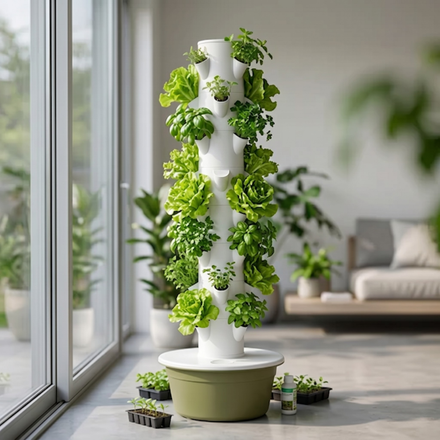
Indoor hydroponic tower in production with green lettuces across all six tiers under LED lighting

The lower plants that are lagging behind

On a growing tower, a top-to-bottom gradient appears in nearly every grower's account, and it almost always has the same cause. The lower plants receive less light than those at the top because the light source is too high, singular, or too far away. The foliage at the summit acts as a screen, and the gap becomes established.

Three corrections exist, in order of effectiveness. Distribute the lighting across the full height of the tower — as indoor towers with lateral LED bars do — rather than relying on a single overhead source. Rotate the tower a quarter turn every three or four days if it is lit by a window. And physically swap the pots by moving slower-growing plants up to mid-height during the growing cycle. A secondary cause is worth ruling out before drawing conclusions: on certain towers, the bottom of the column actually receives all the runoff, and roots that are constantly waterlogged grow poorly. If the lighting is correct and the symptom persists, check the flow distribution.

Lettuce leaf showing interveinal chlorosis, a sign of iron deficiency Chelated iron (iron chelate) EDDHA 6%

Identifying a deficiency in the column

In tower growing, deficiencies are identified first by their location. A mobile element such as nitrogen, magnesium, or potassium moves from older leaves towards younger ones, so symptoms appear lower down. An immobile element such as iron, calcium, or manganese stays where it was deposited, and symptoms appear higher up, on the newest growth.

Iron deficiency is by far the most common, and it is rarely a true deficiency. Most of the time, iron is present but locked up by a pH that is too high — so correct the pH first, and if the symptom persists after a week, apply a chelated iron, choosing the EDDHA form, which remains stable above pH 7. Magnesium is corrected with a little Epsom salt, potassium with a dedicated supplement, and our guide to deficiencies in soilless growing covers each symptom in detail.

Hand-rinsing a filter element in a bowl of clean water

Cleaning between crops

Between two cycles, the column is cleaned thoroughly. Virginia Tech explicitly recommends this for soilless edible crops: a full clean and disinfection between each rotation, using a product approved for food contact at the doses stated on its label. Remove dry residues first, scrub with warm soapy water — a disinfectant applied to a dirty surface does not work — rinse, disinfect, then leave to air-dry. Slotted growing cups trap debris in their slots, and at a few tens of pence each it is often more practical to replace them than to scrub them one by one.

Colony of greenfly settled on the stem of a young lettuce plant

Fungus gnats, aphids and thrips

An indoor growing tower is not immune to pests — it simply attracts different ones. Aphids arrive on a plant bought at a garden centre and colonise young shoots within a week. Thrips leave silvery patches and tiny black specks on the underside of leaves. Fungus gnats, meanwhile, come from a grow medium that is too moist and from light reaching the nutrient solution.

Prevention is worth any number of treatments. Quarantine every new plant for a week before introducing it, plug any unoccupied holes, keep the reservoir covered, and never leave dead leaves floating in the tank. In the event of an established infestation, biological control works remarkably well in an enclosed environment where beneficial insects do not disperse — and our article on beneficial insects in soilless growing details the species to introduce depending on the pest identified.

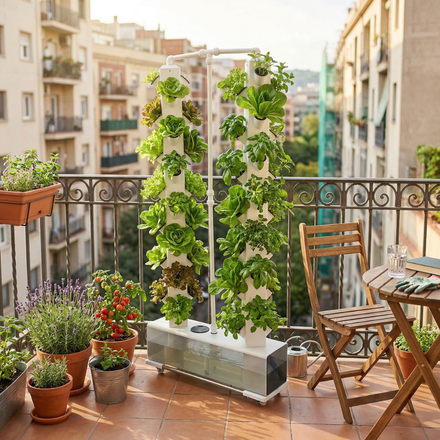
Vertical growing tower filled with flowering strawberry plants and lettuces on a sunny terrace Daily timer

Going on holiday without taking risks

Two weeks away is perfectly manageable, provided you prepare the tower rather than leaving it running and hoping for the best. The question is not the volume of water — it is the stability of the solution. One week before you leave, renew it so you start from a clean baseline, fill the reservoir to its maximum since the evaporation margin is your only buffer, shade the tank, and harvest everything that is ripe.

Then secure the electrics. A daily timer that reduces pump operation to fifteen minutes per hour cuts evaporation, limits wear, and gives the system a comfortable level of inertia. Beyond three weeks, no amount of preparation replaces a human visit — arrange for a neighbour with two written instructions: top up the water level with fresh water and check that the pump is running.

Growing tower installed in the garden, exposed to late-season weather

Winter: slow down, drain or bring indoors

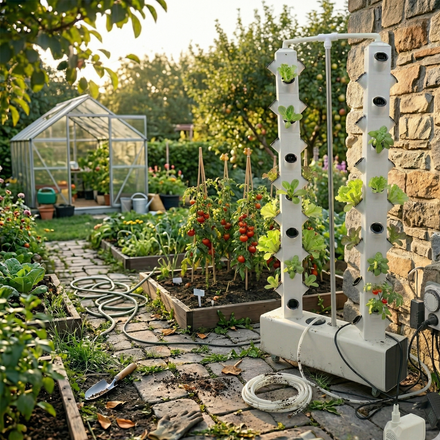
An outdoor tower should never be left to chance when the first frosts arrive. Water that freezes expands in the pipes, splits the fittings and destroys the pump rotor, so the rule is to drain completely before the first forecast frost, then remove the pump, rinse it and store it somewhere dry. If the column is staying outside, empty the stages too by tipping it — a forgotten pocket of water inside a module is enough to crack it. Brought into a bright garage or a frost-free conservatory with a grow light, it will yield lamb's lettuce, rocket and seedlings throughout the winter.

The logbook: the tool that makes all the difference

No piece of equipment does more to improve results than a simple notebook kept beside the tower. Three lines a week is enough: the date, the pH, the conductivity, the water level recorded before topping up, and a free note on the condition of the plants. After two months, that notebook is worth more than any general advice, because it describes your own system, in your own home, with your own water and your own light. It makes visible phenomena that no one-off measurement can reveal — how quickly your pH climbs back up between corrections, water consumption by season, the exact moment a crop starts to decline.

It is also the best safeguard against over-correction — that spiral where you add a little acid, then a little fertiliser, then a little water, until you no longer have any idea what state the solution is in. A logbook imposes the discipline of making one change at a time, and in practice that discipline accounts for half the skill involved.

Conclusion: consistency beats every corrective measure

Almost every failure discussed on forums comes down to four causes: water that is too warm, pH left to drift, a pump that has never been cleaned, and a solution change put off week after week. None of them requires any particular skill — only consistency — and that is precisely why they are so common. Keep to the routine: five minutes of checks every week, a water change every fortnight, ten minutes on the pump every month, and a full clean-down between crops.

And keep the habit of checking the roots. They speak before the leaves do — they tell you about temperature, oxygen and the cleanliness of the system — and lifting three baskets is all it takes to listen to them.

Sources

Oklahoma State University Extension, HLA-6722, Electrical Conductivity and pH Guide for Hydroponics, pH and conductivity ranges by crop, fixed-time monitoring, sodium chloride accumulation, and fortnightly solution replacement

University of Florida IFAS Extension, HS1422, Growing Lettuce in Small Hydroponic Systems, Nutrient solution temperature, minimum dissolved oxygen threshold, and conductivity benchmarks for lettuce

Cornell University, Neil Mattson, Pythium root rot on hydroponically grown basil and spinach, Pythium species, ideal root-zone temperature, dissolved oxygen thresholds, and a description of the rat-tail symptom

Virginia Cooperative Extension, SPES-467, Hydroponic Production of Edible Crops, Food Safety Considerations, Cleaning and disinfection between each rotation, use of food-contact-approved products, and exclusion of porous materials

Oklahoma State University Extension, HLA-6724, Building a Vertical Hydroponic Tower, Watering schedules by crop and general management of a vertical growing column

Frequently asked questions

On a drip-flow tower planted with leafy crops, yes, without issue. A six-to-eight-hour break allows the roots to breathe, reduces noise and energy consumption, and the grow medium retains enough moisture. On an aeroponic system where roots are bare, however, a full overnight shutdown is risky — opt instead for short, spaced cycles.

Yes. A muddy smell indicates an anaerobic zone — in other words, a lack of oxygen somewhere in the circuit. Drain, rinse, check the roots and the water temperature before mixing a fresh solution.

Reverse osmosis water is perfectly suitable, with one condition: it contains nothing — not even the calcium and magnesium that most nutrient solutions assume to be present in the source water. These must therefore be added, otherwise deficiencies appear quickly.

Bottled spring water also works, but its cost limits it to very small volumes. In practice, a moderately hard tap water, cut where necessary with filtered rainwater, remains the best compromise.

Each component has its own lifespan.

  • Rockwool cubes and coco pots: replace with every new crop.
  • Mesh baskets: every three to four cycles, or as soon as they crack.
  • Discharge pipe: once a year, or sooner if it becomes rigid.
  • Pump: every two to three years in continuous use, longer if it is timer-controlled.

Clay pebbles can be reused almost indefinitely after washing and disinfection, making them the most cost-effective grow medium over time.

It is very popular on forums, and it needs to be handled with care. It does oxidise organic matter and briefly raises dissolved oxygen levels, but it also destroys beneficial microflora and scorches young root tips when the dose is misjudged. Its effect lasts only a few hours, while the underlying cause remains entirely unaddressed.

University recommendations point in a different direction: act on solution temperature, oxygenation, and circuit cleanliness, then remove affected plants. If you want to use a treatment, look for a product approved for edible crops and follow its label instructions.

It depends entirely on the grow medium and the season. With baskets filled with clay pebbles or rockwool, a trickle column can go twelve to twenty-four hours without harm in temperate conditions, and less than half that in high heat. In aeroponics, where the roots are bare, damage begins within two to four hours.

The most useful precaution before an absence is to water the top baskets thoroughly — they are the first to dry out.

Read next

Choosing your hydroponic tower

Choosing your hydroponic tower

A hydroponic tower promises around thirty lettuces in less than half a square metre of floor space, and it delivers on that promise — provided the column suits your room, your light levels, and

Read the article
How does a hydroponic grow tower work ?

How does a hydroponic grow tower work ?

Vertical column hydroponics, which originated in NASA laboratories and was then popularized by EPCOT in 2005, allows growing up to 60 plants in 0.5 m² of ground space with 90% less water. Understanding the

Read the article
Getting started with indoor hydroponics

Getting started with indoor hydroponics

Growing your own salads, herbs and fruit without soil, indoors, all year round and with accelerated growth is no longer the preserve of well-equipped enthusiasts. Indoor hydroponics opens up this possibility to any household,

Read the article
What to grow in hydroponics, season by season

What to grow in hydroponics, season by season

Hydroponics is not entirely independent of the seasons. While soilless cultivation allows you to extend harvests and grow indoors all year round, light, temperature, and day length continue to influence the rhythm of your

Read the article
Kratky Method : Passive Hydroponics Without a Pump

Kratky Method : Passive Hydroponics Without a Pump

Pump-free, electricity-free, and intervention-free hydroponics, that's the astonishing promise of the Kratky method. A minimalist approach based on a simple physical principle that opens up soilless cultivation to all gardeners, from curious beginners to

Read the article
Growing without soil in hydroponics

Growing without soil in hydroponics

Hydroponics is not a trend but an agronomic revolution thousands of years old, using up to 90% less water and supporting faster plant growth. Understanding its principles, methods and limitations is becoming essential for

Read the article