Choosing your hydroponic tower

Written by Tristan Ulrich · September 19, 2026
Choisir sa tour hydroponique

A hydroponic tower promises around thirty lettuces in less than half a square metre of floor space, and it delivers on that promise — provided the column suits your room, your light levels, and the time you are willing to give it each week. This guide goes through each criterion that separates a tower that produces all year round from one that ends up in the garage after two harvests.

Which hydroponic tower should you choose for home use?

Vertical growing has long since left the laboratory. On a two-square-metre balcony or in a corner of the living room, a growing column produces salads, herbs and strawberries while the outdoor kitchen garden waits for spring. The principle is the same across all models: a pump draws the nutrient solution up to the top, the water trickles down by gravity past the roots, returns to the reservoir and starts again. On this identical foundation, manufacturers offer very different products, and that is precisely where buyers go wrong.

This guide does not repeat how a tower works; it helps you choose yours. We review the criteria that truly determine success: available light, reservoir volume, pump control, noise, how easy the unit is to move and the real cost of the first year. At the end, a five-question checklist lets you reach a decision in a few minutes.

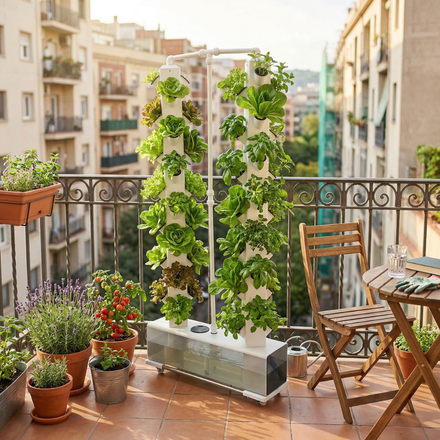
Two-arch hydroponic system rolled out on an urban balcony, in full production

Where will the tower be installed?

Before capacity, before price, a single question determines everything else. A tower installed indoors away from a window depends entirely on artificial lighting and will produce nothing edible without a dedicated grow light. A tower placed on a south-facing balcony receives light for free but is exposed to wind, temperature swings, and rapid evaporation. A tower in the garden enjoys full sun and becomes a serious production column from April to October, but then raises the question of frost.

These three situations do not call for the same equipment. Indoors, the grow light and an opaque reservoir are not optional extras. On a balcony, stability in the wind and ease of draining matter more than anything else. In the garden, you need a UV-stabilised plastic; without it, the column yellows and becomes brittle within two seasons.

Bear in mind the electrical constraint as well. A tower needs a nearby power socket, with weatherproof protection if it is outdoors. Many buyers discover this detail after delivery and end up with an extension lead running across the patio.

The April to October season mentioned here applies to a temperate climate. It extends from March to November around the Mediterranean and is often limited to May through September in Scandinavia. The question of frost applies everywhere: an outdoor tower must be drainable before the first freeze, whatever date that falls on in your area.

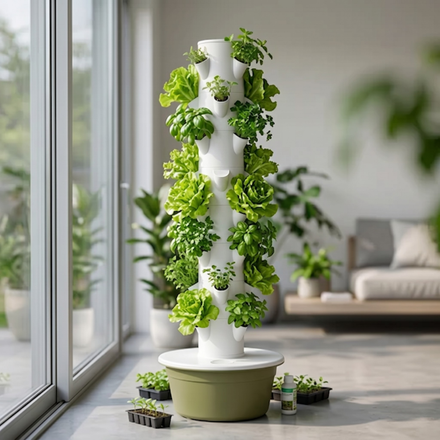
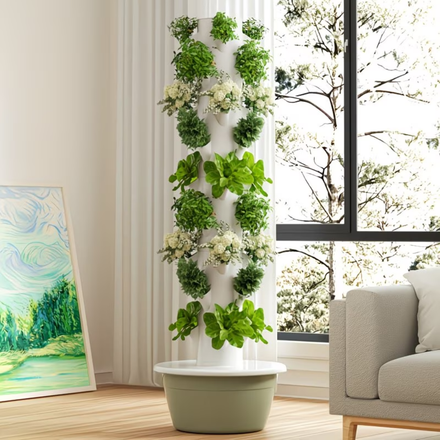
Active hydroponic tower growing lettuces and herbs in vertical soilless cultivation

Stated capacity vs actual yield

A tower sold for thirty plants offers thirty positions, not thirty full-grown lettuces at the same time. The difference comes down to spacing. Oklahoma State University recommendations for a vertical growing column specify 15 to 20 cm between two leaf lettuces, and around thirty centimetres for a butterhead lettuce, chard, spinach, or a cabbage. On a tower where the holes are spaced 15 cm apart, one butterhead lettuce therefore effectively occupies two positions.

The right way to read a specification sheet is to convert the number of holes into canopy area. Thirty positions are perfectly suited to herbs, lamb's lettuce, rocket, and seedlings. Those same thirty positions will comfortably accommodate around fifteen lettuces, with every other hole left empty.

The second factor is staggered sowing. Planting all thirty positions on the same day produces thirty harvests in the same week, then six weeks of an empty tower. Sowing in batches of five or six plants every ten days turns the same column into a continuous harvest. It is the one adjustment that genuinely changes perceived yield, and it costs nothing.

The four families of growing towers

Beneath a similar appearance, four hydraulic principles coexist, and they have neither the same requirements nor the same tolerance for error. Knowing which one applies to the model you are looking at is worth more than any marketing sheet.

  • Gravity drip, the most common among home growers. A pump sends the solution to the top, the water flows down from level to level and returns to the reservoir.
  • Low-pressure aeroponics, where water is sprayed as fine droplets inside the hollow column. Fast growth, highly oxygenated roots, but a pump failure takes its toll within a few hours.
  • Vertical NFT, a nutrient film circulating through stacked or angled tubes. Excellent for leafy crops, demanding in terms of slope and pipe cleanliness.
  • Wick columns, pump-free, where a capillary fabric draws water upward. Silent and virtually indestructible, but limited in height and vigour.

For a first purchase, gravity drip remains the best all-round choice. It forgives dosing errors, cleans without full disassembly, and works with an ordinary aquarium pump that can be replaced for a few pounds. Aeroponics delivers spectacular results with leafy crops and strawberries, provided you accept a total dependence on electricity. The Cornell team notes that dissolved oxygen levels below 6 mg/L already encourage root rot, whereas the comfortable target sits between 8 and 9 mg/L. The passive approach has its own niche, described in our guide to pump-free hydroponics.

Two-arch hydroponic system mounted on its wheeled reservoir, overall view on a white background

The reservoir, the organ we forget

This is the most overlooked criterion, and the one that causes the most people to give up. The reservoir determines how long the tower can run between interventions and, above all, the chemical stability of the solution. A small ten-litre tank supporting twenty plants in full growth can lose several litres a day in summer. Every litre that evaporates concentrates the remaining salts, conductivity rises, pH drifts, and leaf scorch appears before your next visit.

A generous volume acts as a buffer. Around thirty litres for thirty plants gives breathing room, absorbs a dosing error, and lets you go away for a weekend without worry. Also check three details that product sheets rarely mention: the presence of a water level indicator, access to lower a bucket or drainage pump, and the opacity of the tank.

On that last point, no compromise is acceptable. A translucent reservoir placed near a window will turn green within ten days. Algae do not kill plants directly, but they consume oxygen overnight, clog the pump, and lock up some of the nutrients.

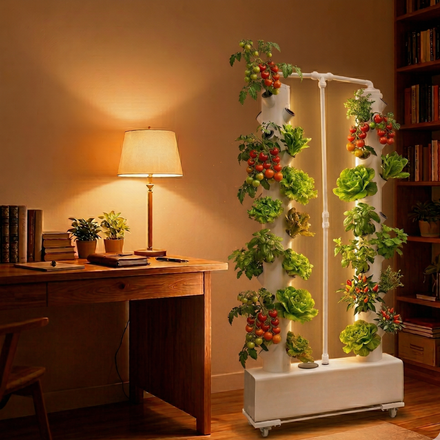
Hydroponic tower with integrated horticultural LED lighting for indoor growing without direct natural light

Integrated LED bar or natural daylight

In a living space, natural light is rarely sufficient. A study published in Scientific Reports on iceberg lettuce grown in an indoor vertical tower places the optimum at around 11.5 mol per square metre per day, achieved with 200 µmol per square metre per second over sixteen hours. Counter-intuitively, increasing this to 14.4 mol brings no improvement and reduces fresh weight by approximately ten per cent. More light is not better — the right dose over the right duration is what matters.

In practical terms, an indoor tower should come with its light bars distributed across the full height of the column, not concentrated at the top. A single source at the top creates a steep gradient: the plants at the bottom become etiolated and stretch towards the light. This is precisely what our 30-plant indoor hydroponic tower addresses, with its LED bars mounted on the support frame to illuminate every level equally.

If your tower sits in front of a south-facing window, a light bar is still useful from November to February. You can supplement with an LED bar mounted on an adjustable suspension system.

Mechanical timer plugged into a weatherproof socket to control the pump in a growing system Daily timer

The pump and how to control it

The pump in a domestic tower is a small submersible unit of five to fifteen watts. What matters is not its wattage but how you control it. The Oklahoma State University fact sheet on vertical towers puts it plainly: irrigation can run continuously around the clock for lettuce, whereas strawberries are best managed on seven to ten one-hour cycles per day.

In other words, a timer is not a luxury. It cuts energy consumption, reduces pump wear, limits noise at night and lets the roots breathe between cycles. On a trickle column, fifteen minutes per hour is almost always enough for leafy crops, switching back to continuous flow during heatwaves.

The equipment itself is nothing exotic. A domestic tower runs on an ordinary aquarium or pond pump, available everywhere and replaceable for just a few pounds. The one accessory you really need is a daily timer, rarely included with the column, yet it is the timer that determines the watering schedule, the noise level and the pump's lifespan.

Water pump, air pump, and heater: the three electrical consumption items in an off-ground installation

Power consumption of a hydroponic tower

The calculation is straightforward and rather reassuring. A 42-watt LED bar running for fourteen hours a day uses around 210 kWh over a full year. A ten-watt pump running continuously adds approximately 88 kWh, but only around twenty if it is set to run for fifteen minutes in every hour. Multiply that total by your electricity tariff and you get an annual bill that, for an indoor tower, is in the same ballpark as a small refrigerator.

Water tells a different story. Recirculating hydroponic systems routinely exceed ninety percent water-use efficiency, according to Oklahoma State University, because nothing drains away and only evaporation and transpiration remove water from the system. A tower therefore uses less water than a kitchen garden bed of equivalent output, despite the contrary impression given by the sound of trickling water.

Then there are the consumables, which nobody prices up at the point of purchase: nutrient salts, propagation cubes, pH adjusters, a replacement pump every two or three years. It is this line item, not the electricity, that genuinely weighs on running costs.

Dimensioned diagram of the two-arch hydroponic system, height 165 cm, width 80 cm, depth 20 cm 2-tower hydroponic growing system on wheels

Footprint, weight and portability

A growing tower is measured in three dimensions but transported in kilograms. A dimensioned diagram is your best ally before purchasing. A tower one metre sixty-five tall will not fit under a mezzanine, and an eighty-centimetre-wide base will not slide into a kitchen corner.

The real trap remains the water weight. A thirty-litre reservoir weighs thirty kilograms once filled, to which you must add the structure, the grow medium, and the plants. A full tower cannot be moved — it must be emptied first. If you plan to bring it outside in spring and back in during autumn, or simply to push it aside to clean the floor, castors make all the difference.

On models mounted on a wheeled reservoir — such as our fifty-six-plant hydroponic system on castors — the manoeuvre remains manageable for one person, provided the tank is partially emptied first. Check that the castors are locked; otherwise the tower will drift at the slightest gust of wind on a terrace.

Small submersible pump resting on anti-vibration foam next to a flexible pipe

Noise, a greatly underrated criterion

Nobody thinks about noise before installing a tower in a living room or spare bedroom. It comes from three sources: vibration from the pump transmitted to the tank, the sound of water trickling back into the reservoir, and the fan on certain grow light bars.

Vibration can be addressed by sitting the pump on a small foam mat — never directly on the rigid base. The trickling noise can be fixed by extending the return pipe so that it dips below the water surface rather than cascading into it. Both fixes cost a few pounds and turn an audible tower into a quiet one.

There remains the matter of timer control. A pump programmed to switch off at night settles the issue entirely in a bedroom, and an eight-hour break in circulation does not affect any leafy crop grown on a drip system. With aeroponics, however, a full overnight shutdown is inadvisable — exposed roots dry out quickly.

Technical details of a hydroponic growing tower, stackable pots and internal irrigation system

Materials, opacity and durability

One detail lets you sort towers in thirty seconds: the quality of the plastic. A food-grade polypropylene or ABS, opaque and thick-walled, will last for years. Thin, translucent plastic warps under the weight of water-logged plants, lets light through to the solution, and cracks at the fixing points.

For outdoor use, insist on UV protection. Without it, a bright white finish turns chalky grey within two summers and the column becomes brittle. Reputable manufacturers state this clearly; others say nothing, which is already an answer in itself.

Finally, look at how the tiers fit together. Interlocking modules with seals can be dismantled for cleaning and replaced individually. A glued, one-piece column means throwing the whole thing away the day one tier breaks. On a tower meant to last ten years, that difference matters far more than a thirty-euro gap in the purchase price.

Filling a slotted growing pot with clay pebbles over a grow bed Hydroponic growing pot: 5 or 6.5 cm

Diameter of baskets and grow medium

Each slot in a growing tower takes a net pot, and the diameter determines what you can grow. Home towers most commonly use 5 to 6.5 cm pots, ideal for lettuce, herbs, lamb's lettuce, and microgreens. Field-scale towers described by Oklahoma State University go up to 7.6 cm, which accommodates larger plants such as chard or cabbage.

Check that the hydroponic net pots on your tower match a standard size. An unusual diameter ties you to buying replacements directly from the manufacturer every cycle, whereas common sizes can be found for a few pence each and replaced in bulk.

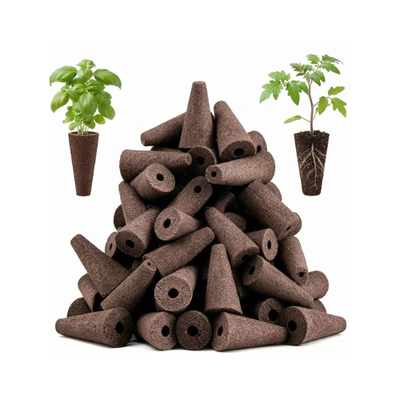
On the grow medium side, the column has its own constraints. The medium must stay in the pot without breaking apart into the system, otherwise particles end up in the pump. Rockwool cubes and pressed coco coir plugs work well, as do clay pebbles provided they are rinsed before first use. Our germination cubes go straight from the seedling tray into the net pot without disturbing the roots.

What to grow in a hydroponic tower?

A growing tower is primarily designed for leafy vegetables. Lettuces, lamb's lettuce, rocket, spinach, chard, kale, basil, parsley, chives, mint and coriander are particularly well suited to this type of growing, because their root systems remain compact and their short cycle — fifty to sixty days for a lettuce according to the University of Florida — allows for rapid rotations. Strawberries also thrive in towers, with the added benefit of keeping the fruit off the ground and out of reach of slugs.

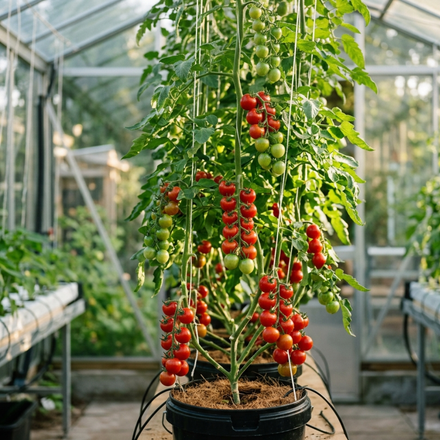
Summer fruiting crops are possible, but require careful thought. A tomato, pepper or cucumber grown in a column demands solid staking, generous spacing, manual pollination indoors and a more concentrated solution. Oklahoma State University places tomatoes at a conductivity of 2.0–4.0 mS/cm, compared with 1.2–1.8 for lettuce, which rules out growing both on the same reservoir without accepting a compromise that disadvantages one of the two crops.

Finally, some crops simply have no place in a tower. Root vegetables and tubers — carrots, potatoes, beetroot and turnips — have neither the space nor the support they need. Maize, squash and melon far exceed the dimensions available. These crops are not a failure of the method; they simply belong in a different container, and our article on what to grow hydroponically covers the corresponding planting calendar in detail.
Open water test kit with its coloured test tubes for analysing a nutrient solution Hydrogen Potential Test

Your tap water, the starting point

Two identical towers installed in two different towns will not be managed the same way, because the starting water is not the same. A very hard water supply arrives already loaded with calcium and magnesium, with a pH often above 7.5 and a strong buffering capacity that resists correction. Soft, lightly mineralised water, on the other hand, offers almost no resistance, and a slightly over-generous correction will drive the pH far lower than intended.

Before even choosing a tower, measure your water. The targets published by Oklahoma State University are around pH 6.0 to 7.0 for lettuce and spinach, 5.5 to 6.0 for basil, and 5.0 to 5.5 for cucumber. These values are easy to maintain with moderately hard water, much less so with very hard water.

If your water is hard, two approaches are available. Either cut the tap water with filtered rainwater, or accept that you will need to correct more frequently and renew the solution more often. In either case, a liquid pH test is far more reliable than test strips, whose readings are always open to debate.

Three-dimensional concept of a vertical growing column assembled from drilled tubes

Buy ready-made or build your own

Building your own tower is an accessible and instructive project. Oklahoma State University publishes a detailed plan based on a 12.7 cm square, 2.4 m long PVC fence post, brought down to a working height of 1.5 to 1.8 m, fed by a 400-gallon-per-hour pump from a 45-gallon reservoir, supporting twenty-eight plants per column.

The plan is excellent — provided you read what it actually entails. It is aimed at a semi-professional scale, with an oversized tank, a pump far too large for an indoor setting, and precise cutting work. Translated as-is into a living room, it produces a noisy and bulky installation.

For a home project, the most effective compromise is to start with pre-drilled industrial components and assemble them yourself. Our NFT hydroponic growing tubes with 108 positions allow you to build a custom growing column or wall, with drilling geometry already perfected. You retain full design freedom, without the risk of imprecise drilling that causes a tower to leak for two years.

Starter equipment for hydroponics: bucket, clay pebbles, net pots, air pump, pH tester and nutrient solution

The budget for the first year

An honest budget adds up four items. The tower itself, between one hundred and fifty and four hundred euros for a serious domestic model, lighting included or not — a growing tower for twenty to forty-four plants will tend towards the lower end of that range. Instrumentation — a pH meter and a hardness test kit — from thirty to one hundred euros depending on the level of precision required. Start-up consumables: seedling cubes, net pots, nutrient salts, and seeds — a few tens of euros. Finally, electricity, as calculated above.

That total puts a complete indoor tower in the same bracket as a decent exercise bike, with one notable difference: it produces something. Around thirty lettuces and herbs per cycle, over six to eight cycles a year indoors, represents a volume that holds its own quite comfortably against a weekly veg box.

The payback calculation only makes sense, however, if the tower is actually used. That is why the real budgetary criterion is not the purchase price, but ease of maintenance. A three-hundred-euro tower used for four years costs less in the long run than a one-hundred-and-eighty-euro tower abandoned after a single summer.

Hydroponic tower integrated into an aquaponic system to combine plants and fish in a closed loop

Adding a tower to an aquaponic system

A tower can be fed from a fish pond rather than a mineral solution. The principle works, subject to three conditions. The water must be properly filtered upstream; otherwise particles will block the nozzles and pipes. The compromise pH sits higher than in pure hydroponics, around 6.8 to 7.0, to protect the nitrifying bacteria. And the lower element concentration naturally favours leafy crops over fruiting ones.

The benefits are real. The tower becomes an additional filtration stage, consuming nitrates and reducing the load on the biological filter. With modular aquaponic kits, the addition is made using a tower extension designed for the flow rate of the existing system.

One frequently overlooked point deserves attention. A tower grafted onto a pond can no longer be adjusted freely, since anything added will ultimately reach the fish. The concentrated fertilisers used in conventional hydroponics are off limits here; only gentle, targeted corrections have a place.

Hydroponic system fitted with its pump, illustrating the build quality of a domestic installation

The most common buying mistakes

Four mistakes come up time and again. The first is choosing based on the number of holes. A high figure looks impressive but tells you nothing about the available light, the volume of water per plant, or the actual space offered to the foliage.

The second is buying an indoor tower without a grow light, thinking the window will compensate. Unless you have a south-facing conservatory, the result is a column of etiolated plants that never heart up, bolt without producing anything, and go to seed.

The third is overlooking spare parts. A non-standard pot diameter or a glued-together column turns the slightest breakage into an end-of-life situation. The pump, on the other hand, rarely causes problems — it is a standard aquarium or pond pump that can be replaced without difficulty for a few pounds.

The fourth, finally, is buying too large to begin with. A thirty-pot tower managed well already keeps a household in salads and herbs. Two sixty-pot towers left poorly tended produce nothing and put you off for good. Start small — a second column can always be added later.

Five questions to reach a decision quickly

These five questions, asked in order, rule out most poor choices within a few minutes. Answer them before comparing prices, never after.

  • Where will it be placed, and how many hours of genuine light does that spot receive in December?
  • How many litres does the reservoir hold per growing slot?
  • What will I grow during the first six months — leaves or fruiting crops?
  • Which parts can be replaced individually — pump, net pots, tiers, seals?
  • How many minutes per week am I genuinely prepared to devote to it?

The last question is the most decisive and the least often asked. A tower is not a passive object: it requires a weekly check of the water level, pH, and root condition, as well as a complete solution change every two weeks in line with Oklahoma State University guidelines. If that schedule feels demanding, look towards a model with a large reservoir and automated control, which extends the time between interventions without compromising results. Making an informed choice is far better than discovering the commitment halfway through your first summer.

Conclusion: the right tower is the one you will actually maintain

A hydroponic tower is not a magic product — it is a production tool whose performance depends on four parameters you control entirely: the light it receives, the volume of water available, how the pump is managed, and the regularity of your attention. Everything else — number of holes, design, yield promises — is largely marketing.

If you are growing indoors, favour a model with lighting distributed along the full height and a generous reservoir. If you are growing outdoors, look for UV-stabilised plastic, wind stability, and ease of draining before winter. In both cases, check what can be dismantled and what can be replaced, because that is what will determine the real service life of your tower.

Start with leafy crops and herbs, stagger your seedlings, and let the tower teach you its rhythm over a first full cycle. Fruit crops, larger volumes, and a second tower will follow naturally — with one added certainty: knowing exactly what you are doing.

Sources

Oklahoma State University Extension, HLA-6724, Building a Vertical Hydroponic Tower, Construction plan, 28 plants per column, spacings by crop, watering cycles, and water efficiency above 90%

Oklahoma State University Extension, HLA-6722, Electrical Conductivity and pH Guide for Hydroponics, Conductivity and pH ranges by crop, and full nutrient solution replacement every two weeks

University of Florida IFAS Extension, HS1422, Growing Lettuce in Small Hydroponic Systems, Lettuce crop cycle duration and management targets for small domestic systems

Scientific Reports, Determination of optimal daily light integral for indoor cultivation of iceberg lettuce in a vertical hydroponic system, Light optimum of 11.5 mol per square metre per day, and the yield loss beyond that threshold

Cornell University, Neil Mattson, Pythium root rot on hydroponically grown basil and spinach, Dissolved oxygen thresholds at root level and the risks associated with heavily aerated systems

Frequently asked questions

Yes, but not to the extent sometimes claimed. A column with thirty growing positions occupies around half a square metre of floor space and replaces, for lettuces and herbs, a vegetable bed of three to four square metres. The saving is therefore real, provided you account for the space needed to move around it and access the reservoir. Always allow twenty to thirty centimetres of clearance on each side.

Yes, this is actually the typical use case for models with integrated lighting. The only requirement is that the light bars cover the full height of the column and run for around fifteen hours a day. Also plan for minimal air circulation, as completely still air encourages foliar disease and impairs plant transpiration.

Allow around fifteen minutes per week once you are in a steady routine, broken down as follows.

  • Five minutes for the water level, pH, and a quick check of the roots.
  • Five minutes for harvesting and removing damaged leaves.
  • Five minutes to sow the next wave.

On top of this, allow a longer session every two weeks — around thirty minutes — to drain and make up a fresh solution.

The column, yes — the water, no. Frost causes water trapped in pipes and the reservoir to expand, splitting fittings and pumps. The rule is to drain everything completely before the first frosts, remove the pump and store it somewhere dry, then leave the structure in place if the plastic has UV-stabilised treatment. A tower brought into the garage will obviously fare better over winter than one left out in the snow.

Yes, and it is often an excellent idea with very hard mains water. Simply filter it before use to remove debris, and never collect water running off a treated roof or a corroded metal tank.

With the same number of plants and the same light, the difference in yield is small. What vertical growing changes is ground density, not the growth rate of each individual plant. A tower therefore produces more per square metre of floor space occupied, not more per plant.

Vertical growing does, however, introduce a constraint that horizontal beds do not have: the light gradient between the top and bottom of the column. If the lighting is lateral and well distributed, the difference remains small. If it comes from the ceiling, the lower tiers can easily lose twenty to thirty per cent of growth, and you will then need to rotate the baskets between levels during the growing cycle.

Read next

How does a hydroponic grow tower work ?

How does a hydroponic grow tower work ?

Vertical column hydroponics, which originated in NASA laboratories and was then popularized by EPCOT in 2005, allows growing up to 60 plants in 0.5 m² of ground space with 90% less water. Understanding the

Read the article
Maintaining your hydroponic tower

Maintaining your hydroponic tower

The output of a hydroponic tower almost never drops off suddenly — it drifts slowly, through small deviations that nothing flags at first glance, and which can end up costing an entire crop. This

Read the article
Getting started with indoor hydroponics

Getting started with indoor hydroponics

Growing your own salads, herbs and fruit without soil, indoors, all year round and with accelerated growth is no longer the preserve of well-equipped enthusiasts. Indoor hydroponics opens up this possibility to any household,

Read the article
What to grow in hydroponics, season by season

What to grow in hydroponics, season by season

Hydroponics is not entirely independent of the seasons. While soilless cultivation allows you to extend harvests and grow indoors all year round, light, temperature, and day length continue to influence the rhythm of your

Read the article
Kratky Method : Passive Hydroponics Without a Pump

Kratky Method : Passive Hydroponics Without a Pump

Pump-free, electricity-free, and intervention-free hydroponics, that's the astonishing promise of the Kratky method. A minimalist approach based on a simple physical principle that opens up soilless cultivation to all gardeners, from curious beginners to

Read the article
Growing without soil in hydroponics

Growing without soil in hydroponics

Hydroponics is not a trend but an agronomic revolution thousands of years old, using up to 90% less water and supporting faster plant growth. Understanding its principles, methods and limitations is becoming essential for

Read the article