


Colour-enhancing food for koi carp, floating pellets
Regular price
¥7,400
Regular price
Sale price
¥7,400
Unit price
/
per
These 4 to 5 mm floating pellets feed koi carp when the water temperature exceeds 16 °C. The medium size is intended for fish of around fifteen centimetres and above.
The formula contains 39.5% protein, with astaxanthin declared at 15 mg per kg and a probiotic. The resealable bag weighs 2 kg.

7/7 customer service by e-mail

Payment in instalments, free of charge
The summary
- What you receive: a 2 kg bag, medium pellets of 4 to 5 mm, 90% floating.
- What's in it: 39.5% protein, 8.5% fat, astaxanthin, probiotic, vitamins.
- When to use it: above 16 °C, during breeding, after treatment, before a show.
- How long it lasts: approximately ten days for 10 kg of fish, a good month for 3 kg.
- What else you'll need: a pond thermometer, and a set of scales to weigh out the ration.
- How it arrives: 2 kg parcel, collection point or home delivery, France, Belgium, Luxembourg and Germany.
Floating pellets of 4 to 5 mm to enhance koi colour in summer
These 4 to 5 mm floating pellets are the warm-season food. Feed them from 16 °C onwards, when your koi's metabolism is at its peak and digestion keeps pace. The 2 kg bag contains a medium pellet, intended for fish of around fifteen centimetres and above. It floats at 90 %, so the fish come to collect it at the surface: you can see who is eating and who is not, and you can stop feeding before any surplus sinks to the bottom.
🎨 What astaxanthin does
The label declares astaxanthin at 15 mg per kg, under additive code 2a161j. This carotenoid binds into the skin and revives the reds and oranges of a koi carp. Allow eight weeks of continuous feeding before assessing any change, as colour cannot be recovered in a single bag. A pigment enhances what your fish already carries, it cannot give it a colouration it does not have. Also included is a probiotic, Bacillus subtilis at 10 billion CFU per kg, declared as a zootechnical additive.
🌞 Above 16 degrees
The feeding window opens at 16 °C and closes again as the water cools. Measure it in the water, in the morning, not in the air. Between 12 and 16 °C, switch to a floating maintenance food, then below 12 °C use a cold-water food, one to three times a week, and below 8 °C stop feeding altogether. In the height of summer, offer two to four small feeds per day rather than one large one, since a short digestive tract handles small, repeated meals far more efficiently.
Three common warm-season mistakes
Do not overfeed at the spring restart: a pond turning green and a filter becoming overloaded almost always trace back to this, as our article on green pond water explains. Do not keep an opened bag from one season to the next, as fish oil oxidises in light and heat. And never feed this food to ruminants or any other animal species, as the label states, because it contains fish meal.
A thermometer decides which bag to open
This entire schedule comes down to a single degree, and air temperature can be several degrees off in spring and autumn. A floating thermometer checked each morning tells you which of the three bags to open, at a cost that bears no comparison to that of a wasted bag. The maintenance and cold-water formulas are available alongside this one in the pond fish food collection, so a single order covers the whole year.
This pellet is not a growth food in disguise, and that distinction is worth making before you buy. A growth formula targets weight gain in young fish and is assessed over a few weeks on the scales. This one targets the colouration of an already mature fish and is assessed at the end of the season, by colour. Feeding a pigmented food to young fish still in the growing phase therefore produces nothing visible, whereas giving it to well-fed adult koi delivers its full effect.
🌿 In ponds and in aquaponics
With 39.5% protein, this pellet is richer than maintenance feed at 33.5% and freshwater feed at 32%. Every extra percentage point of protein translates directly into nitrogen in your water, and its 1.3% total phosphorus also feeds algae in a pond that receives a great deal of sun. Any pellet that goes uneaten sinks, decomposes on the bottom, and adds to the load your filtration has to handle. That is why you should remove refusals with a net, and monitor your water with an ammonium test during the weeks following a bag change, as our article on the nitrogen cycle describes.
📦 Opening and storage
A 2 kg bag represents roughly six weeks' feeding for around ten adult koi at the height of the season, which is approximately how long it retains its qualities once opened. Carotenoids and fish oils are the two most fragile components, and both deteriorate in light and heat, precisely the conditions found in a poolside shed in summer. Close the bag after every use, store it somewhere cool and dry, and scoop with a cup rather than your hand. A colour-enhancing food that has lost its freshness will still feed your fish, but it can no longer deliver on the promise you bought it for.
Technical specifications
The essentials
- Pellet type
- Floating, 90% statedThe fraction that sinks is taken at mid-depth.
- Particle size
- 4 to 5 mm, medium sizeAn oversized pellet gets spat out; an undersized one forces the fish to take too many bites.
- Crude protein
- 39.5%Compared with 33.5% for the maintenance feed and 32% for the cold-water feed.
- Crude fat
- 8.5%
- Minimum temperature
- 16 °CBelow this threshold, digestion slows and a less rich food takes over.
- Packaging
- Resealable bag of 2 kgApproximately 10 days for 10 kg of fish at a 2% daily ration.
Analytical composition
- Crude fibre
- 3.2%
- Mineral content
- 9.6%
- Calcium
- 1.5%
- Total phosphorus
- 1.3%Compared to 0.9% for cold-water feed: this is what returns to the water.
- Sodium
- 0.35%
- Ingredients
- Cereals, oilseeds, fish, algaeCereals and oilseed by-products, fish meal and fish oil, algae, minerals.
Declared additives
- Vitamin A (E672)
- min. 10 000 IU per kg
- Vitamine D3 (E671)
- min. 1 750 UI per kg
- Vitamine E (3a700)
- min. 275 mg per kg
- Vitamine C (3a312)
- min. 575 mg per kg
- Astaxanthine (2a161j)
- 15 mg per kgColourant, the pigment declared on the label.
- Probiotic
- Bacillus subtilisZootechnical additive, 10 billion CFU per kg.
To budget for separately
- Pond thermometer
- 1 floating thermometer
- Feeding dose
- 1 set of scales or a measuring jug
12 further specifications are available in the detailed view.
In the box
- 1 resealable bag of 2 kg of medium floating pellets, 4 to 5 mm
- 1 manufacturer label: composition, analysis, batch number, and best-before date
Analysis, additives and composition recorded on 5 September 2026 from supplier product descriptions. Buoyancy, recommended fish size and feeding rates are guidelines from retailers and the shop.
Which pond food to choose according to the season
This feed compared to the three other pond products: warm-season maintenance, cold water, and the pond bottom.
Is colour-enhancing food the right choice right now?
A pond food is chosen first by water temperature, then by what you expect from it, then by the feeding level at which your fish eat.
| Recommended Colour food, 2 kgYour choice | Pond fish food, floating pelletsYour choice | Floating food for koi carp in cool waterYour choice | Sinking food for sturgeon and bottom-feeding fishYour choice | |
|---|---|---|---|---|
| When to use it | ||||
| Minimum recommended temperature | 16 °C | 10 °C | 5 °C | cold water |
| Typical season | Midsummer | Spring to autumn | Late autumn and mild winter | Year-round in cold water |
| Who it's for | Koi you want to be more colourful | All pond fish | Koi being prepared for winter | Sturgeon and bottom-dwelling fish |
| The pellet | ||||
| Floating | Yes | Yes | Yes | No |
| Size available from us | 4 à 5 mm | 2 to 3 mm or 4 to 5 mm | 4 à 5 mm | 4 à 5 mm |
| The formula | ||||
| Crude protein (%) | 39.5 % | 33.5 % | 32 % | 47 % |
| Crude fat (%) | 8.5 % | 8.9 % | 9 % | 13 % |
| Probiotics | Yes | No | No | No |
| What the formula provides | Colour, immunity, digestibility | Digestibility, all fish | Cold digestion | Stability in water |
| The price | ||||
| Price | ¥7,400 | ¥4,700 | ¥10,500 | ¥5,000 |
| Bag sold | 2 kg | 2 kg or 5 kg | 5 kg | 2 kg |
Colour food, 2 kgRecommended
When to use it
Minimum recommended temperature16 °C
Typical seasonMidsummer
Who it's forKoi you want to be more colourful
The pellet
FloatingYes
Size available from us4 à 5 mm
The formula
Crude protein (%)39.5 %
Crude fat (%)8.5 %
ProbioticsYes
What the formula providesColour, immunity, digestibility
The price
Bag sold2 kg
Pond fish food, floating pellets
When to use it
Minimum recommended temperature10 °C
Typical seasonSpring to autumn
Who it's forAll pond fish
The pellet
FloatingYes
Size available from us2 to 3 mm or 4 to 5 mm
The formula
Crude protein (%)33.5 %
Crude fat (%)8.9 %
ProbioticsNo
What the formula providesDigestibility, all fish
The price
Bag sold2 kg or 5 kg
Floating food for koi carp in cool water
When to use it
Minimum recommended temperature5 °C
Typical seasonLate autumn and mild winter
Who it's forKoi being prepared for winter
The pellet
FloatingYes
Size available from us4 à 5 mm
The formula
Crude protein (%)32 %
Crude fat (%)9 %
ProbioticsNo
What the formula providesCold digestion
The price
Bag sold5 kg
Sinking food for sturgeon and bottom-feeding fish
When to use it
Minimum recommended temperaturecold water
Typical seasonYear-round in cold water
Who it's forSturgeon and bottom-dwelling fish
The pellet
FloatingNo
Size available from us4 à 5 mm
The formula
Crude protein (%)47 %
Crude fat (%)13 %
ProbioticsNo
What the formula providesStability in water
The price
Bag sold2 kg
Rates and specifications recorded on 5 September 2026 from supplier data sheets. The 16 °C threshold and the 5 to 15 °C range are published by the manufacturer; the 10 °C threshold comes from resellers.
Help choosing
Which bag to open today
Product videos
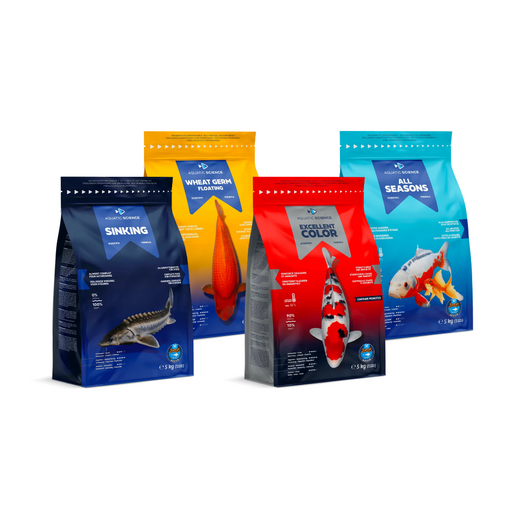
The Aquatic Science pond food range in store
All Seasons, the maintenance feed from the same range
Estimate your
delivery time
Your estimate
Delivery
Estimated time
It covers preparing your order and then the transit time quoted by the carrier, counted in working days.
It is not a guaranteed delivery date: public holidays, peak periods, customs or a carrier delay can extend it. The exact amount, in your currency, is worked out in the cart once your address is entered.
2 kg bag, dispatched to a collection point or to your door — your choice at checkout. The exact delivery cost is calculated in your basket based on the total weight of your order.
Frequently asked questions
8 questions
6 key questions, 8 in the detailed view
Estimate your koi's daily feeding ration
Enter the total biomass of your fish, that is the sum of their weights. The calculator uses a feeding rate of 2% of biomass per day, the figure commonly published for water between 21 and 23 °C, the temperature range where Excellent Color performs best. Adjust accordingly based on your thermometer reading.
kg
1 kg60 kg
0g per day
Total daily ration, to be split into several small feeds, for water at 21 to 23 °C.
Consumption over a full month at this ration
0 2 kg bags
These feeding guidelines are those commonly published for koi carp. Below 16 °C, Excellent Color is no longer the appropriate food. The overriding rule remains to feed only what is consumed within five minutes.
Vous aimerez aussi




Related articles

Guide
Koi carp in aquaponics: the complete guide
Required volume, filtration, water parameters and compatibility before introducing koi.
Read the article

Guide
Which fish should you choose for aquaponics?
Koi, goldfish, sturgeon or trout: what each species eats and can tolerate.
Read the article

Understand
The nitrogen cycle in aquaponics
Why every uneaten pellet ends up as ammonium and then nitrates in your water.
Read the article

Problem
Green water in your pond: 5 chemical-free solutions
The first symptom of overfeeding when warmer weather returns, and how to correct it.
Read the article

Season
Algae in the pond during summer: causes and solutions
What the feed rate changes in nutrient load when the water is warm.
Read the article

Season
Pond water evaporation in summer
Top up without thermal shock during the period when koi feed most actively.
Read the article

Tips
Aquaponics in summer: going on holiday with peace of mind
A short fast or an automatic feeder: managing feeding during an absence.
Read the article
Let us talk about your project
Une question sur ce produit ou votre installation ? Notre équipe vous répond et vous conseille.

Paiement plusieurs fois sans frais
Proposé selon le montant du panier, au moment du paiement.

Livraison sous 5 à 15 jours ouvrés
Selon les produits et sites d'expédition. Estimation par destination dans l'estimateur de cette page.

SAV 7/7 par mail ou chat
Notre équipe répond à toutes vos questions.

Faire un achat engagé
Devenez acteurs du changement.
