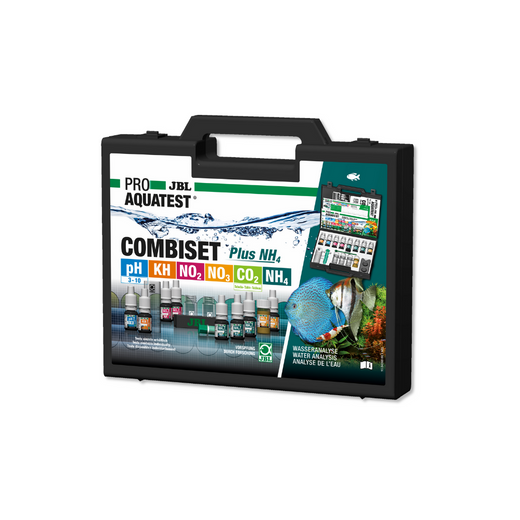


Ammonium NH4 water test in drops
Regular price
¥2,800
Regular price
Sale price
¥2,800
Unit price
/
per
This test tells you whether your biological filtration is still doing its job. It measures ammoniacal nitrogen from 0.05 to 5 mg/L, in freshwater, pond and aquaponic systems.
A single figure is not enough to make a decision: it is your pH that determines the genuinely toxic fraction, and the same result can be harmless or critical depending on it.

7/7 customer service by e-mail

Payment in instalments, free of charge
The summary
- What you receive: 3 reagent bottles, 2 glass test tubes, a syringe, a comparator block, and a three-band colour chart.
- What you measure: total ammoniacal nitrogen, from 0.05 to 5 mg/L, across nine fields, in fresh water, pond water, and seawater.
- What the reading means: at a reading of 0.5 mg/L, there is twenty-eight times more ammonia at pH 8.5 than at pH 7.
- When to test: every day during cycling, then after a filter clean, a treatment, or a pump failure.
- How to choose: this test complements a full test kit or is sufficient on its own for monitoring a system start-up.
- What is dispatched to you: a 0.12 kg parcel, reagents in their original packaging.
Drop test for ammonia nitrogen, from 0.05 to 5 mg/L, to be read alongside your pH
An aquarium or an aquaponic system gives no warning. By the time your fish are gasping at the surface, the imbalance has already been building for several days. Ammonium appears as soon as waste begins to decompose and normally disappears within a few hours if the nitrifying bacteria are established, so any measurable reading on a mature system always points to biological filtration that is struggling to keep up.
🧬 Ammonium and ammonia
The chemistry used measures total ammoniacal nitrogen, that is, ammonium NH4 combined with ammonia NH3, and the result is expressed in mg/L of NH4. Many experienced aquarists believe they are reading ammonia directly, and this confusion leads to the danger being underestimated in alkaline water just as much as it triggers unnecessary panic in acidic water. Ammonium remains virtually harmless at the concentrations found in a pond, whereas ammonia damages gill tissue from just a few hundredths of a milligram per litre.
🔗 The ammonium and nitrite pair
NH4 high, nitrites at zero
No bacteria are active: new tank, filter rinsed under the tap, recent treatment.
NH4 high, nitrites high
Cycling is under way. This is the worst time to introduce fish.
NH4 at zero, fish in distress
Look elsewhere: oxygen, temperature, drifting pH. A zero reading is the expected result.
In aquaponics
Nitrates feed your crops, whilst ammonium must remain at zero.
Three handling details skew the reading more often than the chemistry itself does. Read the result in daylight, with the test tube held against the white zone, because a warm artificial light shifts the perception of greens and blues. Use only the syringe and test tube supplied with the kit, as a different volume will alter the final concentration and therefore the shade produced. Finally, be aware that the third reagent produces noticeably smaller drops than the first two: this is normal, and compensating by adding extra drops would give a false result.
Your pH determines toxicity
Both forms coexist, and their proportion depends on pH, with the ammonia fraction multiplying by approximately 10 for each pH unit gained. At 20 degrees, a reading of 0,5 mg/L corresponds to 0,002 mg/L of ammonia at pH 7, but to 0,056 mg/L at pH 8,5, while the chronic limit recognised for aquatic life is 0,019 mg/L. The same figure is therefore harmless in an acidic tank and above the limit in a koi pond, which makes pH measurement inseparable from this one.
Restocking the reagents without replacing the glassware
Only the bottles run out on this type of kit, whereas the comparator block, test tubes, syringe, and colour chart last for years. The ammonium reagent refill therefore provides around fifty measurements at a fraction of the cost of a new kit. Pick it up with your first purchase if you are starting a tank, since reagent consumption is at its highest during cycling. You will avoid any gap in monitoring at precisely the moment when that gap is most costly.
🚑 When the value rises
A water change of around half the tank volume will protect your fish within the hour, provided the fresh water has a pH no higher than that of the tank, otherwise the proportion of free ammonia would rise rather than fall. Then reduce feeding and look for the cause in the filter rather than the water, since measurable ammonium almost always points to a bacterial colony that is insufficient or has recently been destroyed. The nitrite test then takes over as the routine check once the value has returned to zero, as it is the one that signals the second stage of the cycle.
Technical specifications
The essentials
- Parameter measured
- Ammoniacal nitrogen, expressed as NH4The reaction measures ammonium and ammonia together; the result is displayed in mg/L of NH4
- Measurement range
- 0.05 to 5 mg/LBelow 0.05 mg/L the test reads zero, which is the expected result on a well-established system
- The colour chart fields
- 0,05 · 0,1 · 0,2 · 0,4 · 0,6 · 1 · 1,5 · 3 · 5Bracket between the two nearest fields — there's no need to find the exact shade.
- Target values
- Below 0.25 mg/L in an aquariumBelow 0.1 mg/L in a pond. These thresholds assume a pH close to neutral; above pH 8 they become optimistic.
- Tests per kit
- Around 50Three reagents used with each measurement
- Manufacturer reference
- JBL 2412100, PROAQUATEST rangeCode EAN 4014162241214
The procedure
- Water volume
- 2 times 5 mlTaken from the middle of the volume, never at the surface or close to the bottom
- The steps
- Fill, dose 1, dose 2, dose 3, wait, readThe three reagents in this order, without swapping any of them
- Waiting time
- 15 minutesReading too early underestimates the value. This is the longest test in the range along with copper
- Total duration
- Approximately 17 minutesHandling included
- Reading
- Colour chart, in natural daylightThree reading strips identified by pictogram: freshwater, pond and marine
- Pitfall to know about
- Reagent 3 produces smaller dropsThis is normal — do not compensate by adding more
Security and parcels
- Ranking
- DangerThe three bottles are labelled, and one of them is highly flammable
- Main risks
- Flammable, burns, drowsinessMentions H225, H314, H318 and H336
- Precautions
- Sink, ventilated room, out of reachChild-resistant caps, and bottles kept away from any flame
- Parcel weight
- 0,12 kgPackaging included
To budget for separately
- The matching test
- A pH testWithout it, the ammonium figure says nothing about actual toxicity
- Reagent refill
- Reagents only, ref. 2412200The glassware, the comparator block and the colour chart keep well
10 further specifications are available in the detailed view.
In the box
- 3 reagent bottles with child-safety caps
- 2 glass test tubes with screw caps
- 1 graduated sampling syringe
- 1 laboratory comparator block
- 1 colour chart with 3 reading strips, freshwater, pond and marine
- 1 multilingual instruction manual, French included
Reference, EAN code, kit contents, number of tests, protocol, recommended thresholds, and hazard statements taken from the manufacturer's datasheet and instructions on 05/09/2026. The range of 0.05 to 5 mg/L and the detail of the nine parameters come from earlier manufacturer texts, reproduced in two retailer descriptions. The chronic limit of 0.019 mg/L of ammonia is a recommendation for the protection of aquatic life.
A single parameter, or the full water chemistry?
Ammonia is the first test for a new tank, and the only one you run every day for three weeks. The three columns differ in what they allow you to monitor once the cycling phase is complete.
The same NH4 reading does not cause the same damage in every situation
At 18 °C and pH 6.8, half a milligram per litre goes almost unnoticed. At 28 °C and pH 8.2, the same reading shifts to ammonia and burns the gills overnight.
| Parameters covered (parameters) | Drop tests included (tests) | Ammonium NH4 | pH, KH, nitrites and nitrates | GH, iron, phosphates, copper, silicates, oxygen | Reagent bottles (bottles) | Glass test tubes | Laboratory comparator block | Thermometer | Reagent refill sold separately | Price | |
|---|---|---|---|---|---|---|---|---|---|---|---|
| Recommended Ammonium test onlyYour choice | 1 parameters | 1 tests | Yes | No | No | 3 bottles | 2 | Yes | No | Yes | ¥2,800 |
| 6-in-1 water test kit for aquariumsYour choice | 6 parameters | 5 tests | Yes | Yes | No | 9 bottles | 3 | Yes | No | Yes | ¥7,900 |
| 14-in-1 water test case for aquariumsYour choice | 14 parameters | 13 tests | Yes | Yes | Yes | 23 bottles | 12 | Yes | Yes | Yes | ¥16,400 |
Ammonium test onlyRecommended
What you are measuring
Parameters covered (parameters)1 parameters
Drop tests included (tests)1 tests
Ammonium NH4Yes
pH, KH, nitrites and nitratesNo
GH, iron, phosphates, copper, silicates, oxygenNo
Equipment supplied
Reagent bottles (bottles)3 bottles
Glass test tubes2
Laboratory comparator blockYes
ThermometerNo
Budget
Reagent refill sold separatelyYes
6-in-1 water test kit for aquariums
What you are measuring
Parameters covered (parameters)6 parameters
Drop tests included (tests)5 tests
Ammonium NH4Yes
pH, KH, nitrites and nitratesYes
GH, iron, phosphates, copper, silicates, oxygenNo
Equipment supplied
Reagent bottles (bottles)9 bottles
Glass test tubes3
Laboratory comparator blockYes
ThermometerNo
Budget
Reagent refill sold separatelyYes
14-in-1 water test case for aquariums
What you are measuring
Parameters covered (parameters)14 parameters
Drop tests included (tests)13 tests
Ammonium NH4Yes
pH, KH, nitrites and nitratesYes
GH, iron, phosphates, copper, silicates, oxygenYes
Equipment supplied
Reagent bottles (bottles)23 bottles
Glass test tubes12
Laboratory comparator blockYes
ThermometerYes
Budget
Reagent refill sold separatelyYes
Parameters covered, equipment supplied and kit contents recorded from the three product sheets on 05/09/2026.
Help choosing
Testing ammonia when the filter is young
Documents & manuals
Official manufacturer's instructions, in French
Six-step protocol, volumes and number of drops, and the ammonia toxicity table as a function of pH published by the manufacturer on the last page.
Document not showing? Some publishers block display inside a frame, so open it in a tab.
Estimate your
delivery time
Your estimate
Delivery
Estimated time
It covers preparing your order and then the transit time quoted by the carrier, counted in working days.
It is not a guaranteed delivery date: public holidays, peak periods, customs or a carrier delay can extend it. The exact amount, in your currency, is worked out in the cart once your address is entered.
Parcel weighing 0.12 kg, dispatched to a collection point or via Colissimo to your home address, your choice at checkout. Reagents are sent in their original packaging. The exact amount is shown in the basket.
Frequently asked questions
6 questions
6 key questions
Vous aimerez aussi


Related articles

Guide
The nitrogen cycle in aquaponics
Ammonium, nitrite, nitrate: the sequence this test makes visible, and the point at which fish can finally be introduced.
Read the article

Parameters
Regulating pH in an aquaponics system
pH determines the proportion of toxic ammonia. How to adjust it without destabilising KH or harming the bacteria.
Read the article

Guide
Common mistakes in aquaponics
Rinsing a filter under tap water, overfeeding, introducing fish too early: the actions that cause ammonia to spike.
Read the article

Troubleshooting
Understanding and fixing cloudy water
The four causes of cloudy water, and why coloured water skews every reading taken without a colour comparator block.
Read the article

Guide
Which fish should you choose for aquaponics?
The fish load determines how much ammonium is produced each day, and therefore what the filtration must handle.
Read the article

Pond
Koi carp in aquaponics
A koi pond often runs above pH 8, where the same NH4 reading becomes considerably more dangerous.
Read the article
Let us talk about your project
Une question sur ce produit ou votre installation ? Notre équipe vous répond et vous conseille.

Paiement plusieurs fois sans frais
Proposé selon le montant du panier, au moment du paiement.

Livraison sous 5 à 15 jours ouvrés
Selon les produits et sites d'expédition. Estimation par destination dans l'estimateur de cette page.

SAV 7/7 par mail ou chat
Notre équipe répond à toutes vos questions.

Faire un achat engagé
Devenez acteurs du changement.
