





JBL ProPond Winter, winter food for pond fish
Regular price
$18.00
Regular price
Sale price
$18.00
Unit price
/
per
| Conditionnement | Price | Price per kg | vs 600 g |
|---|---|---|---|
| 600 g | $18.00 | $30.00 | — |
| 1,8 kg | $50.00 | $27.78 | −7 % |
| 3,6 kg | $96.00 | $26.67 | −11 % |
$6.00 × 3 with no fees
Klarna.
This sinking stick feeds your koi and goldfish when the pond water stays between 5 and 15 °C. Its wheat germ recipe, 2 parts protein to 1 part fat, provides quickly available energy for fish whose digestion has slowed down.
 Customer support 7 days a week by email
 Delivery within 2 to 15 business days
100 % secure payment
The summary
- What it is: a complete cold-season feed, in sinking sticks, in 600 g, 1.8 kg or 3.6 kg packs.
- Its recipe: 22% protein, 11% fat and 15% wheat germ, with no colourings or preservatives.
- When to feed it: as soon as the water drops below 15 °C in the morning, and not at all below 5 °C.
- How much to give: no more than 1% of your fish's body weight per day, less as the water cools.
- How to choose: the water temperature and the level at which your fish feed tell the pond foods apart.
- How it arrives: in a tub or resealable pouch, delivered to your door by Colissimo or Chronopost.
Sinking stick for koi and goldfish, in water at 5 to 15 °C
A koi carp or a goldfish is a poikilothermic animal: its internal temperature follows that of the water, so its digestion slows down as autumn cools the pond. Between 15 and 5 °C, your fish still eat, but they absorb less and more slowly, and a peak-season food, richer in protein, is partly poorly digested. These winter sticks are formulated for this period, from late autumn until spring returns.
🌡️ A recipe for cold water
The analysis states 22% crude protein to 11% fat, a ratio of 2 to 1. The spring, autumn and all-season formulas run at about 3 to 1, because in warm water the fish grow and their protein requirement is higher. In cold water, they mainly need energy that is easy to mobilise, which lipids provide without a long digestive effort. The recipe is built on wheat flour and 15% wheat germ, a very digestible raw material, supplemented with salmon and krill meal, 4% fish oil and 2% garlic powder. Each kilo also supplies your fish with 200 mg of vitamin C and 300 mg of vitamin E.
The sticks sink, which suits the behaviour of your fish in winter. As soon as the water cools, they stay close to the bottom, in the most stable layer of the pond, and rarely come up to look for food at the surface. A stick that sinks down to them is found and eaten, whereas a floating pellet often stays untouched and ends up breaking down in the water. Only feed when your fish are active, because a fish sitting motionless on the bottom has entered its winter rest.
🍽️ Feeding amounts by temperature
From 12 to 15 °C
Your fish receive at most one meal a day, around 0.5 to 1% of their body weight, during the mildest hours.
From 5 to 12 °C
Meals become small and spaced out, every other day and then a few times a week, if your fish come to take them.
Below 5 °C
Feeding stops, even on a sunny day when your fish come up to the surface, because their digestion has almost shut down.
Below 5 °C, no more feeding
In water at 3 or 4 °C, a fish barely digests anything, and the food it swallows is no longer absorbed. Stop all feeding as soon as the thermometer drops below 5 °C, even if your fish come to the surface on a sunny afternoon. Measure the temperature in the water, in the morning, about twenty centimetres below the surface, because the air can be several degrees warmer. The floating pond thermometer stays in the water permanently and can be read at a glance.
Monitor ammonium when the filter slows down
In winter, the bacteria in the filter convert ammonium much more slowly, so uneaten food stays in the water for longer. The ammonium NH4 drop test kit tells you in about fifteen minutes whether the amount you are feeding exceeds what the filter can process at that time of year. It is especially useful in spring, when your fish start begging for food again while the bacteria are still working slowly in barely warmed water.
Take a pond housing 6 koi of about 1 kg each, making 6 kg of fish. At 13 °C, a ration of 0.5% of that weight comes to 30 g of sticks a day, a small handful. The 1.8 kg bag then lasts around sixty days at this rate, and much longer once the water drops below 12 °C and meals become less frequent. The amount is then adjusted to your fish: what they have eaten in 5 minutes is the right dose, and sticks still visible on the bottom mean you should reduce the next meal.
🔄 From one season to the next
Switch to this food when the water temperature falls below 15 °C for several mornings in a row. Above that, a maintenance food such as the all-season food for koi and goldfish, floating and designed for 10 to 25 °C, meets the needs of the warm season. The autumn and spring formulas cover the intermediate range of 10 to 20 °C, with a ratio of about 3 to 1 that prepares the fish for winter or restarts growth. In spring, when the water rises back above 5 °C, you resume with these sticks in small quantities, then return to the full ration once the water stays above 15 °C.
🌱 Winter in an aquaponic system
In aquaponics, the ration given to the fish is also the plants' source of nitrogen, and winter slows both down at the same time. Nitrifying bacteria are most active between 17 and 34 °C, and below 10 °C their activity can fall by half or more. A highly digestible feed, given in small quantities, therefore leaves less waste for a filter that is running slowly. On the growing side, the available nitrogen also decreases, which steers you towards undemanding leafy vegetables rather than fruiting plants. The guide to preparing your aquaponic system for autumn covers these seasonal adjustments in detail.
The sticks are supplied in a 600 g tub, or in a resealable bag of 1.8 kg or 3.6 kg, airtight packaging that keeps out air, water and light. Reseal the packaging after each feed and store it somewhere dry, away from heat, to preserve the vitamins and fats in the food. The 3.6 kg bag works out cheapest per kilo, and it suits koi ponds and aquaponic systems alike.
Technical specifications
The analysis
- Crude protein
- 22%
- Crude fat
- 11%
- Crude fibre
- 2 %
- Crude ash
- 6 %
Use
- Water temperature
- From 5 to 15 °CBelow 5 °C, feeding stops entirely.
- Shape
- Sinking stickYour fish find it near the bottom, where they stay in winter.
- Protein and fat ratio
- 2 to 1Against roughly 3 to 1 for a spring, autumn or all-season food.
- Amount per meal
- What is eaten in 5 minutesOnly when the fish are active, never when they are resting on the bottom.
The composition
- First raw ingredients
- Wheat, wheat germ, maize, salmonThen rice, krill, wheat gluten, fish oil, yeasts, alfalfa, algae and garlic.
- Wheatgerm
- 15%
- Fish oil and garlic
- 4% and 2%
- Vitamins per kilo
- C 200 mg, E 300 mgAnd A 25,000 IU, D3 2,000 IU. No colourings or preservatives.
To budget for separately
- Reading the temperature
- Floating thermometer for pond
- Warm-season food
- All-season feed
6 further specifications are available in the detailed view.
In the box
- 1 tub or resealable bag of sinking sticks, from 0.6 to 3.6 kg depending on the size chosen
Analysis, composition, additives and the 5 to 15 °C range recorded on 08/10/2026 from the manufacturer's data sheet. Rations as a percentage of fish weight are orders of magnitude taken from koi feeding guides.
Winter, cool water or all seasons?
Three pond foods arranged from coldest to warmest. The water temperature and the level at which your fish feed decide between the three.
Winter, cool water or all seasons?
This morning's water temperature and the spot where your fish feed point to just one of the three foods.
| Water temperature | Behaviour in water | Crude protein (%) | Crude fat (%) | Pouch weight | Price | |
|---|---|---|---|---|---|---|
| Recommended JBL ProPond Winter, winter food for pond fishYour choice | 5 to 15 °C | Sinking stick | 22 % | 11 % | 1.8 kg | $50.00 |
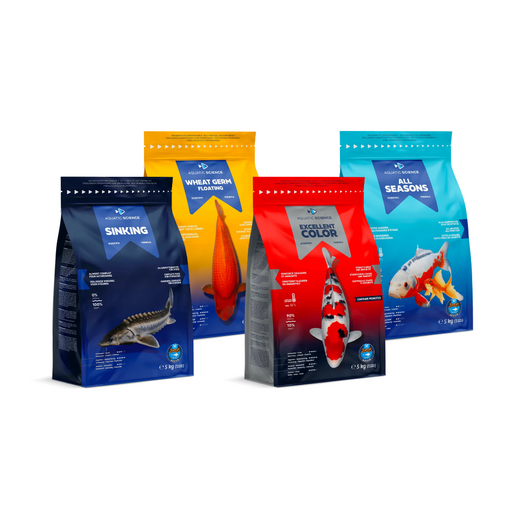
| Wheat Germ Floating freshwater food forYour choice | 5 to 15 °C | Floating pellets | 32 % | 9 % | 5 kg | $104.00 |
| JBL ProPond All Seasons food for koi andYour choice | 10 to 25 °C | Floating stick | 24 % | 7 % | 2.2 kg | $53.00 |
JBL ProPond Winter, winter food for pond fishRecommended
When to feed
Water temperature5 to 15 °C
Behaviour in waterSinking stick
What the label states
Crude protein (%)22 %
Crude fat (%)11 %
The formats compared
Pouch weight1.8 kg
Wheat Germ Floating freshwater food for
When to feed
Water temperature5 to 15 °C
Behaviour in waterFloating pellets
What the label states
Crude protein (%)32 %
Crude fat (%)9 %
The formats compared
Pouch weight5 kg
JBL ProPond All Seasons food for koi and
When to feed
Water temperature10 to 25 °C
Behaviour in waterFloating stick
What the label states
Crude protein (%)24 %
Crude fat (%)7 %
The formats compared
Pouch weight2.2 kg
Analyses, temperature ranges and behaviour in the water taken on 08/10/2026 from the manufacturer's data sheets. Data sheets compared: floating food for cool water and all-season food.
Help choosing
Two observations at the pond's edge
Estimate your
delivery time
Your estimate
Delivery
Estimated time
It covers preparing your order and then the transit time quoted by the carrier, counted in working days.
It is not a guaranteed delivery date: public holidays, peak periods, customs or a carrier delay can extend it. The exact amount, in your currency, is worked out in the cart once your address is entered.
Box or sachet shipped within 48 h by Colissimo or Chronopost to your home, as you choose during payment. The exact cost is shown at checkout, according to the total weight of your order.
Frequently asked questions
6 questions
6 key questions
You may also like




Related articles

Season
Feeding your fish in winter
Feeding pond fish according to the water temperature in winter.
Read the article

Season
Preparing your aquaponic system for autumn
The autumn settings of an aquaponic system, including the ration.
Read the article

Fish

Fish
Goldfish in aquaponics
Keeping goldfish in aquaponics, the species beginners start with.
Read the article

Understanding
The nitrogen cycle in aquaponics
The nitrogen cycle, from the food given to the nitrate taken up by the plants.
Read the article
Let us talk about your project
A question about this product or your setup? Our team will answer and advise you.

Interest-free instalment payments
Offered depending on the cart amount, at checkout.

Delivery in 2 to 15 working days
Depending on the products and shipping sites. Estimate by destination in the estimator on this page.

After-sales service 7 days a week by email or chat
Our team answers all your questions.

Shop responsibly
Become part of the change.
