

UGro compressed coco coir, 15 L bag or 70 L block
Regular price
$14.00
Regular price
Sale price
$14.00
Unit price
/
per
| Volume | Price | Price per L | vs 15 L |
|---|---|---|---|
| 15 L | $14.00 | $0.93 | — |
| 70 L | $31.00 | $0.44 | −53 % |
UGro Rhiza coir, washed twice in fresh water and buffered at the factory, comes out at pH 5.5 to 6.5. It is available in two formats, which are not prepared in the same way.
The 15 L growing bag is planted as it is after receiving 6.5 L of water, whereas the 70 L block, rehydrated with 18 L of water, fills your own pots and baskets.
 Customer support 7 days a week by email
 Delivery within 2 to 15 business days
100 % secure payment
The summary
- What you receive: washed, buffered UGro Rhiza coco coir, in a 15 L grow bag or a 70 L block.
- How long it takes: 20 to 30 minutes of expansion for the 70 L block, a good hour of resting for the 15 L bag.
- Preparation: 6.5 L of clean water for the 15 L size, 18 L for the 70 L size, and a container for the final volume.
- Before commissioning: a rinse with clear water, and that water must not be returned to the fish tank.
- What maintenance is needed: none for the grow medium, only watering or fertigation of your crops.
- How to choose: the 15 L bag is planted as it comes, the 70 L block fills your own pots.
Washed and buffered coco fibre, in a grow bag or as a block to rehydrate
UGro Rhiza compressed coco fibre serves as a planting medium in pots and baskets, thanks to its pH of 5.5 to 6.5 after a double rinse in fresh water. The 15 L grow bag can be planted as it is after adding 6.5 L of water, whereas the 70 L block, rehydrated with 18 L, fills your own containers.
Once compressed, coco fibre fits on a shelf: the 15-litre grow bag weighs just 1.6 kg before it is watered. It regains its volume the day you moisten it, so you can store a dense format all year round and make up the grow medium when you need it, without cluttering a garden shed over the winter. Both formats share the same fibre, washed twice in fresh water and buffered at the factory, but they are not prepared in the same way.
The 15 L bag
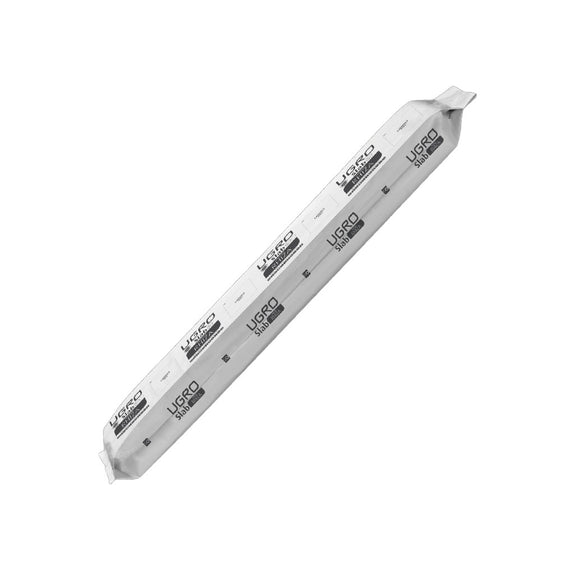
It is a flexible grow bag of about one metre, UV-treated, which you place and plant as it is.
The 70 L block
It is a block to rehydrate in a container, to fill your own pots and baskets.
💧 Preparing a block
Preparation requires no tools. The 70-litre block needs 18 litres of clean water and expands in 20 to 30 minutes in a large tub or wheelbarrow. The 15-litre bag is prepared differently: you cut open one of the four marked positions on top, pour 6.5 litres of clean water through that opening, then let capillary action distribute the moisture before planting. Allow a good hour for the bag to become evenly moist along its whole length.
🌿 Coir in aquaponics
In aquaponics, coco fibre serves as a planting medium, in pots and baskets. It holds the root ball, keeps moisture around the roots and offers a surface that bacteria colonise. Keep it for that use rather than filling a whole flood bed with it, where its fineness ends up packing down the medium and reducing circulation. The guide on which grow medium to choose in aquaponics compares the options one by one.
Rinse the fibre and measure out the rehydration water
The start-up rinse must not be skipped, because in aquaponics it prevents the first leaching water from being sent to the fish tank. So run the rehydrated grow medium under clean water and drain that water elsewhere. Soaking the block excessively is of no use either, since beyond the quantities indicated the fibre loses volume and compacts instead of staying airy. Finally, keep it out of the bottom of a flood bed, where its fineness makes it migrate towards the strainer and the pump.
A complete fertiliser from the very first watering
Coconut fibre supplies almost no nutrients, so everything depends on what you add: in hydroponics on coconut fibre, a complete fertiliser feeds your plants from the very first watering. If you are filling your own pots and baskets, the 70-litre block is the one to choose, since the 15-litre bag is planted as it is, through the marked openings on top.
♻️ After the crop
Used coco fibre does not necessarily have to be thrown away. After a healthy crop, it can be shaken out to remove the roots, rinsed thoroughly and used a second time, with slightly reduced water retention and a somewhat finer structure. After a root attack, however, it goes to the compost heap rather than into the next pot, because a fibrous grow medium holds on to spores far better than a mineral medium. Compost remains its natural end of life, since it breaks down slowly there while improving the structure of heavy soil.
Technical specifications
The essentials
- Volume once hydrated
- 15 or 70 litresDepending on the capacity chosen.
- Rehydration water
- 6.5 or 18 litresDo not exceed this: beyond it, the fibre compacts instead of staying airy.
- Grow medium pH
- 5.5 to 6.5The range in which most vegetables absorb minerals best.
- EC conductivity
- Below 0.6 mS/cmOn new grow medium, before any fertiliser is added.
- Water retention
- 40 to 65 % depending on size40 to 45% for the 15 L bag, 60 to 65% for the 70 L block.
- Reuse
- A second season in potsRemove the large roots and rewet the material, provided the previous crop had no root disease.
To budget for separately
- Water and container
- 6.5 or 18 L of clean waterPlus a washing-up bowl, a wheelbarrow or a tub large enough for the final volume.
- Fertilisation
- A complete fertiliserAll the nutrition comes from what you add, from the very first watering.
In the box
- 1 grow bag of 15 litres of hydrated medium, with 4 marked planting positions to cut out, drainage holes underneath and a UV-treated film (15 L variant)
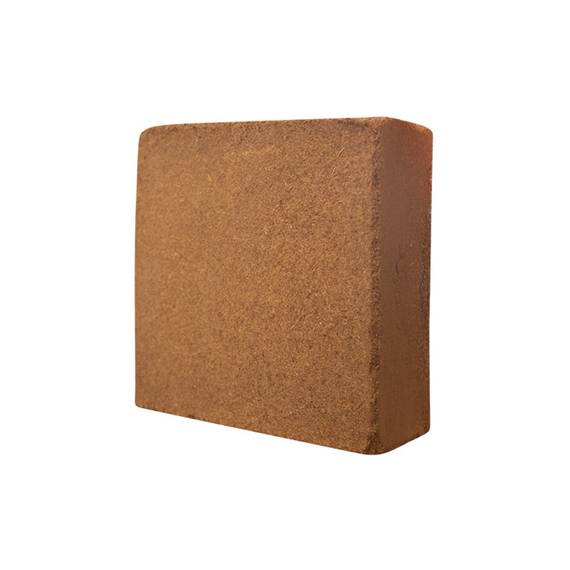
- 1 compressed block of 70 litres once hydrated, 32 x 32 x 14 cm, in film with a carrying handle (70 L variant)
Hydrated volume, rehydration water, pH, conductivity, retention and weight: values stated for this product, taken on 10/09/2026. Retention and structure differ from one format to another; details are given beneath each line.
15 litres or 70 litres: which one is right for you
Both sizes contain the same washed and buffered coco fibre, but they are not prepared in the same way and do not serve the same purpose.
The same fibre, two ways of setting it up
The bag is planted up as it is, with nothing to transfer. The block is expanded in a washing-up bowl and fills your own pots, all at once or in several batches.
| Volume once hydrated (L) | Clean water to have ready (L) | Weight of the parcel to carry (kg) | Packaging | Fibre structure | Water retention | Enriched with endomycorrhizae | Prepared in several stages | Ready to plant without transferring | Fills your own pots and baskets | Price | Best value for volume | |
|---|---|---|---|---|---|---|---|---|---|---|---|---|
| 15 L grow bagYour choice | 15 L | 6,5 L | 1,6 kg | Flexible bag, marked spots to cut out | Medium grade, long fibres and chips | 40 to 45% | Yes | No | Yes | No | $14.00 | No |
| Recommended 70 L compressed blockYour choice | 70 L | 18 L | 5 kg | Shrink-wrapped block, 32 x 32 x 14 cm | Medium grade, medium share of fibres | 60 to 65% | Yes | Yes | No | Yes | $31.00 | Yes |
15 L grow bag
Format and rehydration
Volume once hydrated (L)15 L
Clean water to have ready (L)6,5 L
Weight of the parcel to carry (kg)1,6 kg
PackagingFlexible bag, marked spots to cut out
How the grow medium behaves
Fibre structureMedium grade, long fibres and chips
Water retention40 to 45%
Enriched with endomycorrhizaeYes
Prepared in several stagesNo
In use
Ready to plant without transferringYes
Fills your own pots and basketsNo
Price$14.00
Best value for volumeNo
70 L compressed blockRecommended
Format and rehydration
Volume once hydrated (L)70 L
Clean water to have ready (L)18 L
Weight of the parcel to carry (kg)5 kg
PackagingShrink-wrapped block, 32 x 32 x 14 cm
How the grow medium behaves
Fibre structureMedium grade, medium share of fibres
Water retention60 to 65%
Enriched with endomycorrhizaeYes
Prepared in several stagesYes
In use
Ready to plant without transferringNo
Fills your own pots and basketsYes
Price$31.00
Best value for volumeYes
Technical values taken from the Slab Professional Rhiza and XL Rhiza datasheets.
Help choosing
15 L grow bag or 70 L block
Product videos
Documents & manuals
Catalogue UGro Coco, Tree of Life 2024
Full range of UGro coco grow media and the characteristics of each product. English and Spanish.
UGro 2022 range leaflet
Detailed compositions of the Slab 15 L and XL 70 L, weights and volumes. English and Spanish.
UGro product catalogue
Condensed datasheets for the full range, dimensions and pack sizes. English and Spanish.
Rhiza 1200 instructions, the mycorrhizal inoculant
Manufacturer's document on endomycorrhizae in the Rhiza range. In English.
Document not showing? Some publishers block display inside a frame, so open it in a tab.
Estimate your
delivery time
Your estimate
Delivery
Estimated time
It covers preparing your order and then the transit time quoted by the carrier, counted in working days.
It is not a guaranteed delivery date: public holidays, peak periods, customs or a carrier delay can extend it. The exact amount, in your currency, is worked out in the cart once your address is entered.
The 70-litre block weighs 5 kg, and the 15-litre one about 1.6 kg. The exact delivery cost is calculated at the basket according to the total weight of your order.
Frequently asked questions
6 questions
6 key questions
You may also like




Related articles

Grow media
Which grow medium to choose for aquaponics?
Clay pebbles, coco, pozzolana: what each medium brings to your roots.
Read the article

Seedling
Germination failure: causes and solutions
Grow medium too wet, too compacted or too cold: diagnosing a seedling that fails to come up.
Read the article

Seedling
Successful spring seedlings in aquaponics
The calendar and the techniques that get your seeds to germinate first time.
Read the article

Seedling
Setting up an indoor seedling space
Light, warmth and grow medium: setting up a seedling corner that really works.
Read the article

Fertilisation
Which fertiliser should you use in aquaponics?
What really feeds your plants, and the supplements to add without harming the fish.
Read the article

Plants
Which plants can be grown in aquaponics?
The species that do best in aquaponic growing.
Read the article

Above ground
Aquaponics and hydroponics — what's the difference?
Two ways of growing without soil, and what the grow medium changes.
Read the article
Let us talk about your project
A question about this product or your setup? Our team will answer and advise you.

Interest-free instalment payments
Offered depending on the cart amount, at checkout.

Delivery in 2 to 15 working days
Depending on the products and shipping sites. Estimate by destination in the estimator on this page.

After-sales service 7 days a week by email or chat
Our team answers all your questions.

Shop responsibly
Become part of the change.
