Sold out
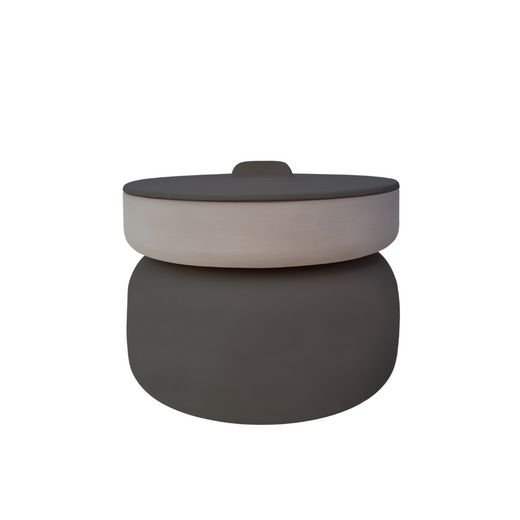


This clay pot is buried in the vegetable patch with its lid flush with the surface: soil worms come up to collect your peelings and return to enrich the surrounding earth, without any need to remove or turn anything. Depending on the capacity chosen from the six available sizes, it absorbs 1.5 to 18 kg of food waste per year.

7/7 customer service by e-mail

Payment in instalments, free of charge
A surface composter requires two actions: filling it, then removing the compost and carrying it to where it is needed. This clay pot eliminates the second step. You bury it in the middle of a growing bed with the lid flush with the surface, and the compost never needs to be removed, as it passes directly into the surrounding soil.
Dig in the right spot
Place the pot in the middle of a bed, within reach of hungry plants, in soil you are already working.
Bury up to the lid
The body disappears; only the lid remains visible and accessible underfoot.
Prime with worms
A handful of compost worms gets the colony started. Soil worms will join on their own from there.
Place and reseal
Add peelings, vegetable tops and coffee grounds, then a handful of sawdust on top.
The volume doesn't tell you what the pot contains, it tells you what it absorbs over the year, and the ratio stays constant, at roughly 1.5 kg of food waste per litre per year. The 1-litre model handles 1.5 kg, the 12-litre model handles 18 kg. A small unit placed at the foot of a herb bed does its job all season, while the kitchen waste of an entire household calls for a larger model, or a stacking composter that can be emptied and harvested at different levels. There's nothing stopping you from burying several units spread around the garden, rather than one large one in a single spot.
Worms are not included with the pot
A batch of compost worms kick-starts the colony as soon as the pot is planted. Soil worms will join them on their own in time, but it is those first worms that begin breaking down your waste and spreading fertility through the bed. Order them when you plant rather than waiting for the following spring, as a pot that is started at the beginning of the season will already be giving something back by the end of it.
What won't fit in the pot
A buried worm composter works in a low-oxygen environment, which rules out meat, fish, dairy products and fats, these ferment rather than decompose and attract unwanted visitors. Also avoid large quantities of citrus peel, which is too acidic for the worms, as well as waste from treated plants. And never tip in the contents of a bucket that has been accumulating for a fortnight all at once: a large load heats the vessel and drives the worms out.
The balance in the bin comes down to a simple ratio between wet materials and dry materials. Peelings, vegetable tops, and coffee grounds provide nitrogen and moisture, while torn brown cardboard, untreated sawdust, and dead leaves provide carbon and structure. A handful of dry material with each addition is enough to maintain that ratio, and it is that one action that keeps odours at bay. A bin that smells is almost always one that is too wet and too compacted, two handfuls of cardboard will sort it out within a few days.
The worms don't stay in the pot. They move up to find fresh matter, then return to the soil by burrowing and leaving their castings behind. Through this back-and-forth movement, fertility spreads through the surrounding soil, without any spreading on your part. For anyone already running an aquatic system, this is the simplest way to handle the waste that system won't take, peelings and brown cardboard, and to return it to the open-ground vegetable plot alongside it. Our article on vermicompost as fertiliser covers in detail what this material brings to the soil.
A buried pot can stay in the ground over winter, unlike an irrigation jar, because it contains no standing water that could cause the clay to crack. Worm activity slows considerably below 10 °C and stops almost entirely near freezing, so deposits naturally become less frequent during this period. Resume your usual feeding rhythm in spring when the soil warms up, starting with small quantities. Beyond that, maintenance is simply a matter of checking once a season that the lid closes properly and that soil has not built up around the neck, a pot whose opening disappears will eventually be forgotten.
The essentials
To budget for separately
In the box
Annual capacity by volume, material, heights, widths, weights and parcel contents: figures stated by the supplier, checked on 20/09/2026.
Your estimate
It covers preparing your order and then the transit time quoted by the carrier, counted in working days.
It is not a guaranteed delivery date: public holidays, peak periods, customs or a carrier delay can extend it. The exact amount, in your currency, is worked out in the cart once your address is entered.
A clay piece, fragile and heavy: from 1.6 to 8 kg depending on the capacity, packed accordingly. Lead times are longer than for the rest of the catalogue and vary by capacity. Exact shipping costs are displayed in the basket once the delivery address has been entered.
8 questions
6 key questions, 8 in the detailed view

What worm castings bring to a kitchen garden soil.

The time of year when you prepare a bed before planting around it.

Laying out a bed in spring, including a buried composter.

What happens in the soil, and what happens in the water.

Where the peelings that go back into the pot come from.

What lurks around a source of organic waste, and how to avoid it.
Une question sur ce produit ou votre installation ? Notre équipe vous répond et vous conseille.

Paiement plusieurs fois sans frais
Proposé selon le montant du panier, au moment du paiement.

Livraison sous 5 à 15 jours ouvrés
Selon les produits et sites d'expédition. Estimation par destination dans l'estimateur de cette page.

SAV 7/7 par mail ou chat
Notre équipe répond à toutes vos questions.

Faire un achat engagé
Devenez acteurs du changement.


