






Wireless thermostat for heating or cooling, 3,000 W
Regular price
$40.00
Regular price
Sale price
$40.00
Unit price
/
per
This wireless thermostat combines a sensor unit, placed near the plants, and a receiver socket that switches your appliance on or off. It controls heating or cooling up to 3,000 W, with a range of 20 m in open space.
100 % secure payment
The summary
- What you receive: a thermostat unit with a built-in sensor and a receiver socket that pair automatically.
- How it works: the sensor measures the temperature near the plants, and the socket switches the appliance on or off remotely.
- Two functions: heating in winter, cooling or extraction when it gets too hot.
- The load: up to 3,000 W at 230 V, for a fanless radiator or a heat mat.
- The range: 20 m in open air between the unit and the receiver socket.
- The power supply: 2 AA batteries in the unit, with a low-battery alert.
Remote sensor and receiver socket for greenhouse, grow tent and growing room
An ordinary thermostat measures the temperature wherever it is plugged in, which is often at floor level, near a socket and far from the leaves. The LightHouse wireless thermostat separates the two functions: a unit with a built-in sensor measures the temperature where it matters for your plants, and a receiver plug, connected to the mains, switches on or cuts off the appliance attached to it. The two units pair automatically on start-up, with no installation and no cable between them, and communicate up to 20 m in open space. The unit can be hung, placed on a shelf or fixed to the wall of a greenhouse, a grow tent or a growing room.
The thermostat housing
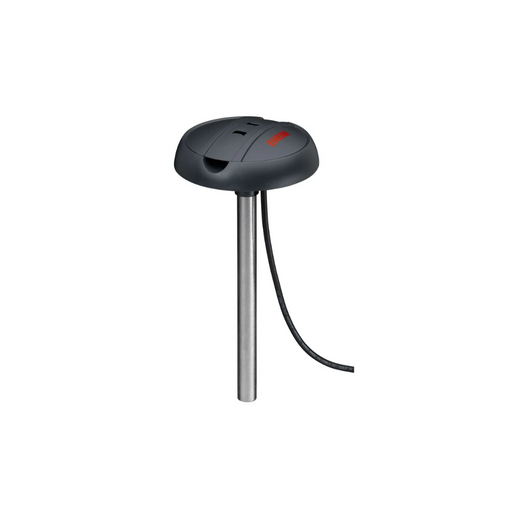
It measures the temperature with its built-in sensor and shows the measured value and the set point on a backlit screen.
The receiving socket
Plugged into a wall socket, it receives the command from the box and powers or cuts the connected appliance.
🔁 Heating or cooling
The thermostat works in both directions. In heating mode, it powers a heater or a heating mat while the temperature stays below the set point, then cuts it once the set point is reached, which suits frost protection for your greenhouse or the night-time of a grow tent. In cooling mode, it reverses the logic and switches on an extractor fan or a cooling unit as soon as the air exceeds the set point, which is useful in summer, when a closed greenhouse heats up within a few hours of sun. The display shows the temperature in degrees Celsius or Fahrenheit, and an automatic display switch-off conserves the unit's 2 AA batteries, whose low charge is signalled by an alert. The set point is adjusted degree by degree, from 0 to 70 °C, and a forced mode keeps the socket on or off regardless of temperature, for the duration of a job.
No fan heater on the receiving socket
The receiving socket accepts up to 3,000 W, but it is not suitable for heating appliances with a built-in fan, including LightHouse fan heaters for greenhouses. Reserve it for a fanless radiator, a heating tube or a heat mat. For a fan heater, set its own thermostat or choose a thermostat compatible with this type of appliance.
📍 Placing the sensor in the right spot
The unit is positioned at plant height, in the centre of the greenhouse or tent, away from the appliance it controls and out of direct sunlight, which would skew the reading. In a tent, hang it from a bar at canopy level; in a greenhouse, fix it to an upright above the growing shelf. The receiver socket, meanwhile, is plugged in near the appliance, away from watering spray, and the 20 m range comfortably covers a garden greenhouse. To check the link, raise the setpoint by a few degrees, and the socket should switch on immediately.
The 360° thermometer to monitor a second point
The thermostat controls the unit from a single reading, taken wherever the housing sits. In a long greenhouse, the 360° digital thermometer and hygrometer placed at the other end shows you whether the heat reaches the whole area, and it also displays the humidity of the air. You can then move the housing or the unit on the strength of a real reading, rather than by guesswork.
🔌 A socket that switches on or off
The principle is that of a remotely controlled switch: the receiver socket lets the current through or cuts it, without modulating the power of the appliance. It is therefore suited to appliances that start as soon as they are powered, such as an oil-filled radiator, a heating tube or a heating mat, which you leave on their highest setting so that the thermostat keeps sole control. A 3,000 W load represents a current of about 13 A at 230 V: plug the receiver socket directly into an earthed wall socket protected by a 30 mA residual current device, rather than into an extension lead that already powers a pump or a light. An appliance fitted with an electronic switch or a timer that resets to zero at each power cut would not restart by itself, and it is not suitable for this method of control.
Its uses follow one another through the seasons. In winter, the thermostat keeps a greenhouse, a conservatory or the utility room frost-free, where a system's pipes and pump run, because a frozen pipe splits and a pump caught in ice is damaged. In a grow tent, it controls the extractor fan when the lamps warm the air in summer, or a small heater during winter nights. In spring, it can control a heat mat under seedling trays, whose power of a few dozen watts stays far below the socket's limit; for that last use, however, a thermostat with a probe pushed into the compost measures the heat as close as possible to the seeds. The unit moves from one use to another without tools, since no cable connects it to the socket.
🐟 The air in an aquaponic greenhouse
Your aquaponic greenhouse goes through two tricky seasons: winter, when the air freezes around the grow beds, and summer, when it overheats above the tank. The same thermostat covers both, controlling a frost-protection heater during the cold months and then an extractor fan during hot days. The fish water keeps its own submersible heater, chosen from the heaters and thermometers, because the unit measures only the air. The guide on heating your greenhouse in winter details the insulation that reduces the heater's running time.
The set point depends on what you raise and grow. The vegetables in an aquaponic system do best in air at 21 to 24 °C, and common systems run between 18 and 29 °C. Cold-water fish, such as trout, live in water at 13 to 18 °C, whereas tilapia die below 10 °C. Simple frost protection of the air therefore safeguards the pipes and a winter lettuce crop, while raising tropical species calls for a greenhouse kept noticeably warmer, with the water heated separately. In summer, set the extractor fan's set point just above the target range: it then runs only during the hottest hours, which limits evaporation from the tank and the humidity that encourages foliage diseases. Lettuce, which bolts in the heat, benefits first, as the guide on lettuce bolting explains.
📡 Radio link and safety
The control unit and the socket communicate by radio on 433.92 MHz, a band that does not interfere with the home's wifi or Bluetooth. The 20 m range applies in open space: a thick wall, a tank full of water or a metal structure will reduce it, and the system may stop responding if the control unit is enclosed far from the socket. A single control unit can operate several receiver sockets, whereas two control units in the same room jam each other's commands: keep just one per room. Insert the batteries before plugging in the socket, then let them pair. The receiver socket is an indoor device: place it somewhere dry, out of reach of splashes and condensation. Its 3,000 W limit corresponds to about 13 A, a current that an oil-filled radiator can sustain for hours; to keep a 20% margin, choose an appliance of 2,400 W at most. Fan heaters remain excluded, because their fan must keep running after the power is cut to cool the heating element.
Technical specifications
Regulation
- Functions
- Heating or cooling
- Sensor
- Built into the thermostat unit
- Display
- Backlit screen, °C or °FMeasured temperature and setpoint
- Wireless range
- 20 m in open field
- Setpoint range
- 0 to 70 °C, in steps of 1 °C
- Radio link
- 433.92 MHzNo interference with wifi
Electricity
- Maximum load
- 3,000 W at 230 VFanless heater; 2,400 W at most for a 20% margin
- Control unit batteries
- 2 AA batteries of 1.5 VLow battery alert and automatic screen shut-off
- Pairing
- Automatic, no installation needed
- Fitting the housing
- Hung, placed or fixed to the wall
Compatibility
- Compatible devices
- Heater, heating tube and heating mats
- Excluded appliances
- Heaters with built-in fanIncluding LightHouse greenhouse blowers
To allow for in addition
- Batteries
- 2 AA batteries of 1.5 V
- A second reading
- Digital 360° thermometer and hygrometerTo check the far end of a long greenhouse
6 further specifications are available in the detailed view.
In the box
- 1 wireless thermostat unit with built-in sensor
- 1 230 V receiver socket
Manufacturer's figures (product sheet) and figures from the brand's retailers. Temperature guidelines from New Mexico State University.
Estimate your
delivery time
Your estimate
Delivery
Estimated time
It covers preparing your order and then the transit time quoted by the carrier, counted in working days.
It is not a guaranteed delivery date: public holidays, peak periods, customs or a carrier delay can extend it. The exact amount, in your currency, is worked out in the cart once your address is entered.
The exact shipping cost is calculated at checkout, based on the total weight of your order and the destination. Lead times start from dispatch and remain estimates. For a destination not listed here, write to us at contact@univers-aquaponie.com.
Frequently asked questions
8 questions
6 key questions, 8 in the detailed view
You may also like





Related articles

Summer
Looking after your aquaponic system in summer
This article explains when to ventilate an aquaponic greenhouse, and what the automated cooling mode does.
Read the article

Winter
Heating your greenhouse in winter
A thermostat-controlled heater only runs during the cold hours of the night.
Read the article

Winter
Protecting your aquaponic system in winter
The greenhouse air and the tank water are each protected by their own device.
Read the article

Hydroponics
Getting started with indoor hydroponics
A grow room needs temperature control, whether the lamps are on or off.
Read the article

Crops
Lettuce bolting
Heat makes lettuces bolt, hence the value of cutting down overheating in the greenhouse.
Read the article

Season
Getting your aquaponic system ready for autumn
Autumn is the time to switch the thermostat from cooling mode to heating mode.
Read the article
Let us talk about your project
A question about this product or your setup? Our team will answer and advise you.

Interest-free instalment payments
Offered depending on the cart amount, at checkout.

Delivery in 2 to 15 working days
Depending on the products and shipping sites. Estimate by destination in the estimator on this page.

After-sales service 7 days a week by email or chat
Our team answers all your questions.

Shop responsibly
Become part of the change.
