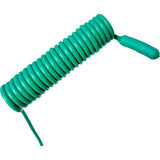






Heating cable for seedlings and cuttings, 4 or 10 m
Regular price
$23.00
Regular price
Sale price
$23.00
Unit price
/
per
This heating cable unrolls beneath your seed trays and cutting pots to warm the grow medium from below. Flexible, it follows the shape of a shelf or a tray, and comes in 4 m for 30 W or 10 m for 60 W.
100 % secure payment
The summary
- What you receive: a 4 or 10 m heating cable, extended by a power cable with a plug.
- The principle: a gentle heat, spread beneath the trays, which warms the grow medium from the bottom.
- Which length: 4 m for a shelf or a single tray, 10 m for an entire seedling table.
- Consumption: 30 or 60 W, that is 0.72 or 1.44 kWh per day in continuous operation.
- Flexibility: the cable follows the contours you give it, whereas a rigid mat imposes its own shape.
- For aquaponics: a heated seedling table that prepares the seedlings for the net pots.
Flexible heating cable to roll out under seedling and cutting trays
A heating cable is an electric cable whose PVC sheath encloses a resistance wire: once plugged in, it produces a gentle, even heat along its whole length. Laid out under seed trays or pots of cuttings, it warms the grow medium from below, where seeds germinate and roots form, while the air in a conservatory or an unheated greenhouse stays cool at the end of winter. This Neptune Hydroponics model comes in two lengths, 4 m for 30 W and 10 m for 60 W, and is extended by a power cable fitted with a plug.
Its flexibility is what sets it apart from a heating mat. A mat imposes its rectangular surface, whereas the cable can be laid in tight zigzags under a narrow shelf, in loops around a group of pots or in back-and-forth runs under an entire seedling table. This lets you distribute the heat exactly where your crops are, and you can adapt the density of the loops to your needs: tight loops heat a small area more, while spaced loops spread the same power over a larger area.
〰️ Fitting under the trays
The cable is laid flat, on a stable surface, in regular loops that never cross or touch, because two overlapping strands concentrate heat at a single point. You then place the trays or pots directly on top, making sure they sit in good contact with the base so that the heat passes into the grow medium rather than into the air. The power cable stays out of the watered area, with the plug connected in a dry spot, and a digital thermometer and hygrometer placed between the trays shows you the temperature reached.
Zigzag
Under a narrow shelf, tight back-and-forth runs concentrate the heat beneath a single row of trays.
In loops
Around a group of pots of cuttings, a few wide loops are enough to warm the base.
No crossing over
The strands never overlap, so that the heat stays evenly distributed along the whole length.
On contact
The trays rest directly on the cable, so that the heat passes into the grow medium.
A cable is plugged in dry and must not be cut
Never shorten the cable: its length sets its power output, and cutting it makes it dangerous. Keep the plug and the power cable dry, out of reach of watering water, and connect it to a socket protected by a 30 mA RCD, the threshold that protects people. Do not place heavy or sharp objects on the heating strands, and unplug the cable before moving it.
Peat pods on the cable
Placed in a tray above the cable, peat germination pods make the most of the heat from below, since their small volume warms up quickly. You sow one seed per pod, then transplant the whole pod when its roots come through, without disturbing the young plant. Emergence stays even from one pod to the next, because they all receive the same warmth.
Not all seeds need the same warmth, so the heating cable is set according to the crop rather than the calendar. The germination tables from Oregon State University give an optimum of about 29 °C for tomato and pepper, whereas tomato no longer germinates below about 10 °C and pepper below about 16 °C: for these summer vegetables, sown in late winter in a cool room, bottom heat genuinely makes a difference to emergence. Lettuce is content with far less, with an optimum of about 24 °C, and above 25 °C its seed can enter thermodormancy and refuse to germinate; spinach has its optimum around 21 °C. Under salad crops, the cable therefore serves only to take the grow medium out of the cold, and excess heat would harm the seedling. Since the cable heats continuously, a greenhouse thermostat with probe plugged in between the socket and the cable cuts the heating as soon as the probe, slipped into a pot, reaches a setpoint of around 22 °C, without lasting above 24 to 25 °C: this is the rule of caution, and the density of the loops now serves only to spread the heat.
⚡ Which length to choose
The 4 m, 30 W version suits a windowsill, a propagation tray or two seedling trays set side by side. The 10 m, 60 W version covers an entire seedling bench, or several rows of trays in an unheated greenhouse. On running costs, the 30 W cable uses about 0.72 kWh a day when run continuously, and the 60 W one about 1.44 kWh, a modest outlay compared with the few weeks a batch of seedlings takes. To switch the heating off at night or once the seedlings have come up, a daily timer plugged in at the socket does the job without any intervention.
🌱 In aquaponics
An aquaponic system is better restocked with plants that already have roots than with seeds sown in the grow bed, where the water stays cool in spring. The FAO manual on small-scale aquaponics recommends, in fact, a separate nursery using an inert grow medium such as rock wool or coconut fibre, and transferring the plants only at least two weeks after their first leaves appear. The heating cable turns a simple shelf into this heated nursery: you start a batch of lettuces or herbs there, then transfer the plants to the net pots as soon as their roots show through the support, with no potting compost to cloud the fish water. By staggering your sowings two or three weeks apart, you always have a batch ready to replace the one you are harvesting, as the guide to making a success of spring seedlings in aquaponics shows. The cable is for the nursery only: it must not be placed in a flooded grow bed or in contact with the pond water, whose temperature is managed with an aquarium heater suited to the volume. The FAO puts lettuce between 18 and 26 °C in the system water, a range the plants return to without shock if they germinated in mild rather than hot conditions.
Technical specifications
The cord
- Length and power
- 4 m and 30 W, or 10 m and 60 W
- Feeding
- 220 to 230 V2 m of non-heating cable up to the socket
- Sleeve
- Flexible PVC
- Use
- Indoors, under trays and potsSeedlings, cuttings, young plants
Consumption
- 4 m cord
- Around 0.72 kWh per dayRunning continuously
- 10 m cable
- Around 1.44 kWh per dayRunning continuously
Installation
- Layout
- Even loops, with no crossovers
- Contact
- Trays resting on the bead
- In the water
- Never submergedNeither a flooded grow bed nor a pond
- Protection
- 30 mA residual current deviceRecommended for damp environments
To allow for in addition
- A timer
- Daily timerTo switch the heating off at set times
- A thermostat
- Greenhouse probe thermostat, 16 AIt cuts the heating at the set temperature
4 further specifications are available in the detailed view.
In the box
- 1 heating cable of 4 or 10 m, depending on the version chosen, with its power cable and plug
Lengths, power ratings, voltage and cable from the brand; power consumption calculated from the rated power. Germination temperatures based on Oregon State University and the University of Florida, nursery stage based on the FAO.
4 m or 10 m?
The same cable in two lengths, with an output proportional to the length.
4 or 10 metres?
Answer based on the space you have available, and the right length lights up in the table.
| Length (m) | Power (W) | Daily consumption (kWh) | Typical coverage | Price | |
|---|---|---|---|---|---|
| 4 m, 30 WYour choice | 4 m | 30 W | 0,72 kWh | Shelf or cutting tray | $23.00 |
| 10 m, 60 WYour choice | 10 m | 60 W | 1,44 kWh | An entire seedling table | $32.00 |
4 m, 30 W
Length (m)4 m
Power (W)30 W
Daily consumption (kWh)0,72 kWh
Typical coverageShelf or cutting tray
10 m, 60 W
Length (m)10 m
Power (W)60 W
Daily consumption (kWh)1,44 kWh
Typical coverageAn entire seedling table
Lengths and power ratings from the brand; consumption figures calculated from the power rating.
Buying guide
What length for your support?
Estimate your
delivery time
Your estimate
Delivery
Estimated time
It covers preparing your order and then the transit time quoted by the carrier, counted in working days.
It is not a guaranteed delivery date: public holidays, peak periods, customs or a carrier delay can extend it. The exact amount, in your currency, is worked out in the cart once your address is entered.
The cord is sent coiled in a small parcel from a distributor's warehouse in France. The exact postage cost is shown in your basket.
Frequently asked questions
8 questions
6 key questions, 8 in the detailed view
You may also like


Related articles

Seedling
Getting spring seedlings off to a good start in aquaponics
This article slots into the season the batches of seedlings that the heated table prepares.
Read the article

Diagnosis
Germination failure: causes and solutions
A cold grow medium slows germination, and that is the fault that bottom heat corrects.
Read the article

Seedling
Setting up an indoor seedling area
Heat, light and humidity are organised there around a seedling table.
Read the article

Crops
What to sow in autumn in aquaponics
Autumn seedlings come up better on a heated shelf, sheltered from the first cold nights.
Read the article

Crops
Herbs in aquaponics
Basil and mint are rooted as cuttings in the warm before joining the baskets.
Read the article
Let us talk about your project
A question about this product or your setup? Our team will answer and advise you.

Interest-free instalment payments
Offered depending on the cart amount, at checkout.

Delivery in 2 to 15 working days
Depending on the products and shipping sites. Estimate by destination in the estimator on this page.

After-sales service 7 days a week by email or chat
Our team answers all your questions.

Shop responsibly
Become part of the change.
