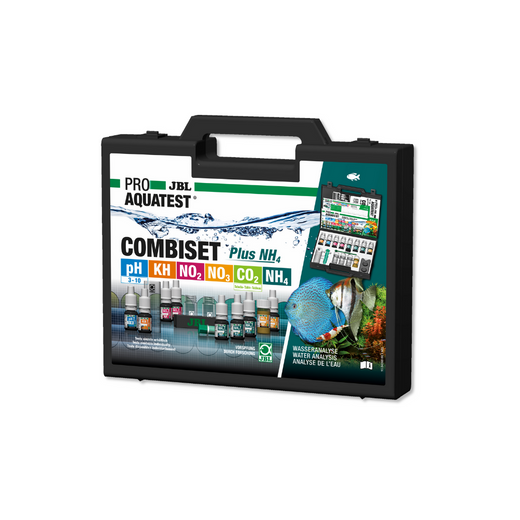

Reagent refill for KH carbonate hardness test
Regular price
$7.00
Regular price
Sale price
$7.00
Unit price
/
per
$2.33 × 3 with no fees
Klarna.
This bottle is the titration reagent for the carbonate hardness test, sold separately. You add it drop by drop to 5 ml of water until the colour changes from blue to orange-yellow.
The number of drops added gives the result directly, at a rate of 1 °dKH per drop. The test tube from your kit remains in use, and there is no colour chart to replace with a titration method.
 Customer support 7 days a week by email
 Delivery within 2 to 15 business days
100 % secure payment
The summary
- What it measures: carbonate hardness, i.e. the buffering capacity of your water.
- What the box contains: 1 bottle of titration reagent.
- How to read the result: count the drops until the colour change — no colour chart needed.
- How many tests: the softer your water, the more tests you get, as each degree uses one drop.
- What to aim for: 5 to 16 °dKH in freshwater, at least 5 in a pond.
- Reading to half a degree: using 10 ml of water, one drop equals 0.5 °dKH.
The titration bottle on its own, one drop equals 1 °dKH per 5 ml of water
Carbonate hardness, or KH, measures the dissolved hydrogen carbonates in your water, that is, its capacity to neutralise acids without the pH shifting. This bottle is the titration reagent alone from the drop-based KH test kit, and it is used with the test tube from your kit.
🔢 One drop, one degree
Fill the test tube with 5 ml of water, then add the reagent drop by drop, swirling after each drop, until the colour changes from blue to orange-yellow. The number of drops added gives the carbonate hardness directly in German degrees, so no colour chart is needed. One drop also corresponds to 1.78 °fH, an alkalinity of 0.36 mmol/L and 21.8 mg/L of hydrogen carbonates, which allows you to compare your result with a mains water analysis report.
Per 10 ml of water
By doubling the sample volume, each drop is worth only 0.5 °dKH, which refines the reading for soft water.
One bottle matched to your water
Each test uses as many drops as the water has degrees of hardness, so soft water uses the bottle more slowly.
🦠 A reserve that bacteria consume
Most freshwater fish and plants do well between 5 and 16 °dKH, and a garden pond requires at least 5 °dKH. In aquaponics, this reserve naturally declines, as the bacteria that convert ammonium into nitrate consume alkalinity, approximately 7.14 mg/L expressed as calcium carbonate for every milligram per litre of ammoniacal nitrogen. The larger the feed ration given to the fish, the more frequently this measurement should be taken, and the guide on the nitrogen cycle covers this reaction in detail.
The first turn to yellow stops the count
Stop counting at the first drop that shifts the colour to orange-yellow, not when a clean yellow appears. Swirl after each drop; if you do not, the colour change comes too late and your result will read too high. Also take care not to confuse this bottle with the total hardness reagent, which changes from red to green.
Raise alkalinity with potassium bicarbonate
When your reading drops below 5 °dKH, potassium bicarbonate raises the carbonate hardness whilst supplying potassium to your plants, which are often deficient in it in aquaponics. Dose it in small amounts, then carry out a titration the following day using this same test kit to verify the effect. The pH test completes the picture, as it shows the pH that your carbonate hardness is maintaining.
🧯 A corrosive and flammable reagent
The reagent is classified as Danger, with hazard statements H314, H318, and H226: it causes severe skin burns and eye damage, and is a flammable liquid. Work over a sink, replace the child-resistant cap after each series of tests, and store the bottle in a dry place at room temperature in its original packaging. Always keep it upright, nozzle facing down and dry on the outside, as a drop that exits with an air bubble counts as a full drop and will shift your result by one degree.
Technical specifications
What the refill contains
- Contents
- 1 reagent bottleKH titration reagent, child-safety cap
- Corresponding test
- KH carbonate hardness test, ref. 2411000The refill is used with the test tube supplied with this test
Counting the drops
- Value of one drop
- 1 °dKH per 5 mlOver 10 ml, one drop equals 0.5 °dKH
- Colour change
- From blue to orange-yellowStop at the first drop that causes the colour to shift.
Reference and safety
- Manufacturer's reference
- JBL 2411100, PROAQUATEST rangeNot to be confused with 2411000, which is the complete test kit
- Hazard classification
- Danger, single bottleHazard statements H226, H314 and H318. Store dry, cap tightly closed, away from all ignition sources
To budget for separately
- Test tube
- That of the carbonate hardness testFilled to 5 ml, or to 10 ml for half-degree readings
- How to raise the KH
- Potassium bicarbonateIt provides alkalinity and leaves potassium available to your crops
In the box
- 1 bottle of KH titration reagent, with child-resistant cap
Reference, EAN code, contents, protocol, number of measurements and hazard statements taken from the JBL product sheet and instructions on 07/10/2026. The 10 ml reading is from the JBL FAQ. The alkalinity consumption by nitrification, 7.14 mg/L as CaCO3 per mg/L of ammonia nitrogen, is a standard value in water treatment.
Documents & manuals
Official manufacturer's instructions, in French
Full titration test protocol, reference volume and endpoint reading rule. This is the kit's instruction leaflet: it applies equally to the refill, which contains the same reagent.
Document not showing? Some publishers block display inside a frame, so open it in a tab.
Estimate your
delivery time
Your estimate
Delivery
Estimated time
It covers preparing your order and then the transit time quoted by the carrier, counted in working days.
It is not a guaranteed delivery date: public holidays, peak periods, customs or a carrier delay can extend it. The exact amount, in your currency, is worked out in the cart once your address is entered.
Package weight 0.02 kg, dispatched to a collection point or to your home address, your choice at checkout. The bottle is sent in its original packaging. The exact shipping cost is shown in the basket.
Frequently asked questions
6 questions
6 key questions
You may also like


Related articles

Parameters
Regulating pH in an aquaponics system
The parameter to correct first, and the one that shifts on its own once you have corrected it.
Read the article

Guide
The nitrogen cycle in aquaponics
The reaction that consumes alkalinity, explained step by step.
Read the article

Start-up
Getting started with an aquaponic system
The first few weeks, when this parameter drops faster than at any other point during the following year.
Read the article

Guide
Common mistakes in aquaponics
Adjusting pH without checking the buffer is high on the list of common mistakes.
Read the article

Troubleshooting
Understanding and correcting cloudy water in aquaponics
A mineral film is quite different from a bacterial film, and titration tells them apart.
Read the article

Pond
Koi carp in aquaponics
In a pond, diluted rainwater causes this parameter to drop with every heavy storm.
Read the article
Let us talk about your project
A question about this product or your setup? Our team will answer and advise you.

Interest-free instalment payments
Offered depending on the cart amount, at checkout.

Delivery in 2 to 15 working days
Depending on the products and shipping sites. Estimate by destination in the estimator on this page.

After-sales service 7 days a week by email or chat
Our team answers all your questions.

Shop responsibly
Become part of the change.
