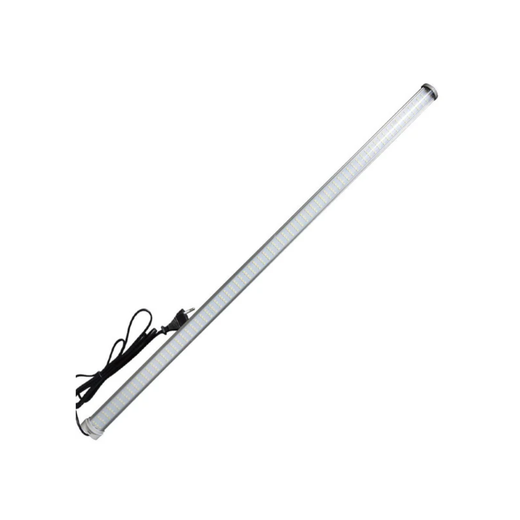


Horticultural LED bar light, 465 to 1,000 W
Regular price
$638.00
Regular price
Sale price
$638.00
Unit price
/
per
$212.66 × 3 with no fees
Klarna.
The Lumatek Zeus is an LED light fitting with magnetic bars that lights large areas of vegetables indoors or in a winter greenhouse, from 1.2 x 1.2 m to 2 x 1.5 m depending on the power. Rated IP65 and fanless, it is adjusted in four steps with the supplied dimmer.
 Customer support 7 days a week by email
 Delivery within 2 to 15 business days
100 % secure payment
The summary
- What you receive: the frame, its magnetic LED bars, the power supply, a dimmer and the hanging kits.
- How to choose: 465 W for 1.2 x 1.2 m, 600 W for 1.4 to 1.5 m per side, 1,000 W Pro for 2 x 1.5 m.
- The height: from 50 cm to 1 m above the plants, lower for tomatoes than for salad leaves.
- The adjustment: four steps from 25 to 100%, or a 0-10 V controller for several light fittings.
- The climate: humidity from 20 to 90% without condensation, above the grow bed and not above the fish tank.
- The lifespan: bars rated for 60,000 hours, with a 5-year manufacturer's warranty.
Bar-style grow light for a large growing bed, a room or a greenhouse
The Zeus Pro is a large-area horticultural LED light fitting designed by the British brand Lumatek. Each model consists of a black metal frame onto which aluminium bars of around 100 W (93 W on the 465 W model), covered in diodes, are clipped by magnets. The power supply is fixed to the frame or can be mounted away from the growing area. No fan runs: heat is dissipated through the bars, so the light fitting stays silent. The bars are independent and can be replaced one by one, and the whole unit is rated IP65, protected against dust and water jets. This rating protects against accidental splashes, but it does not make the Zeus a unit for a soaking-wet room: the instructions specify air at 20 to 90% humidity, without condensation.
📐 Four power ratings, four growing areas
465 W, 1.2 x 1.2 m
Its five bars deliver 1,353 µmol/s, enough to cover a grow bed 1.2 m square or a 120 cm grow tent.
600 W, 1.5 x 1.5 m
Its six bars deliver 1,770 µmol/s over an area 1.4 to 1.5 m square, enough for one large grow bed or two beds side by side.
1,000 W Pro, 2 x 1.5 m
Its ten bars, spaced further apart on a 1.70 m frame, deliver 2,925 µmol/s over a row of growing tables.
1,000 W Xtreme, 1.5 x 1.5 m
Its ten tightly spaced bars concentrate 2,925 µmol/s over an area 1.5 m on each side, an intensity intended for a CO2-enriched crop.
Your choice depends first on the area to be lit, then on the crop. All four models use the same Lumileds 3030 HE Plus white diodes at 4000 K and Osram SQ3.24 red diodes at 660 nm, for a stated efficacy of up to 2.9 µmol/J. The 465 W carries five 93 W bars, the others 100 W bars, so only the area covered really changes from one model to the next. The 1,000 W Pro spreads its ten bars over 1.70 x 1.10 m, whereas the 1,000 W Xtreme packs them more tightly into 1.18 x 1.09 m. Its intensity then exceeds 1,000 µmol/m²/s down to about fifty centimetres, which is only justified for fruiting vegetables grown in a closed greenhouse enriched with CO2; hung higher, it covers 1.8 x 1.8 m without CO2. In every case, the 120° angle spreads the light across the stated area.
Switch the Zeus on with a contactor timer
A household timer copes poorly with the inrush current of an LED power supply of this size, and the Zeus manual rules it out: the day length should be handled by a contactor timer or the brand's lighting controller. Allow 14 to 16 hours of daylight for seedlings and salad leaves, and around twelve hours once fruiting vegetables start to flower. Ratchet hangers rated at 68 kg raise the frame as the plants grow, without you having to unhook the light.
No misting or condensation on the frame
The Zeus withstands an accidental splash, but its instructions rule it out for soaking-wet rooms, for outdoor use and for misters, and specify air without condensation. Plug it into a socket protected by a 30 mA residual current device, keep the socket, the contactor and the controller dry, and form a drip loop in the cable so that a drop falls to the floor rather than into the socket. Always unplug the light before removing a bar or cleaning it, then let the bars cool for 20 to 30 minutes before touching them.
🍅 Adjusting the light to suit the crop
Salad leaves and herbs are content with 200 to 400 µmol/m²/s, while tomatoes, peppers and cucumbers in production benefit from 600 µmol/m²/s and more. Under the Zeus 465 W at full power, the average intensity measured over 1.2 x 1.2 m reaches 758 µmol/m²/s at 30 cm, 667 at 50 cm and 593 at 1 m: set to 50% and hung at one metre, it therefore suits your leafy vegetables, and at full power at around 50 cm, your fruiting vegetables. Under the 600 W, the average falls from 631 µmol/m²/s at 50 cm to 513 at 1 m, and under the 1,000 W Pro from 794 to 641 µmol/m²/s over 2 x 1.5 m. The 1,000 W Xtreme reaches 1,148 µmol/m²/s at 30 cm and still delivers 708 µmol/m²/s at 1.5 m. Above 1,000 µmol/m²/s, enrich the air with CO2 in proportion to the light level, at a rate of 1 ppm per µmol/m²/s.
🐟 Above an aquaponic installation
A Zeus 600 W covers a grow bed measuring 1.4 to 1.5 m on each side, filled with clay pebbles, above or beside a fish tank installed in a garage, cellar or greenhouse. Direct the light towards your plants and cover the tank with an opaque sheet, because lit water turns green: the algae consume the nutrients meant for the crops, make the dissolved oxygen swing between day and night and clog the filters. The humidity rising from the water also calls for regular ventilation, since the light fitting is designed for air free of condensation: an oscillating clip-on fan circulates the air beneath the frame, and extraction renews the air in the room. At full power, keep the surroundings below 25 °C: in summer, lower the intensity or ventilate. The article on tomatoes in aquaponics sets out in detail how to grow fruiting vegetables under artificial light.
The lit area also determines the number of plants and the size of the tank. Under the Zeus 465 W, a 1.2 x 1.2 m bed, or 1.44 m², holds around thirty lettuces spaced 18 to 30 cm apart, or four to seven tomato plants set 40 to 60 cm from one another. On the tank side, this area calls for 40 to 50 g of feed per square metre per day for leafy vegetables, and 50 to 80 g for fruiting vegetables, according to the FAO. You therefore feed 58 to 72 g per day for a lettuce bed under the 465 W, and 150 to 240 g for 3 m² of tomatoes under the 1,000 W Pro. This way you size the tank according to the lit area, rather than adding light to plants that the fish cannot feed sufficiently.
Almost all the electricity a light fitting consumes ends up as heat in the room: the data sheet for the 465 W model gives 1,689 BTU per hour, or about 495 W of heat, and the Xtreme's gives nearly 3,500 BTU per hour, about 1,000 W. In winter, this heat benefits an unheated aquaponic space, where it helps you keep the water temperature within your fish's range. In summer, it adds to the heat of the sun and pushes the water towards temperatures at which dissolved oxygen falls: light at night, when the air is cooler, or extract the hot air. A thermometer and hygrometer placed at plant height tells you when to step in.
💡 Daily light and height
Instantaneous light intensity does not tell the whole story: plants respond to the total amount of light received over the day, the daily light integral, expressed in moles per square metre. It equals the light intensity multiplied by the lighting duration in hours, then by 0.0036. Tomatoes need 20 to 30 mol per day, strawberries 17 to 20, and lettuce performs best at around 17. If you hang the Zeus 465 W at 1 m, the upper limit given in the instructions, it delivers 593 µmol/m²/s: over 12 hours, it provides about 26 mol, the dose a tomato plant needs in production. For a salad crop, the same height with the dimmer at 50% and 16 hours of lighting comes close to the target of 17 mol, while halving the power consumption.
Salad leaves and herbs
They need 12 to 17 mol per day, dimmer at 50% and the frame raised high.
Strawberry plants
They need 17 to 20 mol per day, at medium intensity.
Tomatoes and peppers
They need 20 to 30 mol per day, at full power and with the fixture lowered.
Above 1,000 µmol
CO2 supplementation becomes necessary for the plants to benefit.
⚡ Power consumption and control
At full power, the 465 W draws 475 to 495 W, the 600 W draws 615 to 645 W and the two 1,000 W models draw 1,021 to 1,075 W, depending on the mains voltage. Over 16 hours, the 465 W therefore uses nearly 7.9 kWh, and the 600 W about 10.3 kWh. At the 50% setting, power falls to 251 W on the 465 W and 328 W on the 600 W, roughly half of full power. The supplied dimmer is fixed with a hook-and-loop strap close to the light fitting. If you install several light fittings, the manufacturer's Digital Panel Plus 2.0 controller, or any 0-10 V controller, can control up to 100 together, in 1% steps, with a gradual sunrise and sunset that spare the plants an abrupt change from darkness to full light.
🔧 Installation, maintenance and warranty
The 465 W frame measures 998 x 900 x 52 mm and weighs 10 kg, the 600 W measures 1,091 x 1,182 x 52 mm and weighs 13.5 kg, the 1,000 W Pro measures 1,700 x 1,100 x 48 mm and weighs 17.5 kg, and the Xtreme measures 1,181 x 1,091 x 106 mm and weighs 18 kg. So make sure you have a solid anchor point, such as a beam or grow tent bar, and hang the frame perfectly level, leaving at least 5 cm of air between the luminaire and the ceiling of a 150 cm grow tent. The bars clip in magnetically and can be removed one at a time, which makes cleaning easier and allows a faulty bar to be replaced without changing the whole luminaire.
Allow about ten years at 16 hours a day before reaching the 60,000 hours quoted for the bars; the light fitting itself carries a 5-year warranty. Dust the bars with the light unplugged and cooled down, using a dry or barely damp cloth and no abrasive products, because a film of dust or limescale on the diodes reduces the light reaching your plants. Also check the condition of the suspension cables and the mains cable every time you clean, especially in a room where water is constantly evaporating.
📦 In the box
In the box you will find the frame and its connection cables, the magnetic LED bars, from 5 to 10 depending on the model, the power supply and its cables, the 0-10 V dimmer and its hook-and-loop fastener, the metal suspension cables and the instructions. The 5 m extension leads that let you move the power supply away from the frame are ordered separately.
Technical specifications
Lighting
- Photosynthetic flux
- 1,353 to 2,925 µmol/s1,353, 1,770 and 2,925 µmol/s depending on the model
- Yield
- Up to 2.9 µmol/J
- Spectrum
- White 4000 K and red 660 nm
- LEDs
- Lumileds 3030 HE Plus, Osram SQ3.24
- Lighting angle
- 120°
- Average intensity
- 593 to 1,148 µmol/m²/sFrom the 465 W at 1 m to the Xtreme at 30 cm, at full power
The light fitting
- Power consumption
- 475 to 1,075 WDepending on the model and the mains voltage
- LED bars
- 5 bars of 93 W, 6 or 10 bars of 100 W
- Net weight
- 10 to 18 kg
- Protection
- IP65, passive coolingAir at 20 to 90% humidity, without condensation
- Heat output
- 1,689 to 3,497 BTU/hTo be included in the room's ventilation
- Rod lifespan
- 60,000 hours5-year manufacturer's warranty
Usage
- Illuminated area
- 1.2 x 1.2 to 2 x 1.5 m
- Height above the plants
- 50 cm to 1 mAt least 5 cm of air below the ceiling
- Dimming
- 25, 50, 75 and 100%Or external 0-10 V controller
- Feeding
- 220 to 240 V, 50/60 HzSocket protected by a 30 mA RCD
- Maximum ambience
- 25 °C at full powerAbove that, turn the dimmer down or ventilate
- No CO2 below
- 1,000 µmol/m²/sBeyond that, 1 ppm of CO2 per µmol/m²/s
To allow for in addition
- Timer
- Contactor timerNo household timer, according to the instructions
- Height adjustment
- Ratchet hangers
12 further specifications are available in the detailed view.
In the box
- 1 frame with its connection cables
- 1 Lumatek power supply with cables
- 1 0-10 V dimmer with hook-and-loop fastening
- 1 set of metal suspension cables
- 1 instruction leaflet
- 5 to 10 magnetic LED bars, depending on the power chosen
Manufacturer's values (data sheets for the Zeus 465 W, 600 W and 1,000 W Pro 2.9, 1,000 W Xtreme, Zeus 600 W Pro manual). Light benchmarks by crop: Cornell University CEA group; balance between plants and fish: FAO.
Manufacturer and product safety
- Website
- www.lumatek-lighting.com
Information provided under Regulation (EU) 2023/988 on general product safety.
Documents & manuals
Document not showing? Some publishers block display inside a frame, so open it in a tab.
Estimate your
delivery time
Your estimate
Delivery
Estimated time
It covers preparing your order and then the transit time quoted by the carrier, counted in working days.
It is not a guaranteed delivery date: public holidays, peak periods, customs or a carrier delay can extend it. The exact amount, in your currency, is worked out in the cart once your address is entered.
The light is sent in its original box, shipped from a distributor's warehouse in France. The exact shipping cost is shown in your basket.
Frequently asked questions
12 questions
6 key questions, 12 in the detailed view
You may also like


Related articles

Crops
Growing tomatoes in aquaponics
This guide follows the tomato from choosing the variety to harvest, including pruning and pollination.
Read the article

Season
Heating your greenhouse in winter
Insulation, thermal mass of the water and backup heating keep the greenhouse frost-free, where the Zeus extends the days.
Read the article

Gesture
Pollinating your plants indoors
Away from bees and wind, flowers often stay sterile, and this guide shows the technique that pollinates them.
Read the article

Guide
LED lighting for indoor growing
This guide converts the intensity of a light fitting into a daily light dose for each crop.
Read the article

Assembly
Build your own aquaponic system
This article explains how an aquaponic system works and what you need to know before building one.
Read the article

Crops
Growing strawberries in aquaponics
This guide presents strawberry varieties and the conditions that make them produce in aquaponics.
Read the article
Let us talk about your project
A question about this product or your setup? Our team will answer and advise you.

Interest-free instalment payments
Offered depending on the cart amount, at checkout.

Delivery in 2 to 15 working days
Depending on the products and shipping sites. Estimate by destination in the estimator on this page.

After-sales service 7 days a week by email or chat
Our team answers all your questions.

Shop responsibly
Become part of the change.
