



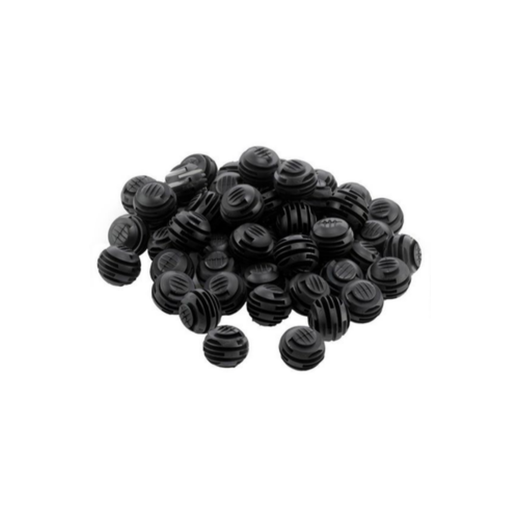

IchiPond Optinit start-up bacteria for ponds, 12,000 to 40,000 L
Regular price
$16.00
Regular price
Sale price
$16.00
Unit price
/
per
$5.33 × 3 with no fees
Klarna.
Optinit seeds a pond filter with spore-forming nitrifying bacteria, along with mineral salts and trace elements. It is used to start up a new filter, or to restart a filter after winter, a clean or a treatment, as soon as the water rises above 10 °C.
Three tubs treat up to 12,000, 24,000 or 40,000 litres.
 Customer support 7 days a week by email
 Delivery within 2 to 15 business days
100 % secure payment
The summary
- Which tub: 200 g up to 12,000 L, 400 g up to 24,000 L, 700 g up to 40,000 L.
- What it provides: spore-forming nitrifying bacteria, mineral salts and trace elements.
- When to use it: at start-up, in spring and after a clean-out, from 10 °C.
- How to dose it: one 15 g scoop per cubic metre of water.
Nitrifying bacteria to start or restart a pond filter from 10 °C
In a pond, fish release ammonia, which is toxic even at low levels. Two families of bacteria convert it, first into nitrites and then into nitrates, which are far less harmful: this is nitrification. These bacteria live in the filter, on the filter media. In spring, after a winter when the cold water put them into dormancy, or after a thorough clean, the colony is too weak to keep up with the fish as they start feeding again. Optinit provides nitrifying bacteria in spore form, which activate on contact with water and colonise your filter faster than a colony starting from zero.
🦠 When to use it
Use Optinit as soon as the water rises above 10 °C, when restarting the filter at the end of winter, when filling a new pond, and after anything that has weakened the colony: a complete filter clean, a change of filter media, a course of medication or a large water change. The product also contains mineral salts and trace elements that support the bacteria as they get started. Over the following 2 to 3 weeks, an ammonia test and a nitrite drop test, carried out every 2 or 3 days, show you whether the colony has taken over: both values should return towards zero.
New pond
The filter is seeded before the fish arrive.
Late winter
The filter restarts as soon as the water rises above 10 °C.
After a treatment
One dose rebuilds the colony affected by the medication.
Media replaced
New filter media are colonised more quickly.
The dosage is one 15 g scoop per cubic metre of water. Spread the dose in the filter and at the surface of the pond, where the water circulates most. Switch off the UV lamp for 3 days, long enough for the bacteria to settle, and keep good aeration: nitrification consumes a lot of oxygen. For a 6 m³ pond, you therefore need 6 scoops, or about 90 g.
Maintain KH while the filter gets going again
Nitrification consumes alkalinity: in soft water, KH falls over the weeks, pH becomes unstable and bacterial activity slows down. The KH booster for ponds keeps carbonate hardness above 6 dKH and so stabilises the pH during the recovery. Measure your KH before the first dose of Optinit, then every week during the first month.
🧪 Monitoring recovery
Here is a sample schedule for a 6 m³ pond restarted in March, when the water reaches 11 °C. On day one, pour the 6 measures into the filter and onto the surface, switch off the UV lamp and feed your fish very lightly. On days 3, 6 and 9, test for ammonia and nitrite. A slight rise in ammonia, then in nitrite, is normal; as long as the readings stay low, carry on without changing the water. Around the third week, both readings fall back towards zero and nitrate appears: the colony has taken over, and feeding can return to normal.
Three mistakes often slow down recovery. If you rinse the filter media under tap water, you destroy the bacteria living in it: always rinse them in pond water. Feeding generously from the first warm days brings in more ammonia than the colony can process. Finally, an algae or parasite treatment applied at the same time can weaken the bacteria: leave a few days between them.
The tub reseals well after use and should be kept dry, away from frost and heat. The 200 g size covers a starter dose for 12,000 litres; the 400 g and 700 g sizes suit large ponds, or allow you to restart the filter in spring and then top up again after a summer clean. In a heavily stocked pond, a half dose a few days after the first helps the colony keep up.
🌱 In aquaponics
In an aquaponic system, nitrification is the whole link between the fish and the plants: the nitrates it produces are the fertiliser for the crops. If you seed the filter at start-up, you shorten the cycling, the period of a few weeks during which ammonia and nitrite levels rise before the colony becomes established. The guide to starting an aquaponic system properly details these steps and the tests to carry out.
Technical specifications
The essentials
- Contents
- Spore-forming nitrifying bacteriaWith mineral salts and trace elements.
- Dosage
- 15 g per m³One measure per cubic metre of water.
- Water temperature
- Above 10 °C
- Storage
- Kept dry, between 10 and 25 °C
The three pots
- 200 g
- Up to 12,000 L
- 400 g
- Up to 24,000 L
- 700 g
- Up to 40,000 L
- Manufacturing
- Belgique
In the box
- 1 tub of Optinit bacteria with its measuring scoop, depending on the size chosen
Composition, dosage, temperature and sizes recorded on 09/10/2026 from the manufacturer's data sheet and from specialist retailers.
Which pot for your pond?
The same product in three sizes. What separates them is the volume of water to be treated.
Which tub?
Answer one question and the table highlights the pot that suits you.
| Pond volume (L) | Capacity (g) | Typical pond | Price | |
|---|---|---|---|---|
| Recommended 200 gYour choice | 12000 L | 200 g | Pond up to 12 m³ | $16.00 |
| 400 gYour choice | 24000 L | 400 g | Pond up to 24 m³ | $30.00 |
| 700 gYour choice | 40000 L | 700 g | Pond up to 40 m³ | $48.00 |
200 gRecommended
What the pot treats
Pond volume (L)12000 L
Capacity (g)200 g
Typical pondPond up to 12 m³
400 g
What the pot treats
Pond volume (L)24000 L
Capacity (g)400 g
Typical pondPond up to 24 m³
700 g
What the pot treats
Pond volume (L)40000 L
Capacity (g)700 g
Typical pondPond up to 40 m³
Volumes and capacities taken on 09/10/2026 from the manufacturer's data sheet.
Help choosing
A question about your pond
Estimate your
delivery time
Your estimate
Delivery
Estimated time
It covers preparing your order and then the transit time quoted by the carrier, counted in working days.
It is not a guaranteed delivery date: public holidays, peak periods, customs or a carrier delay can extend it. The exact amount, in your currency, is worked out in the cart once your address is entered.
Delivered to your home by Colissimo or Chronopost, as you choose during checkout. The exact amount is shown in your basket, according to the total weight of your order.
Frequently asked questions
6 questions
6 key questions
You may also like




Related articles

Start-up

Understanding

Start-up

Season

Pond
Green water in the pond: five solutions without chemicals
Nitrates and green water in spring.
Read the article
Let us talk about your project
A question about this product or your setup? Our team will answer and advise you.

Interest-free instalment payments
Offered depending on the cart amount, at checkout.

Delivery in 2 to 15 working days
Depending on the products and shipping sites. Estimate by destination in the estimator on this page.

After-sales service 7 days a week by email or chat
Our team answers all your questions.

Shop responsibly
Become part of the change.
