




Hobby fine filter foam, cut to size, 50 x 50 x 5 cm
Regular price
$19.00
Regular price
Sale price
$19.00
Unit price
/
per
$6.33 × 3 with no fees
Klarna.
A sheet of fine filter foam measuring 50 x 50 cm and 5 cm thick, with a porosity of 30 ppi, which can be cut to fit any filter.
It traps fine particles and provides a surface for beneficial bacteria, in freshwater and marine tanks alike.
 Customer support 7 days a week by email
 Delivery within 2 to 15 business days
100 % secure payment
The summary
- Its dimensions: 50 x 50 cm, 5 cm thick, cut to size.
- Its fineness: 30 ppi, a fine foam for clear water.
- Which filters it suits: all of them, from the aquarium filter to the homemade filter.
- How to maintain it: squeeze it out in tank water, never under the tap.
A sheet to cut to size, to fill any filter or build your own.
Filter foam does two jobs at once in a filter. It traps particles like a sieve, and its thousands of pores also provide a large surface area for nitrifying bacteria, which convert the ammonia released by the fish into nitrates. This Hobby sheet, 50 x 50 cm and 5 cm thick, can be cut with scissors or a bread knife, so you can replace the foams in a commercial filter, fill a homemade filter or add a polishing layer in a pond filter.
🔍 A fine porosity, 30 ppi
The fineness of a foam is expressed in ppi, the number of pores per inch. The higher the figure, the smaller the pores. At 30 ppi, this blue foam falls into the fine category: it retains the particles that coarse 10 ppi foams let through, and gives visibly clearer water. In return, it clogs more quickly: ideally place it after a coarser medium that catches the larger debris.
In a multi-stage filter, the classic order runs from coarsest to finest: first a coarse-pore foam or pre-filtration noodles, then the biological medium, such as biological filtration balls, then this fine foam as a finishing stage. It can also serve, on its own, as the filling of a small internal filter or an air-driven filter, where it provides both mechanical and biological filtration.
Replacing a foam
A piece cut to the dimensions of the original sponge takes its place in the filter.
DIY filter
The plate fills a hand-built filter bed or filtration bucket.
Finish
A thin layer, placed after the biological media, traps the last particles.
Pre-filter
A sleeve wrapped around the strainer protects a pump's intake.
✂️ Cutting without waste
Measure the inside of your filter's compartment, then mark out the piece with a felt-tip pen, adding 2 to 3 mm on each side: the foam should be slightly compressed so that the water cannot bypass it. Cut a piece that is a little too large first and test it, as it is easy to remove a centimetre but impossible to add one back. Work with a long, serrated-blade knife, using a back-and-forth motion, without pressing down. Take a pond filter whose compartment measures 24 x 24 cm: the sheet yields 4 pieces of 25 x 25 cm, enough to fill two levels and keep two spare pieces.
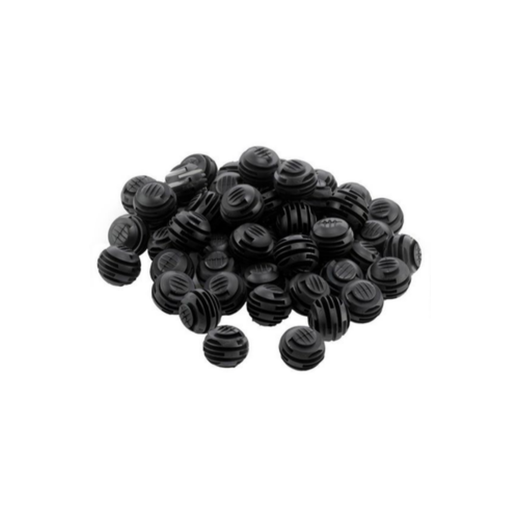
Ceramic noodles in front of the fine foam
When placed first in the filter, a fine 30 ppi foam clogs quickly with large debris. Ceramic pre-filter noodles, placed before it, catch this debris and spread the water across the whole surface of the foam. You then rinse it less often, and it keeps the bacteria established in its pores for longer.
A pre-cut foam suits only one specific filter model, and it often costs more per square centimetre than a sheet. With 2,500 cm² of surface area and 5 cm of thickness, this sheet represents 12.5 litres of foam, enough to fill several filters or to renew the same part several times. The offcuts need not go to waste: a narrow strip wrapped around a pump strainer stops you drawing in fry and shrimp, and a small cube serves as a pre-filter in a quarantine tank. Keep unused pieces in a sealed bag, dry and away from light, which weakens the foam over time.
For maintenance, squeeze the foam in a bucket of water from the aquarium or pond when your filter's flow rate drops, never under the tap: the chlorine and the temperature shock would kill the established bacteria. A properly rinsed foam lasts for years. Replace it only when it tears or no longer springs back into shape, and never at the same time as the filter's other media.
🌱 In aquaponics
In aquaponics, filters are often built by hand, in a tank, a barrel or a bucket, and a foam sheet to be cut to size fits in easily. Placed after a settling tank, it catches the fine particles that would otherwise settle on the roots or in the clay pebbles, and it adds extra surface area for bacteria. The guide to building your own aquaponic system shows where to place the filter and the pump in the circuit. One sheet is often enough to equip your homemade filter, with enough left over to replace the finishing layer several times.
Technical specifications
The essentials
- Dimensions
- 50 x 50 x 5 cm
- Porosity
- 30 ppi, fine
- Role
- Mechanical and biological filtration
- Water
- Freshwater and marine
To budget for separately
- Pre-filtration
- Pre-filtration noodles
- Tool
- A knife with a long, serrated blade
In the box
- 1 sheet of fine blue filter foam, 50 x 50 x 5 cm
Dimensions, porosity and uses recorded on 09/10/2026 from the manufacturer's descriptions.
Estimate your
delivery time
Your estimate
Delivery
Estimated time
It covers preparing your order and then the transit time quoted by the carrier, counted in working days.
It is not a guaranteed delivery date: public holidays, peak periods, customs or a carrier delay can extend it. The exact amount, in your currency, is worked out in the cart once your address is entered.
Delivered to your door by Colissimo or Chronopost, as you choose during checkout. The exact cost is shown in your basket, based on the total weight of your order.
Frequently asked questions
8 questions
6 key questions, 8 in the detailed view
You may also like





Related articles

Understanding
The nitrogen cycle in aquaponics
The exact mechanism that turns fish waste into food for the plants, and the reason why a new system needs a few weeks before it reaches its working rhythm.
Read the article

Water

Guide

Start-up
Let us talk about your project
A question about this product or your setup? Our team will answer and advise you.

Interest-free instalment payments
Offered depending on the cart amount, at checkout.

Delivery in 2 to 15 working days
Depending on the products and shipping sites. Estimate by destination in the estimator on this page.

After-sales service 7 days a week by email or chat
Our team answers all your questions.

Shop responsibly
Become part of the change.
