





Aquapouss'Mini aquaponic aquarium
Regular price
$447.00
Regular price
Sale price
$447.00
Unit price
/
per
$149.00 × 3 with no fees
Klarna.
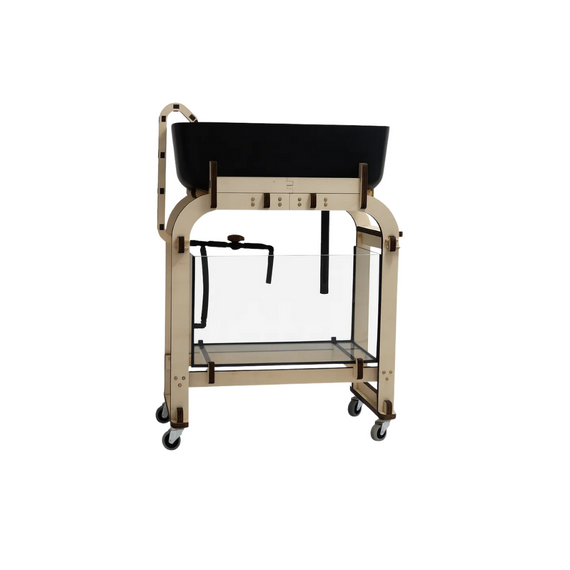
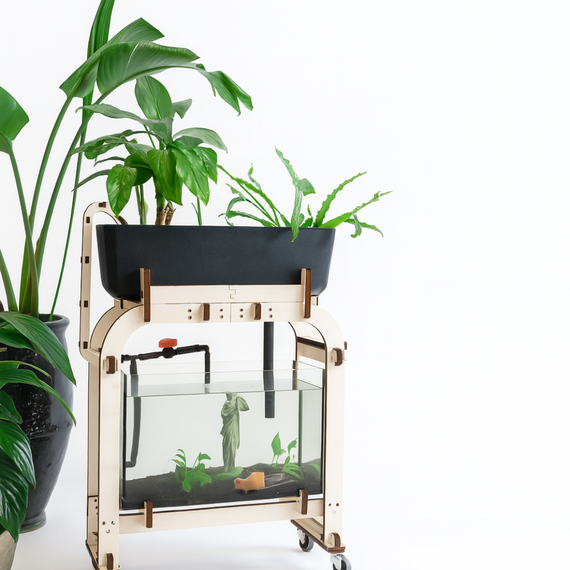
The Aquapouss'Mini is an indoor aquaponic aquarium: a 43-litre aquarium and a 15-litre grow bed, supported by an FSC wooden frame mounted on castors. It is ideal for a first setup at home or at school, with small ornamental fish.
100 % secure payment
The summary
- What you receive: a 43-litre aquarium, a 15-litre grow bed and an FSC-certified wooden frame.
- Dimensions: 64 cm wide, 30 cm deep, 85 cm high, on four castors.
- What it produces: two or three culinary herbs to cut, and a few ornamental fish.
- Getting started: 3 weeks of cycling before the first fish, pump at the very least.
Fish below, herbs above, for a living room or a classroom
The principle comes down to a loop. The pump submerged in the aquarium lifts the water up to the grow bed, filled with clay pebbles, then the water passes through the pebbles and returns to the aquarium by gravity. During this passage, the bacteria living on the pebbles convert the ammonia excreted by the fish into nitrite, then into nitrate, which the roots absorb as fertiliser. The plants therefore grow without soil or added fertiliser, and the water returning to the fish has been cleared of part of what they excreted.
🏡 Easy to position, easy to move
This kit is just 30 cm deep by 64 cm wide and 85 cm high, so it fits almost anywhere in a room. The four castors let you move it easily without emptying the aquarium, to vacuum around it or bring it closer to a window in winter, then put it back in place without help. Two side hooks, two plant supports and a feeding shelf are built into the frame, which assembles by slotting together wooden dowels. The shelf keeps the food pot within reach, out of the water. The grow bed combines 33% wood and 20% recycled plastic, and it is fully recyclable.
🐟 What 43 litres allow
A volume of this size can house a few small ornamental fish, such as guppies, platies or a bristlenose pleco. The 15-litre grow bed is filled with about 10 litres of expanded clay pebbles and holds two or three adult plants, ideally herbs. For vegetable production, you need to move out into the garden, to a 500-litre pond or larger. This small volume is, however, well suited to observation, in the classroom or at home, since the nitrogen cycle can be followed in full, from feeding right through to the harvested leaf. Start with two or three fish and a pinch of food, rather than a full shoal.
3 weeks before the first fish
Install the plants and the bacteria first, then wait 3 weeks before introducing any fish. During this time, the bacterial colony settles on the clay pebbles and becomes able to convert the ammonia. A fish put in on the first day ends up in a tank that does not yet purify anything, and this is a frequent cause of failure on a small volume. Set the pump to its minimum flow rate during this period.
A 10-litre bag of beads for the tank
Add a 10-litre bag of clay pebbles to your order: this is the volume the grow bed requires, and a single bag is enough. The pebbles serve both as a support for the roots and as a surface for the nitrifying bacteria, so they act as the system's biological filter from the moment it is filled with water.
🌡️ The water temperature
The choice of fish depends on the temperature of the room. Goldfish prefer slightly cooler water, around 15 to 22 °C: they suit a room that is not heavily heated and do without a heater. Guppies, platies and bristlenose plecos are tropical fish, which live between 18 and 28 °C. In a room heated all year round, the water follows the ambient temperature and generally stays within this range; in a classroom closed during the holidays or a cool room in winter, it can drop below 18 °C. An immersed aquarium heater then keeps the water at the set value, and a suction-cup thermometer stuck to the glass lets you read it at a glance. Also avoid full sun behind a window, which quickly warms a volume of 43 litres.
🌿 What grows in the tub
The grow bed holds herbs or indoor foliage plants. Their roots reach down into the clay pebbles, where water circulates constantly, and they find there the nitrates that come from the fish waste. Place the cabinet near a bright window, but out of direct sunlight on the aquarium: plants need light to grow properly.
Herbs
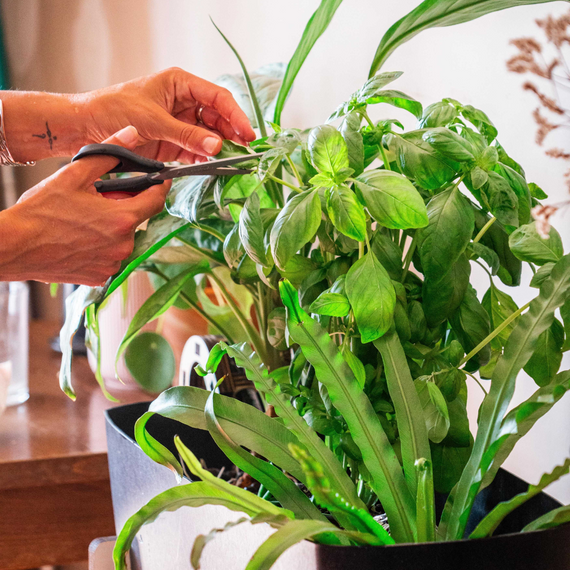
Mint, chives and basil are harvested by cutting and grow back. Two or three mature plants fill the 15-litre grow bed.
Green plants
An indoor foliage plant settles into the tray and fills the unit all year round.
💧 The pump and flow rate
The NJ600 submersible pump, made in Italy, uses 7 W and its flow rate is adjustable from about 200 to 600 litres per hour. At maximum flow rate, the volume of the aquarium therefore passes through the grow bed about 14 times an hour, and about 5 times at the minimum setting. The minimum suits start-up, while the bacterial colony establishes itself; you then increase the flow rate if the water in the bed stagnates. Running continuously, the pump uses about 61 kWh a year.
🔧 Assembly by interlocking
The structure is made of 15 mm FSC poplar plywood, laser-cut, and is assembled with 28 dowels and 16 screws, with no glue or varnish. The kit arrives with its pipework, its filter grid and an illustrated instruction leaflet, and assembly requires a screwdriver and a hammer. The wooden parts are cut in Dijon and the whole is assembled near Nantes. The demountable structure makes maintenance and replacing a part easier, and the whole is guaranteed for 2 years.
📦 What arrives in the box
The box contains the 43-litre aquarium, the 15-litre grow bed, the FSC-certified wooden structure, the pump, the pipework system and the filtration grid, the 28 dowels and 16 screws, the four castors, the two side hooks, the two plant supports, the feed-resting shelf and the illustrated instructions. Assemble the whole unit in the room where it will stay, as the filled aquarium alone holds 43 kg of water.
The rest is for you to choose: the ornamental fish, the plants, the substrate decoration, the clay pebbles, the fish food, the net, a thermometer and test strips to monitor the water during the first few weeks.
Technical specifications
Volumes and dimensions
- Aquarium
- 43 L
- Grow bed
- 15 LIt fills with around 10 litres of clay pebbles.
- Dimensions
- 64 × 30 × 85 cmWidth, depth, height: just 30 cm deep.
- Mobility
- 4 castors
Circulation and materials
- Pump
- 7 W, NJ600 modelAdjustable flow rate of roughly 200 to 600 L per hour.
- Structure
- FSC wood, assembled with dowels
- Grow bed
- 33% wood, 20% recycled plasticFully recyclable at end of life.
- Warranty
- 2 years
Getting started
- Assembly
- Screwdriver and hammer28 dowels and 16 screws, no glue or varnish.
- Before the fish
- 3 weeksThe time it takes for the bacterial colony to establish itself on the beads.
- Flow rate at start-up
- Pump at minimum
- Water changes
- One third every 3 months
To allow for in addition
- Clay pebbles
- About 10 L for the bed
- The fish and the plants
- Small ornamental fish, herbs
- Water monitoring
- Test strips and thermometer
- The substrate and the food
- Sand, hiding places, net, food
8 further specifications are available in the detailed view.
In the box
- 1 aquarium of 43 L and 1 grow bed of 15 L
- 1 FSC timber structure, 28 dowels and 16 screws
- 1 NJ600 pump (7 W), the piping and the filter grille
- 4 castors and 2 side hooks
- 2 plant stakes and 1 feed rest shelf
- 1 illustrated assembly instruction leaflet
Volumes, dimensions, materials, pump, indoor use and package contents: official Aquapouss page, recorded on 11/10/2026. Pump flow rate: Newa NJ600 model datasheet. Guppy temperature: FishBase.
Manufacturer and product safety
- Manufacturer
- Glaez Aquaponie (GLÆZ)
- Postal address
- 9 rue Jean Jaurès, 44620 La Montagne, France
Information provided under Regulation (EU) 2023/988 on general product safety.
Indoors or outdoors: two ways to get started
The indoor aquaponic aquarium and the small garden pond, compared on what sets them apart.
The smaller one, or the garden one?
Both circulate the same water between fish and plants. One sits on a console in a heated room, the other stands outdoors and holds ten times more water.
| Water volume (L) | Location | Growing medium | Moves on castors | Inspection portholes | Price | |
|---|---|---|---|---|---|---|
| Recommended Aquapouss'Mini aquaponic aquariumYour choice | 43 L | Indoors | 15 L tub | Yes | No | $447.00 |
| Small garden aquaponics kit, 500 L pondYour choice | 500 L | Outdoor | 1 m² of growing space | No | Yes | $990.00 |
Aquapouss'Mini aquaponic aquariumRecommended
What sets them apart
Water volume (L)43 L
LocationIndoors
Growing medium15 L tub
What you notice in use
Moves on castorsYes
Inspection portholesNo
Small garden aquaponics kit, 500 L pond
What sets them apart
Water volume (L)500 L
LocationOutdoor
Growing medium1 m² of growing space
What you notice in use
Moves on castorsNo
Inspection portholesYes
Volumes, locations and equipment taken from the manufacturers' documentation, on 20/09/2026.
Help choosing
Indoors on a piece of furniture, or outdoors in the garden?
Estimate your
delivery time
Your estimate
Delivery
Estimated time
It covers preparing your order and then the transit time quoted by the carrier, counted in working days.
It is not a guaranteed delivery date: public holidays, peak periods, customs or a carrier delay can extend it. The exact amount, in your currency, is worked out in the cart once your address is entered.
The exact shipping cost is calculated at checkout, based on the total weight of your order and the destination. Lead times start from dispatch and remain estimates. For a destination not listed here, write to us at contact@univers-aquaponie.com.
Frequently asked questions
12 questions
6 key questions, 12 in the detailed view
You may also like
Related articles

Start-up
Getting started with an aquaponic system
Getting an aquaponic system off to a good start, before the first fish.
Read the article

Understanding
The nitrogen cycle in aquaponics
The nitrogen cycle in aquaponics, which this small volume makes visible.
Read the article

Fish
Goldfish in aquaponics
The goldfish in aquaponics, one of the fish that this tank can house.
Read the article

Grow media
Which grow medium to choose for aquaponics?
Which grow medium to choose in aquaponics to fill the grow bed.
Read the article

Plants
Which plants can be grown in aquaponics?
Which plants to grow in aquaponics, to help you choose what goes in the bed.
Read the article
Let us talk about your project
A question about this product or your setup? Our team will answer and advise you.

Interest-free instalment payments
Offered depending on the cart amount, at checkout.

Delivery in 2 to 15 working days
Depending on the products and shipping sites. Estimate by destination in the estimator on this page.

After-sales service 7 days a week by email or chat
Our team answers all your questions.

Shop responsibly
Become part of the change.
