Understanding and correcting cloudy water in aquaponics

Written by Tristan Ulrich · December 19, 2025
Eau trouble dans un bassin aquaponique

An aquaponics system is not a simple machine ; it is a living and complex ecosystem. It relies on a fragile but fascinating balance between three main players : fish, plants, and, above all, the invisible bacteria that link the two.

Whether it's a bacterial bloom, a mechanical problem, or an algae overgrowth, cloudy water is a sign that your system isn't functioning properly. Let's delve into the causes of this phenomenon to learn how to control it.

Why does water turn cloudy in aquaponics?

In aquaponics, water is not simply a growing medium: it is the central carrier of the entire ecosystem. It transports nutrients, connects the fish to the plants and allows the nitrogen cycle to function. Because the system operates as a closed loop, the slightest disturbance is quickly reflected in the appearance of the water.

Cloudy water in aquaponics is almost always a sign of a biological or mechanical imbalance. It generally indicates an accumulation of suspended particles, excessive bacterial activity or a filtration problem. Uneaten food, fish waste, an immature biofilter or an overloaded system are all factors that can affect water clarity. Understanding the source of this turbidity is essential in order to correct the problem without harming the fish or the overall functioning of the system.

Milky water: a sign of an immature biofilter

Whitish water : a sign of an immature biofilter

White or milky water in the first few days after start-up is perfectly normal. It usually accompanies the colonisation of the biofilter by nitrifying bacteria.

When a system starts up, bacteria multiply rapidly, creating a visible bacterial bloom that looks like a milky haze. In this case, there is nothing to do but wait. The haze clears naturally once the nitrogen cycle reaches equilibrium.

Milky water can also appear after an overly aggressive filter clean or a large water change, both of which disturb the bacterial colony. The water clears again once the microbial population stabilises.

Green water: an algae bloom Clear UV Sterilizer (7-60)

Green water : an algae bloom

Green water indicates excessive growth of microscopic algae. They appear when three conditions are met : direct light, presence of nutrients, and heat.

This phenomenon often occurs when the pond is exposed to sunlight, or when nutrients (especially nitrates) accumulate in the water. Algae are not toxic in small quantities, but they consume oxygen at night and compete with plants.

The solution is to reduce direct sunlight, improve mechanical filtration, and increase the capacity of the biofilter. A well-balanced system, with limited sun exposure and adequate oxygenation, rarely produces excessive algae.

Brown or cloudy water: a mechanical problem

Brown or murky water : a mechanical problem

Brownish or slightly cloudy water is often caused by suspended particles. These particles generally come from fish food, waste, or a clogged mechanical filter.

When too much solid matter is circulating in the water, it indicates that the first stage of filtration — mechanical filtration — is not doing its job. A simple improvement to the pre-filter, more frequent cleaning of the filter foams, or the addition of a settlement chamber is often enough to clarify the water.

In aquaponics, it is important that mechanical filtration is kept separate from biofiltration to avoid smothering the nitrifying bacteria.

The essential role of water quality 6-in-1 pond water analysis kit

The essential role of water quality

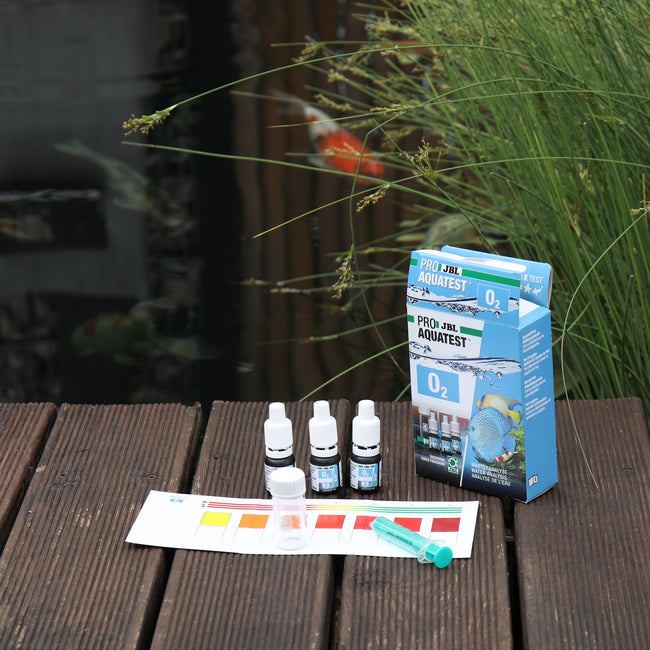
To understand and resolve cloudy water, three key parameters must be monitored : ammonia, nitrites, and nitrates.

A spike in ammonia or nitrites often coincides with cloudy water. This indicates that the biofilter is unable to absorb the current organic load, either because it is too new, has been disturbed, or there are too many fish in the system.

Temperature also influences water clariy : cold water slows down nitrification and promotes the accumulation of undegraded organic matter.

How to achieve long-lasting clear water?

How to restore clear water permanently ?

The key to restoring clear water isn't adding products or doing a complete water change. On the contrary, massive water changes can worsen the problem by further disrupting the bacterial colony. To restore water clarity, you need to restore the biological balance. This involves :

– a sufficient supply of oxygen,
– clean and efficient mechanical filtration,
– a mature or reinforced biofilter,
– a diet adapted to the quantity of fish
– controlled light exposure.

In most cases, the water naturally becomes crystal clear once the ecosystem stabilizes.

Fine-tuning mechanical filtration Mechanical pre-filtration noodles : 1, 2 and 5L

Refine mechanical filtration

If your water is full of small suspended particles or is starting to turn green, it means your mechanical filtration system (the first stage that traps larger debris) is letting too much matter through. Unfiltered waste decomposes in the water and feeds microscopic algae.

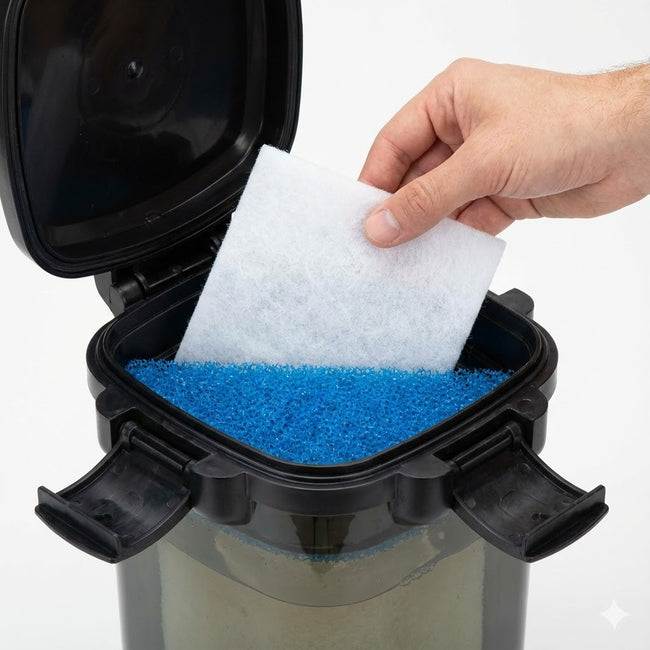
The solution is to temporarily add a finer filtration layer at the beginning of the circuit. Using filter floss (perlon) or fine mesh foams allows the water to be "polished" by retaining the finest particles.

Warning : these materials clog quickly, they must be rinsed very regularly (every 2-3 days) until the water runs clear.

Boosting biological filtration Biological filter balls : 1, 2 and 5L

Boost biological filtration

If your water looks like diluted milk, it's a bacterial bloom. This means that the "good" nitrifying bacteria (those that live in the biofilter) are not numerous enough to compete with the free-water bacteria that are clouding your pond.

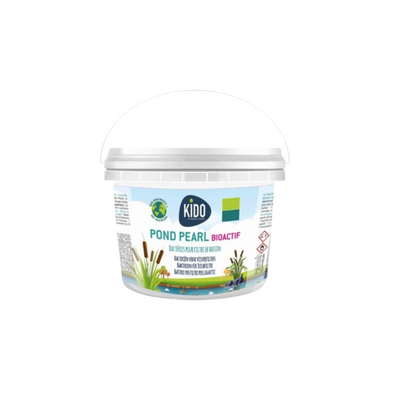
This is common at startup or after over-cleaning the filter. To help the system, you need to re-seed your biofilter extensively. Adding a biological activator (concentrated bacteria) allows you to quickly recolonize your filter media and clear up cloudy water.


Preventing cloudy water in aquaponics: understand before you act

Cloudy water is not a problem in itself: it is a message sent by the ecosystem.
A well-sized system with a generous biofilter, consistent water circulation, and good oxygenation stays clear without any particular effort. Prevention comes down to a simple routine: feed in moderation, clean the pre-filter, monitor the parameters, and shield the water from direct light when it serves no purpose for the crop.

Over time, observation becomes your best tool. A mature, stable, and well-maintained aquaponic system is capable of remaining crystal clear for years — proof of a perfectly managed balance.

Sources

SRAC Publication 453, Recirculating Aquaculture Tank Production Systems, A Review of Current Design Practice, Solid particle size classes, mechanical filter fineness, settling residence times, and the effect of fines on the biofilter.

Oklahoma State University Extension, Recirculating Aquaculture Tank Production Systems, Aquaponics, Integrating Fish and Plant Culture, Ratio between daily feed ration and growing area, and the proportion of solids retained by a clarifier.

Oklahoma State University Extension, Nitrification and Maintenance in Media Bed Aquaponics, Cycling duration and ammonia and nitrate thresholds during biofilter maturation.

New Mexico State University, Circular 680, Aquaponics, Dissolved oxygen thresholds, ammoniacal nitrogen, nitrite and nitrate levels, and the effect of temperature.

UF/IFAS HS1252, A Practical Guide for Aquaponics as an Alternative Enterprise, Fish stocking densities, feed rations, and daily water turnover rates.

SMIDAP, report of the OPRA 2 programme, aquaponics in recirculating systems, French operational feedback on daily water exchange rates and organic load in closed-loop systems.

Frequently asked questions

Not directly. What causes harm is what comes with it — a drop in oxygen and a rise in nitrogen. Test before treating anything.

It follows the cycling timeline, which university technical guides most commonly place between two and four weeks in a media bed, longer in cold water. As long as ammonia and nitrite levels are still moving, the film may come and go.

Beyond that period, a persistent film is no longer a start-up biofilm. Look instead for organic overload, a saturated mechanical filter releasing fines back into the system, or a feeding rate that exceeds what the bacterial biomass can process.

It is worth understanding what a UV unit actually treats. It destroys what passes in front of the lamp and is alive and free in the water — essentially the suspended algae responsible for green water. On persistent green water that is well exposed to sunlight, the effect is spectacular within a few days.

A UV unit does not, however, remove any particles. On brown water loaded with fine solids, it will change nothing, and on a bacterial bloom during start-up it works against you, since it slows the colonisation your biofilter needs. It can also degrade certain iron chelates, which later manifests as chlorosis on young leaves — an effect well worth bearing in mind if you are supplementing with iron.

The sensible sequence is therefore to address the mechanical cause first, with a clean pre-filter and, where space allows, a properly sized settling stage. Recirculating aquaculture manuals recommend a residence time in the region of fifteen to thirty minutes in a settling tank to capture settleable solids. UV comes only afterwards, as a finishing step for an identified algae problem — never as the first response.
Water that remains cloudy after a thorough clean is almost always a question of particle size. Recirculating aquaculture manuals classify solids as follows.

  • Settleable solids, above around one hundred micrometres, which any settling chamber or screen will capture.
  • Suspended solids, between one and one hundred micrometres, which account for the bulk of visible turbidity.
  • Colloids, below one micrometre, which no domestic mechanical filtration will retain.

A drum filter typically operates at a few tens of micrometres, and a floating bead filter retains most particles in the same size range. In other words, the colloidal fraction cannot be filtered out — it has to be managed by reducing its production, which means feeding accurately and removing solids quickly.

This is the first hypothesis to test, because the solids load follows directly from the feed rate. Recirculating aquaculture publications indicate that roughly half of the feed consumed is excreted as solids, which gives a fairly blunt indication of what your filtration must handle every day.

The most useful sizing benchmark is the ratio between daily feed and growing area. University aquaponic guides cite around sixty to one hundred grams of feed per square metre of raft per day, and roughly a quarter of that figure for media beds or NFT. If you are well above these figures, turbid water is not an incident — it is the expected outcome.

The test is straightforward. Halve the feed rate for one week without changing anything else. If the water clears, you have your answer.

Because the cleaning is too thorough. Rinsing the foams, the bacterial media and the pre-filter at the same time removes a large proportion of the nitrifying colony, which lives on those surfaces. The system then goes through a mini cycle, complete with the white haze that comes with it.

Two habits are all you need. Clean only one stage at a time, leaving at least a week between each, and always rinse in water taken from the system itself — never under the tap, whose chlorine sterilises the media in a matter of seconds.

Read next

Salmonponics: aquaponics in cold water

Salmonponics: aquaponics in cold water

Aquaponics is often associated with pond fish like goldfish and koi. However, there is a variant perfectly suited for our temperate regions, cool climates, and winters : salmoponics. Trout, char, brook trout, these iconic

Read the article
Koi carp in aquaponics

Koi carp in aquaponics

Koi carp is one of the most popular species used in ornamental aquaponics. Hardy, gregarious, and producing a good amount of waste, it integrates perfectly into a well-designed system. This comprehensive guide gives you

Read the article
Regulating pH in an aquaponics system

Regulating pH in an aquaponics system

pH is one of the most sensitive and critical parameters in aquaponics. It directly influences the health of the fish, the effectiveness of nitrifying bacteria, and the plants' ability to absorb nutrients. An improperly

Read the article
Growing lotus in aquaponics

Growing lotus in aquaponics

The lotus is an aquatic plant whose flowers are emblematic of the most beautiful ornamental ponds. In aquaponics, in an ornamental system (a pond with goldfish or koi carp) that does not need to

Read the article
Aquaponics and Summer Holidays

Aquaponics and Summer Holidays

You're going away for two weeks in July and your aquaponics system will be running without you : this thought rightly makes you anxious, because heatwaves, evaporation, and fish feeding raise practical questions. Good

Read the article
Green pond water: 5 solutions

Green pond water: 5 solutions

In the middle of summer, the water in your pond turns an opaque green and you can no longer see your fish. Good news : five natural solutions, well combined, are enough to restore

Read the article