Beneficial insects against pests

Written by Tristan Ulrich · September 5, 2026
Coccinelle adulte dévorant une colonie de pucerons sur une tige, lutte biologique intégrée en aquaponie

In aquaponics, fish and plants share the same water, which makes most insecticides unusable. Beneficial insects and mites — predators and parasitoids — become the only truly sustainable strategy for protecting your crops.

Beneficial insects: your best line of defence

In an aquaponic system, anything you spray on the leaves will sooner or later end up in the fish water. An insecticide, even one marketed as natural, can destroy within hours the bacterial colony responsible for the nitrogen cycle, or directly poison your fish. This constraint, often seen as a drawback, can actually prove to be an advantage. It forces you to build a balanced ecosystem rather than simply treating symptoms.

Integrated biological control involves introducing or encouraging living organisms that regulate pests. Ladybirds, lacewings, parasitoid micro-wasps, predatory mites and nematodes form a complementary team, each specialised on a particular prey. We will look at how to identify your pests, which beneficial to choose for each one, at what release rate to introduce them, and what mistakes cause a good proportion of attempts to fail.

Seven-spot ladybird, a beneficial predatory insect that feeds on aphids infesting plants

What a beneficial insect actually is

A beneficial insect is a living organism that naturally regulates a pest population. There are two main groups. Predators consume their prey directly, like the ladybird that devours aphids. Parasitoids, on the other hand, lay their eggs inside a host, whose body nourishes the larva before it emerges.

This distinction is not merely academic. A predator acts quickly and is visible, which is reassuring. A parasitoid acts slowly and stays out of sight, but establishes itself durably when conditions suit it. Against an active infestation, the two are often used together: the predator to bring the population down, and the parasitoid to maintain control over time.

Most of these organisms are reared and sold by specialist European producers, packaged in vials, sachets, or hanging cards. They travel poorly beyond a few days, which explains the short delivery windows and the importance of releasing them promptly after receipt.

A domestic aquaponic system where fish and plants share the same water, which rules out any chemical treatments

Why chemicals are ruled out here

In conventional growing, a gardener can apply a treatment and then wait out the pre-harvest interval. In aquaponics, that logic simply doesn't hold. Water circulates in a closed loop between the fish tank, the biological filter, and the growing beds. Any molecule that washes off a leaf enters the circuit and stays there, with no dilution or renewal.

Pyrethroids, which are widely used in commercial insecticides, are particularly toxic to fish at very low concentrations. Copper-based treatments cause the same problem and also disrupt nitrification. Even black soap, often recommended as a safe option, warrants caution if the runoff finds its way back into the pond.

Sticking to biological methods is therefore not an ideological stance — it is a technical necessity. It is also what makes aquaponics both demanding and rewarding, since the health of your crops depends on an ecosystem you manage yourself, as illustrated by the most common beginner mistakes.

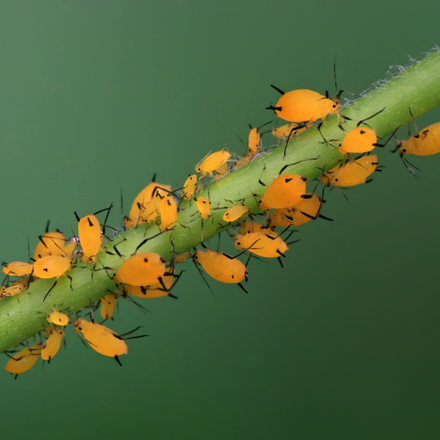
Colony of green aphids established on the stem of a young lettuce, the first pest to look out for

Spotting aphids in time

The aphid remains the number one pest in water-based growing systems, particularly on lettuces, chard and herbs. It is identified by clusters of soft-bodied insects — green, black or pinkish — gathered on young shoots and on the undersides of leaves, where the sap is most accessible.

Two signs betray its presence before it is even spotted. Honeydew, the sticky, shiny substance it excretes, coats the leaves and subsequently attracts a black sooty mould. Ants moving up and down the stems are a second warning signal, as they farm and protect the colonies.

Its strength lies in its speed. A female gives birth to fully formed offspring without mating, and a population can double within a few days when temperatures approach twenty-five degrees. Dealing with the first colonies takes infinitely less effort than trying to regain control three weeks later.

Observe and count before releasing anything

The most common mistake is to order beneficial insects the moment a pest is spotted, without knowing which one or how many. Yet each beneficial species is specialised. Ladybirds released against a whitefly infestation will do nothing, and the money will be wasted. Ten minutes of diagnosis is worth more than a hasty order.

The method comes down to three steps. Always turn leaves over, as the vast majority of pests live on the underside. Then choose around ten plants spread throughout the system and actually count the individuals on each one, rather than estimating by eye. Finally, record that count with the date, in a notebook or on your phone. Without a numerical baseline, you will never know whether the release worked.

This monitoring will also tell you when to do nothing. A very low, stable population accompanied by a few naturally occurring predators indicates a balance that would be counterproductive to disturb. Beneficial insects need prey to stay put, and a perfectly sterile crop is in reality a defenceless one.

  • Turn leaves over every three to four days during warm periods.
  • Count on ten indicator plants distributed throughout the system.
  • Photograph the damage to compare week on week.
  • Identify the species before ordering any beneficial insect.
  • Hang yellow sticky traps to detect flying pests.
Ladybird larva devouring aphids, the most voracious life stage of this beneficial insect

The ladybird larva, the most voracious of all

Everyone recognises the adult ladybird, far fewer people recognise its larva, which looks like a small slate-grey alligator spotted with orange. Yet it is the larva that does the real work. Depending on the species and conditions, a single larva typically consumes several hundred aphids during its development, whereas the adult's appetite is considerably more modest.

This difference has a practical implication. Suppliers most often sell larvae rather than adults, because adults tend to fly off shortly after release, while the larva, unable to fly, stays on whichever plant you place it on. If you spot these larvae appearing on their own in your garden, whatever you do, don't crush them.

Ladybirds give good results against concentrated, visible infestations. They are less suited to diffuse ones, where parasitoid micro-wasps have the upper hand thanks to their ability to actively seek out their hosts.

Aphid mummy parasitised by Aphidius with its emergence hole, a sign that the parasitoid is active

Aphidius, the parasitoid wasp for aphids

Aphidius colemani is a parasitic wasp measuring two to three millimetres, completely harmless to humans. The female seeks out aphids and lays a single egg inside each one. The larva develops within the host, whose body then hardens and takes on a characteristic golden-beige colour.

These husks are known as mummies, and they are your best indicators. A mummy with a round exit hole means a new wasp has already emerged and is hunting in your greenhouse. Never clean leaves that carry them — they represent a free, self-sustaining colony.

Commonly recommended release rates are around 0.5 individuals per square metre as a preventive measure, 0.5 to 1 for an early infestation, and up to around 2 for reinforcement, with repeated releases every eight to fifteen days. The species performs well between fifteen and twenty-five degrees, which covers the majority of European greenhouses during the main growing season.

Adult green lacewing resting on a leaf in a greenhouse, a versatile predator of aphids

The lacewing, a versatile predator

The green lacewing, recognisable by its translucent veined wings and golden eyes, is one of the most useful beneficial insects in protected cultivation. As with ladybirds, it is the larva that does the hunting. Equipped with long pincer-like mandibles, it attacks aphids as well as young whiteflies, thrips, and spider mite eggs.

This versatility makes it a sound choice when several pests are present at once — a frequent situation in a small domestic greenhouse growing a variety of species. It avoids the need to order multiple highly specialised beneficial insects.

The larvae are generally supplied in a vermiculite or buckwheat carrier, to be distributed directly over the affected foliage. Commonly cited application rates range from around ten to fifty larvae per square metre, depending on the severity of the infestation. One important point: the larvae are cannibalistic, so they must be spread out and never grouped together in the same spot.

Greenhouse whitefly on the underside of a tomato leaf, target of the parasitoid Encarsia formosa

Whitefly and Encarsia formosa

The whitefly, often called the greenhouse whitefly, rises in a cloud the moment you brush against a plant. It is particularly fond of tomatoes, aubergines, cucumbers and basil, and also produces a sticky honeydew that soils the harvest. Its larvae, flat and translucent, remain fixed to the undersides of leaves and often go unnoticed.

Encarsia formosa is the reference parasitoid against this pest, used in professional greenhouses for decades. It is supplied in the form of cards bearing glued pupae, to be hung in the foliage. Whitefly larvae that have been parasitised turn black, making monitoring very easy to follow with the naked eye.

Published application rates vary according to pest pressure, generally from 1.5 to 6 individuals per square metre per release, with two to three releases spaced approximately eight days apart after planting, then monthly maintenance. This beneficial insect requires warmth and becomes noticeably less active below eighteen degrees, which limits its use at the beginning and end of the season.
Fine webbing from red spider mites and discoloured stippling on a cucumber leaf in a greenhouse 360° digital thermometer and hygrometer

Red spider mites and Phytoseiulus

Red spider mite is not a spider but a tiny mite, barely visible without a magnifying glass. It thrives in warm, dry conditions — exactly the climate of a closed greenhouse in high summer. Leaves become speckled with pale dots, turn yellow, and then become covered in a fine, distinctive webbing.

Phytoseiulus persimilis is the predatory mite specifically targeted against it. Faster and slightly larger than its prey, with a bright orange colouring, it consumes both eggs and adults and can clear an infestation in two to three weeks. Recommended rates are typically between two and ten individuals per square metre, adjusted according to the severity of the attack.

The most effective lever, however, remains climatic. By raising relative humidity above sixty per cent through floor damping and controlled ventilation, you significantly worsen the reproductive conditions for red spider mite while favouring its predator.

Thrips, fungus gnats and other greenhouse visitors

Beyond the trio of aphids, whitefly and red spider mite, a few secondary pests recur regularly in water-based growing and are worth being able to identify. Thrips are slender insects of one to two millimetres that rasp plant tissue, leaving silvery patches dotted with black specks — their droppings. They hide inside flowers and young shoots, making them difficult to reach. The predatory mite Amblyseius swirskii and bugs of the genus Orius are among the most widely used responses, with the latter being especially effective when days are long.

Fungus gnats — those small black flies that hover just above the growing beds — are largely harmless as adults, but their larvae live in the moist grow medium and nibble the fine roots of young plants, opening the door to rot. They multiply rapidly when the surface of the grow medium remains permanently saturated, a common situation in poorly adjusted aquaponics systems.

Then there are leaf miners, whose larvae tunnel pale, winding galleries through the thickness of leaves, and slugs that take advantage of the constant moisture around the growing troughs. For the latter, physical barriers and regular trapping remain the simplest solution, with no risk whatsoever to the system's water.

Watering a clay pebble media bed to apply beneficial nematodes against substrate larvae

Nematodes against larvae

Beneficial nematodes are microscopic worms that live in moist grow medium and penetrate insect larvae to kill them. Steinernema feltiae is the most widely used species against fungus gnat larvae, while other species target vine weevils or certain soil-dwelling larvae.

They come in powder form, to be diluted in non-chlorinated water and then applied with a watering can over the entire surface of the growing bed. One technical point is particularly important: the temperature of the grow medium must generally exceed twelve degrees, and the medium must remain moist for several days to allow the nematodes to move around.

Aquaponics offers them precisely these favourable conditions, with a bed of clay pebbles kept constantly moist. Store the sachets in the refrigerator, observe the use-by date, and apply preferably in the evening, as ultraviolet light destroys them rapidly.

Caterpillar and feeding damage on a cabbage leaf, a target for Bacillus thuringiensis in soilless growing

Bacillus thuringiensis and caterpillars

Cabbage white and noctuid moth caterpillars attack mainly brassicas, chard and lettuces, leaving clean bite marks and clearly visible green droppings. On a small growing area, hand-picking in the evening remains the most straightforward and economical method.

When pressure increases, Bacillus thuringiensis is the benchmark treatment in organic growing. This bacterium produces protein crystals that destroy the gut of caterpillars after ingestion, with no effect on insects that do not feed on the treated leaves. The kurstaki strain is the one that targets lepidopteran larvae.

Its selectivity makes it more reassuring than a broad-spectrum insecticide, but caution remains essential in aquaponics. Treat on overcast days, avoiding any run-off towards the fish tank, and stop the water circulation during application if your system allows it. If in any doubt about a product, withholding treatment and picking by hand is preferable to a risky trial.

Insect-proof mesh stretched across the opening of a garden greenhouse to block pest entry

Insect netting first

The best beneficial organism is the one you never need. Before ordering anything living, keep pests out in the first place. In a greenhouse, that means fitting all vents and doors with a fine-mesh netting — the most cost-effective physical barrier there is.

The mesh size determines what you stop. A mesh of around one millimetre blocks cabbage white butterflies and most flies, whereas you need to go significantly finer to contain whitefly and thrips. The finer the mesh, the more it restricts airflow, so you should check your ventilation after installation.

Complement this with a few simple habits. Inspect every new plant before bringing it in, as pests most often arrive with a purchase from a garden centre. Remove dead leaves lying on the ground and space plants far enough apart to allow air to circulate between them.

What European regulations say, country by country

The use of beneficial organisms is common throughout Europe, but the legal framework governing it is not harmonised at EU level. Macro-organisms — that is, insects, mites and nematodes sold for biological control — are not subject to the same rules as conventional plant protection products. Each member state therefore applies its own regulations, based primarily on protecting local biodiversity against the introduction of non-native species.

The general principle is fairly straightforward. Native species or those already well established in a given territory may circulate freely, whereas the introduction of non-native species requires authorisation in several countries, including France. In practice, an amateur gardener buying from a reputable European supplier has no paperwork to deal with, since the producer only sells species that are permitted in each given country. This is one of the strongest reasons to choose a supplier based in your region rather than a distant vendor.

The most tangible differences for you are not legal but climatic. In a Mediterranean climate, the beneficial organism season runs from March to November and red spider mite is the dominant problem. In northern Europe, the useful window narrows and heat-demanding beneficials such as Encarsia formosa require a heated greenhouse to perform at their best. Adjust your release schedule to suit your region rather than following a generic calendar.

Yellow sticky trap suspended above the crops to monitor insect flight activity

The mistakes that ruin a release

The first mistake is leaving yellow sticky traps in place after the release. These traps are excellent for detection and monitoring, but they also catch your winged beneficials, particularly the parasitic wasps. Use them for diagnosis, then remove them before introduction.

The second mistake is prior treatment. An insecticidal soap or oil applied a few days beforehand leaves residues that kill the beneficials on arrival. Allow a minimum of one to two weeks between any treatment and a release, and longer for persistent products.

Then there is impatience and poor weather. A parasitoid will not bring a population down in three days — it takes two to four weeks to see a clear effect, and generally requires several successive releases rather than a single large one. Finally, release at the end of the day, never in full sun on scorching leaves, and do not forget to manage the ants that actively protect aphid colonies from your beneficial insects.

Conclusion: turning your greenhouse into an ecosystem

Moving to beneficial insects requires a change of mindset. The aim is no longer to eliminate a pest but to keep its population below the threshold at which it damages the crop. That means accepting a few aphids at all times, since they are the food source without which your predators will not stay. A perfectly clean crop is one that will collapse at the first invasion.

The winning approach comes down to a few principles. Keep pests out with physical barriers, inspect regularly by turning leaves over, identify the problem precisely before ordering, then introduce the right beneficial insect at the correct dose and in several releases. The climate in your greenhouse — humidity and temperature — often has a greater influence than the release itself, and adjusting it costs nothing.

This approach demands more attention than a chemical treatment, but it improves over time. Season by season, a population of beneficial insects establishes itself in your greenhouse, balances stabilise and interventions become less frequent. You then harvest healthy produce from a system in which the health of the fish, the bacteria and the plants is one and the same.

Sources

UMass Extension Greenhouse Crops and Floriculture Program, Biological Control: Greenhouse Pests and their Natural Enemies, Lists the pest and beneficial insect pairings used under cover, and supports the distinction between predators and parasitoids that underpins the article.

University of Connecticut IPM, Biological Control of Aphids, An integrated pest management resource on aphids, their field indicators, and the use of Aphidius parasitoids as described in the article.

Cornell University Department of Entomology, Biological Control: Phytoseiulus persimilis, Establishes the decisive effect of relative humidity and temperature on the predatory mite, with figures referenced in the FAQ and in the section on spider mites.

Cornell University Department of Entomology, Biological Control: Encarsia formosa, Documents the introduction strategies for the whitefly parasitoid and its temperature dependency, as discussed in the corresponding section.

Cornell University Department of Entomology, Biological Control: Nematodes, Justifies the target hosts, sensitivity to ultraviolet light and desiccation, and the cold-storage requirements of entomopathogenic nematodes discussed in the article.

Frequently asked questions

There is no direct risk. Insects or mites that fall into the water are simply consumed or caught by the filtration. The real risk lies elsewhere: in the release carriers loaded with vermiculite or buckwheat that cloud the water, and above all in any treatments you might be tempted to apply around the release area.

Yes, but with less consistent results. In a living room, winged beneficials disperse towards windows and are lost. Forms that stay on the plant work noticeably better: ladybird larvae, lacewing larvae, and predatory mites. With just a few plants, manually removing colonies and gently washing the foliage often remains more effective than a release.

The best approach is to release them within twenty-four hours. If that is not possible, keep the package cool and out of the light, following the producer's instructions.

  • Nematodes can be stored in the refrigerator, at around 4 to 8 °C, for a period ranging from a few weeks to several months depending on the formulation
  • Live insects and mites survive for a very short time only, a few days at most

Never freeze a package and never leave it in a car in direct sunlight.

No. The parasitic wasps used measure two to three millimetres, do not sting and are only interested in their hosts. Once prey runs out, their populations die off naturally.

Yes, and this even becomes the norm once several pests are present together. Simply avoid pairing a very generalist predator with a fragile parasitoid on the same plants, as lacewing larvae will readily consume whatever they come across. In practice, separate the zones or stagger releases by a few days.

It plays a significant role, particularly against red spider mite. Reference data on Phytoseiulus persimilis show that at 27 °C egg hatching collapses at around 40 per cent relative humidity, whereas it is almost complete at 80 per cent. A predator released into a dry greenhouse is therefore working against itself. Raising the humidity before introduction costs nothing and often makes the difference between success and failure.

Read next

Controlling pests in aquaponics

Controlling pests in aquaponics

Aquaponics has a reputation for being a clean, ecological, and naturally protective method of cultivation. However, like any living system, it can be affected by pests : aphids, gnats, mites, invasive algae, or unwanted

Read the article
What to sow in autumn in aquaponics

What to sow in autumn in aquaponics

Autumn is not the end of the growing season — it is the start of the most peaceful one. Here is what to sow, when to do it and how to achieve leaf harvests

Read the article
Preparing your aquaponic system for autumn

Preparing your aquaponic system for autumn

Autumn is the season that determines the health of your system throughout winter, as the water cools faster than the aquaponist's habits tend to change. Here is how to manage this transition without stressing

Read the article
Lettuce bolting

Lettuce bolting

Your aquaponic lettuces suddenly start bolting upwards, their leaves turn bitter, and a flower stalk appears : this is bolting, an almost systematic phenomenon in July and August. Good news, understanding its three causes

Read the article
Aquaponics and Summer Holidays

Aquaponics and Summer Holidays

You're going away for two weeks in July and your aquaponics system will be running without you : this thought rightly makes you anxious, because heatwaves, evaporation, and fish feeding raise practical questions. Good

Read the article
All about Ollas (Guide 2026)

All about Ollas (Guide 2026)

Olla irrigation (or Oyas) is a passive hydraulic engineering that redefines autonomy in modern vegetable gardens. Faced with recurring heatwaves and increasingly severe water restrictions in Europe, understanding the physics of microporosity and soil-plant

Read the article