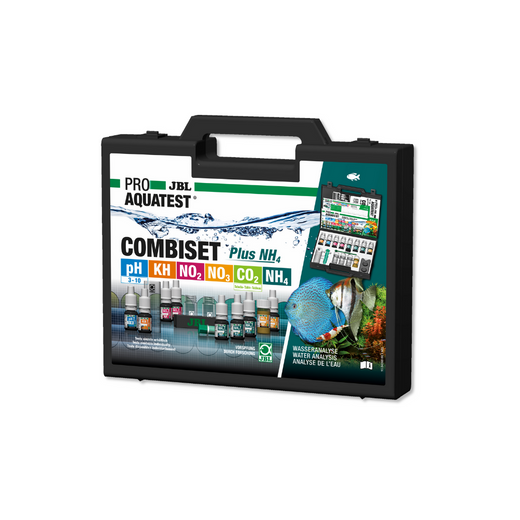


Water phosphate PO4 drop test, 50 measurements
Regular price
2,000.00 RSD
Regular price
Sale price
2,000.00 RSD
Unit price
/
per
This colorimetric test measures phosphate PO4 by drops, using a comparator block and a reference sample, for aquariums, ponds, and aquaponics. The scale starts at 0.05 mg/L, the range where the useful thresholds fall.
Phosphate feeds both plants and algae, and should be read alongside nitrate.

7/7 customer service by e-mail

Payment in instalments, free of charge
The summary
- In the box: 3 reagent bottles, 2 glass test tubes, a syringe, a double measuring spoon, a comparator block and a colour chart.
- What it measures: dissolved phosphate, from 0.05 to 1.8 mg/L, on a colour chart, with a blank sample that cancels out the natural tint of the water.
- How long it takes: twelve minutes per test, including ten minutes of waiting time, with approximately 50 tests per kit.
- Useful thresholds: 0.4 mg/L in a freshwater aquarium, 0.1 mg/L in a marine aquarium and in a garden pond.
- How to choose: this is the parameter that sets the 6-in-1 kit apart from the 14-in-1.
- What gets sent to you: a parcel weighing 0.12 kg, with reagents in their original box, available for collection point or home delivery.
Drop-based phosphate test, 50 measurements, for aquariums, ponds and aquaponics
Clean, unpolluted water contains around 0.01 mg/L of phosphate, whereas a heavily stocked tank can reach a hundred times that level without any visible sign. Phosphate does not cloud the water, has no smell, and causes no harm to fish at the concentrations found in an aquarium: it simply determines whether algae or your plants benefit from the nitrogen present. That is why it needs to be measured, and the Sensitive formulation in this kit reads from 0.05 mg/L.
🔬 Reading across two test tubes
The test uses two 10 ml test tubes: one receives the reagents while the other holds untreated water and serves as a reference sample in the grey comparator block. This setup compensates for the natural colour of the water and gives a reliable reading even in water darkened by peat filtration or a treatment, where a single test tube would return an artificially high value. The scale runs up to 1.8 mg/L, which comfortably covers the thresholds you need to monitor: 0.4 mg/L in a freshwater aquarium, 0.1 mg/L in a marine aquarium, and 0.1 mg/L in a garden pond.
🐟 Where does phosphate come from
The bulk of it comes from fish digestion and leftover food, as most people suspect. Two other sources, however, almost always go unnoticed. Some water companies add phosphates to the mains supply to reduce limescale and corrosion in the pipework, so your top-up water may already contain them straight from the tap. A garden pond also receives phosphates in spring, carried in by pollen and fertilisers from neighbouring land, which explains the algae blooms that appear even when you haven't changed anything about the way you manage it.
High phosphate, high nitrate
Both come from the same source: the tank receives more nutrients than it consumes.
High phosphate, low nitrate
The plants have used up the nitrogen and are struggling. Phosphate is building up without being used.
Low phosphate, algae present
Algae store it and keep growing after levels drop. Today's reading describes the water, not their reserves.
Low phosphate, slow-growing plants
In a heavily planted tank with few fish, it becomes a limiting factor and is dosed like a fertiliser.
Poorly dissolved powder throws everything off
Reagent 1 comes as a powder rather than a liquid, which changes how you handle it. Seal the test tube and shake until it has fully dissolved before adding the 10 drops of reagent 2, failing to do so will leave the colour pale and give you a reading that is too low. Use the sampling syringe provided to measure both 10 ml portions rather than estimating by eye, and allow the full 10 minutes to elapse, as the colour does not finish developing until that point.
Reading phosphate alongside nitrate
Neither figure alone can tell you whether you have an algae outbreak or a stalling crop, it is their ratio that matters. The nitrate test can be carried out on the same sample straight afterwards, adding just 10 minutes for a result that is twice as reliable. Pick up the reagent refill at the same time: only the bottles run out, while your glassware, sampling syringe, measure, comparator block and colour chart last from one purchase to the next.
🌱 Phosphorus in aquaponics
In aquaponics, phosphorus is one of the elements that water supplies most sparingly to plants. A coupled system's water contains roughly ten times less than a hydroponic solution, and a good proportion of what the feed provides is removed with the solid waste that the mechanical filter takes out of the circuit before it can mineralise. Your system may therefore show a comfortable nitrate reading and tomatoes that flower without setting fruit, the most telling sign of a deficiency. Visual symptoms often appear before any figure does, and the guide to deficiencies in aquaponics runs through each of them.
💧 Bringing a high value down
Start with the source rather than the remedy: cut back feeding, siphon the substrate where solid waste accumulates, then re-test after 48 hours before drawing any conclusions. A partial water change will achieve nothing if the top-up water already contains phosphate, a single test on tap water will tell you immediately. In a pond where the source cannot be eliminated, a phosphate treatment takes over by binding the dissolved fraction. Other approaches to tackling green water are covered in the article on pond algae in summer.
Technical specifications
The essentials
- Parameter measured
- Phosphate, expressed as PO4A nutrient for plants and algae alike, in fresh water, salt water and ponds
- Measurement range
- 0.05 to 1.8 mg/LThe Sensitive formulation reads the low end of the scale, right where the recommended thresholds fall.
- Tests per kit
- Around 50
- Recommended thresholds
- 0.4 mg/L in fresh water0.1 mg/L in a marine aquarium and in a garden pond
- Method
- Powder, drops, and comparator blockThe reference tube cancels out the natural colour of the water, including water coloured by peat.
- Reference
- JBL 2412700, PROAQUATEST rangeCode EAN 4014162241276
The procedure
- Water volume
- 2 x 10 mlOne test tube receives the reagents, the other remains with untreated water
- Reagents to dose
- 1 measure and 10 dropsSmall end of the double measure spoon for reagent 1, in powder form
- The steps
- Rinse, fill, dose, dissolve, wait, readIn that order. Fully dissolving the powder is the step people rush, and it determines the outcome.
- Waiting time
- 10 minutesDuration of the complete colour change. Reading too early gives a low value
- Total duration
- Approximately 12 minutesHandling included
- Reading
- In the block's notchSlide the block along the colour chart until the two shades match
Security and parcels
- Ranking
- DangerTwo of the three bottles are classified. Declared components: hydrochloric acid and sulphuric acid
- Main risks
- Burns, eye injuriesH314 and H318 statements. H302 if swallowed, H335 for the respiratory tract
- Precautions
- Sink, ventilated room, out of reachNever smell a bottle or a test tube, and empty the treated test tube down the sink.
- Parcel weight
- 0,12 kgPackaging included
To budget for separately
- Reagent refill
- Reagents only, ref. 2412800The glassware, the sampling syringe, the measuring spoon, the comparator block, and the colour chart are all reusable.
- To read alongside
- NitrateIt is the rarer of the two nutrients that limits growth: phosphate alone is not enough
10 further specifications are available in the detailed view.
In the box
- 3 reagent bottles, including 2 of reagent 2
- 2 glass test tubes with screw caps
- 1 graduated sampling syringe
- 1 double measuring spoon, large and small end
- 1 grey comparator block with reading notch
- 1 colour chart and 1 multilingual instruction leaflet, French included
Reference, EAN code, kit contents, number of tests, protocol, thresholds by application, and hazard statements taken from the product datasheet and manufacturer's instructions on 19/09/2026. The range of 0.05 to 1.8 mg/L comes from the manufacturer's text, reproduced by retailer listings. The tenfold difference in phosphorus between a coupled aquaponics system and a hydroponic solution is drawn from scientific literature on the nutrient cycle in aquaponics.
The phosphate on its own, or the rest of the water with it?
Same drop reagents, same comparator block, same manufacturer. What differs is the number of parameters the kit covers, and phosphate is only present in the larger of the two.
Phosphate on its own, or a test kit?
Two questions about your setup, and the table highlights itself.
| Parameters covered (parameters) | Drop tests included (tests) | Phosphates PO4 | Nitrates, ammonium, nitrites, pH and carbonate hardness | Iron, copper, oxygen and silicates | Glass test tubes | Laboratory comparator block | Thermometer | Reagent refill sold separately | Price | |
|---|---|---|---|---|---|---|---|---|---|---|
| Recommended PO4 phosphate test onlyYour choice | 1 parameters | 1 tests | Yes | No | No | 2 | Yes | No | Yes | 2,000.00 RSD |
| 6-in-1 Aquarium Water Testing KitYour choice | 6 parameters | 5 tests | No | Yes | No | 3 | Yes | No | Yes | 5,100.00 RSD |
| 14-in-1 water analysis kit for aquariumYour choice | 14 parameters | 13 tests | Yes | Yes | Yes | 12 | Yes | Yes | Yes | 10,700.00 RSD |
PO4 phosphate test onlyRecommended
What the kit covers
Parameters covered (parameters)1 parameters
Drop tests included (tests)1 tests
Phosphates PO4Yes
Nitrates, ammonium, nitrites, pH and carbonate hardnessNo
Iron, copper, oxygen and silicatesNo
Equipment supplied
Glass test tubes2
Laboratory comparator blockYes
ThermometerNo
What needs replacing
Reagent refill sold separatelyYes
6-in-1 Aquarium Water Testing Kit
What the kit covers
Parameters covered (parameters)6 parameters
Drop tests included (tests)5 tests
Phosphates PO4No
Nitrates, ammonium, nitrites, pH and carbonate hardnessYes
Iron, copper, oxygen and silicatesNo
Equipment supplied
Glass test tubes3
Laboratory comparator blockYes
ThermometerNo
What needs replacing
Reagent refill sold separatelyYes
14-in-1 water analysis kit for aquarium
What the kit covers
Parameters covered (parameters)14 parameters
Drop tests included (tests)13 tests
Phosphates PO4Yes
Nitrates, ammonium, nitrites, pH and carbonate hardnessYes
Iron, copper, oxygen and silicatesYes
Equipment supplied
Glass test tubes12
Laboratory comparator blockYes
ThermometerYes
What needs replacing
Reagent refill sold separatelyYes
Parameters covered, equipment provided and kit contents taken from the three product pages on 05/09/2026. Pages compared: the 6-in-1 kit and the 14-in-1 kit.
Help choosing
Two questions to help you decide
Documents & manuals
Official manufacturer's instructions, in French
Six-step protocol, dosing for both reagents, recommended thresholds in fresh water, salt water and ponds, and sources of phosphate in the water.
Document not showing? Some publishers block display inside a frame, so open it in a tab.
Estimate your
delivery time
Your estimate
Delivery
Estimated time
It covers preparing your order and then the transit time quoted by the carrier, counted in working days.
It is not a guaranteed delivery date: public holidays, peak periods, customs or a carrier delay can extend it. The exact amount, in your currency, is worked out in the cart once your address is entered.
Package weight 0.12 kg, dispatched to a collection point or via Colissimo to your door — your choice at checkout. Reagents are sent in their original packaging, powder and drops kept separate. The exact cost is shown in your basket.
Frequently asked questions
8 questions
6 key questions, 8 in the detailed view
Vous aimerez aussi


Related articles

Pond
Pond algae in summer
What to do once phosphate has already fuelled an outbreak, and why the bloom persists for a while after levels drop.
Read the article

Pond
Green pond water: 5 solutions
Phytoplankton thrives on very little: the levers that actually work go beyond simply changing the water.
Read the article

Diagnostic
Plant deficiencies in aquaponics
Slow growth and flowers that fail to set: the signs appear well before the figure triggers any alarm.
Read the article

Crops
Which fertiliser should you use in aquaponics?
What fish cover poorly — phosphorus and potassium above all — and how to supplement without upsetting the tank.
Read the article

Guide
The nitrogen cycle in aquaponics
The other half of the ratio: where the nitrate you compare to phosphate actually comes from.
Read the article

Guide
Common mistakes in aquaponics
Overfeeding is the leading cause, and that is how phosphate enters the system.
Read the article
Let us talk about your project
Une question sur ce produit ou votre installation ? Notre équipe vous répond et vous conseille.

Paiement plusieurs fois sans frais
Proposé selon le montant du panier, au moment du paiement.

Livraison sous 5 à 15 jours ouvrés
Selon les produits et sites d'expédition. Estimation par destination dans l'estimateur de cette page.

SAV 7/7 par mail ou chat
Notre équipe répond à toutes vos questions.

Faire un achat engagé
Devenez acteurs du changement.
