



Sold out

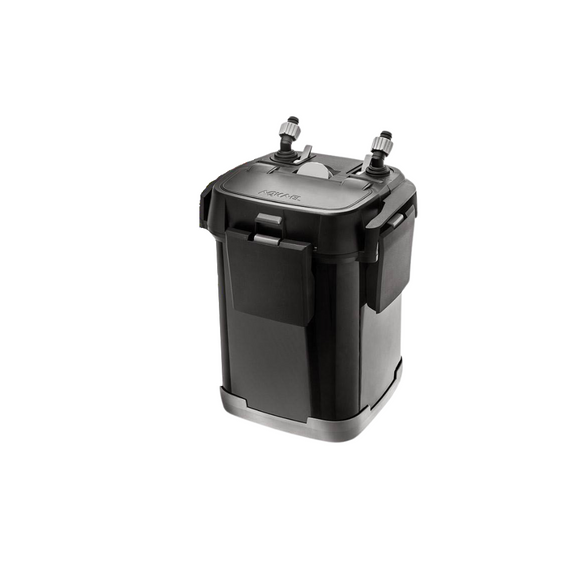
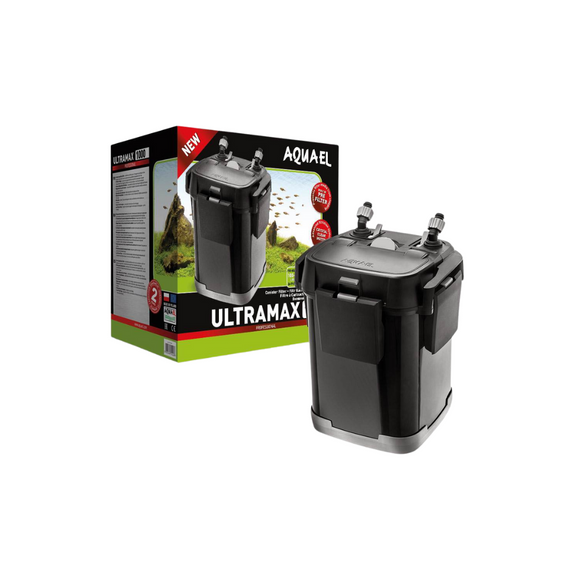


This Aquael Ultramax external filter sits beneath the aquarium and passes all of the tank's water through baskets of filter media, supplied with a first set of media. The 1000 version handles a tank of 100 to 300 litres, the 2000 version a tank of 400 to 700 litres.
In an aquaponic system, the baskets carry the nitrification that feeds the plants.
 Customer support 7 days a week by email
 Delivery within 2 to 15 business days
The Ultramax external filter sits beneath the aquarium and passes all of the tank's water through baskets of filter media, which you arrange to suit your needs. The 1000 version handles a tank of 100 to 300 litres, the 2000 version a tank of 400 to 700 litres. You choose between the two according to the volume of your tank, and above all the amount of media you want to fit underneath.
The 1000 version carries three 1.9-litre baskets, the 2000 version carries five, which gives a tank of 11 litres on one side and 16 litres on the other. A foam pre-filter, housed under the lid, stops coarse dirt before it reaches the baskets. By stepping up to the larger version, you are therefore mainly buying media volume, and it is this volume that sets the time between two cleanings: with the same stocking, an 11-litre filter clogs up noticeably faster than a 16-litre one.
The filter comes with a first set of media, consisting of a polishing wool, BioCeraMAX ceramic rings and a fine foam. In the tank, the water passes through the baskets from bottom to top, so the filling order follows the fineness of the media: the porous ceramics go in the lower baskets, where they stop the largest debris and offer a large surface area to the bacteria, then the fine foam and the wool go at the top to catch the last particles before the water returns to the tank. Rinse each new piece of media in clean water before putting it in place.
The maximum flow rate, 1,000 or 2,000 litres per hour, corresponds to a pump running with no head and no loaded media. Every filled basket, every metre of pipe and every elbow slows the water, and the actual return flow drops further as the foams clog. That is why the 2000 version is the one to choose as soon as the tank exceeds 300 litres: it maintains sufficient circulation when the filter has already been running for a few weeks. On your electricity bill, the difference is small, since the power only rises from 15 to 17 watts.
The 1000
It uses 15 watts when running continuously, or around 131 kilowatt-hours over a full year.
The 2000
It uses 17 watts for double the flow, which comes to around 149 kilowatt-hours over the year.
The height
The flow rate of the 1000 drops to zero at a head of 1.9 metres, and that of the 2000 at 2.4 metres.
The pipe
The 1000 connects with 16/22 millimetre pipe, the 2000 with 19/25 millimetre pipe.
Adding sintered media beads to the biological baskets
In a heavily stocked tank, or one connected to crops, the biological part of the filter deserves to be reinforced. The biological filtration balls slip into one or two baskets, in addition to the supplied ceramics, and their porosity gives nitrifying bacteria a far greater surface area than a foam of the same volume. Sold in packs of up to 5 litres, they can be measured out basket by basket: 1.9 litres is enough to fill one.
In a tank where plants live off the fish's water, the baskets carry the nitrification. The bacteria fixed on the media convert the ammonia from the waste into nitrite, then the nitrite into nitrate, and it is this nitrate that the roots take up. You are therefore best advised to reserve most of the baskets for biological media and to keep only the top basket for mechanical finishing, avoiding chemical media that would hold back some of the nutrients. Rinsing is done with water from the tank and never with tap water, because the chlorine in mains water destroys the colony that took several weeks to establish. The article on the nitrogen cycle in aquaponics explains these steps in detail.
For a 250-litre aquarium stocked with about fifteen goldfish, the 1000 version is sufficient, and its prefilter catches the waste before it reaches the biological baskets. A grow bed of salad plants placed 50 centimetres above the water surface is well within the 1.9-metre limit, so the return flow can feed it directly before going back to the aquarium by gravity. To size the rest of your setup, see the guide on how to build an aquaponic system.
The tank is primed via the head system: you open the two ball valves, operate the primer a few times, and the water fills the filter without your having to suck on a pipe by mouth. For cleaning, these same valves are closed and the head can be lifted off with the pipes left in place, which avoids emptying the line each time. The prefilter catches the coarse dirt ahead of the baskets, so rinsing this prefilter alone spaces out the cleaning of the biological media. The ceramic rotor shaft is suitable for both freshwater and seawater and keeps operating noise down.
In the first month, a new tank carries almost no bacteria yet. Nitrification becomes established gradually on the ceramics, and the ammonium level, then the nitrite level, goes through a peak before falling. During this period, rinse only the pre-filter, feed lightly and measure ammonium regularly: the NH4 ammonium drop test tells you when the biological filtration has taken over and the tank's population can be increased.
The two tanks have the same footprint, 27 centimetres by 29, and differ only in height: 40 centimetres for the 1000, 51 centimetres for the 2000. Measure the clear height under your cabinet before ordering, allowing an extra ten centimetres or so to lift your head out during maintenance. The two pipes supplied, 1.5 metres each, can be cut to the shortest length needed, with no loops or tight bends, to preserve the return flow. If your setup requires sending the water higher than the rim of the tank, for example to a grow bed placed above, the head height tells you how far the pump will still push.
Flow rate and tank volume
The tank and the media
Footprint and connection
References
6 further specifications are available in the detailed view.
In the box
Flow rates, power ratings, heights, volumes, dimensions and contents recorded on 11/10/2026 from the manufacturer's data for the 230 V models.
The flow rate doubles, the tank grows from 11 to 16 litres and the power rises by only 2 watts.
| Maximum flow rate (L/h) | Maximum aquarium volume (L) | Head height (cm) | Power (W) | Total tank volume (L) | 1.9 L baskets | Pipe diameter | Tank height (cm) | Price | |
|---|---|---|---|---|---|---|---|---|---|
| 1,000 L/hYour choice | 1000 L/h | 300 L | 190 cm | 15 W | 11 L | 3 | 16/22 mm | 40 cm | 18,600.00 RSD |
| Recommended 2,000 L/hYour choice | 2000 L/h | 700 L | 240 cm | 17 W | 16 L | 5 | 19/25 mm | 51 cm | 26,400.00 RSD |
Manufacturer's values for the 230 V models, taken on 11/10/2026.
Help choosing
Which of the two versions for your tank?
Your estimate
It covers preparing your order and then the transit time quoted by the carrier, counted in working days.
It is not a guaranteed delivery date: public holidays, peak periods, customs or a carrier delay can extend it. The exact amount, in your currency, is worked out in the cart once your address is entered.
The tank measures 27 x 29 cm at the base and is 40 or 51 cm high, depending on the version. Dispatched within 48 hours by Colissimo or Chronopost to your door, as you choose at checkout. The exact cost depends on the method selected.
10 questions
6 key questions, 10 in the detailed view

The nitrogen cycle, the work done by the biological baskets.

Understanding and correcting cloudy water, particularly in a tank that is starting up.

Getting an aquaponic system off to a good start, filter included.

Building your own aquaponic system, to connect the tank to a grow bed.


A question about this product or your setup? Our team will answer and advise you.

Interest-free instalment payments
Offered depending on the cart amount, at checkout.

Delivery in 2 to 15 working days
Depending on the products and shipping sites. Estimate by destination in the estimator on this page.

After-sales service 7 days a week by email or chat
Our team answers all your questions.

Shop responsibly
Become part of the change.


