
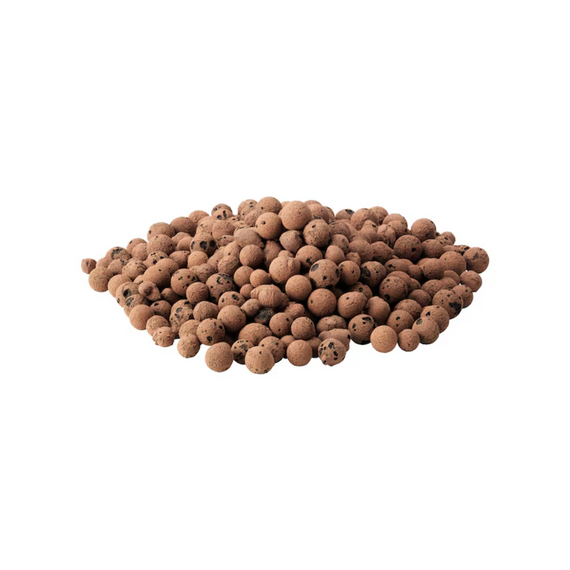
Washed expanded clay pebbles, 8 to 16 mm grade
Regular price
1,300.00 RSD
Regular price
Sale price
1,300.00 RSD
Unit price
/
per
433.33 RSD × 3 with no fees
Klarna.
Plagron expanded clay pebbles form an inert grow medium, fired from pure clay and free of salt. The 10-litre bag contains pebbles of 8 to 16 mm, used in hydroponics and aquaponics, or mixed with soil, compost or coco fibre.
 Customer support 7 days a week by email
 Delivery within 2 to 15 business days
100 % secure payment
The summary
- In the bag: 10 litres of expanded clay pebbles of 8 to 16 mm, weighing 4 to 5 kg.
- Measured values: pH 6.8 to 8.3 on a new bag, conductivity 0.15 to 0.8 mS/cm, no organic matter.
- Aquaponic bed: root support and biological filter, at a depth of about 30 cm.
- Soilless irrigation: at least two waterings per hour, night included, by drip irrigation.
- Before commissioning: a thorough rinse with clean water, the first rinse water never going to the fish.
- Shipping: one 10-litre bag, sent with the rest of your order.
Expanded clay pebbles of 8 to 16 mm, an inert grow medium for soilless growing
Plagron Euro Pebbles expanded clay pebbles, from 8 to 16 mm, form an inert grow medium for hydroponics and aquaponic grow beds, where they also act as a biological filter. Rinse the 10 litre bag with clean water before filling with water. Allow 8 bags for an 80 litre tank.
Plagron's Euro Pebbles expanded clay pebbles weigh 4 to 5 kg per 10 L, and they add nothing to the solution that passes through them. Their organic matter content is zero and their conductivity lies between 0.15 and 0.8 mS/cm: what your plants receive is what you have poured in. Fired in an open kiln from pure, salt-free clay, they come out with irregular shapes.
📊 What the figures say
Four values place this grow medium. The particle size of 8 to 16 mm, held across 90% of the balls, leaves gaps between them that air occupies permanently, which protects the roots from suffocation. The retention of 0.3 ml per gram is low: the grow medium drains rather than keeping a reserve, so water must come back to your roots often.
The dry matter of 97% and the nil organic matter mean there is nothing to decompose, and so nothing to cloud the water of a circuit. The pH measured in water ranges from 6.8 to 8.3, above the comfort zone of most vegetables, and this is what makes your initial rinse useful. The product meets the NF U 44-551 standard for growing media.
💦 The irrigation rhythm
A grow medium that retains almost nothing is managed by frequency rather than by quantity. In soilless growing with drip irrigation, or in pots watered by a pump, allow at least two waterings per hour, night included, run by a timer: the porosity makes excess water practically impossible, and it is drought that threatens as soon as irrigation stops. Feeding starts on day one, since the medium releases nothing by itself, and you water before planting with a nutrient solution whose pH and conductivity are already adjusted.
A complete fertiliser from the very first filling
This inert medium should be fed with a complete fertiliser from the very first filling with water, since the beads supply no nitrogen, potassium or trace elements. If leaves then turn yellow between the veins, chelated iron completes the supply. In aquaponics, where the fish water already provides the nitrogen, iron remains the supplement most often needed.
An irrigation system that stops
A pump failure shows up much faster here than with a grow medium that holds water: at 0.3 ml per gram, the reserve is counted in hours, not days. If your setup is left alone during an absence, choose a medium that retains water instead, or plan for a second pump before you leave.
🌊 In an aquaponic flood-and-drain bed
In your ebb-and-flow aquaponic system, the media bed acts as both support and filter: the particles shed by the fish settle and mineralise in it, and the nitrifying bacteria colonise the porous surface of the pebbles, where ammonia becomes nitrate. The flood and drain cycle therefore takes the place of the timer. A bed filled to a depth of about 30 cm needs 300 L of pebbles per square metre, which is 30 bags weighing 120 to 150 kg dry, whereas an 80 L grow bed is filled with 8 bags. After rinsing, check the pH of your water every day during the first week, as the pH of the pebbles, up to 8.3, can exceed the range of 6.4 to 7.5 aimed for in aquaponics; the guide to regulating pH in aquaponics explains how to correct it.
The size matters as much as the nature of the grow medium. The FAO aquaponics manual recommends, for grow beds, expanded clay pebbles 8 to 20 mm in diameter. Finer ones clog up with the fish's solid waste; larger ones offer less surface area for the bacteria and hold plants poorly. The pebbles in this bag, at 8 to 16 mm, fall within this range. Expanded clay has a colonisable surface area of 250 to 300 m² per cubic metre, of the same order as volcanic gravel, and its lightness reduces the load of a bed placed on a balcony, a terrace or a growing table.
At a depth of 30 cm, an ebb-and-flow bed divides into three layers that do not work in the same way. The top 2 to 5 cm stay dry: they act as a screen against light, limit algae and protect the collar of your plants from rot. The middle layer, about 10 to 20 cm deep, fills and then empties with each cycle, and this is where the roots and most of the nitrifying bacteria develop. The bottom 3 to 5 cm stay permanently flooded, so that fine particles of waste build up there and mineralise before feeding the plants.
This filtering role has a limit, which the same manual places at around 15 kg of fish per cubic metre of water, and it is sized on the feed: allow 40 to 50 g of feed per day per square metre of bed for leafy vegetables, and 50 to 80 g for fruiting vegetables. Beyond that, the solids gradually clog the pebbles and create pockets without oxygen, where the beneficial bacteria give way to others. A mechanical filter or a settling tank placed before the bed then catches most of the waste. A few earthworms added to the middle layer complete the job: they consume the droppings, fallen leaves and dead roots, which delays the clogging of your bed accordingly.
Before filling the bed, rinse the clay pebbles in small batches, in a colander with holes or a sieve, until the water runs clear. The clay dust formed during transport then goes onto the garden rather than into your pump or siphons, and this first rinse water never reaches the fish tank. Once rinsed, the clay releases almost nothing: measured in one part pebbles to one and a half parts water, the pebbles show a pH of 7.1 and a conductivity of 0.4 mS/cm.
This near-neutral pH fits the 6.4 to 7.5 range aimed for in aquaponics. Measurements taken on new pebbles, however, range from 6.8 to 8.3, so you should check the water pH every day during the first week, then every week. A lasting deviation most often comes from hard tap water or a poorly rinsed bed, and it is corrected in the tank water with fish-safe products, such as potassium bicarbonate when the pH drops.
♻️ Reuse and storage
In an aquaponic bed, the clay balls stay in place from one season to the next: you remove the large roots at each harvest, and the worms consume the finer ones. In hydroponics, where nothing breaks down the residues, a full clean is done between two crops, with a 24-hour soak in a solution of grow medium enzymes adjusted to pH 5.5, followed by a rinse with Hydro A and B nutrient solution dosed at 1 ml per litre. Clay balls treated in this way should then be rinsed thoroughly with clean water before going into a bed connected to the fish, since neither the enzymes nor the hydroponic fertiliser belong in their water.
Keep an opened bag closed, in a dry place. Clay does not wear out and lasts several years, but an open bag collects dust and debris that would have to be rinsed out again. For an 80-litre grow bed, allow 8 bags, and count on about 30 bags for one square metre of bed filled to a depth of 30 cm, which is 120 to 150 kg of dry pebbles for the structure to support.
Technical specifications
The bag and its values
- Volume
- 10 LThe bag weighs 4 to 5 kg.
- Particle size
- 8 to 16 mmOn 90% of the beads, which leaves air between them at all times.
- pH measured in water
- 6.8 to 8.3Above the comfort zone for vegetables: the initial flush matters.
- Conductivity
- 0.15 to 0.8 mS/cmOn new grow medium, before any fertiliser is applied.
- Water retention
- 0.3 ml/gLow: the frequency of irrigation matters more than the volume given.
- Organic matter
- None, 97% dry matterNothing to break down, so nothing that clouds the water in a closed circuit.
To allow for in addition
- Fertilisation
- A complete fertiliserThe medium is inert: feeding begins with the first watering.
- Initial flush
- A large tank and clean waterThe clay dust formed during transport is washed away with this first water.
In the box
- 1 bag of expanded clay pebbles of 10 litres, 8 to 16 mm, weighing 4 to 5 kg
Particle size, pH, conductivity, retention, dry matter, weight and NF U 44-551 standard: bag label; irrigation frequency, rinsing and reuse: plagron.com and technical data sheet of 14/11/2024; grow bed benchmarks: FAO aquaponics manual.
Manufacturer and product safety
- Manufacturer
- Bertels B.V.
- Website
- plagron.com
Information provided under Regulation (EU) 2023/988 on general product safety.
Which bag of clay pebbles should you choose?
The three bags of clay pebbles in the shop differ in volume, grade and the use for which they are best suited.
Can't decide between these three bags?
All three bags contain expanded clay; they differ in volume, grain size and intended use.
| Format | Volume (L) | Main use | Grade (mm) | Bag weight (kg) | Price | |
|---|---|---|---|---|---|---|
| Clay pebbles 50 L for hydroponics andYour choice | 50-litre bag | 50 L | Hydroponics and aquaponic bed | 8 to 20 | 19,5 kg | 2,300.00 RSD |
| Recommended Washed expanded clay pebbles, 8 to 16 mm gradeYour choice | 10-litre bag | 10 L | Hydroponics and pot growing | 8 to 16 | 4 to 5 kg | 1,300.00 RSD |
| Or Brun clay pebbles for pots and planters, 6 LYour choice | 6-litre bag | 6 L | Pot base and mulching | 8 to 16 | 2,8 kg | 2,100.00 RSD |
Clay pebbles 50 L for hydroponics and
Format50-litre bag
Volume (L)50 L
Main useHydroponics and aquaponic bed
Grade (mm)8 to 20 mm
Bag weight (kg)19,5 kg
Washed expanded clay pebbles, 8 to 16 mm gradeRecommended
Format10-litre bag
Volume (L)10 L
Main useHydroponics and pot growing
Grade (mm)8 to 16 mm
Bag weight (kg)4 to 5 kg
Or Brun clay pebbles for pots and planters, 6 L
Format6-litre bag
Volume (L)6 L
Main usePot base and mulching
Grade (mm)8 to 16 mm
Bag weight (kg)2,8 kg
Volumes, grades and weights taken from the packaging and the manufacturers' data sheets.
Buying guide
How many beads, and for what use?
Estimate your
delivery time
Your estimate
Delivery
Estimated time
It covers preparing your order and then the transit time quoted by the carrier, counted in working days.
It is not a guaranteed delivery date: public holidays, peak periods, customs or a carrier delay can extend it. The exact amount, in your currency, is worked out in the cart once your address is entered.
The 10-litre bag weighs 4 to 5 kg. Volume counts as much as weight in the transport calculation. The exact charges and final delivery times are shown in the basket once you have entered the address.
Frequently asked questions
6 questions
6 key questions
How many bags for your tray
Enter the volume to be filled, that of your grow bed or your pots. The calculation gives the number of 10-litre bags and the weight of dry beads to allow for.
L
5 L1000 L
0bags
of 10 litres, rounded up to the next bag size
Weight of the dry beads, at most
0 kg
A 10-litre bag weighs 4 to 5 kg. The retained water and the water in the cycle add to this weight.
You may also like


Related articles

Grow media
Which grow medium to choose for aquaponics?
What each medium retains, what it lets through, and where clay stands.
Read the article

Technique
Regulating pH in an aquaponics system
Measuring and correcting after setting up a new grow medium.
Read the article

Diagnosis
Understanding and correcting cloudy water in aquaponics
The causes of cloudy water, and the right fix for each one.
Read the article

Above ground
Soilless growing in hydroponics
Why an inert medium changes the way you manage a crop.
Read the article

Fertilisation
Which fertiliser should you use in aquaponics?
The supplements to add when an element is lacking, iron first.
Read the article

Diagnosis
Identifying deficiencies in aquaponics
Reading the leaf to find out which element is missing from the solution.
Read the article
Let us talk about your project
A question about this product or your setup? Our team will answer and advise you.

Interest-free instalment payments
Offered depending on the cart amount, at checkout.

Delivery in 2 to 15 working days
Depending on the products and shipping sites. Estimate by destination in the estimator on this page.

After-sales service 7 days a week by email or chat
Our team answers all your questions.

Shop responsibly
Become part of the change.
