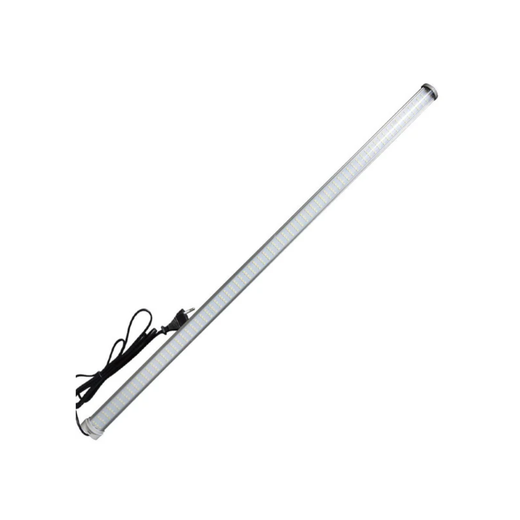


Compact LED panel for seedlings, 65 or 85 W
Regular price
6,000.00 RSD
Regular price
Sale price
6,000.00 RSD
Unit price
/
per
2,000.00 RSD × 3 with no fees
Klarna.
This flat, lightweight LED panel fits above a shelf of seedlings, a tray of microgreens or a few pots of herbs. Its full spectrum, warm and cool white boosted with red, supports plants from germination to harvest, in 65 or 85 W.
 Customer support 7 days a week by email
 Delivery within 2 to 15 business days
100 % secure payment
The summary
- What you receive: an Agrolight Quantum Board LED panel in 65 W or 85 W, with an adjustable hanging kit on the 65 W.
- Its light: white at 3000 and 5000 K, red at 660 nm and a little far-red.
- The crops: a 30 x 30 cm tray of seedlings, cuttings or microgreens, or a few lettuces and herbs.
- Switching on: on/off operation only, best left to a timer.
Small grow panel for a shelf, seedlings and indoor herbs
The Quantum Board Agrolight is a flat grow panel, with no housing or reflector, whose LEDs are soldered directly onto a white aluminium plate. The 65 W version measures 30 x 30 cm and weighs 720 g, which lets you hang it under a shelf or from the ceiling of a small grow cabinet. The 85 W version uses the same construction with more power, for a slightly wider shelf or more demanding plants. This panel format spreads the light across its whole surface, so that plants at the edge receive almost as much light as those at the centre, and the aluminium plate dissipates the heat from the LEDs without a fan, and therefore without noise.
Seedlings and microgreens
Seedling trays germinate under close, even light, without the seedlings stretching.
Herbs and salad leaves
Basil, parsley, chives and cut-and-come-again lettuces grow all year round on a lit shelf.
A timer to switch it on every day
This panel works on a simple on/off basis, with no dimmer, and it is the length of the lighting period that sets the amount of light. The daily timer, plugged in before the panel, switches it on and off at the same times every day, for 14 to 16 hours for seedlings, salad leaves and herbs. Your young plants thus receive a constant dose, which gives even germination across the whole tray.
🌈 Five LED colours
On the 65 W version, 225 diodes share the plate. The white diodes make up most of them, 116 in warm white at 3000 K and 77 in cool white at 5000 K, which gives a light close to daylight, in which blue sustains dense foliage and short stems. The 28 red diodes at 660 nm reinforce the wavelength that chlorophyll absorbs best, while 2 diodes at 730 nm, in the far red, and 2 diodes at 395 nm, at the edge of the ultraviolet, complete the spectrum. Because the light remains white, with a colour rendering index of 90, you can easily spot a yellowing leaf or a pest on your plants.
🌱 For a seedling shelf
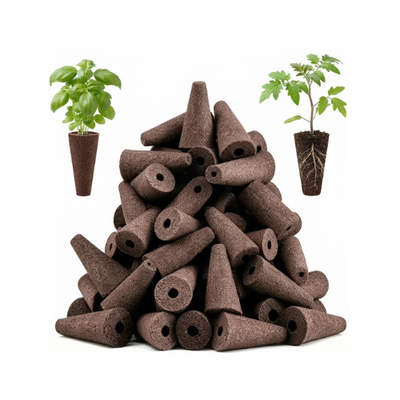
A 30 cm panel is the same width as a standard seedling tray. You can therefore fit each shelf level with one panel, and get tomatoes, peppers and herbs off to an early start at the end of winter, ready to go out into the garden, a greenhouse or a hydroponic system. The germination sponge pods suit this setup well, as the young plants can then be transplanted with their root plug intact. To manage heat and humidity around the light, follow the article setting up your indoor seedling area.
Adjust the height rather than the power
Without a dimmer, the only way to soften the light is to raise the panel. After sowing, place it fairly high and then bring it gradually closer while watching the seedlings. Leaves that turn pale or brown at the edges indicate a panel that is too close, and stems that stretch indicate a panel that is too far away.
☀️ Height, duration and amount of light
What your plants receive depends on two settings: the distance between the panel and the leaves, which determines the intensity, and the number of hours of lighting, which determines the day's total. Horticulturists express this total in moles of photons per square metre per day: microgreens and lettuces grow well from 12 moles per day, lettuce reaches its optimum at around 17, whereas tomatoes in production need at least 20 and up to 30. A compact 65 W or 85 W panel is more than enough for the former over a 30 cm square, which is why it suits seedlings and leafy plants better than mature tomato plants.
After germination, start by hanging the panel quite high, then lower it by a few centimetres every two or three days, until you get sturdy seedlings with deep green leaves. Keep a fixed photoperiod of 14 to 16 hours, because light whose timing changes every day disrupts growth more than slightly low intensity does. For tomato or pepper plants started in February, this panel covers the first six to eight weeks, up to transplanting into pots or moving them into the greenhouse.
🐟 The panel on an aquaponic kit
In a small indoor aquaponic system, the panel lights the grow bed, where lettuces and herbs grow, fed by the nitrates that the system's bacteria draw from the fish waste. Its 30 cm format suits kits placed on top of an aquarium, whose grow bed is often 30 to 60 cm long: one panel for a small bed, two side by side for a longer one. You place it above the plants, avoiding direct light on the fish tank, because very bright water becomes covered in algae that consume part of the nitrates meant for the plants. The article on herbs in aquaponics helps you choose the easiest species.
The panel also fits alongside the system, above a nursery shelf. There you can raise the next batch of lettuce or basil while the previous one finishes growing in the grow bed, so the system is never left without plants to take up the nitrates. Finally, keep the panel and its connections clear of water and of the condensation that forms above a tank: hang the socket higher than the panel, on a circuit protected by a 30 mA residual current device, and leave a drip loop in the cable.
🔌 Mounting, socket and power consumption
The 65 W version is supplied with 4 steel hooks, a carabiner and an adjustable hanging system, which let you hang it under a shelf or from a bar and change its height without tools. As the panel has no dimmer, this height becomes your main adjustment. Its power consumption remains modest: 16 hours of lighting represents about 1.04 kWh per day with the 65 W and 1.36 kWh with the 85 W, which makes it possible to equip several levels of a shelving unit without inflating your bill. Dust the plate from time to time, with the panel unplugged and cooled down, to keep all the light from the diodes.
Technical specifications
The panel
- Power
- 65 or 85 W
- Spectrum
- White 3000 and 5000 K, red 660 nmSupplemented with 730 and 395 nm diodes
- 65 W diodes
- 225 LEDs116 at 3000 K, 77 at 5000 K, 28 at 660 nm, 2 at 730 nm, 2 at 395 nm
- Colour rendering
- CRI 90
- 65 W format
- 30 x 30 cm, 720 g
- Switching on
- On/off, without a dimmerIntensity set by the hanging height
Usage
- Crops
- Seedlings, microgreens, salads, herbs
- Lighting duration
- 14 to 16 h a day
- 65 W surface area
- A 30 x 30 cm trayTwo panels side by side for a longer tank
- Power consumption
- 1.04 or 1.36 kWh per day65 or 85 W, for 16 hours of lighting
For starting seedlings
- Germination pots
- Peat sponge pods
- Net pots
- Net potsTo transfer the seedlings into a system
To allow for in addition
- Timer
- Daily timerTo light the tray at set times
- Suspended
- Suspension systemFor the 85 W or a greater height
6 further specifications are available in the detailed view.
In the box
- 1 Agrolight Quantum Board LED panel of 65 or 85 W, depending on the version chosen
- 4 hooks, 1 carabiner and 1 adjustable hanger with the 65 W version
Diodes, format, weight, colour rendering, switch-on and accessories of the 65 W, taken from its sales sheet (ref. LED-QB065); outputs and spectrum from the distributor. Light benchmarks: Cornell University CEA group.
Estimate your
delivery time
Your estimate
Delivery
Estimated time
It covers preparing your order and then the transit time quoted by the carrier, counted in working days.
It is not a guaranteed delivery date: public holidays, peak periods, customs or a carrier delay can extend it. The exact amount, in your currency, is worked out in the cart once your address is entered.
The panel ships in its original packaging, in a parcel of about 2 kg dispatched from a distributor's warehouse in France. The exact shipping cost is shown in the basket.
Frequently asked questions
8 questions
6 key questions, 8 in the detailed view
You may also like


Related articles

Seedling
Setting up an indoor seedling area
This guide helps you set up an indoor seedling station where young plants do not grow leggy.
Read the article

Seedling
Getting spring seedlings off to a good start in aquaponics
This guide covers the spring seedling calendar and the choice of the first crops for the system.
Read the article

Crops
Herbs in aquaponics
Fast-growing and generous, herbs are among the most rewarding crops for getting started in aquaponics.
Read the article

Hydroponics
The Kratky method: passive hydroponics without a pump
A Kratky tub under a small panel produces lettuces with no pump and no electricity.
Read the article

Hydroponics
Getting started with indoor hydroponics
Before setting up your first hydroponic bed, this article reviews the settings you need to understand.
Read the article

Guide
LED lighting for indoor growing
This guide shows that plant quality improves up to about 12 moles of light per day.
Read the article
Let us talk about your project
A question about this product or your setup? Our team will answer and advise you.

Interest-free instalment payments
Offered depending on the cart amount, at checkout.

Delivery in 2 to 15 working days
Depending on the products and shipping sites. Estimate by destination in the estimator on this page.

After-sales service 7 days a week by email or chat
Our team answers all your questions.

Shop responsibly
Become part of the change.
