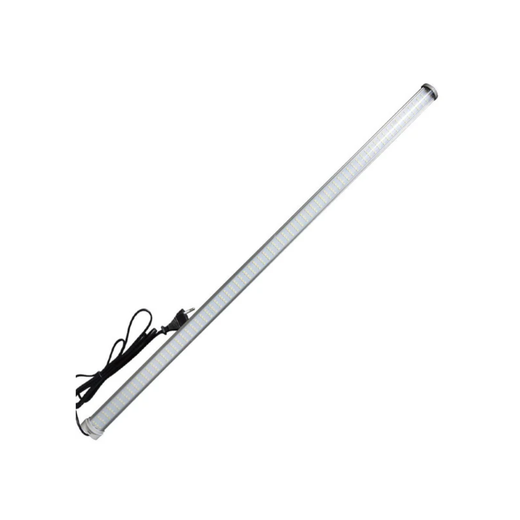


Flowering LED bar 2100 K, 26 or 42 W
Regular price
5,800.00 RSD
Regular price
Sale price
5,800.00 RSD
Unit price
/
per
1,933.33 RSD × 3 with no fees
Klarna.
This flowering LED bar gives off a very warm 2100 K white light, rich in red, which supports flowering and fruiting in tomatoes, peppers and strawberries grown indoors. The 54 and 95 cm bars connect in series on a single power cable, offered here as an accessory with a 1 m interconnecting cable for spacing two bars apart.
 Customer support 7 days a week by email
 Delivery within 2 to 15 business days
100 % secure payment
The summary
- What you receive: a P-LED V2.0 flowering LED bar, with its fixing hooks.
- Its light: a very warm white of 2100 K, rich in red, for flowering and fruiting.
- Which length: 54 cm for 26 W, or 95 cm for 42 W.
- Connection: a 2 m cable powers 10 bars of 26 W or 5 bars of 42 W.
Amber light for flowering tomatoes, peppers and strawberries indoors
The P-LED V2.0 flowering bar is a horticultural LED strip whose light, with a colour temperature of 2100 K, leans distinctly towards orange. It is intended for the stage when your plants flower and then bear fruit, as a supplement to a main light or a growth bar. It comes in two lengths, 54 cm at 26 W and 95 cm at 42 W, and is powered by a separate cable to which several bars can be connected in series, so you can equip a shelf or a grow tent from a single socket.
🌅 2100 K light
Expressed in kelvins, colour temperature places a white light somewhere between bluish and orange. A grow bar at 6500 K gives off a cool white, rich in blue, which keeps young plants compact. At 2100 K, the light becomes almost amber, close to that of the old sodium lamps once used in greenhouses, because the proportion of red and orange clearly outweighs that of blue. Red is the part of the spectrum that chlorophyll absorbs best, and it is also the one that supports flowering and fruit swelling. You should therefore keep this bar for plants that are already well developed, at the point when the first buds appear, rather than for seedlings, which would grow leggy under such warm light.
Programme flowering across the whole row
Plug the power cable into a daily timer: all the connected bars then switch on at the same times every day. For a flowering plant, a regular cycle of day and night matters more than a few extra hours of light added at random. This lets you set the lighting duration for a whole row in one go, while keeping at least 4 to 6 hours of darkness each night.
🔌 Several bars on one socket
The bar has no mains lead, so power is supplied through the 2 m P-LED cable, whose plug goes into a socket and whose connector joins the first bar. The following bars are then connected to one another, up to 10 bars of 26 W or 5 bars of 42 W on a single cable, and the 1 m interconnecting cable lets you space two neighbouring bars apart. The power supply accepts a voltage of 85 to 264 V, at 50 or 60 Hz. You can therefore switch the whole row on and off in a single move, and you can start with one bar and then extend the installation as the seasons go by.
26 W, 54 cm
Its length suits a narrow shelf, a grow cabinet or a few cherry tomato pots.
42 W, 95 cm
It covers a one-metre shelf or a row of fruiting plants in a grow tent.
Unplug before connecting a strip
Always unplug the cable from the socket before adding, removing or moving a bar in the row. Keep the cable, the socket and the fittings away from water splashes, especially above a grow bed or a sump tank, plug the cable into a socket protected by a 30 mA residual current device, and never exceed 10 bars of 26 W or 5 bars of 42 W on a single cable.
🍅 Fruit under grow lights
In hydroponics as in indoor aquaponics, plants harvested for their fruit, such as tomatoes, peppers and strawberries, grow well in leaf but struggle to set fruit when light is lacking. Benchmarks established in protected cultivation show this clearly: a lettuce is content with 12 to 17 moles of light per square metre per day, whereas a tomato or a pepper needs 20 to 30, and a strawberry 17 to 20. It is this gap that you make up with the flowering bar, placed above the row or fixed vertically between the plants, when the trusses are forming.
It performs best as a supplement to a main light source, a very bright window, an LED panel or a 6500 K growth bar: combining a cool white with an amber white covers the whole useful spectrum, from the blue that keeps the internodes short to the red that supports fruit set. In a closed space, with no wind or insects, flowers do not pollinate themselves, and it is up to you to shake them or vibrate them every day, as explained in the article on pollinating plants indoors. Once the first fruits have set, keep to the same schedule until harvest.
🐟 The fruiting stage in aquaponics
In an aquaponic system, this change of phase can also be read in the water. The nitrogen that bacteria extract from the fish waste covers foliage growth well, whereas the demand for potassium rises markedly as the fruit swells. Potassium is, along with iron and calcium, one of the elements most often lacking in aquaponics, because fish feed supplies little of it. So keep an eye on the oldest leaves as soon as you switch on the light bar, since edges that turn yellow and then brown often signal this need, and the guide to deficiencies in aquaponics will help you recognise it.
You then supply the potassium with a fish-safe product, such as potassium bicarbonate for aquaponics, which raises both the pH and the buffering capacity of the water at the same time; add it in small amounts while checking the pH. Standard flowering fertilisers, designed for soil or hydroponics, must not be poured into the fish circuit: keep them for pots watered separately or for a separate plant loop, what is known as decoupled aquaponics. Finally, point the light bar towards the plants, never towards the water in the tank, which would turn green under the light.
📏 Mounting and height
Each bar is fitted with hooks, which allow it to be hung horizontally above the plants or fixed vertically along a tent pole or shelf upright. Hung with an adjustable hanging system, it can be raised as the plants gain height. Check the leaves at the top after each adjustment, as leaves that curl up indicate that the bar is too close and needs to be raised by one notch. When mounted vertically, position it at the height of the developing clusters, where the shade of the upper leaves deprives the fruit of light.
Technical specifications
The bar
- Light
- Very warm white 2100 KRed and orange dominant, for flowering and fruit set
- Power
- 26 or 42 W
- Dimensions
- 54 or 95 x 4 x 3 cmThe 26 W measures 54 cm, the 42 W 95 cm
- Voltage
- 85 to 264 V, 50 or 60 Hz
Connection
- Bars per cable
- 10 x 26 W or 5 x 42 WConnected in series on a single power cable
- Power cable
- 2 m, mains plugSold separately, as an accessory
- Interconnecting cable
- 1 mTo space two bars in the row apart
- Power consumption
- 0.31 or 0.50 kWh per day26 or 42 W switched on for 12 hours
Usage
- Stage
- Flowering and fruitingAs soon as the first buds appear
- Mounting
- Hooks, horizontal or verticalAbove the row or between the plants
- Crops
- Tomatoes, peppers, strawberry plants
- Pairing
- With a grow lightCool white 6500 K, panel or bright window
To allow for in addition
- Feeding
- P-LED power cable, 2 mOne cable for the whole row of strips
- Timer
- Daily timerTo keep the same schedule every day
6 further specifications are available in the detailed view.
In the box
- 1 P-LED V2.0 flowering LED bar, with its mounting hooks
Distributor and brand values for power, lengths, voltage and connection. Light guidelines by crop from the CEA group at Cornell University.
Manufacturer and product safety
- Manufacturer
- The Pure Factory
- Website
- www.thepurefactory.com
Information provided under Regulation (EU) 2023/988 on general product safety.
26 or 42 W light bar?
Two lengths for the same 2100 K flowering light, which can be connected in series on a single power cable.
26 or 42 W?
Three questions about your flowering plants, and the right length is highlighted.
| Power (W) | Length (cm) | Bars per cable (bars) | Price | |
|---|---|---|---|---|
| 26 W, 54 cmYour choice | 26 W | 54 cm | 10 bars | 5,800.00 RSD |
| Recommended 42 W, 95 cmYour choice | 42 W | 95 cm | 5 bars | 9,600.00 RSD |
26 W, 54 cm
Power (W)26 W
Length (cm)54 cm
Bars per cable (bars)10 bars
42 W, 95 cmRecommended
Power (W)42 W
Length (cm)95 cm
Bars per cable (bars)5 bars
Power ratings, lengths and number of bars per cable from the sales sheets for both versions.
Buying guide
Three questions to help you choose your light bar
Estimate your
delivery time
Your estimate
Delivery
Estimated time
It covers preparing your order and then the transit time quoted by the carrier, counted in working days.
It is not a guaranteed delivery date: public holidays, peak periods, customs or a carrier delay can extend it. The exact amount, in your currency, is worked out in the cart once your address is entered.
The bar travels in a long, light parcel, and the cable in a small parcel. The exact postage cost is shown in your basket.
Frequently asked questions
8 questions
6 key questions, 8 in the detailed view
You may also like


Related articles

Gesture
Pollinating your plants indoors
This article compares the brush and vibration methods for pollinating flowers indoors.
Read the article

Crops
Growing tomatoes in aquaponics
To set fruit on tomatoes under a flowering light bar, this article explains hand pollination and pruning.
Read the article

Crops
Growing peppers in aquaponics
This guide follows the pepper from seedling to harvest, a crop that needs warmth and suitable nutrition.
Read the article

Crops
Growing strawberries in aquaponics: the complete guide
This complete guide to strawberries in aquaponics details the varieties and growing conditions.
Read the article

Diagnosis
Plant deficiencies in aquaponics
This guide helps you recognise plant deficiencies when the balance of the system breaks down.
Read the article

Guide
LED lighting for indoor growing
This guide explains what a so-called flowering lamp changes, richer in red and far-red.
Read the article
Let us talk about your project
A question about this product or your setup? Our team will answer and advise you.

Interest-free instalment payments
Offered depending on the cart amount, at checkout.

Delivery in 2 to 15 working days
Depending on the products and shipping sites. Estimate by destination in the estimator on this page.

After-sales service 7 days a week by email or chat
Our team answers all your questions.

Shop responsibly
Become part of the change.
