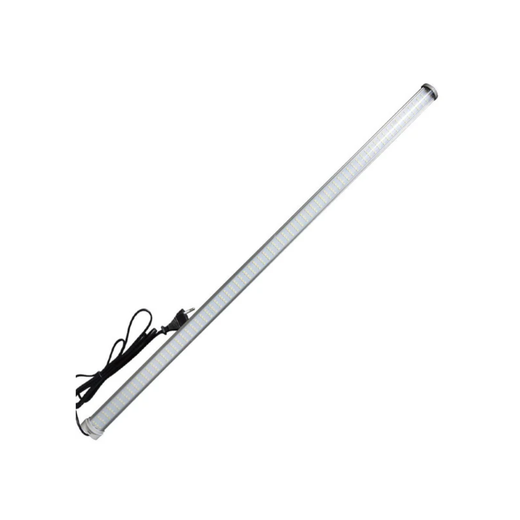


100 W horticultural LED bar, 115 cm, full spectrum
Regular price
27,500.00 RSD
Regular price
Sale price
27,500.00 RSD
Unit price
/
per
9,166.66 RSD × 3 with no fees
Klarna.
This 115 cm LED bar delivers 295 µmol/s of grow light for 102 W, with its separate power supply. Slim and IP65 waterproof, it slips in above a seedling shelf, an NFT gutter or a growing bed, and tops up a panel along the edges of a surface that is poorly lit.
 Customer support 7 days a week by email
 Delivery within 2 to 15 business days
100 % secure payment
The summary
- What you receive: a 115 cm LED bar and its 100 W power supply.
- The lit area: a strip of 120 x 25 cm per bar, to be multiplied according to the width.
- The light: 4000 K white and 660 nm red, 295 µmol/s for 102 W.
- Adjustment: by the suspension height, or with an external 0-10 V controller.
- Uses: seedling shelf, NFT channel, narrow growing bed, supplementary lighting.
- In aquaponics: a light that follows the length of the channels without lighting the fish tank.
Linear lighting for a seedling shelf, NFT gutter and narrow growing bed
The 100 W LED bar from Lumatek is a linear light fitting 115 cm long, 2 cm wide and 5.3 cm deep, carrying a row of grow diodes on an aluminium profile. It reproduces the light of the bars that make up the brand's Zeus bar light fittings from Lumatek, but works on its own thanks to its own 100 W power supply, connected by cable and installed away from the fitting. It draws 102 W and produces a photosynthetic flux of 295 µmol/s, with an efficacy of 2.9 µmol/J. Its narrow format makes it suited to long surfaces: a shelf, a growing channel, a planter or the edge of a grow bed that the main light fitting reaches poorly.
🌈 A full spectrum in a strip
The bar's 288 white Lumileds LEDs at 4000 K and 24 red Osram LEDs at 660 nm produce a full-spectrum light, suitable from germination to harvest. Blue keeps seedlings compact, red supports photosynthesis, flowering and fruit set, and white light shows the plants in their true colours, which helps you spot a deficiency or a pest. The 120° beam angle spreads the light over a strip of about 120 x 25 cm per bar. A layer of clear resin protects the LEDs, so the bar is rated IP65, protected against dust and water jets. A humid grow room should still be ventilated, so that condensation does not settle on either the bar or its power supply.
A contactor timer for all the bars
Connect the power supplies to a contactor timer, whose two blocks of 4 sockets switch on up to 8 bars together, because a household timer copes poorly with the inrush current of several LED power supplies. All the bars then switch on and off at the same times, 14 to 16 hours a day for seedlings, salad leaves and herbs. Your plants therefore receive the same dose of light every day, even while you are away, and you no longer have to think about the switch.
Seedling shelf
One bar per 120 cm shelf lights two or three trays of seedlings lined up.
NFT gutter
Suspended along the axis of a gutter, it lights a row of lettuces or basil along its whole length.
Microgreens
Positioned high up, it gives a soft light to trays of microgreens during their few days of growing.
Supplementary lighting
At the side of a grow bed, it backs up a central panel for the plants at the edge.
📏 How many light bars for your area
One bar covers a strip of roughly 120 cm by 25 cm. A 120 x 30 cm shelf, a planter or an NFT gutter needs only a single bar. A 120 x 50 cm grow bed takes two, and a 120 x 100 cm surface takes four, lined up lengthways and spaced 25 cm apart, which gives even lighting with no hot spots. As each bar has its own power supply, the installation stays modular: you add a bar when you extend the growing area, without changing the ones already in place. The suspension system for LED bars lets you hang them and adjust their height.
The power supply stays dry and raised off the ground
The bar is IP65 protected, but its power supply and the mains plug are not to the same degree: place them high up, away from the tray, the sump tanks and any splashing from watering, on a circuit protected by a 30 mA RCD. Leave a drip loop in the cable and unplug the power supply before moving or cleaning the bar.
The bar does not replace a square panel, it complements or extends it. Four bars lined up over 120 x 100 cm draw about 408 W for 1,180 µmol/s, whereas a 300 W square panel delivers 816 over 1 m on each side for 310 W. Bars keep the advantage on long, narrow areas, where they spread the light along the whole length, whereas the panel lights a compact bed as a single block.
☀️ How much light
What your plants use is not electrical power but the number of photons received over the day, which horticulturists call the daily light integral and express in moles per square metre per day. The benchmarks established in protected cultivation are telling: a lettuce grows well at between 12 and 17 moles per day, strawberries need 17 to 20 moles, and tomatoes and peppers 20 to 30. To get from the light bar to these figures, you spread its output of 295 µmol/s over the illuminated area, then multiply by the lighting duration.
On a 120 x 50 cm bed, i.e. 0.6 m², the output of one bar spread over the whole surface would give at best close to 490 µmol/m²/s, if all its light fell on the plants. Some is always lost at the sides, so the intensity actually received stays lower. Yet a lettuce already reaches its optimum of 17 moles per day with around 300 µmol/m²/s over 16 hours: a bar suspended above a narrow bed of salad leaves or herbs comes close to this, provided you raise it slightly if the edges of the young leaves turn brown. For tomatoes or peppers on the same surface, two bars together bring the light level closer to the 460 to 690 µmol/m²/s they require over 12 hours, while still giving fruiting plants their night.
🐟 Above the aquaponic gutters
In indoor aquaponics, NFT channels and narrow grow beds are often installed lengthways, above or beside the fish tank. The bar follows this geometry and concentrates the light on the plants, without needlessly lighting the water surface, which limits algae growth in the tank, where it would consume some of the nitrates meant for the plants. Its IP65 rating protects it from ambient humidity and splashes, and its passive cooling, with no fan, makes no noise in a living space. Lettuces and herbs, fed by the nitrates that bacteria produce from the fish waste, are the crops that benefit most from this lighting.
In an NFT channel, where a thin film of water from the pond flows beneath the roots, the light bar is hung along the centre line of the channel, 30 to 40 cm above the leaves. If your system has two or three parallel channels, one bar per channel keeps the light even along the whole length, whereas a square panel would leave the ends in shade. The bar's 102 W ends up as heat in the room, a modest amount that does not noticeably warm the water in the tank. The article on herbs in aquaponics gives the varieties and planting densities suited to these channels.
One bar covers a strip of about 0.3 m², the area of a 1.2 m NFT channel. Lettuces are planted 18 to 30 cm apart, giving 4 to 6 heads per channel, and basil a little closer together. For the fish water to feed this strip, the FAO allows 40 to 50 g of feed per square metre per day for leafy vegetables: 12 to 15 g of daily feed per lit channel. Three channels under three bars therefore call for 36 to 45 g of feed per day, a simple rule of thumb for matching the number of bars to the pond rather than the other way round.
🎚️ Adjust and link the bars
The light bar has no adjustment dial. Its intensity is set first of all by height: 20 or 30 cm from the leaves for fruiting vegetables or mature plants, higher up for seedlings or microgreens. For finer adjustment, connect the power supply to a 0-10 V controller: the brand's Digital Panel Plus can control up to 100 at once, including gradual sunrise and sunset. Several bars can also be daisy-chained with a Lumatek link cable, so that a single controller adjusts a whole shelf.
🧽 Maintaining the bar
The diodes are rated for 60,000 hours of operation, roughly ten years at 16 hours a day, and the manufacturer's warranty covers the bar for 5 years. Dust the light-emitting face from time to time with a soft, slightly damp cloth, with the bar unplugged and cooled down, because a film of dust or limescale holds back some of the light. Also check the condition of the cable between the bar and its power supply, especially if your growing room is humid, and keep the power supply somewhere ventilated so that it does not overheat. The bar weighs 1.1 kg, so it can be hung from simple shelf hooks.
📦 The box and the warranty
The box contains the 115 cm bar, its 100 W power supply with its power and control cables, two metal hooks and the instruction leaflet. The linking cable between bars and the hanging system are ordered separately. The bar carries a 5-year warranty, and its datasheet, in English, details its diodes and dimensions.
Technical specifications
Lighting
- Photosynthetic flux
- 295 µmol/s
- Yield
- Up to 2.9 µmol/J
- Spectrum
- White 4000 K and red 660 nm288 white Lumileds diodes, 24 red Osram
- Lighting angle
- 120°
- Illuminated area
- 120 x 25 cm per barSeveral bars side by side for a wider coverage area
- Lifespan
- 60,000 hours5-year manufacturer's warranty
The bar
- Power consumption
- 102 W
- Dimensions
- 1,148 x 20 x 53 mm
- Weight
- 1.1 kg
- Protection
- IP65, passive cooling
- Feeding
- 220 to 240 V, remoteOn a circuit protected by a residual current device
- Connection
- Daisy-chain link cableTo control several bars together
Usage
- Crops
- Seedlings, microgreens, salad leaves, herbs
- Heat output
- 358 BTU/hAround 100 W given off into the room
To allow for in addition
- Suspended
- Suspension system for barsTo keep the right distance from the leaves
- Timer
- Contactor timerUp to 8 power supplies across two units
8 further specifications are available in the detailed view.
In the box
- 1 Lumatek LED bar, 100 W and 115 cm
- 1 separate 100 W power supply
- 2 metal hooks
- 1 instruction leaflet
Manufacturer's values (data sheet for the 100 W Full-Spectrum bar). Light benchmarks by crop from the CEA group at Cornell University; per-area inputs calculated from the flux.
Manufacturer and product safety
- Website
- www.lumatek-lighting.com
Information provided under Regulation (EU) 2023/988 on general product safety.
Documents & manuals
Datasheet for the 100 W LED bar
LEDs, power, dimensions, heat, dimming and warranty of the light bar and its power supply, in English.
Document not showing? Some publishers block display inside a frame, so open it in a tab.
Estimate your
delivery time
Your estimate
Delivery
Estimated time
It covers preparing your order and then the transit time quoted by the carrier, counted in working days.
It is not a guaranteed delivery date: public holidays, peak periods, customs or a carrier delay can extend it. The exact amount, in your currency, is worked out in the cart once your address is entered.
The bar ships in its original box with its power supply, dispatched from a distributor's warehouse in France. The exact shipping cost is shown in the basket.
Frequently asked questions
12 questions
6 key questions, 12 in the detailed view
You may also like


Related articles

Seedling
Setting up an indoor seedling area
This guide explains how to prevent leggy seedlings indoors by adjusting light, warmth and humidity.
Read the article

Crops
Herbs in aquaponics
Basil, mint and chives can be harvested continually, which makes them easy crops for a lit shelf.
Read the article

Hydroponics
Getting started with indoor hydroponics
This guide helps you choose your first indoor hydroponics system and the parameters to monitor from the start.
Read the article

Seedling
Getting spring seedlings off to a good start in aquaponics
This guide times spring seedlings to the water temperature and the maturity of the aquaponic system.
Read the article

Crops
Lettuce bolting
This article gives the three causes of lettuce bolting and five ways to delay it.
Read the article

Guide
LED lighting for indoor growing
This guide explains why a light bar illuminates a strip roughly as wide as its hanging height.
Read the article
Let us talk about your project
A question about this product or your setup? Our team will answer and advise you.

Interest-free instalment payments
Offered depending on the cart amount, at checkout.

Delivery in 2 to 15 working days
Depending on the products and shipping sites. Estimate by destination in the estimator on this page.

After-sales service 7 days a week by email or chat
Our team answers all your questions.

Shop responsibly
Become part of the change.
