Sold out


| Poids | Price | Price per kg | vs 3 kg |
|---|---|---|---|
| 3 kg | Dhs. 40.00 | Dhs. 13.33 | — |
| 5 kg | Dhs. 57.00 | Dhs. 11.40 | −14 % |
| 10 kg | Dhs. 101.00 | Dhs. 10.10 | −24 % |
| 20 kg | Dhs. 160.00 | Dhs. 8.00 | −40 % |
This sieved worm compost, made from horse and cattle manure digested by worms, enriches the soil with organic matter and micro-organisms. It is mixed into the grow medium at 20% of the volume and can be used in organic farming.
 Customer support 7 days a week by email
 Delivery within 2 to 15 business days
Guano Diffusion worm compost comes from horse and cattle manure digested by worms, with 25% organic matter. It is mixed into potting compost at 20% of the volume, together with an organic fertiliser such as dried blood guano. From the 3 kg pouch to the 20 kg bag, it enriches pots and vegetable beds, but never the pond.
This worm compost is an organic soil improver made from horse and cattle manure digested by compost worms, of the species Eisenia foetida, then finely sieved. It is mixed into the vegetable garden soil, the compost in your pots or the grow medium in your beds to enrich the soil with stable organic matter and micro-organisms. Made in France and compliant with the NF U 44-051 standard for organic soil improvers, it can be used in organic farming and contains no mineral additives. It is offered in four sizes, from the 3 kg bag to the 20 kg sack.
As it passes through the worms' digestive tract, the manure breaks down and completes its decomposition. What comes out is worm castings, the small aggregates that worms excrete, forming a fine, dark material whose organic matter content reaches 25%. Its carbon-to-nitrogen ratio, noted C/N, stands at 10.5, a low value that characterises organic matter that is already stabilised: once incorporated, it releases its nutrients gradually without locking up the nitrogen in the soil, unlike fresh manure or straw, whose decomposition consumes it. You can therefore apply it around the base of a plant that is already established without any risk of depriving it of nitrogen.
1.2% nitrogen
The product contains 1% in organic form, which soil life releases as it breaks down organic matter.
1% phosphorus
The content is expressed as phosphorus pentoxide, P2O5, as on the label of any fertiliser.
0.85% potassium
This content is expressed as potassium oxide, K2O, the regulatory unit for potassium.
25% organic matter
It is what gives soil its structure, holds water and feeds the soil fauna.
With levels close to 1% for each of the three major elements, this worm compost feeds the plant less than the soil itself. Its main role is to provide stable organic matter, which improves soil structure and sustains the microbial life on which nutrient uptake depends. You can therefore use it to revive a worn-out compost, to improve a depleted soil, or to prepare a planting hole. On a long, demanding crop, it is combined with an organic fertiliser, such as the dried blood guano or the Orgatrex liquid fertiliser, which supplies the nitrogen and potassium that plants need during growth and fruiting, and the worm compost then speeds up the breakdown of this fertiliser in the soil. The article on worm compost as a natural fertiliser explains how these two inputs complement each other in the garden.
Combine worm compost with organic fertilisers
This worm compost is meant to be used with organic fertilisers, such as guano, manure or nettle tea, and not with synthetic mineral fertilisers. If you grow with a mineral programme, keep it for pots and plots that you run organically, rather than mixing the two approaches in the same soil.
Make your own worm compost at home
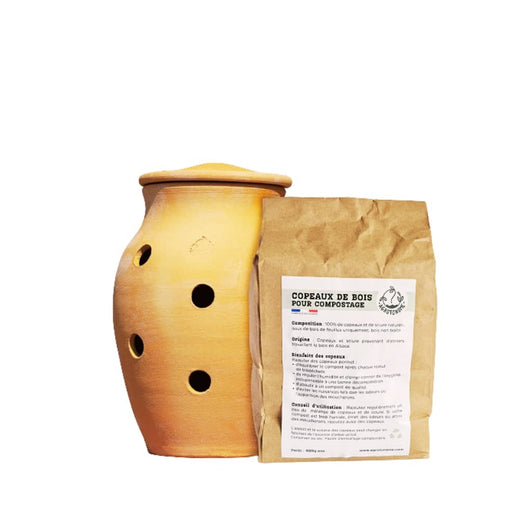
If you produce a lot of peelings, an indoor terracotta worm composter stocked with compost worms turns your kitchen waste into a similar soil improver. The bag then takes over in spring, when the needs of the vegetable garden exceed what the bin produces. That gives you a regular supply all year round, without relying solely on your stocks.
Passing through the worms' gut enriches the material with micro-organisms: this worm compost contains around fifty types of bacteria and nine beneficial fungi, drawn from the rhizosphere, that is, the zone of soil surrounding the roots. It also contains humic and fulvic acids, as well as enzymes. Once mixed into your soil, these organisms carry on breaking down the organic matter and make its elements available to the roots, which is why an amended soil comes back to life after a growing season.
In pots and planters, vermicompost is mixed into the grow medium at 20% of the volume, that is one bucket of vermicompost to four buckets of soil or compost, which works out at about 100 g per litre of mix. In open ground, use 1 to 2 kg per plant, mixed into the soil from the planting hole. When transplanting, add it together with an organic fertiliser, which takes over as the plant grows. Its fine texture, achieved by sieving, makes it easy to blend into a potting compost.
This worm compost must never be poured into the circuit of an aquaponic system, neither into the fish tank nor into a grow bed through which their water flows. Once submerged, its organic matter breaks down in the water, uses up the oxygen that the fish and the filter bacteria need, releases ammonium and clouds the water, whereas a balanced system receives its nutrition from the fish feed. The FAO manual on aquaponics also recommends keeping the droppings of warm-blooded animals away from the water of a system that produces vegetables eaten raw, and an amendment made from manure falls under that precaution. Your seedlings intended for the system's baskets should therefore be started in an inert medium, such as germination pods or rockwool, and not in an enriched compost whose particles would wash into the water.
Vermicompost, on the other hand, comes into its own around the system. Crops in pots, planters or open ground that you water with the water renewed from the tank benefit from a compost amended at 20%, because this water, rich in nitrate, feeds the plants while the organic matter retains moisture and gives the soil structure. Plants too large for the grow bed, such as squashes or tall tomato plants, thus grow in soil beds next to the aquaponic greenhouse. This way, you keep a clean circuit for the fish, and you put every partial water change to use in the vegetable garden.
The link between worms and aquaponics works the other way round too. The FAO manual describes adding compost worms to grow beds with a grow medium, where they break down the solid waste caught by the clay pebbles, as the article on vermiponics explains in detail. The sludge removed from a settling tank, rich in organic matter, can in turn go into a worm bin, mixed with dry waste such as cardboard, and return to the vegetable garden as a soil conditioner.
Worm compost weighs about 0.5 kg per litre: the 3 kg bag represents 6 litres, the 5 kg bag 10 litres, the 10 kg bag 20 litres and the 20 kg bag 40 litres. At a rate of 20%, the 6 litres in the bag will amend 30 litres of mix, enough to fill about ten 3-litre pots. The 10 kg bag makes up 100 litres of amended compost, and the 20 kg bag covers 10 to 20 plants in open ground, at 1 to 2 kg per plant. The price per kilo falls as the bag gets bigger, which makes the larger sizes worthwhile as soon as you are amending a whole vegetable garden or a series of beds.
The composition
Quality and status
Usage
To allow for in addition
12 further specifications are available in the detailed view.
In the box
Composition, organic matter, microbial life, formats, doses and uses: manufacturer's data sheet; C/N ratio and reference to Regulation (EU) 2018/848: product label, which states 0.9% K2O.
Manufacturer and product safety
Information provided under Regulation (EU) 2023/988 on general product safety.
Your estimate
It covers preparing your order and then the transit time quoted by the carrier, counted in working days.
It is not a guaranteed delivery date: public holidays, peak periods, customs or a carrier delay can extend it. The exact amount, in your currency, is worked out in the cart once your address is entered.
The worm compost is shipped in its original sealed bag or sack. The exact shipping cost is shown in your basket, depending on the weight of the size chosen, from 3 to 20 kg.
6 questions
6 key questions


This article explains how to make and use vermicompost in the garden.

The same compost worms also work in the grow beds of an aquaponic system.

The olla buried in the vegetable garden releases water into soil that worm compost helps to structure.

Repotting young plants is the moment when an amended compost makes the difference.

This guide compares the mineral grow media of the aquaponic circuit with vegetable garden composts.
A question about this product or your setup? Our team will answer and advise you.

Interest-free instalment payments
Offered depending on the cart amount, at checkout.

Delivery in 2 to 15 working days
Depending on the products and shipping sites. Estimate by destination in the estimator on this page.

After-sales service 7 days a week by email or chat
Our team answers all your questions.

Shop responsibly
Become part of the change.