

Reagent refill for potassium K test
Regular price
Dhs. 70.00
Regular price
Sale price
Dhs. 70.00
Unit price
/
per
Dhs. 23.33 × 3 with no fees
Klarna.
Potassium is the nutrient least well covered by fish food, which means it is often in short supply in aquaponics. These two reagents are those from the potassium test, for approximately 25 measurements.
The result is read by turbidity: add the reagent until a printed cross disappears. The two tubes, the syringe, the dual measuring spoon and the reading card from your kit remain in use.
 Customer support 7 days a week by email
 Delivery within 2 to 15 business days
100 % secure payment
The summary
- What it measures: dissolved potassium, in milligrams per litre.
- What the box contains: 2 reagent bottles, one liquid and one powder.
- How to read the result: a printed cross disappears — no colour chart or shade comparison required.
- How many tests: approximately 25, the same count as the original kit.
- How much to sample: 15 ml drawn with a syringe, poured into the measurement tube.
- Refill or complete kit: the refill is sufficient if both your tubes and your reading card are still intact.
Reagents K 1 and K 2, approximately 25 tests, result read by turbidity
Potassium is the macronutrient that actively growing plants consume in the greatest quantities, and they absorb it within hours. These two bottles, one liquid reagent and one powder reagent, are the reagents alone for the potassium test, providing approximately 25 measurements in freshwater and, after dilution, in saltwater.
This test does not involve comparing colours: potassium forms a whitish cloudiness with the reagents, and it is the height of liquid required to obscure a printed cross that gives the concentration. The natural colour of your water therefore has no effect on the reading, provided the water is clear to begin with, and you read the value directly from the graduated measuring tube in milligrams per litre.
🔬 A cross that disappears
Fill the 15 ml measuring tube with water using the syringe, then add 10 drops of reagent 1 and mix. Add one heaped measure of powder, taken with the wide end of the double-ended measure; this will make the water turn cloudy. Swirl gently for 30 seconds, leave to stand for 1 minute, then swirl once more. Place the glass test tube on the cross of the card and pour in the mixture until the cross is no longer visible from above; read the graduation at the bottom of the meniscus to obtain the concentration in mg/L.
The large powder measure should be levelled off
The powdered reagent is measured using the wide end of the double-ended scoop, and a heaped measure will distort the turbidity reading. Scrape the scoop level on the rim of the bottle before adding it, and measure away from any draught.
Saltwater
Dilute 10 ml of sample to 300 ml with distilled water, measure, then multiply the result by 30.
Glass reading tube
The graduated tube in mg/L is available as a spare part, so you don't need to buy the whole kit if it breaks.
A salt that supplies potassium and alkalinity
Use potassium bicarbonate alongside the refill if your reading remains below 10 mg/L. It raises both the potassium level and the carbonate hardness in a single dose, saving you from having to correct the same water twice. The carbonate hardness test lets you monitor the second value after each addition.
Both reagents are classified Danger, with the hazard statements H314 and H318, indicating severe skin burns and serious eye damage. Measure out the powder over a sink, without blowing on the measure to level it, and rinse immediately and thoroughly with water if any splashes into your eye. The treated tube should be emptied down the sink, never into your tank, and the bottles should be stored sealed, dry, at ambient temperature, and in their original packaging.
🌱 One element that feed covers poorly
Fish waste provides mainly nitrogen and phosphorus, while potassium remains too scarce to support plant growth, meaning it is often deficient in an aquaponic system. For healthy growth, the level should be around 10 mg/L, and up to 30 mg/L under intense lighting. Beyond that, filamentous algae take advantage of it, and an excessively high level becomes dangerous for sensitive species such as shrimps. The guide on plant deficiencies in aquaponics shows the discoloured leaf margins that indicate this shortfall.
📏 A gradually widening interval
At start-up, measure potassium every day until you know how quickly your plants consume it, then space out the checks once that rhythm is established. The 25 measurements in the refill kit are therefore concentrated in the first few weeks, whereas a stable system will make them last considerably longer. Always take readings at the same time of day, since your plants absorb potassium within a few hours and a measurement taken just after dosing is not comparable to the one from the day before.
Technical specifications
What the refill contains
- Contents
- 2 reagent bottlesOne liquid reagent and one powder reagent, numbered on the label.
- Measurements
- Approximately 25The same volume of reagent as in the original kit
- Manufacturer's reference
- JBL 2413100, PROAQUATEST rangeNot to be confused with 2413000, which is the complete kit
- Corresponding test
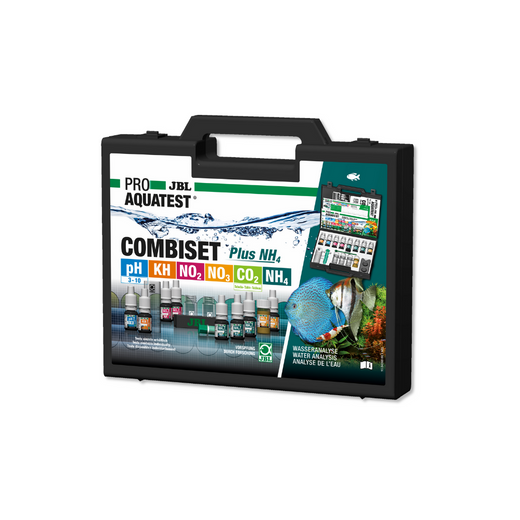
- Potassium K test, ref. 2413000The refill is used with the tubes, the syringe, the measuring spoon and the colour card from this test
Measuring potassium
- Reading principle
- Turbidity, not colourThe potassium precipitates as a whitish suspension, and it is the turbidity produced that gives the reading
- Sample volume
- 15 ml per measurementMeasured with a syringe, into the plastic measuring tube
- Reagents to dose
- 10 drops and 1 large level measureWide end of the dual measure spoon for powder
- Duration of a measurement
- Approximately 4 minutes30 seconds of shaking, 1 minute's rest, then pouring
Security and dispatch
- Hazard classification
- Warning, the 2 bottlesH314 and H318 labelling. Child-resistant caps on both
- Storage
- Store dry, at room temperatureBottles sealed tight, in their original packaging
- Environments covered
- Freshwater, saltwaterIn seawater, 10 ml diluted to 300 ml, result multiplied by 30
- Parcel weight
- 0.08 kgPackaging included
To budget for separately
- Tubes, syringe and measuring spoon
- Those from the potassium testThe collection tube is graduated in milligrams per litre — it is the tube that displays the result
- Reading card
- The one for the potassium testIt carries the reference cross, without which the pour cannot be read.
6 further specifications are available in the detailed view.
In the box
- 2 reagent bottles, one liquid and one powder
Reference, EAN code, contents, protocol, number of measurements and hazard statements checked against the JBL datasheet and instructions on 07/10/2026. Dilution beyond the graduation mark and spare measuring tube: JBL FAQ.
Two bottles, or the complete kit?
The refill and the kit contain the same reagent, follow the same protocol and give the same number of measurements. The decision depends on whether you already have the tubes, the measuring spoon and the reading card.
Turbidity is read from a card, not a colour chart
The reading requires the reference cross, the graduated sampling tube in milligrams per litre and the measuring scoop for dosing the powder.
| Reagent bottles (bottles) | Possible readings (measurements) | Plastic measuring tube | Glass reading tube | Sampling syringe | Double measure | Cross-reference reading card | Price | |
|---|---|---|---|---|---|---|---|---|
| Recommended Reagent refill for potassium K testYour choice | 2 bottles | 25 measurements | No | No | No | No | No | Dhs. 70.00 |
| Potassium K drop water testYour choice | 2 bottles | 25 measurements | Yes | Yes | Yes | Yes | Yes | Dhs. 97.00 |
Reagent refill for potassium K testRecommended
What gets used up
Reagent bottles (bottles)2 bottles
Possible readings (measurements)25 measurements
What keeps well
Plastic measuring tubeNo
Glass reading tubeNo
Sampling syringeNo
Double measureNo
Cross-reference reading cardNo
Budget
Potassium K drop water test
What gets used up
Reagent bottles (bottles)2 bottles
Possible readings (measurements)25 measurements
What keeps well
Plastic measuring tubeYes
Glass reading tubeYes
Sampling syringeYes
Double measureYes
Cross-reference reading cardYes
Budget
Contents of both columns taken from the supplier's data sheet and instruction leaflet, on 05/09/2026.
Help choosing
Replace the reagents, or start again from the kit
Estimate your
delivery time
Your estimate
Delivery
Estimated time
It covers preparing your order and then the transit time quoted by the carrier, counted in working days.
It is not a guaranteed delivery date: public holidays, peak periods, customs or a carrier delay can extend it. The exact amount, in your currency, is worked out in the cart once your address is entered.
Parcel weight 0.08 kg, dispatched to a collection point or to your door, your choice at checkout. The bottles are sent in their original packaging. The exact postage cost is shown in the basket.
Frequently asked questions
6 questions
6 key questions
You may also like


Related articles

Diagnosis
Plant deficiencies in aquaponics
Potassium deficiency is the one most often attributed to iron, simply because it has not been measured.
Read the article

Guide
Identifying deficiencies in aquaponics
What a leaf reveals before a test puts a number to it, and the order in which to check.
Read the article

Growing
Which fertiliser should you use in aquaponics?
What the system produces on its own, and the two or three elements that need to be added.
Read the article

Growing
Which plants can be grown in aquaponics?
Hungry species deplete this parameter quickly; cut-and-come-again leaves much less so.
Read the article

Organisation
A practical schedule for success with aquaponics
Knowing when the growing season starts means knowing when the bottle will run out.
Read the article

Guide
The 15 plants to grow in aquaponics
A list by appetite, useful for anticipating consumption of this element.
Read the article
Let us talk about your project
A question about this product or your setup? Our team will answer and advise you.

Interest-free instalment payments
Offered depending on the cart amount, at checkout.

Delivery in 2 to 15 working days
Depending on the products and shipping sites. Estimate by destination in the estimator on this page.

After-sales service 7 days a week by email or chat
Our team answers all your questions.

Shop responsibly
Become part of the change.
