



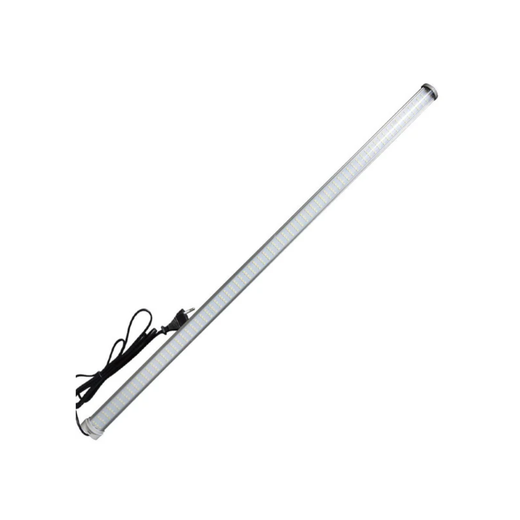


Horticultural LED bar, 26 or 42 W, for growth or flowering
Regular price
Dhs. 604.00
Regular price
Sale price
Dhs. 604.00
Unit price
/
per
Dhs. 201.33 × 3 with no fees
Klarna.
This horticultural LED bar plugs straight into a socket, its power supply being built into the profile. The growth version, at 42 W and 95 cm, lights seedlings, salad leaves and herbs; the flowering version, at 26 W and 54 cm, supports fruit set in tomatoes and peppers.
100 % secure payment
The summary
- What it is: a horticultural LED bar with a built-in power supply, which plugs straight into a socket with no separate box.
- The two versions: 42 W growth model, 95 cm long, in 6500 K cool white; 26 W flowering model, 54 cm long, in warm light.
- For which crops: seedlings, young plants, salad leaves and herbs for the growth version; tomatoes, peppers and strawberries for the flowering version.
- At what height: about 15 cm above the foliage, raised as the plants grow.
- Mounting: hooks supplied for tubes of 16 to 21 mm, horizontal or vertical.
- In indoor aquaponics: lighting for the plants only, never for the tank water, so as not to feed algae.
Mains-powered LED bar for seedlings, salad crops and indoor fruiting plants
Secret Jardin's TLed bar is an LED horticultural light whose power supply is housed inside the profile itself. You can therefore plug it straight into a 230 V socket, with no transformer or external box, since the circuit accepts any voltage between 85 and 264 V. Its long, flat shape, 4 cm wide by 3 cm thick, makes it suited to seedling shelves, small grow cabinets and shelving units where a conventional lamp would not fit. It comes in two versions, which differ in length and above all in the colour of their light.
Growth, 42 W
95 cm long, it gives off around 6,500 lumens in cool white and covers an area of about 120 x 60 cm.
Flowering, 26 W
At 54 cm long, it combines two warm whites and 10% infrared, for a coverage area of about 60 x 30 cm.
💡 Growth or flowering
The growth version emits a cool white light of 6500 K, rich in blue. This colour encourages sturdy, compact growth of leaves and stems, which is why it suits seedlings, young plants, lettuces and aromatic herbs, which you harvest before any flowering. The flowering version combines two warm whites, one at 3000 K and the other at 2100 K, with a small share of infrared; this redder spectrum supports plants grown for their flowers and fruit, such as tomatoes, peppers or strawberries in indoor cultivation. Both remain white lights, so you see your plants in their true colours and can more easily spot a deficiency or a pest.
📏 Installation above the crops
The hooks supplied with the bar clip onto tubes of 16 to 21 mm in diameter, such as those of a metal shelving unit or a grow tent, and let you mount it either horizontally or vertically. You can also hang it from ratchet rope hangers, which makes it easy to adjust the height. Above growing plants, the bar sits about 15 cm from the foliage, a distance you increase as the plants grow. Mounted vertically alongside a row of tomatoes, the flowering version lights the lower trusses that the light from above reaches poorly.
A light bar and a timer for seedlings
The 95 cm grow version spans the length of a standard shelf, which is enough to raise several seedling trays or a row of peat germination pods. Combined with a daily timer, it switches on and off at the same times each day, without you having to think about it. You thus get even seedlings that do not grow leggy reaching for the light of a window.
Keep the bar and its socket away from water
The bar runs on mains power, and its IP54 rating protects it from ambient humidity, not from splashes. Above a hydroponic sump tank or a fish tank, fix it firmly so that it cannot fall into the water, and route the cable and plug away from any splashing, forming a drip loop below the plug.
☀️ How much light for each crop
Your plants do not count watts: they accumulate the light they receive over the course of the day. Growers measure this total as the daily light integral, expressed in moles of photons per square metre per day, which depends on both the intensity of the lamp at leaf level and the length of the lighting period. The benchmarks established for protected cultivation are telling: lettuce grows well from 12 moles a day and reaches its optimum around 17, whereas tomato needs 20 to 30. Above 17 moles for several days running, lettuce in fact develops scorching along the edges of its young leaves.
These figures explain the role of each version. A 42 W bar placed 15 cm from a seedling tray or a planter of herbs provides enough light for dense foliage over a limited area. For fruiting plants, the flowering bar serves rather as a supplement, alongside a bright window or a more powerful panel, since a tomato grown indoors needs nearly twice as much light as a lettuce. Lengthen the lighting period rather than bringing the bar too close: 14 to 16 hours suit leafy plants, while fruiting plants need at least 4 to 6 hours of darkness a day, otherwise their leaves turn yellow.
🐟 One bar above an aquaponic system
A grow tower or a small aquaponic system set up in a room rarely receives enough natural light, especially from autumn to the end of winter. TLed bars then supplement the light from a window or replace it entirely above a grow bed or a deep water culture raft. Lettuce, basil and mint, which are among the easiest plants to manage in indoor aquaponics, are content with the growth version, and their roots draw from the fish water the nitrates that the system's bacteria produce from the fish waste. A 95 cm bar thus covers a grow bed measuring 1 m by 50 to 60 cm, the usual size of indoor kits placed on top of an aquarium.
On the other hand, aim the light at the leaves, never at the surface of the fish tank. Water lit for several hours a day becomes covered in green algae, which use up the nitrates meant for the plants, make oxygen and pH vary between day and night, and foul the walls. So cover the tank with an opaque lid or a board, and keep the lighting for the grow bed. The heat given off by an LED bar remains low, so it does not noticeably warm the water. The article getting started with indoor hydroponics helps you choose crops suited to supplementary lighting.
⏱️ Lifespan and maintenance
The stated lifespan reaches 30,000 hours of operation, which is a little under seven years for a bar switched on 12 hours a day. Maintenance is limited to regular dusting of the diffuser, with the bar unplugged, because a layer of dust or limescale deposits reduces the light reaching the plants. The profile, rated IP54 for the 42 W version, withstands the ambient humidity of a growing room, but it must never be sprayed with water or submerged. A bar switched on 16 hours a day uses about 0.7 kWh for the 42 W version and 0.4 kWh for the 26 W one.
🔆 Lumens, PPFD and mounting height
The 6,500 lumens of the growth version tell you how much light the human eye would perceive, not how many useful photons reach your leaves. For a plant, the relevant measure is PPFD, in micromoles per square metre per second, measured at foliage height. The University of Missouri puts lettuce between 250 and 350 µmol/s/m², and states that beyond this the extra energy is wasted; it is this figure, not the lumens, that determines the right height for the light bar. Since light intensity falls off quickly with distance, the only way to know it on your own setup is to measure it. A PAR quantum meter placed at the centre and then at the edge of the shelf tells you whether the bar is at the right distance, and the guide to LED lighting for indoor growing explains how to work out your crops' daily light from it.
🧯 Connection and glare
The bar takes the 230 V mains supply directly, since its power supply is housed in the profile: unlike 24 V lighting, it is mains voltage that reaches the area above the plants. Plug it into a circuit protected by a 30 mA residual current device, and let the cable hang in a loop below the socket so that condensation drips off before it reaches it. At 42 or 26 W, several bars can run from a 16 A weekly timer, leaving a margin for the surge of current that each power supply draws at switch-on. An LED bar placed 15 cm from the leaves also dazzles the person tending the crops. Anses confirms the toxicity of blue light for the retina and describes short-term effects after acute exposure: do not look at the grow bar head-on when it is lit, and adjust its height with the light off.
Technical specifications
Growth 42 W
- Length
- Around 95 cm4 cm wide, 3 cm thick
- Light
- Cool white 6500 KFor seedlings, salads and herbs
- Luminous flux
- Approximately 6500 lumens
- Illuminated area
- Approximately 120 x 60 cmAbout fifteen centimetres from the foliage
26 W flowering
- Length
- 54 cm4 cm wide, 3 cm thick
- Light
- White 3000 and 2100 K, infrared45%, 45% and 10% of the spectrum
- Weight
- 360 g
- Illuminated area
- Around 60 x 30 cmAs a supplement for tomatoes, peppers and strawberries
Shared by both bars
- Feeding
- Built-in, 85 to 264 VPlugs straight into a socket, no control box needed
- Mounting
- Hooks for tubes from 16 to 21 mmHorizontally or vertically
- Lifespan
- 30,000 hoursAround 7 years at 12 hours a day
- Protection
- IP54 on the 42 W versionWithstands ambient humidity, but not splashing water
- Connection
- 230 V socket, 30 mA residual current deviceCable looped below the socket
- Target light
- 250 to 350 µmol/s/m²For a lettuce, measured at leaf height
To allow for in addition
- Timer
- Daily timerTo set the daily lighting duration
- Suspended
- Suspension systemIf you do not fix the bar to a tube
8 further specifications are available in the detailed view.
In the box
- 1 TLed LED bar, 54 or 95 cm depending on the version chosen
- 1 power cable with mains plug
- Fixing clips for 16 to 21 mm tubes
Manufacturer's values (TLed product sheets). Light benchmarks by crop based on the Cornell University CEA group and the University of Missouri.
Manufacturer and product safety
- Website
- www.secretjardin.com
Information provided under Regulation (EU) 2023/988 on general product safety.
Growth or flowering?
Two TLed bars with built-in power supply, one in cool white for foliage, the other in warm whites for flowers and fruit.
Growth or flowering?
Three questions about your crops, and the table highlights itself.
| Power (W) | Length (cm) | Light | Stage | Price | |
|---|---|---|---|---|---|
| Recommended Grow 42 W, 95 cmYour choice | 42 W | 95 cm | Cool white 6500 K | Growth | Dhs. 604.00 |
| Flowering 26 W, 54 cmYour choice | 26 W | 54 cm | Whites at 3000 and 2100 K, infrared | Flowering | Dhs. 226.00 |
Grow 42 W, 95 cmRecommended
Power (W)42 W
Length (cm)95 cm
LightCool white 6500 K
StageGrowth
Flowering 26 W, 54 cm
Power (W)26 W
Length (cm)54 cm
LightWhites at 3000 and 2100 K, infrared
StageFlowering
Manufacturer's values (TLed product sheets).
Buying guide
Three questions to help you choose your light bar
Estimate your
delivery time
Your estimate
Delivery
Estimated time
It covers preparing your order and then the transit time quoted by the carrier, counted in working days.
It is not a guaranteed delivery date: public holidays, peak periods, customs or a carrier delay can extend it. The exact amount, in your currency, is worked out in the cart once your address is entered.
The bar ships in a long, lightweight parcel weighing about 0.9 kg. The exact shipping cost is shown in your basket.
Frequently asked questions
8 questions
6 key questions, 8 in the detailed view
You may also like


Related articles

Lighting
LED lighting for indoor growing
This guide explains PPFD, DLI and spectrum, to help you choose between the growth bar and the flowering bar.
Read the article

Seedling
Setting up an indoor seedling area
The TLed grow bar covers a shelf of seedlings like the one described in the article.
Read the article

Hydroponics
Getting started with indoor hydroponics
This guide helps you choose the crops that a single TLed bar is enough to light indoors.
Read the article

Crops
Herbs in aquaponics
Basil, mint and chives are happy with the grow bar above an aquaponic bed.
Read the article

Seedling
Germination failure: causes and solutions
Seedlings that grow leggy despite the light bar will find their causes here, from height to heat.
Read the article

Crops
Pollinating your plants indoors
Under the flowering light bar, tomatoes and strawberries are pollinated by hand or by vibration.
Read the article

Hydroponics
How a hydroponic grow tower works
Mounted vertically, a TLed bar lights the lower levels of a grow tower.
Read the article
Let us talk about your project
A question about this product or your setup? Our team will answer and advise you.

Interest-free instalment payments
Offered depending on the cart amount, at checkout.

Delivery in 2 to 15 working days
Depending on the products and shipping sites. Estimate by destination in the estimator on this page.

After-sales service 7 days a week by email or chat
Our team answers all your questions.

Shop responsibly
Become part of the change.
