





Cu copper water test in drops
Regular price
$18.59
Regular price
Sale price
$18.59
Unit price
/
per
Copper is tested to confirm it is absent from the water: at doses a fish can tolerate, it kills your shrimps, snails, and freshwater shrimps.
This test measures dissolved copper in fresh water, ponds, and salt water, using a colour comparator block that cancels out the natural tint of your water.
 Customer support 7 days a week by email
 Delivery within 2 to 15 business days
100 % secure payment
The summary
- What you receive: 2 bottles of reagents, 2 glass test tubes with screw caps, a syringe, a grey comparator block and a colour chart.
- What you are measuring: copper dissolved in the water, in freshwater aquariums, in seawater and in garden ponds.
- What the figure means: a level that a fish tolerates during a treatment is enough to kill a shrimp or a snail.
- When to get it out: before introducing invertebrates, after a treatment, or on water drawn from an old installation.
- How to choose: copper is included only in the more complete of the two kits.
- Reagent 2: flammable and irritating to the eyes, it is handled away from a flame and never goes into the fish's water.
Drop test for dissolved copper, 50 measurements, for shrimps, snails and fish
This drop test measures dissolved copper in freshwater, in a pond and in seawater, for around 50 tests, before shrimp are introduced or after a treatment. Outside treatment, the recommended level stays below 0.05 mg/L. The flammable reagent stays in the test tube read on the comparator block, never in the water your fish or shrimp live in.
Copper is a trace element needed by every living cell, and a cellular poison beyond a certain concentration. Its particular feature is its selectivity: copper-based antiparasitic treatments work precisely because the concentrations used are tolerated for a time by the fish while the parasites cannot withstand them. What holds true for a parasite also holds true for a shrimp, a snail and a gammarid. If your invertebrates disappear while your fish stay in perfect health, copper is the first cause to check.
🚰 Where copper comes from
Few aquarists add copper deliberately, yet it gets in by four routes that people rarely think of. Identifying the source lets you remove it, and testing then confirms that the input has really stopped, since a single measurement says nothing about a source that keeps feeding the tank between two readings. So go through these four entry points at the same time as you take your first measurement.
Pet shop treatments
Many antiparasitic treatments and some algaecides contain it, and this can only be seen from the composition.
Copper pipes
When water stands in copper pipes, significant amounts of copper come off into it. Drain the pipes before filling.
Nutrient inputs for the plants
Several aquatic fertilisers contain it as a trace element. It has no effect on fish, but should be monitored in a shrimp tank.
Rainwater from the gutter
A copper gutter is enough to contaminate collected water. This water is not suitable for an invertebrate tank.
🧫 Dissolved copper and bound copper
This test measures dissolved copper, and only that, whereas copper quickly forms insoluble compounds that settle on the bottom. Part of what has been added therefore leaves the water column within a few hours and binds to the grow medium, the filter media, the decorations and the organic debris on the bottom, where the measurement can no longer see it. In a treated pond, most of the copper added ends up in the sediment within a few days. The copper does not break down for all that: it simply moves from the water column to the sediment, from where it can be released again when the pH drops or the substrate is disturbed.
Compliant drinking water and invertebrates
Perfectly compliant tap water can contain up to 2 mg/L of copper, since that is the European regulatory limit. Yet the value that protects 95% of freshwater species is 0.0014 mg/L, more than 1,000 times lower. Compliant drinking water can therefore remain toxic to invertebrates, and only a measurement reveals it.
Remove residual copper after a treatment
Once the treatment is finished, the fraction still dissolved remains toxic to any invertebrates you want to reintroduce. Activated carbon placed in the filter holds back part of it, along with the residues of the active molecule, and so complements partial water changes. Place it in the filter as soon as the treatment ends, then test again before putting back a single shrimp. One litre is enough for a tank of ordinary size and should be replaced after each use.
🧪 When to use this test
Three situations justify getting it out, and otherwise you can leave it in its drawer. The first is a loss of invertebrates in your tank without any mortality among the fish, which is the most common signature. The second is monitoring a treatment in progress, where the measurement is used to check that the concentration stays within the useful window. The third is doubt about the top-up water, whether it comes from your old copper plumbing or from collection under a gutter.
Every time you carry out this test, the procedure is the same: draw the water into the test tube, add the two reagents, read the result in the comparator block in daylight, then pour the sample down the sink and rinse the glassware. Reagent 2 is a flammable solution and irritates the eyes, so keep it away from any flame and out of the reach of children; nothing that has been in the test tube goes back into the tank. When the bottles run low, the Cu reagent refill replaces them without your having to buy the glassware again.
🪸 Treating without condemning the tank
A tank that has received a copper treatment does not become a shrimp tank again with a simple water change, because the insoluble compounds remain in the substrate. They can only be removed by throwing the substrate away completely, which amounts to starting the tank again. So treat in a hospital tank whenever possible, or consider the substrate lost before you even pour the first dose. The guide to koi carp in aquaponics explains why the quarantine tank stays separate from the system during treatment, and the article on choosing a fertiliser points out the copper present in many trace element solutions.
In aquaponics, copper does not only affect shrimp: the same water runs through the biofilter and bathes the roots of your crops. A copper-based anti-parasite treatment should therefore be given in a quarantine tank separate from the circuit, and this test then checks that the water returning to the system no longer contains any before you reconnect the tank. If your top-up water comes from an old copper installation, a test when you start the system is enough to rule the question out.
Technical specifications
Measuring copper
- Parameter measured
- Dissolved copper in the waterCopper already bound to the substrate, decorations or filter media is not counted
- Recommended level
- Less than 0.05 mg/LOutside treatment, in a freshwater or marine aquarium as well as in a pond
- Tests per kit
- Around 50
- Method
- Two samples in the comparator blockOne treated and one control, which cancels out the natural tint of your water, even if amber
- When to use it
- Filling the tank, mortality, dosing a treatmentAlso any water drawn from an old setup
- Manufacturer's reference
- JBL 2411400, PROAQUATEST range
The procedure
- Water volume
- 2 times 5 mlOne treated sample and one untreated control, taken with the syringe supplied
- The steps
- Rinse, draw up, reagent 1, reagent 2, wait, read5 drops of each reagent in the treated test tube only
- Waiting time
- 15 minutesUntil the colour has fully developed. Reading too early underestimates the level
- Total time
- About 17 minutesWaiting time included
- Reading
- In daylight, in the blockNever under the tank lighting, whose tint distorts the comparison
- Water types covered
- Freshwater, pond, seawaterSalt dampens the reaction, so the marine scale is separate
Hazard labelling
- Signal word
- WarningOnly reagent 2 is classified
- Pictograms
- Flame and exclamation markGHS02 for flammability, GHS07 for irritation
- Hazard statements
- H226, H319Flammable liquid and vapours, causes serious eye irritation
- Precautionary statements
- P101, P102, P305+P351+P338, P501Keep the label for the doctor, out of reach of children, eyes rinsed for several minutes, dispose of as required by regulations
- Precautions
- Away from flame, out of reachMeasured sample poured down the sink, never into the tank
- Reagent 1
- UnrankedIt should be handled with the same care as the second one
To allow for in addition
- Reagent refills
- Reagents only, ref. 2411500The two bottles only, the rest of the kit can be kept
- Enough to remove copper
- Activated filtration carbonIt retains some of the dissolved copper, but not copper already bound to the grow medium
12 further specifications are available in the detailed view.
In the box
- 2 reagent bottles
- 2 glass test tubes with screw caps
- 1 graduated sampling syringe
- 1 grey comparator block, read against a control
- 1 colour chart for reading and 1 set of instructions in several languages, including French
Manufacturer's values (instructions, colour chart and test brochure). The limit of 2 mg/L is the European value for drinking water, and 0.0014 mg/L is a guideline value for the protection of freshwater species.
Manufacturer and product safety
- Manufacturer
- JBL GmbH & Co. KG
- Postal address
- Dieselstraße 3, 67141 Neuhofen, Allemagne
- Contact
- info@jbl.de
- Website
- www.jbl.de
Information provided under Regulation (EU) 2023/988 on general product safety.
A single metal, or all of the water chemistry?
Copper is absent from entry-level kits. That is the first reason to buy this test on its own, and the only question to settle is what you will actually be measuring.
What treats a fish sterilises a shrimp tank
A few hundredths of a milligram per litre are enough to kill shrimp and snails. Copper arrives through a treatment, through an old pipe, or through a borehole.
| Parameters covered | Drop test kits included | Copper Cu | pH, KH, nitrite, nitrate, ammonium | GH, iron, phosphate, oxygen, silicate | Reagent bottles (bottles) | Glass test tubes | Laboratory comparator block | Thermometer | Reagent refill sold separately | Price | |
|---|---|---|---|---|---|---|---|---|---|---|---|
| Recommended Copper test onlyYour choice | 1 | 1 | Yes | No | No | 2 bottles | 2 | Yes | No | Yes | $18.59 |
| 6-in-1 Aquarium Water Testing KitYour choice | 6 | 5 | No | Yes | No | 9 bottles | 3 | Yes | No | Yes | $57.35 |
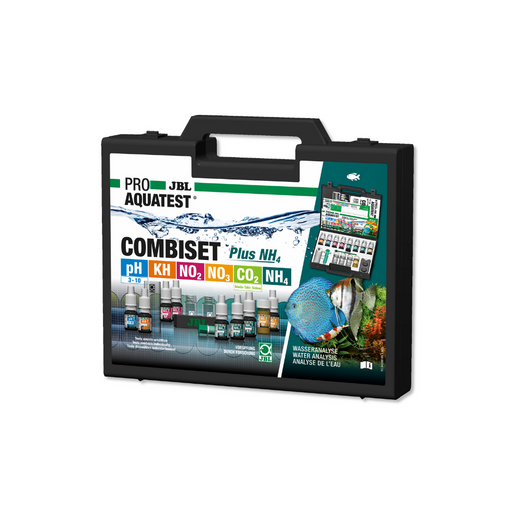
| JBL ProAquaTest Lab water analysis case, 13 tests for aquarium and pondYour choice | 12 | 13 | Yes | Yes | Yes | 23 bottles | 12 | Yes | Yes | Yes | $112.56 |
Copper test onlyRecommended
What you are measuring
Parameters covered1
Drop test kits included1
Copper CuYes
pH, KH, nitrite, nitrate, ammoniumNo
GH, iron, phosphate, oxygen, silicateNo
Equipment supplied
Reagent bottles (bottles)2 bottles
Glass test tubes2
Laboratory comparator blockYes
ThermometerNo
Budget
Reagent refill sold separatelyYes
6-in-1 Aquarium Water Testing Kit
What you are measuring
Parameters covered6
Drop test kits included5
Copper CuNo
pH, KH, nitrite, nitrate, ammoniumYes
GH, iron, phosphate, oxygen, silicateNo
Equipment supplied
Reagent bottles (bottles)9 bottles
Glass test tubes3
Laboratory comparator blockYes
ThermometerNo
Budget
Reagent refill sold separatelyYes
JBL ProAquaTest Lab water analysis case, 13 tests for aquarium and pond
What you are measuring
Parameters covered12
Drop test kits included13
Copper CuYes
pH, KH, nitrite, nitrate, ammoniumYes
GH, iron, phosphate, oxygen, silicateYes
Equipment supplied
Reagent bottles (bottles)23 bottles
Glass test tubes12
Laboratory comparator blockYes
ThermometerYes
Budget
Reagent refill sold separatelyYes
Parameters covered and equipment in the kits, as described in their data sheets.
Buying guide
Look for copper, or monitor nitrogen
Documents & manuals
Official manufacturer's instructions, in French
The full six-step protocol, where the copper in tap water comes from, and how to remove insoluble compounds.
Document not showing? Some publishers block display inside a frame, so open it in a tab.
Estimate your
delivery time
Your estimate
Delivery
Estimated time
It covers preparing your order and then the transit time quoted by the carrier, counted in working days.
It is not a guaranteed delivery date: public holidays, peak periods, customs or a carrier delay can extend it. The exact amount, in your currency, is worked out in the cart once your address is entered.
Parcel of 0.15 kg, dispatched within 48 h by Colissimo or Chronopost to your home, as you choose during payment. The reagents are sent in their original box. The exact amount is shown in the basket. Once unsealed, this product can no longer be returned under the right of withdrawal (article L221-28, 5° of the French Consumer Code), for reasons of hygiene and health protection.
Frequently asked questions
8 questions
6 key questions, 8 in the detailed view
You may also like




Related articles

Guide
Common mistakes in aquaponics
After a treatment, check the water every two days, and record the readings as a series rather than as isolated measurements.
Read the article

Crops
Which fertiliser should you use in aquaponics?
Copper appears as a trace element in several trace element mixes. What you pour into the crops ends up in the tank.
Read the article

Diagnosis
Recognising deficiencies in aquaponics
The article teaches you to tell a true trace element deficiency from a look-alike picture, before correcting blindly.
Read the article

Pond
Green pond water: 5 solutions
Green water can be treated in five ways without resorting to an algaecide, some of which are copper-based.
Read the article

Fish
Koi carp in aquaponics
An antiparasitic treatment is given in a quarantine tank, separate from the system, since it can damage the biofilter and the roots.
Read the article

Guide
The nitrogen cycle in aquaponics
The signs of a nitrogen cycle that has broken down, and what to do when ammonia or nitrite reappears.
Read the article
Let us talk about your project
A question about this product or your setup? Our team will answer and advise you.

Interest-free instalment payments
Offered depending on the cart amount, at checkout.

Delivery in 2 to 15 working days
Depending on the products and shipping sites. Estimate by destination in the estimator on this page.

After-sales service 7 days a week by email or chat
Our team answers all your questions.

Shop responsibly
Become part of the change.
