





Spring food for pond fish JBL ProPond Spring
Regular price
$10.18
Regular price
Sale price
$10.18
Unit price
/
per
| Poids | Price | Price per kg | vs 360 g |
|---|---|---|---|
| 360 g | $10.18 | $28.28 | — |
| 1,1 kg | $25.05 | $22.77 | −19 % |
| 2,1 kg | $41.07 | $19.56 | −31 % |
$3.39 × 3 with no fees
Klarna.
These floating pellets support the recovery of your koi and goldfish as winter ends, when the water temperature rises from 10 to 20 °C. Their recipe of insect protein and spirulina restarts growth after the winter fast.
 Customer support 7 days a week by email
 Delivery within 2 to 15 business days
100 % secure payment
The summary
- What it is: a complete end-of-winter food, in floating pellets, in a 360 g tub or in a 1.1 or 2.1 kg pouch.
- Its recipe: 28% protein, 8% fat, 5% insect protein, 5% spirulina and 5% shrimp.
- When to feed it: as soon as the water climbs back above 10 °C, until it reaches 20 °C.
- How much to feed: small portions at first, then as much as your fish eat in a few minutes.
- How to choose: water temperature and the point in the season are what set pond foods apart.
- How it arrives: in a tub or resealable pouch, delivered to your door by Colissimo or Chronopost.
Floating recovery pellets for koi and goldfish, in water at 10 to 20 °C
Coming out of winter, your pond fish have spent several weeks eating almost nothing, and they have drawn on their reserves. When the water rises back above 10 °C, they come up again, begin begging for food, and their bodies need to rebuild their reserves and resume growing. These floating pellets are formulated for this recovery, in water warming from 10 to 20 °C, with a richer recipe than a winter food but still low in fat.
🌸 Getting back to feeding after the fast
In spring, the water temperature rises faster than the filter's activity. Your fish beg for food from the first mild days, while the bacteria that break down their waste are still working slowly after months in cold water. Restarting feeding too generously therefore leaves more ammonia and nitrite in the pond than the filter can process. Begin with one meal every 2 or 3 days at around 10 to 13 °C, then increase gradually to 1 or 2 meals a day as the water approaches 20 °C.
Restarting with small rations
The first meals of spring should stay small, even if your fish seem ravenous. Give what they eat in 1 or 2 minutes, without going back for more, during the first 2 weeks. A fish coming out of winter still digests slowly, and excess food ends up in the water as ammonia, at the very moment when the filter is least able to remove it.
🧪 A boosting recipe
The analysis declares 28% crude protein, with 8% fat, 3% fibre and 8% ash. The protein comes from salmon, squid and shrimp meal, plus 5% insect protein from the black soldier fly, a natural part of fish diets. Spirulina, at 5%, and spinach meal complete the formula. Each kilo also gives your fish 3,940 mg of lysine and 2,970 mg of methionine, two amino acids that drive growth, as well as 200 mg of vitamin C, 300 mg of vitamin E and 50 mg of astaxanthin.
Keep an eye on the nitrite during the restart
In spring, nitrite is the parameter that signals a filter whose activity has not yet resumed, because the bacteria that convert nitrite into nitrate restart more slowly than those that convert ammonium into nitrite. The nitrite NO2 water test drops tell you within a few minutes whether the filter is already processing all the nitrite produced by the ration. Test once a week during the first month of feeding, and reduce the ration as soon as the reading rises above zero.
From 10 to 13 °C
Give a small meal every 2 or 3 days, eaten within 1 or 2 minutes.
From 13 to 16 °C
Feed 3 to 5 meals a week, depending on your fish's appetite.
From 16 to 20 °C
Move to 1 or 2 meals a day, each eaten within a few minutes.
🌱 Spring in aquaponics
In an aquaponic system, spring restarts the fish, the filter and the crops all at once, but not at the same pace. The ration your fish receive determines the nitrogen available to the plants, so a gradual restart limits the nitrite spike and supports the growth of the first seedlings. Nitrification only reaches full efficiency between 17 and 34 °C: below that, let demanding crops wait and begin with salad leaves or herbs. The article on spring seedlings in aquaponics sets out this schedule in detail.
Take a pond holding 3 kg of goldfish and young koi. At 15 °C, a ration of around 1% of that weight comes to 30 g per meal, served 3 to 5 times a week. The 1.1 kg pouch then lasts about 2 months, which matches the usual length of the recovery period, from the pond waking up until the first water at 20 °C. After that, you switch to a full-season food, richer in protein.
The 360 g tub is enough for the few goldfish in a small pond, while the resealable 1.1 and 2.1 kg bags suit koi ponds and aquaponic systems. Keep the packaging closed, dry and away from heat to preserve the vitamins. The granules float, which lets you see what is being eaten and remove any excess with the telescopic pond net before it sinks and decomposes.
Technical specifications
The analysis
- Crude protein
- 28 %
- Crude fat
- 8 %
- Crude fibre
- 3 %
- Crude ash
- 8 %
Use
- Water temperature
- From 10 to 20 °CAbove 20 °C, a full-season food takes over.
- Shape
- Floating pelletsYou can see what is eaten and remove the surplus.
- Fish concerned
- Koi and goldfishGranules designed for fish over 15 cm.
- Resumption
- Small portions to begin withThe filter restarts more slowly than the fish's appetite.
The composition
- First raw ingredients
- Maize, rice, salmon, soyaThen insects, spirulina, squid, shrimp, spinach, yeast and wheat.
- Insects, spirulina, shrimp
- 5% each
- Amino acids per kilo
- Lysine 3,940 mgAnd methionine 2,970 mg.
- Vitamins and pigment
- C 200 mg, E 300 mgAnd A 25,000 IU, D3 2,000 IU, astaxanthin 50 mg per kilo.
To budget for separately
- Filter monitoring
- Nitrite test
- Reading the temperature
- Floating thermometer
6 further specifications are available in the detailed view.
In the box
- 1 360 g tub or 1 resealable 1.1 or 2.1 kg bag of floating pellets, depending on the size chosen
Analysis, composition, additives and the 10 to 20 °C range taken from the manufacturer's data sheet on 08/10/2026. Feeding frequencies by temperature: two koi feeding guides. Nitrification from 17 to 34 °C: FAO guide to small-scale aquaponics.
Spring, cool water or all seasons?
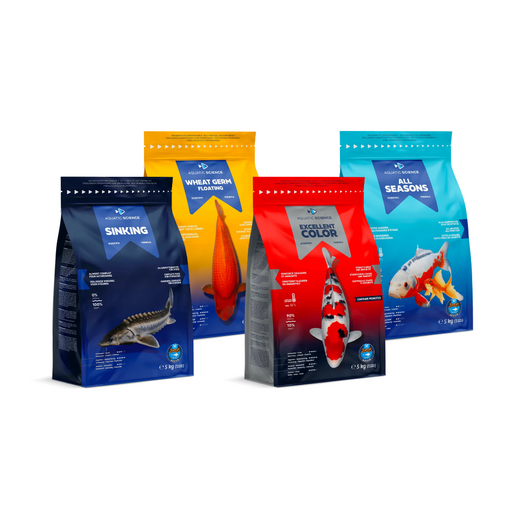
Three floating foods arranged by time of year. The water temperature and the priority of the moment decide between the three.
Spring, cool water or all seasons?
Three answers, and the table highlights the food that suits the current season.
| Water temperature | Time of year | Crude protein (%) | Crude fat (%) | Shape | Pouch weight | Price | |
|---|---|---|---|---|---|---|---|
| Recommended Spring food for pond fish JBL ProPondYour choice | 10 to 20 °C | Spring restart | 28 % | 8 % | Floating pellets | 1.1 kg | $25.05 |
| JBL ProPond All Seasons food for koi andYour choice | 10 to 25 °C | Good season | 24 % | 9 % | Floating stick | 2.2 kg | $36.49 |
| Wheat Germ Floating freshwater food forYour choice | 5 to 15 °C | Fresh water, at the start and end of the season | 32 % | 9 % | Floating pellets | 5 kg | $71.96 |
Spring food for pond fish JBL ProPondRecommended
When to feed
Water temperature10 to 20 °C
Time of yearSpring restart
What the label states
Crude protein (%)28 %
Crude fat (%)8 %
ShapeFloating pellets
The formats compared
Pouch weight1.1 kg
JBL ProPond All Seasons food for koi and
When to feed
Water temperature10 to 25 °C
Time of yearGood season
What the label states
Crude protein (%)24 %
Crude fat (%)9 %
ShapeFloating stick
The formats compared
Pouch weight2.2 kg
Wheat Germ Floating freshwater food for
When to feed
Water temperature5 to 15 °C
Time of yearFresh water, at the start and end of the season
What the label states
Crude protein (%)32 %
Crude fat (%)9 %
ShapeFloating pellets
The formats compared
Pouch weight5 kg
Analyses and temperature ranges recorded on 08/10/2026 and 11/10/2026 from the manufacturer's data sheets and packaging. Sheets compared: all-season food and floating food for cool water.
Help choosing
Three questions as the pond wakes up
Estimate your
delivery time
Your estimate
Delivery
Estimated time
It covers preparing your order and then the transit time quoted by the carrier, counted in working days.
It is not a guaranteed delivery date: public holidays, peak periods, customs or a carrier delay can extend it. The exact amount, in your currency, is worked out in the cart once your address is entered.
Box or sachet shipped within 48 h by Colissimo or Chronopost to your home, as you choose during payment. The exact cost is shown at checkout, according to the total weight of your order.
Frequently asked questions
6 questions
6 key questions
You may also like




Related articles

Crops
Successful spring seedlings in aquaponics
The first seedlings of the year, at the pace of the nitrogen the fish provide.
Read the article

Understanding
The nitrogen cycle in aquaponics
Why the nitrite level rises in spring when the filter restarts.
Read the article

Fish

Season
A practical schedule for success with aquaponics
The calendar of an aquaponic system, from the spring wake-up to winter.
Read the article

Start-up
Getting started with an aquaponic system
The start-up rules, which also apply when restarting a filter in spring.
Read the article
Let us talk about your project
A question about this product or your setup? Our team will answer and advise you.

Interest-free instalment payments
Offered depending on the cart amount, at checkout.

Delivery in 2 to 15 working days
Depending on the products and shipping sites. Estimate by destination in the estimator on this page.

After-sales service 7 days a week by email or chat
Our team answers all your questions.

Shop responsibly
Become part of the change.
