



360° digital thermometer and hygrometer
Regular price
$20.48
Regular price
Sale price
$20.48
Unit price
/
per
$6.82 × 3 with no fees
Klarna.
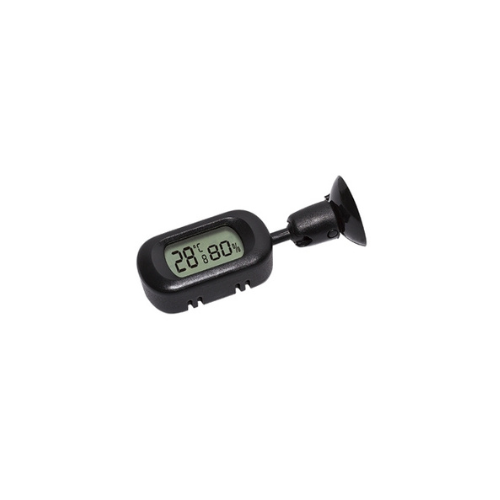
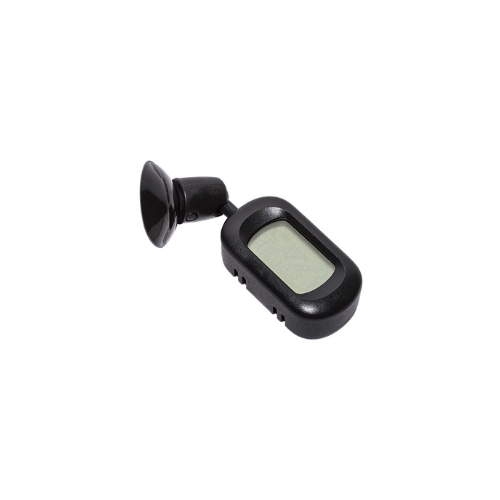
This digital probe displays the air temperature and humidity on the same screen. Its head swivels through 360 degrees, and the screen can be read whatever the position of the suction cup.
Pocket-sized at 5.5 x 3 x 1.5 cm, the probe suits a greenhouse, a growing shelter or a terrarium.
 Customer support 7 days a week by email
 Delivery within 2 to 15 business days
100 % secure payment
The summary
- What it measures: temperature from -10 to 50 °C and air humidity from 20 to 90 %, on the same screen.
- Where it is used: in a greenhouse, in a growing shelter or in a terrarium.
- How it mounts: a suction cup and a head that swivels through 360 degrees.
- Where to place it: at foliage height, in the shade, away from a wall heated by the sun.
- Its size: 5.5 by 3 cm, 1.5 cm thick, 35 g.
- How it arrives: a tiny parcel, together with the rest of your order.
Air temperature and humidity on a single adjustable screen
This Repti Zoo SH128 digital probe shows the air temperature and relative humidity on the same screen, from -10 to 50 °C and from 20 to 90 %, in a casing measuring 5.5 by 3 cm. It attaches by a suction cup mounted on a head that swivels through 360 degrees, and it refreshes its reading every 20 seconds. In a greenhouse or under a shelter, the air surrounding the leaves often has neither the temperature nor the humidity of the water in the neighbouring tank, and it is this air that the probe lets you monitor.
💨 Air humidity, the other measurement
Temperature is monitored almost by reflex; relative humidity is rarely checked, yet it governs two very practical things. Air that is too humid and too stagnant is exactly where foliage diseases take hold, usually appearing first on the lower leaves of a tightly packed row. Air that is too dry makes the plant transpire faster than it can take up water, so leaf edges scorch and young fruit drops. Between the two, you can almost always correct the reading with the same simple action: open up, ventilate, get the air moving.
Relative humidity expresses the amount of water vapour the air contains, relative to the maximum it could hold at the same temperature. This maximum increases with heat, since a cubic metre of saturated air holds about 17 g of water at 20 °C and about 30 g at 30 °C. Air at 90% and 20 °C in the morning, warmed to 30 °C during the day with no added water, will therefore read around 50% in the afternoon even though it contains the same amount of vapour. Compare your readings at the same time of day, and treat a humidity level that drops around midday as a sign of a greenhouse that is heating up.
Also monitor the water of the tank under the greenhouse
This probe reads the air, whereas the water in a grow bed or an aquarium set up in the greenhouse is monitored with a submerged instrument. The JBL Float glass thermometer sticks to a smooth wall or floats upright, so you can read both temperatures side by side. The difference between air and water then tells you whether to shade, ventilate or heat.
Direct sunlight skews both readings
A unit exposed to full sun heats up faster than the surrounding air: the displayed temperature rises and the relative humidity reading drops accordingly, without the greenhouse air having changed. Place the probe in the shade of the foliage, and bring it indoors if it gets rained on or repeatedly splashed, since its casing is not designed to get wet.
🪟 Where to stick it in a greenhouse
Placement determines what you read. Position the probe at foliage height, in the middle of the crop and not against a wall: the glazing heats up in the sun and gives a reading that belongs to no plant. Also avoid the immediate vicinity of a tank of water, which creates a local humid microclimate, and avoid draughts. The swivelling head is there for exactly this: you stick the suction cup where the measurement is accurate, then turn the screen towards the spot from which you will read it.
On a central post
Place it in the middle of the greenhouse, at canopy height. This is the most representative measurement.
Not against the glass
An exposed wall gives off its own heat, not that of the surrounding air.
Not above a tank
Evaporation creates a local pocket of humidity that tells you nothing about the rest of the shelter.
At eye level
Turn the screen towards the aisle to read it without bending down or unhooking the suction cup.
📏 Ranges and accuracy
The probe measures temperature from -10 to 50 °C, to within 1 °C, and relative humidity from 20 to 90 %, to within 5 %. This accuracy is sufficient for controlling ventilation, as the decision rests on how the value changes over the course of the day rather than on a few points of difference. A closed greenhouse often reaches saturation at daybreak, when vapour condenses on the glazing, and the reading then goes beyond the device's range: that is the time to open up. As the screen updates every 20 seconds, the effect of an open door can be read almost immediately.
🐟 Under an aquaponic greenhouse
In an aquaponic greenhouse, the pond and the grow beds evaporate continuously, so the air quickly fills with water vapour. In the evening and at night, when the vents are closed, the relative humidity approaches saturation, and it is during these hours that foliage diseases take hold. The probe shows you when to open the vents and how long to leave them open, particularly for sensitive crops such as tomatoes in aquaponics. The guide to outdoor aquaponics greenhouses and kits explains what a greenhouse changes in terms of water temperature and the choice of species.
The same monitoring applies to an indoor seedling space, under a mini-greenhouse or a lid, where the confined air becomes saturated within a few hours. High humidity helps germination, but once the seedlings have emerged, air that stays close to saturation encourages damping-off: lift the lid every day and follow the drop on the display. The guide to setting up your indoor seedling space describes this routine in detail.
Technical specifications
The measurements
- Measurements
- Air temperature and humidityBoth values are shown at the same time on the same screen.
- Temperature
- -10 to 50 °CWithin 1 °C
- Relative humidity
- 20 to 90 %Within 5%
- Update
- Every 20 seconds
- Display
- DigitalReadable from a step back, with no need to interpret a column.
- Reference
- Repti Zoo SH128
The housing and installation
- Dimensions
- 5.5 x 3 x 1.5 cmA format that slips between two rows without casting a shadow.
- Weight
- 35 gLight enough for the suction cup to hold on a smooth wall.
- Fixing
- Suction cup, 360° rotating headStick it where the reading is accurate, then turn the screen towards you.
- Location
- At foliage heightNot against the glass, not above a tank full of water, and not in a draught.
2 further specifications are available in the detailed view.
In the box
- 1 digital thermometer-hygrometer with a rotating head, supplied with its suction cup.
Measured quantities, ranges, accuracy, dimensions, weight and mounting of the Repti Zoo SH128 model, recorded on 20/09/2026 and 11/10/2026.
Estimate your
delivery time
Your estimate
Delivery
Estimated time
It covers preparing your order and then the transit time quoted by the carrier, counted in working days.
It is not a guaranteed delivery date: public holidays, peak periods, customs or a carrier delay can extend it. The exact amount, in your currency, is worked out in the cart once your address is entered.
35 g for a pocket-sized unit: the parcel stays tiny and travels with the rest of your order. The exact shipping costs and final delivery times are shown in your basket once you have entered your address.
Frequently asked questions
8 questions
6 key questions, 8 in the detailed view
You may also like


Related articles

Installations
Greenhouses and outdoor aquaponics kits
Kit or outdoor greenhouse: what each allows you to grow, and how a greenhouse stabilises the water temperature.
Read the article

Seasons
Maintaining your aquaponic system in summer
Ventilating, shading, and knowing when to do it.
Read the article

Practical
Controlling pests in aquaponics
Stale, humid air, the favourite breeding ground for foliage problems.
Read the article

Crops

Guide
Setting up an indoor seedling space
A confined space where humidity rises quickly, and what to do about it.
Read the article

Diagnosis
Let us talk about your project
A question about this product or your setup? Our team will answer and advise you.

Interest-free instalment payments
Offered depending on the cart amount, at checkout.

Delivery in 2 to 15 working days
Depending on the products and shipping sites. Estimate by destination in the estimator on this page.

After-sales service 7 days a week by email or chat
Our team answers all your questions.

Shop responsibly
Become part of the change.
