





Dissolved oxygen O2 water test in drops
Regular price
$17.00
Regular price
Sale price
$17.00
Unit price
/
per
A lack of oxygen can kill the fish in a pond in a single summer night. This test measures the actual dissolved oxygen, from 1 to 10 mg/L, in aquariums, ponds, and aquaponics systems.
The difficulty lies in the sampling: the test tube must be filled by immersion, to the brim, and the slightest trapped bubble will skew the result upwards.
 Customer support 7 days a week by email
 Delivery within 2 to 15 business days
100 % secure payment
The summary
- What you receive: 3 bottles of reagents, a glass test tube with a screw cap, a syringe and a colour chart.
- What you measure: dissolved oxygen from 1 to 10 mg/L, in freshwater, seawater and ponds.
- When to test: in the early morning, before sunrise, when oxygen is at its lowest of the day.
- How long it takes: 12 minutes per test, 10 of which are waiting time.
- How to choose: this test is sold on its own, and oxygen is also included in the 13-in-1 case for aquariums and in the 10-in-1 case for ponds.
- Three corrosive reagents: they react in the screw-cap test tube, which you then empty down the sink; they never go into the fish water.
Dissolved oxygen drop test, from 1 to 10 mg/L, for aquariums, ponds, and aquaponics
This drop test reads dissolved oxygen from 1 to 10 mg/L, for about 40 measurements, in aquariums, ponds and aquaponics, where the FAO advises at least 5 mg/L. Measure in the early morning, when oxygen is at its lowest, using a test tube filled by immersion: the reagents never enter the fish water.
A rise in ammonium or nitrite develops over several days, whereas a lack of oxygen becomes dangerous within hours. A night spent in the red zone of the colour chart, at 2 mg/L or less, can be enough to kill the fish in a pond where nothing looked wrong the previous evening, because the level reaches its minimum just before dawn, at an hour when people rarely test. This test is therefore best done in the early morning, to catch the lowest value of the day.
🌞 Warm water, less oxygen
The amount of oxygen that water can dissolve depends first of all on its temperature. Saturated fresh water holds about 11 mg/L of oxygen at 10 °C, and less than 8 mg/L at 30 °C. A heatwave therefore hits your pond twice: it lowers the available ceiling while the heat speeds up the respiration of fish and bacteria, which then use more. This is the mechanism described in the guide to system maintenance in summer.
Break the surface as soon as oxygen drops below 4 mg/L
Aim for 5 to 8 mg/L in a freshwater community aquarium, and 5 to 10 mg/L in a lightly stocked planted tank, in seawater and in a pond. Below 4 mg/L, break the water surface: an air pump and its diffusers raise the level within a few hours, because they renew the water in contact with the air. Then check the nitrite over the following days, since nitrifying bacteria need oxygen to convert ammonium.
🌱 Oxygen in aquaponics
In an aquaponic system, three populations breathe the same water: the fish, the nitrifying bacteria in the biofilter and the plant roots. The bacteria need oxygen to convert ammonium into nitrate, so a lack of oxygen often shows up in nitrification before it shows in the fish. Aim for at least 5 mg/L in the fish tank and in the grow beds, and sample at the least agitated point, the end of a channel or the bottom of a media bed, rather than right next to the diffuser. Setting up a complete system is described in the article Getting an aquaponic system off to a good start.
A reading taken at the end of the day overestimates your oxygen
Plants and algae produce oxygen as long as there is light, and consume it all night without producing any. In a well-planted tank or pond, the level even exceeds saturation by 1 to 2 mg/L at the end of the lighting period. The maximum level is therefore reached in the late afternoon and the minimum just before sunrise, so a reading taken at the end of the day gives the highest value and says nothing about the lowest.
Garden pond in summer
Warm water, high biomass and short nights add up. Green water lowers the night-time minimum even further.
Aquaponics
The biofilter consumes oxygen continuously, in addition to the fish. Without oxygen, nitrification stops.
Planted tank with CO2 injection
Oxygen content drops at night, while gas injection sometimes carries on.
After a power cut
A pump stopped for a few hours, a medication, an algal bloom dying off all at once: each can make oxygen plunge within a day.
🫧 Fill without an air bubble
The sample for this test is not drawn with a syringe. Rinse the test tube, then fill it by immersion, right to the brim, and place it on a waterproof surface. Add the 6 drops of the first reagent and the 6 of the second slowly, allowing it to overflow, and screw on the cap without trapping a single bubble. These two reagents chemically fix the oxygen present at the moment of closing: a bubble trapped at this stage would add its own oxygen, and your result would be overestimated. After 30 seconds of shaking, the third reagent develops the colour, from yellow to dark red, and any bubbles trapped when closing the test tube no longer play any part.
⚗️ Three bottles to close straight away
All three reagents carry the Danger warning. The first contains manganese chloride, the second sodium hydroxide, and the third sulphuric acid and a phenylenediamine derivative that can cause an allergic reaction of the skin or respiratory tract. As the test tube is filled to the brim by immersion, add the drops over a sink, screw the cap back on without trapping any air, then shake while holding the tube closed. On a pond or an aquaponic system, never dip the bottle into the water and never pour the sample back after reading: it goes down the sink, and you rinse the tube. The O2 reagent refill replaces all three bottles.
Technical specifications
Measuring oxygen
- Parameter measured
- Dissolved oxygen in the waterThe method chemically fixes the oxygen present at the moment of sampling, then reveals it through a colour change from yellow to dark red
- Measuring range
- 1 to 10 mg/LIn fresh water, one milligram per litre is equivalent to one ppm
- Tests per kit
- Around 40Each measurement uses 6 drops from each of the 3 bottles, so 18 drops
- Target values
- 5 to 8 mg/L in freshwater5 to 10 mg/L in a lightly stocked planted tank, in seawater and in a pond. The colour chart turns red at 2 mg/L and below
- Method
- Chemical fixation, colorimetric readingManganese salt, strong base, then an acid developer: this is the principle behind laboratory oxygen assays
- Manufacturer's reference
- JBL 2411200, PROAQUATEST rangeEAN code 4014162241122
The procedure
- Sampling
- Test tube filled by immersionRight up to the rim, with no bubbles, and not with a syringe
- The steps
- Rinse, immerse, add reagent, shake, develop, readIn that order. The cap screws on while letting the test tube overflow
- Drops per reagent
- 6 drops, three times6 of reagent 1, 6 of reagent 2, then 6 of reagent 3 after the first shake
- Shaking and waiting
- 2 times 30 s, then 10 minReading before the 10 minutes are up underestimates the value
- Total time
- About 12 minutesHandling included
- Reading
- Test tube lying on its side, 3 to 5 cm from the colour chartMoved back and forth over the white section, until the colour matches as closely as possible
Hazard labelling
- Signal word
- DangerOn all three bottles
- Pictograms
- Corrosion and health hazardGHS05 on all three bottles, GHS08 on reagents 1 and 3
- Hazard statements
- H314, H373, H412, H317, H334Burns, organ damage from repeated exposure and aquatic toxicity (reagent 1), skin and respiratory allergy (reagent 3)
- Precautionary statements
- P101, P102, P303+P361+P353, P305+P351+P338, P501Label kept for medical advice, children kept away, skin and eyes rinsed with water, bottles disposed of according to local rules
- Precautions
- Sink, ventilated room, out of reachNever smell a bottle or a test tube, and empty the treated tube down the sink
- Classified components
- Manganese, soda, sulphuric acidManganese chloride, sodium hydroxide and sulphuric acid, one per bottle
To allow for in addition
- Reagent refills
- Reagents only, ref. 2411300The glass test tube, its stopper, the syringe and the colour chart keep
- Enough to correct
- An air pump and its diffusersBelow 4 mg/L at early morning, aeration is increased the same day
12 further specifications are available in the detailed view.
In the box
- 3 reagent bottles
- 1 glass test tube with a screw cap
- 1 graduated sampling syringe
- 1 reading chart with a white background
- 1 multilingual instruction leaflet, French included
Manufacturer's values (instructions, colour chart and safety data sheets for the three reagents). Aquaponic reference values from the FAO.
Manufacturer and product safety
- Manufacturer
- JBL GmbH & Co. KG
- Postal address
- Dieselstraße 3, 67141 Neuhofen, Allemagne
- Contact
- info@jbl.de
- Website
- www.jbl.de
Information provided under Regulation (EU) 2023/988 on general product safety.
Oxygen is not in every kit
It is a parameter that not all test kits include. Before buying a kit to measure it, check that it really does contain it.
Oxygen depletion occurs before daybreak
At night, plants consume oxygen without producing any, and warm water holds less of it. A check carried out in the afternoon therefore does not reveal this minimum.
| Dissolved oxygen | Parameters covered | Drop test kits included | pH, KH, nitrite, nitrate and ammonium | GH, iron, phosphates, copper and silicates | Reagent bottles (bottles) | Glass test tubes | Screw-cap test tube | Thermometer | Reagent refill sold separately | Price | |
|---|---|---|---|---|---|---|---|---|---|---|---|
| Recommended Dissolved oxygen test onlyYour choice | Yes | 1 | 1 | No | No | 3 bottles | 1 | Yes | No | Yes | $17.00 |
| 6-in-1 Aquarium Water Testing KitYour choice | No | 6 | 5 | Yes | No | 9 bottles | 3 | No | No | Yes | $58.00 |
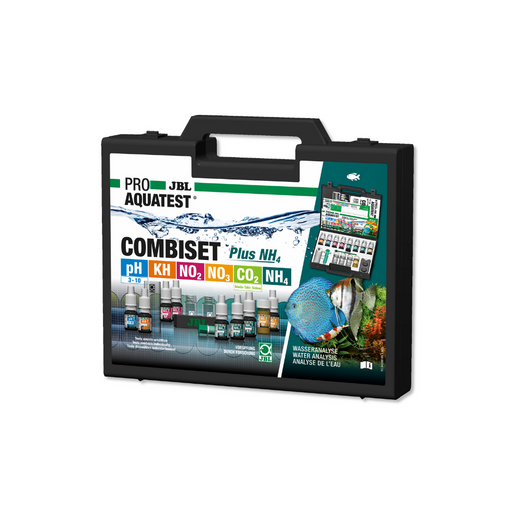
| JBL ProAquaTest Lab water analysis case, 13 tests for aquarium and pondYour choice | Yes | 12 | 13 | Yes | Yes | 23 bottles | 12 | Yes | Yes | Yes | $114.00 |
Dissolved oxygen test onlyRecommended
What you are measuring
Dissolved oxygenYes
Parameters covered1
Drop test kits included1
pH, KH, nitrite, nitrate and ammoniumNo
GH, iron, phosphates, copper and silicatesNo
Equipment supplied
Reagent bottles (bottles)3 bottles
Glass test tubes1
Screw-cap test tubeYes
ThermometerNo
Budget
Reagent refill sold separatelyYes
6-in-1 Aquarium Water Testing Kit
What you are measuring
Dissolved oxygenNo
Parameters covered6
Drop test kits included5
pH, KH, nitrite, nitrate and ammoniumYes
GH, iron, phosphates, copper and silicatesNo
Equipment supplied
Reagent bottles (bottles)9 bottles
Glass test tubes3
Screw-cap test tubeNo
ThermometerNo
Budget
Reagent refill sold separatelyYes
JBL ProAquaTest Lab water analysis case, 13 tests for aquarium and pond
What you are measuring
Dissolved oxygenYes
Parameters covered12
Drop test kits included13
pH, KH, nitrite, nitrate and ammoniumYes
GH, iron, phosphates, copper and silicatesYes
Equipment supplied
Reagent bottles (bottles)23 bottles
Glass test tubes12
Screw-cap test tubeYes
ThermometerYes
Budget
Reagent refill sold separatelyYes
Parameters covered and equipment taken from the data sheets of this test and the two kits.
Buying guide
Tracking the night's oxygen
Documents & manuals
Official manufacturer's instructions, in French
The eight-step protocol, filling the test tube by immersion, and the oxygen saturation table as a function of temperature on the last page.
Document not showing? Some publishers block display inside a frame, so open it in a tab.
Estimate your
delivery time
Your estimate
Delivery
Estimated time
It covers preparing your order and then the transit time quoted by the carrier, counted in working days.
It is not a guaranteed delivery date: public holidays, peak periods, customs or a carrier delay can extend it. The exact amount, in your currency, is worked out in the cart once your address is entered.
Parcel of 0.11 kg, dispatched within 48 h by Colissimo or Chronopost home delivery, as you choose during payment. The reagents are sent in their original box. The exact amount is shown in the basket. Once unsealed, this product can no longer be returned under the right of withdrawal (article L221-28, 5° of the French Consumer Code), for reasons of hygiene and health protection.
Frequently asked questions
6 questions
6 key questions
You may also like




Related articles

Season
Looking after your aquaponic system in summer
Heat lowers the oxygen ceiling while speeding up consumption. The article brings together the steps that keep a system going in July.
Read the article

Guide
Aquaponics and summer holidays
Going away for three weeks calls for aeration that does not depend on you, and a measurement taken on the morning you leave.
Read the article

Pond
Pond algae in summer
An algal bloom produces oxygen by day and consumes it at night: it is what drives the dawn minimum down.
Read the article

Pond
Green pond water: 5 solutions
Green water whose algae die off all at once causes oxygen to plummet within a few hours. The article explains how to treat it without causing this sudden die-off.
Read the article

Guide
Which fish should you choose for aquaponics?
Oxygen requirements can differ by a factor of two from one species to another, and they determine the permissible stocking load.
Read the article

Stocking
Salmoponics, cold-water aquaponics
Trout is the extreme case: it needs cold water, and therefore oxygen-rich water, and tolerates no margin.
Read the article
Let us talk about your project
A question about this product or your setup? Our team will answer and advise you.

Interest-free instalment payments
Offered depending on the cart amount, at checkout.

Delivery in 2 to 15 working days
Depending on the products and shipping sites. Estimate by destination in the estimator on this page.

After-sales service 7 days a week by email or chat
Our team answers all your questions.

Shop responsibly
Become part of the change.
