



Magnesium water test in drops, freshwater
Regular price
$23.00
Regular price
Sale price
$23.00
Unit price
/
per
$7.66 × 3 with no fees
Klarna.
This drop-based test measures magnesium from 0 to 10 mg/L in freshwater, whether in a planted aquarium or in aquaponics. Magnesium is the central atom of chlorophyll, and a plant deficient in it will yellow between the veins.
An iron deficiency produces the same yellowing, but it starts with the young leaves, whereas a magnesium deficiency starts with the lower leaves.
 Customer support 7 days a week by email
 Delivery within 2 to 15 business days
100 % secure payment
The summary
- What you measure: dissolved magnesium, from 0 to 10 mg/L, across eight colour fields, in fresh water only.
- Why measure it: aim for 5 to 10 mg/L for good growth. Very hard water may nonetheless contain little of it.
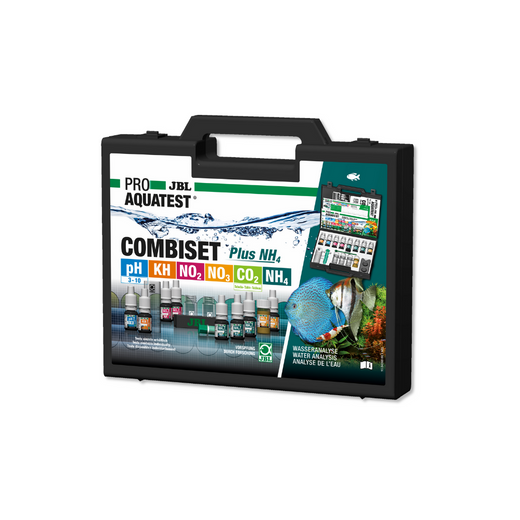
- What you receive: 3 bottles of reagents, 2 glass test tubes with screw caps, a syringe, a comparator block and a colour chart.
- How long it takes: 3 minutes, and the colour stays readable for 15 minutes, no longer.
- How to choose: a total hardness test adds calcium and magnesium together without separating them.
- What is sent to you: a 0.17 kg parcel, reagents in their original box.
Drop test for magnesium from 0 to 10 mg/L, in fresh water, to distinguish between iron and magnesium deficiency
A leaf that yellows between veins that have stayed perfectly green often suggests an iron deficiency first. Magnesium produces the same picture, however, so a chelate supplement can go on for weeks without the foliage turning green again. This test tells the two apart in 3 minutes, over a range of 0 to 10 mg/L and for around sixty measurements.
🍂 Lower leaves, upper leaves
The difference comes down to how mobile the element is within the plant. Magnesium travels in the sap and is remobilised from older tissues to growing organs as soon as the supply becomes insufficient, so the base of the plant turns pale first. Iron, on the other hand, hardly moves at all: once deposited in a leaf, it stays there, and the deficiency shows on the new leaves, at the top. So start by looking at where the yellowing begins on your plants, and you will know which of the two kits to take out before you have even drawn a single drop.
🥬 The magnesium in chlorophyll
Every chlorophyll molecule is built around a single magnesium atom, and no other mineral can fill that role. A plant that lacks it produces less of this light-capturing pigment, so its leaves turn pale and its growth stalls. Paleness is therefore the first sign to watch for on your plants, bearing in mind that this yellowing can have two causes.
The loss of colour begins between the veins because that is where the tissue responsible for photosynthesis is concentrated, while the veins themselves, made of conducting vessels, keep their colour for longer. This green network pattern on a pale background is the shared signature of magnesium and iron, which is exactly why the eye alone cannot tell them apart. Our articles on deficiencies in aquaponics cover the neighbouring tables, including nitrogen, potassium and iron.
Remineralise without forgetting magnesium
Osmosis water remineralised with calcium alone shows a perfectly good GH and a magnesium content of zero, which is a common imbalance in remineralised water. Epsom salt corrects this specific imbalance, since it supplies magnesium and sulphate with no carbonate at all and so leaves your buffering capacity intact. A carbonate-based corrector, by contrast, would raise the KH and the pH along the way.
Dose the Epsom salt to the gram
The order of magnitude is surprising the first time: 1 gram in 10 litres raises magnesium by about 10 mg/L, which is the whole range of the colour chart in one go. Dose small, let the water circulate through one full filtration cycle, and only then retest. An excess can only be corrected with a partial water change, which costs far more time than the half-day of waiting you saved.
💧 What the GH blends
Magnesium ions and calcium ions together make up the total hardness, which the GH test counts as a single block without ever telling them apart. Very hard tap water can therefore contain plenty of calcium and too little magnesium for aquatic plants, and nothing in the GH reveals it. That is the purpose of this kit: it isolates the one fraction on which chlorophyll depends. On remineralised water, measure both: the GH gives the total, this test gives the magnesium share.
🧪 When testing is worth it
Yellowing starts at the bottom
The old leaves turn pale between green veins, while the new shoots are fine. This is the magnesium table.
Yellowing starts from the top
New leaves come out pale while the lower ones stay green. Reach for the iron test, not this one.
Under 5 mg/L, plants do reasonably well
It is not an emergency. Keep an eye on the leaf before correcting anything.
After remineralisation
A salt that supplies only calcium leaves magnesium at zero. Measure from the very first fill.
Technical specifications
The essentials
- Parameter measured
- Dissolved magnesium, in mg/LThe colour chart is marked mg/l (ppm): the two units are equivalent in fresh water
- Measurement range
- 0 to 10 mg/L, plus a range beyond thatThe steps get closer together at the low end of the scale, where the decision is made
- The colour chart fields
- 0, 1, 2, 3, 6, 8, 10 and over 10Eight values, the last field being recorded as more than 10 mg/L
- Target values
- 5 to 10 mg/LRange for good growth of aquatic plants
- Tests per kit
- Approximately 60
- Manufacturer's reference
- JBL 2414200, PROAQUATEST range
The procedure
- Water volume
- 2 times 10 mlOne treated sample and one untreated blank, side by side in the comparator block
- The steps
- Rinse, fill, dose 1, dose 2, dose 3, readWith a mix between each addition of reagent
- Drops per reagent
- 7, then 3, then 2Three different measurements to note down before you begin
- Waiting time
- 1 minuteThe colour then stays stable for 15 minutes: take your reading within that window
- Total duration
- Approximately 3 minutesHandling included
- Reading
- Colour chart, in daylightThe block slides along the colour chart until the two shades match
Security and parcels
- Ranking
- DangerOnly reagent 2 is classified; it contains sodium hydroxide
- Main risks
- Burns, eye injuriesH314 and H318 statements
- Precautions
- Sink, well-ventilated room, out of reachChild-resistant caps on all three bottles
- Covered environment
- Freshwater onlySeawater measures around a thousand mg/L, far beyond this scale
To budget for separately
- What to correct with
- Epsom salt, magnesium sulphate1 gram in 10 litres raises the magnesium content by about 10 mg/L: dose sparingly
- Reagent refill
- Reagents only, ref. 2414300The glassware, comparator block and colour chart can be kept
10 further specifications are available in the detailed view.
In the box
- 3 reagent bottles with child-resistant caps
- 2 glass test tubes with screw caps
- 1 graduated sampling syringe
- 1 laboratory comparator block, in grey
- 1 colour chart with 8 colour fields, from 0 to over 10 mg/L
- 1 multilingual instruction leaflet, French included
Reference, EAN code, number of tests, kit contents, six-step protocol, target value and hazard statements taken from the manufacturer's data sheet and instructions on 05/09/2026. The range of 0 to 10 mg/L and the detail of the eight fields are taken from a photograph of the colour chart supplied.
Magnesium, or total hardness?
A total hardness test adds calcium and magnesium together without separating them. Here is what each column really tells you when your question is about magnesium.
GH adds up calcium and magnesium without separating them
Two waters showing 8 °dGH can contain, in one case, three times as much magnesium as in the other. As long as you are dosing a salt yourself, the overall figure is no longer enough.
| Parameters covered (parameters) | Magnesium dosed separately, in mg/L | Calcium and magnesium counted together | The complete nitrogen cycle | Reagent bottles (bottles) | Glass test tubes | Laboratory comparator block | Colour chart | Duration of a measurement (minutes) | Reagent refill sold separately | Price | |
|---|---|---|---|---|---|---|---|---|---|---|---|
| Recommended Magnesium-only testYour choice | 1 parameters | Yes | No | No | 3 bottles | 2 | Yes | Yes | 3 minutes | Yes | $23.00 |
| GH total hardness water test in dropsYour choice | 1 parameters | No | Yes | No | 1 bottles | 0 | No | No | 2 minutes | Yes | $12.00 |
| 13-in-1 water testing kit for aquariumsYour choice | 12 parameters | No | Yes | Yes | 23 bottles | 12 | Yes | Yes | 30 minutes | Yes | $138.00 |
Magnesium-only testRecommended
What testing teaches you
Parameters covered (parameters)1 parameters
Magnesium dosed separately, in mg/LYes
Calcium and magnesium counted togetherNo
The complete nitrogen cycleNo
Equipment supplied
Reagent bottles (bottles)3 bottles
Glass test tubes2
Laboratory comparator blockYes
Colour chartYes
How to use
Duration of a measurement (minutes)3 minutes
Reagent refill sold separatelyYes
GH total hardness water test in drops
What testing teaches you
Parameters covered (parameters)1 parameters
Magnesium dosed separately, in mg/LNo
Calcium and magnesium counted togetherYes
The complete nitrogen cycleNo
Equipment supplied
Reagent bottles (bottles)1 bottles
Glass test tubes0
Laboratory comparator blockNo
Colour chartNo
How to use
Duration of a measurement (minutes)2 minutes
Reagent refill sold separatelyYes
13-in-1 water testing kit for aquariums
What testing teaches you
Parameters covered (parameters)12 parameters
Magnesium dosed separately, in mg/LNo
Calcium and magnesium counted togetherYes
The complete nitrogen cycleYes
Equipment supplied
Reagent bottles (bottles)23 bottles
Glass test tubes12
Laboratory comparator blockYes
Colour chartYes
How to use
Duration of a measurement (minutes)30 minutes
Reagent refill sold separatelyYes
Parameters covered, equipment supplied and kit contents taken from the three data sheets on 05/09/2026. The 13-in-1 kit combines 13 drop tests, three of them for pH, plus CO2 read from a chart.
Help choosing
Magnesium on its own, or overall hardness
Documents & manuals
Official manufacturer's instructions, in French
Six-step protocol, volumes and number of drops reagent by reagent, target value for plant growth, and what to do when the result is too low or too high.
Document not showing? Some publishers block display inside a frame, so open it in a tab.
Estimate your
delivery time
Your estimate
Delivery
Estimated time
It covers preparing your order and then the transit time quoted by the carrier, counted in working days.
It is not a guaranteed delivery date: public holidays, peak periods, customs or a carrier delay can extend it. The exact amount, in your currency, is worked out in the cart once your address is entered.
0.12 kg parcel, dispatched within 48 hours by Colissimo or Chronopost to your home, as you choose at checkout. The reagents are sent in their original box, upright. The exact cost is shown in your basket.
Frequently asked questions
8 questions
6 key questions, 8 in the detailed view
You may also like


Related articles

Diagnostic
Identifying deficiencies in aquaponics
The complete guide to discolouration patterns, and the key question that distinguishes them: did the symptom start at the top or the bottom of the plant?
Read the article

Guide
Plant deficiencies in aquaponics
What is actually lacking in an aquaponic system, and why macronutrients are depleted faster than trace elements.
Read the article

Diagnostic
Iron deficiency in aquaponics
The other culprit behind interveinal yellowing — the one that strikes young leaves first. Worth reading before you conclude it's magnesium.
Read the article

Nutrition
Which fertiliser should you use in aquaponics?
Where magnesium sits among a system's inputs, and what a foliar fertiliser changes when the roots can no longer keep up.
Read the article

Guide
Common mistakes in aquaponics
Correcting a symptom without measuring it first ranks among the most common mistakes, and leaf yellowing is the most frequent example.
Read the article

Guide
The nitrogen cycle in aquaponics
Nitrogen explains some of the yellowing, but it bleaches the entire leaf rather than sparing the veins.
Read the article
Let us talk about your project
A question about this product or your setup? Our team will answer and advise you.

Interest-free instalment payments
Offered depending on the cart amount, at checkout.

Delivery in 2 to 15 working days
Depending on the products and shipping sites. Estimate by destination in the estimator on this page.

After-sales service 7 days a week by email or chat
Our team answers all your questions.

Shop responsibly
Become part of the change.
