
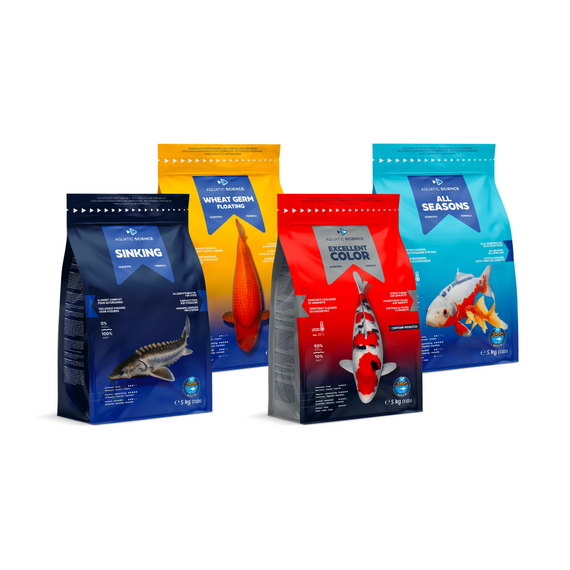


Pond fish food, pack of 4 formulas
Regular price
$157.00
Regular price
$182.00
Sale price
$157.00
Unit price
/
per
$52.33 × 3 with no fees
Klarna.
The pack contains four sealed bags, 11 kg in total, one for each water temperature range: cold-water food in 5 kg, maintenance food in 2 kg, colour food in 2 kg and sinking food for bottom-dwelling fish in 2 kg.
The pack saves you from having to order the right food at the very moment the water changes. Open the bag your thermometer points to, and leave the other three sealed.
 Customer support 7 days a week by email
 Delivery within 2 to 15 business days
100 % secure payment
The summary
- What you receive: four sealed bags, 11 kg in total, four different formulas.
- What is in them: from 32% protein in the cool-water feed to 47% in the sinking feed.
- Which bag to open: the water temperature decides, from 5 °C for the first to over 16 °C for the last.
- For which ponds: water that drops below 12 °C for several weeks a year, and a bottom-dwelling fish.
- What else you will need: a pond thermometer, and scales to calibrate the first meal.
- How it arrives: one 11 kg parcel, to France, Belgium, Luxembourg and Germany.
Four bags, four water temperature ranges, 11 kg in total
The Aquatic Science pond fish food pack contains four sealed bags, 11 kg in total, one for each water temperature range: cool water from 5 °C, maintenance, colour above 16 °C and sinking food for bottom-feeding fish. The formulas range from 32% to 47% protein, and the thermometer shows which bag to open.
The pack brings together, in a single 11 kg parcel, four pond foods also sold individually: a 5 kg bag of cool-water food, a 2 kg bag of maintenance food, a 2 kg bag of colour food and a 2 kg bag of sinking food for bottom-feeding fish.
📆 The bag the water points to
The three floating foods are spread across the water temperature scale, with overlapping ranges so that the switch from one to the next happens smoothly: the cold-water food up to 15 °C, the maintenance food from 12 °C and the colour food above 16 °C. The fourth bag follows a different logic, since the sinking food is chosen according to the level of the tank at which the fish feeds, and not according to the temperature of your water.
From 5 to 15 °C
The fresh-water food, at 32% protein, takes up the biggest bag in the parcel, 5 kg, because this window comes round twice a year.
From 12 to 25 °C
The maintenance food, at 33.5% protein, is the one used on the greatest number of days in a pond year.
Above 16 °C
The colour food, with 39.5 % protein, is the only one in the parcel to declare a pigment, astaxanthin at 15 mg per kg.
On the bottom, all season long
The sinking feed, with 47% protein, feeds sturgeon, barbel, tench and ide.
🍂 The moment the water tips over
In spring as in autumn, the water temperature crosses the 12 and 16 °C thresholds that separate the formulas within a few weeks, and it can cross them again in the other direction after a few cold nights. With the four bags to hand, you open the one the thermometer points to that very morning, rather than stretching out last season's feed while waiting for an order. During these transition weeks, gradually blending the two neighbouring formulas avoids an abrupt change of ration, provided you reduce the share of the richer one as the water cools.
The 12 and 16 °C thresholds are read in the water
The two temperatures that tell you when to change bag are measured in the water, not in the air, which can read 20 °C above water at 11 °C. A floating thermometer read every morning, when the water is at its coldest of the day, gives you this value without any calculation. A precision scale or a graduated cup is then used to weigh out the first meal from each new bag.
Three calendar mix-ups
Do not keep using the colour feed once the water drops back below 16 °C, as its high protein content then weighs on a digestion that is slowing down. Do not give the sinking feed to koi just to finish the bag, because they take food at mid-depth and the sturgeon will go hungry. And never give these feeds to ruminants or any other animal species, as the label reminds you, because they contain fishmeal.
🧪 What a bag change involves
Between the lowest-protein bag in the parcel, at 32%, and the highest-protein one, at 47%, the difference in ammoniacal nitrogen produced at an equal ration is around 45%. Your biological filter takes a few days to adjust to a new load. Between 2 and 3 days after each change of bag, run an ammonium test and a nitrite test; if either value rises, reduce the ration before making any other correction. The way you feed, on the other hand, does not change from one bag to the next: several small feeds are better than one large one, and you give only what is eaten within 5 minutes. The full mechanism is described in the article on the nitrogen cycle.
📦 Three bags stay sealed
What ages in a pellet is the lipids, and this pack ranges from 8.5% fat on the colour feed to 13% on the sinking feed. The pack has an advantage here that a stock of four opened bags does not: while one formula is being used up, the other three stay sealed and do not oxidise. So open one bag at a time, the one the water temperature points to, start with the fattiest if you have a sturgeon, and do not keep a bag that has been opened from one year to the next. Single-bag formats are in the pond fish food collection.
⚖️ A season in figures
Take a pond stocked with 10 kg of fish. In full summer heat, at 2% of body weight per day, the colour feed is given at 200 g per day, so its 2 kg bag lasts about 10 days. The maintenance feed, at around 1.5% per day, or 150 g, lasts nearly 2 weeks with its own bag. The cold-water bag is used up much more slowly, since at 100 g per meal and 2 meals a week it lasts about 25 weeks of mid-season, that is, one autumn and the following spring. For a pond with 3 kg of fish, the same calculations give about 1 month for the colour bag and 6 weeks for the maintenance bag. In both cases, the summer bags run out first, and you can buy them again on their own, one at a time, while the others stay sealed.
🌿 The pack in aquaponics
In aquaponics, every change of bag also changes your plants' ration, since the nitrogen they receive follows the protein level fed. Moving from the freshwater food, at 32%, to the colour food, at 39.5%, therefore increases the nitrogen supplied by roughly a quarter for the same quantity. In spring, this increase arrives just as the crops restart and can absorb it, whereas in autumn the drop in protein goes along with the plants slowing down. To accommodate a sturgeon, the aquaponic set-up calls for a large pond coupled to grow beds, and the guide to keeping sturgeon in a garden pond details the conditions for this set-up.
Technical specifications
The four bags and what each is for
- Cold-water feed
- 5 kg, 32% proteinOpen between 5 and 15 °C. 9% fat, 4.4% fibre, 8.4% ash, 0.9% total phosphorus.
- Maintenance feed
- 2 kg, 33.5% proteinOpen between 12 and 25 °C. 8.9% fat, 4.1% fibre, 8.6% ash, 0.99% total phosphorus.
- Colour-enhancing food
- 2 kg, 39.5% proteinOpen above 16 °C. 8.5% fat, 3.2% fibre, 9.6% ash, 1.3% phosphorus, astaxanthin 15 mg per kg.
- Sinking food
- 2 kg, 47% proteinTo be fed at the bottom, for sturgeon and bottom-feeding fish. 13% fat, 2.1% cellulose, 10.9% ash, 1.6% total phosphorus.
- Total parcel weight
- 11 kg in 4 sealed bagsShipping weight 11.2 kg, packaging included.
- Length of a feed
- 5 minutes at mostThis is the rule that overrides all the others, whichever bag is open.
To budget for separately
- Pond thermometer
- 1 floating thermometer
- Meal dosage
- 1 set of scales or a graduated cup
In the box
- 1 sealed 5 kg bag of floating fresh-water food, with Wheat Germ Floating on the label
- 1 sealed 2 kg bag of floating maintenance food, All Seasons shown on the label
- 1 sealed 2 kg bag of floating colour food, Excellent Color shown on the label
- 1 sealed 2 kg bag of sinking feed, marked Sinking on the label
- 4 manufacturer labels: composition, analysis, batch number and best-before date
Guaranteed analyses noted on 5 September 2026 from the manufacturer's data sheets, Aquatic Science. The thresholds of 5 to 15 °C and 16 °C are the manufacturer's, and 12 °C is a cautious guide for the maintenance feed. Pellet sizes and buoyancy are shown on the packaging.
Manufacturer and product safety
- Manufacturer
- AQUATIC SCIENCE SA
- Postal address
- Rue des Biolleux 8, 4800 Verviers, Belgique
- Contact
- info@aquatic-science.com
- Website
- aquatic-science.com
Information provided under Regulation (EU) 2023/988 on general product safety.
Which bag to open, and what it would cost on its own
The four bags in the parcel, ranked from coldest to warmest, with the price of each sold separately.
Four bags, only one to open at a time
The pack covers the entire year. What decides which bag to open is the water temperature, the level at which your fish feed, and what you expect from the coming month.
| Wheat Germ Floating freshwater food forYour choice | Pond fish food, floating pelletsYour choice | Excellent Color astaxanthin food for koiYour choice | Sinking feed for sturgeon andYour choice | |
|---|---|---|---|---|
| When to open this bag | ||||
| Minimum operating temperature | 5 °C | 12 °C | 16 °C | cold water |
| The temperature guide | Range 5 to 15 °C | From 12 °C | Above 16 °C | Cold water |
| Target fish | Koi and goldfish | All pond fish | Koi | Sturgeon and bottom-dwelling fish |
| What the pack delivers | ||||
| Weight supplied in the pack (kg) | 5 kg | 2 kg | 2 kg | 2 kg |
| Crude protein (%) | 32 % | 33.5 % | 39.5 % | 47 % |
| Floating | Yes | Yes | Yes | No |
| Declared pigment | No | No | Yes | No |
| If you bought this bag on its own | ||||
| Price | $72.00 | $29.00 | $49.00 | $33.00 |
Wheat Germ Floating freshwater food for
When to open this bag
Minimum operating temperature5 °C
The temperature guideRange 5 to 15 °C
Target fishKoi and goldfish
What the pack delivers
Weight supplied in the pack (kg)5 kg
Crude protein (%)32 %
FloatingYes
Declared pigmentNo
If you bought this bag on its own
Pond fish food, floating pellets
When to open this bag
Minimum operating temperature12 °C
The temperature guideFrom 12 °C
Target fishAll pond fish
What the pack delivers
Weight supplied in the pack (kg)2 kg
Crude protein (%)33.5 %
FloatingYes
Declared pigmentNo
If you bought this bag on its own
Excellent Color astaxanthin food for koi
When to open this bag
Minimum operating temperature16 °C
The temperature guideAbove 16 °C
Target fishKoi
What the pack delivers
Weight supplied in the pack (kg)2 kg
Crude protein (%)39.5 %
FloatingYes
Declared pigmentYes
If you bought this bag on its own
Sinking feed for sturgeon and
When to open this bag
Minimum operating temperaturecold water
The temperature guideCold water
Target fishSturgeon and bottom-dwelling fish
What the pack delivers
Weight supplied in the pack (kg)2 kg
Crude protein (%)47 %
FloatingNo
Declared pigmentNo
If you bought this bag on its own
Analyses, temperature limits and buoyancy recorded on 5 September 2026 from the manufacturer's data sheets and packaging, Aquatic Science.
Help choosing
Which bag in the pack to open today
Estimate your
delivery time
Your estimate
Delivery
Estimated time
It covers preparing your order and then the transit time quoted by the carrier, counted in working days.
It is not a guaranteed delivery date: public holidays, peak periods, customs or a carrier delay can extend it. The exact amount, in your currency, is worked out in the cart once your address is entered.
11.2 kg parcel, four bags in a single box, sent to a pick-up point or to your home, as you choose during payment. France, Belgium, Luxembourg and Germany. The exact amount is calculated in the basket according to the total weight of your order.
Frequently asked questions
10 questions
6 key questions, 10 in the detailed view
How much the pack must cover each month
Enter the biomass of your fish, that is, the sum of their live weight. The calculation uses a feeding rate of 2% per day, the upper value for warm water, and converts it to a monthly figure. Compare the result with the 11 kg of the pack to see how many months of peak season it represents for you.
kg
1 kg60 kg
0kg of feed per month
Monthly consumption at the height of the season, all bags combined, to compare with the 11 kg in the pack.
Corresponding daily ration
0 g per day
These guidelines apply to warm water and adult fish. Below 16 °C the actual ration is much lower, and below 5 °C it is nil: the pack then lasts much longer. The guideline of 1.5 to 2% of biomass comes from the FAO species fact sheet on the common carp.
You may also like


Related articles

Guide
Koi carp in aquaponics: the complete guide
Estimating the live weight of your koi, a prerequisite for any ration calculated as a percentage.
Read the article

Guide
Sturgeon in a garden pond
To find out whether the fourth bag in the pack, the sinking one, will really be of use to you.
Read the article

Understanding
The nitrogen cycle in aquaponics
What becomes of an uneaten pellet, and why the protein content changes the load on the filter.
Read the article

Problem
Green water in the pond: 5 solutions without chemicals
The most visible symptom of a ration left at its summer level when the water has changed.
Read the article

Guide
Which fish to choose for aquaponics?
To find out whether the pack's sinking bag will have a bottom-dwelling fish to feed at your place.
Read the article

Problem
Common mistakes in aquaponics
Overfeeding when the warmer weather returns features prominently among them.
Read the article
Let us talk about your project
A question about this product or your setup? Our team will answer and advise you.

Interest-free instalment payments
Offered depending on the cart amount, at checkout.

Delivery in 2 to 15 working days
Depending on the products and shipping sites. Estimate by destination in the estimator on this page.

After-sales service 7 days a week by email or chat
Our team answers all your questions.

Shop responsibly
Become part of the change.
