


RDWC PRO hydroponic kit, 3 to 24 buckets
Regular price
$487.00
Regular price
$522.00
Sale price
$487.00
Unit price
/
per
This RDWC hydroponic kit from the PRO range connects between 3 and 24 pots of 19 L to a controller pot, on a push-fit circuit of 50 mm with high flow rate, inline filter and float valve. It is designed for experienced growers and semi-industrial production, ships from Italy within 3 to 7 days and comes with a 2-year manufacturer's warranty.

7/7 customer service by e-mail

Payment in instalments, free of charge
The summary
- What it is: a network of 19 L pots in which the roots are permanently submerged, connected to a controller pot that circulates and redistributes the nutrient solution.
- What changes with the PRO line: a 50 mm circuit instead of 32 mm, an inline filter on the pump outlet and a float valve at the controller.
- Nine configurations: from 3 pots in a single row up to 24 pots, with a 12-pot format available in either 3 rows or 4 rows.
- What you do each week: read the pH and EC at the controller, make your corrections at a single point, and rinse the filter.
- What you select alongside it: the grow medium for the baskets, a complete hydroponic nutrient solution and a means of reading pH.
- Where it ships from: from the workshop in Robassomero, near Turin, in several parcels depending on the configuration.
Recirculating deep water culture, 50 mm circuit, 3 to 24 × 19 L pots
Your roots no longer need to seek out water: they're already in it. In an RDWC, each 19 L pot holds a body of nutrient solution in which the root system is permanently submerged, and all the pots are connected to a controller pot that circulates, filters, and redistributes the solution. The PRO range is the high-flow version of this principle, built for installations you won't be checking every day, from 3 to 24 pots depending on the configuration chosen.
⚙️ The circuit in 50 mm
The PRO growing pot is drilled in line at 58 mm and takes 50 mm diameter pipework, whereas the 2.0 generation works with 38 and 32 mm. The cross-section changes by an order of magnitude, and with it the speed at which the solution travels around the system. On a large setup, this determines whether the pot at the far end receives the same water as the one next to the controller. A wider diameter also handles roots escaping from a basket far better than a narrow section, which gradually narrows without any warning. The PRO also features two pumps instead of one, one for circulation, one for aeration, allowing each to be sized for its specific task rather than asking a single pump to do everything.
On the pump outlet, an in-line filter with a 3/4-inch threaded fitting retains detached roots and particles before they enter the circuit. Its body is polypropylene, its cartridge stainless steel, and you dismantle it by hand to rinse it under the tap. The controller also features a float valve: when the level drops, it opens the water inlet, and closes it again once the level is restored. You connect a reservoir positioned higher than the controller to it, and gravity does the rest. This remote reservoir changes the nature of maintenance, with top-ups becoming automatic between full water changes, and that is precisely what makes a large system manageable without daily attention.
🚿 Directing the solution
A single measurement point
You insert the probe into the controller, not into the pots. The reading applies to the entire system.
A single correction point
The fertilisers and pH corrector are added at the controller. The pump homogenises the circuit within a few minutes.
The filter rinses
When the visible flow weakens in a distant pot, the filter is the first thing to open, not the pump.
Draining remains a manual step
A float valve compensates for the volume consumed. It does not replace a full solution change.
What is charged across the whole network
A shared system amplifies every mistake. An over-generous dose reaches every pot within minutes, so weigh and measure before you pour rather than after. A poorly seated lid or a basket smaller than its hole lets in enough light to turn the solution green within a few days, and algae then spread throughout the entire circuit. Finally, position the air pump above the water level, if there is a power cut, the solution will siphon back up through the air pipes.
Nutrition and correction in a single pack
The complete TriPart pack with pH adjuster covers nutrition and correction in a single order, which matters on a network where a dosing error spreads throughout in minutes. The 6 L clay pebbles fill the baskets without any complicated rinsing.
🧪 One single adjustment for all
This is why a RDWC is managed differently from a row of independent pots. You are not adjusting twelve separate crops, you are adjusting a single crop spread across twelve positions. The trade-off is that a dosing error propagates everywhere within minutes, which is why your electronic pH meter deserves a place next to the controller rather than at the back of a drawer. Always measure before correcting, then measure again half an hour later: in between, the pump will have redistributed your correction throughout the entire system. This shared environment also requires that all your plants are at the same stage, a plant in flower and a young cutting sharing the same circuit will both compromise on a solution that suits neither. Solution temperature should be monitored at the same point; the practical upper limit is around 24 °C, beyond which dissolved oxygen becomes scarce precisely when submerged roots need it most.
🐟 Connecting to a fish tank
A 19 L pot filled with flowing water looks very much like a deep water culture grow bed in aquaponics, and the temptation to connect the network to a pond is understandable. Two things change when you do. You lose the freedom to make corrections, because the pH range that suits plants is not the same as the one that suits fish and nitrifying bacteria, and that is the dividing line between the two growing methods. What you gain, on the other hand, is a considerable buffer volume, which absorbs fluctuations far better than a channel.
The second issue is mechanical. Water from a fish tank carries suspended solids that an inline filter is not designed to handle continuously: mechanical filtration upstream becomes the missing piece. The nitrogen cycle takes place before the pot network in any case, within the tank and the biological filter. In practice, a setup of this kind therefore requires a settling chamber and a biological filter sized for the fish load, with the RDWC network coming only afterwards, at the end of the chain.
🗓️ Choosing your setup
The nine configurations differ in floor footprint as much as in plant count. The 12-pot format is the only one available in two layouts, three rows or four rows: the first runs along a wall, the second clusters into a square. Measure the room before deciding, as both hold the same number of plants. The 16-, 18- and 24-pot formats require a dedicated room and access to water, otherwise manual top-ups become a daily chore. In all cases, allow a passageway of at least 60 cm on one side, so you can reach the controller and rinse the filter without moving a full pot. The number of pots should ultimately be chosen according to what you plan to grow: 24 positions fill up quickly with lettuces or herbs, whereas a 3- to 6-pot format is better suited to full-sized plants that each need their own canopy space and support.
📦 What arrives at your door
You receive the growing pots, the controller pot with its lid and valve, the inline filter, the two pumps, one air stone per pot, and the 50 mm pipework with its elbows, seals and pre-drilled lids. Nothing is glued or screwed: the push-fit fittings clip together by hand, and you can assemble or disassemble an entire network without reaching for a single tool. This is what allows you to change your configuration between cycles, drain the circuit, add or remove a pot, then refill straight away, without cutting or resealing anything. The components are manufactured in Italy, and the pots feature the same double-wall construction as the rest of the range: black on the inside and white on the outside. The black blocks light and prevents algae from establishing themselves; the white reflects lamp energy and limits solution heating in an enclosed space.
🧯 What wears out on a PRO
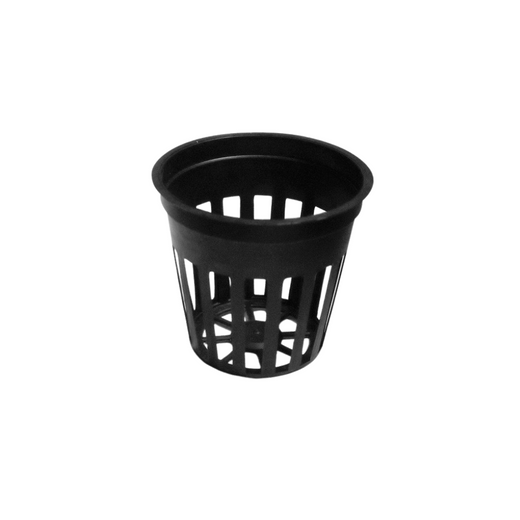
Three families of parts need replacing over time. The 50 mm push-fit seals lose their elasticity after repeated assembly and disassembly and eventually start to weep. The cylindrical air stones become clogged with mineral deposits and can be identified by the large, irregular bubbles they produce. The 14 cm net pots crack when a mature plant is pulled out with force.
A cracked pot can't be repaired either: polypropylene doesn't bond cleanly, and it's the 19 L grow bed that needs to be ordered as a standalone item. The rest of the system, however, can be dismantled and reassembled without tools, which means a PRO can be reconfigured between two cycles rather than replaced.
📐 Floor load
Allow approximately 19 kg per pot once filled, to which you add the wet grow medium and the plant, bringing a 24-pot system well beyond 500 kg spread across a few square metres. The floor should therefore be assessed before the first fill: a concrete slab, a load-bearing floor or a tiled surface is suitable; old timber floorboards or a top resting on trestles far less so. Every pot must also sit at exactly the same level, to the millimetre, as gravity alone equalises the water height between them: a pot sitting fractionally high receives less water than its neighbours, and you will notice it in the plants long before you see it in the water level. Running a spirit level under each pot during assembly saves a great deal of troubleshooting weeks down the line.
Technical specifications
The essentials
- Principle
- Recirculating deep waterThe roots are permanently submerged and the solution circulates in a continuous loop.
- Configurations
- From 3 to 24 pots
- Growing pot
- 19 L, double-walledBlack interior to block light, white exterior to reflect the light from your lamps.
- Material
- Food-grade polypropylene
Hydraulic
- Pot drilling
- 58 mm in-lineThis measurement is what sets a PRO pot apart from a 2.0 pot, which is bored to 38 mm.
- Pipework and seals
- 50 mm push-fitReplacement seals are ordered by this diameter, not by that of the pot.
- Inline filter
- Threaded 3/4 inchPolypropylene body, stainless steel cartridge, hand-dismantlable for rinsing.
- Admissible pressure of the filter
- 10 bar at 20 °C
- Level regulation
- Float valve to controllerIt compensates for the volume consumed from an external reservoir positioned higher up.
- Diffuser
- Cylindrical air stone 50 x 50 mm
Origin and warranty
- Manufacturing
- Italie, Robassomero
- Guarantee
- 2 years
To budget for separately
- Grow medium in the baskets
- Clay pebbles or rockwool
- Nutrition and pH
- Complete nutrition and corrector
- pH reading
- 1 electronic meter or a liquid test kit
- External reservoir
- From 100 to 200 L, positioned higher up
8 further specifications are available in the detailed view.
In the box
- The double-walled 19 L growing pots, in the quantity corresponding to the chosen configuration.
- 1 controller pot of 19 L with its lid and float valve.
- 1 inline filter with a three-quarter-inch threaded fitting.
- 1 submersible water pump and 1 air pump.
- 1 cylindrical air stone per growing pot.
- The 50 mm pipes, bends, push-fit joints and drilled covers of the network.
Drilling dimensions, pipe diameters, and in-line filter specifications taken from the supplier's component catalogue on 19/09/2026. Configurations, warranty details, and country of origin taken from supplier product descriptions on the same date.
Two generations of RDWC
The same principle and the same 19 L pot. This table only compares what changes from one generation to the next.
Not sure whether to go for the 2.0 or the PRO?
Price is not the right criterion. What really makes the difference is the number of pots you have in mind, how long the plants will be left unattended, and how much time you are prepared to give to upkeep.
| Pipework diameter (mm) | Pot drilling (mm) | Inline filter | Float valve to controller | Minimum pots (pots) | Maximum pots (pots) | Volume per pot | Price | |
|---|---|---|---|---|---|---|---|---|
| RDWC 2.0Your choice | 32 mm | 38 mm | No | No | 2 pots | 18 pots | 19 L | $220.00 |
| Recommended RDWC PROYour choice | 50 mm | 58 mm | Yes | Yes | 3 pots | 24 pots | 19 L | $487.00 |
RDWC 2.0
Circuit
Pipework diameter (mm)32 mm
Pot drilling (mm)38 mm
Inline filterNo
Float valve to controllerNo
Capacity
Minimum pots (pots)2 pots
Maximum pots (pots)18 pots
Common to both
Volume per pot19 L
RDWC PRORecommended
Circuit
Pipework diameter (mm)50 mm
Pot drilling (mm)58 mm
Inline filterYes
Float valve to controllerYes
Capacity
Minimum pots (pots)3 pots
Maximum pots (pots)24 pots
Common to both
Volume per pot19 L
Diameters and drilling dimensions taken from the supplier's component catalogue on 19/09/2026.
Help choosing
Two generations , which one suits your setup?
Estimate your
delivery time
Your estimate
Delivery
Estimated time
It covers preparing your order and then the transit time quoted by the carrier, counted in working days.
It is not a guaranteed delivery date: public holidays, peak periods, customs or a carrier delay can extend it. The exact amount, in your currency, is worked out in the cart once your address is entered.
The order is dispatched from the workshop in Robassomero, near Turin. The number of parcels depends on the configuration ordered: a 3-pot unit ships in a single consignment, a 24-pot unit in several, and 19 L pots take up considerable volume for a modest weight. Plan for home delivery and make sure someone is available to receive it. Exact shipping costs and final delivery times are displayed at checkout once the address has been entered. Outside the European Union, import duties and taxes are the responsibility of the recipient.
Frequently asked questions
12 questions
6 key questions, 12 in the detailed view
Vous aimerez aussi


Related articles

Understand
Growing without soil in hydroponics
The starting point if nutrient solution growing is new to you: what it changes, and what it asks of you in return.
Read the article

Crops
Growing tomatoes in aquaponics
A high root-volume crop: varieties, pollination under cover, and training over a single season.
Read the article

Technical
Regulating pH in an aquaponics system
The measurement and correction method, to read before the controller's first start-up.
Read the article

Understand
Aquaponics and hydroponics — what's the difference?
What separates a mineral solution you measure out yourself from pond water enriched by fish.
Read the article

Technical
The nitrogen cycle in aquaponics
Read this before connecting a network of pots to a fish tank: everything is decided upstream of the circuit.
Read the article

Practical
Going on holiday without losing your crop
What a float valve manages during an absence, and what it cannot manage.
Read the article
Let us talk about your project
Une question sur ce produit ou votre installation ? Notre équipe vous répond et vous conseille.

Paiement plusieurs fois sans frais
Proposé selon le montant du panier, au moment du paiement.

Livraison sous 5 à 15 jours ouvrés
Selon les produits et sites d'expédition. Estimation par destination dans l'estimateur de cette page.

SAV 7/7 par mail ou chat
Notre équipe répond à toutes vos questions.

Faire un achat engagé
Devenez acteurs du changement.
