Growing tomatoes in aquaponics

Written by Tristan Ulrich · September 5, 2026
Tomates cerises rouges bien mûres prêtes à être récoltées en aquaponie

Hungry for nutrients and a lover of warmth, the tomato finds aquaponics an ideal growing environment. This comprehensive guide takes you from choosing a variety through to harvest, covering pH, hand pollination, and pruning, to produce flavoursome fruit throughout the season.

Growing successful tomatoes in aquaponics

The tomato tops the list of aquaponic growers' favourite crops, and it is no whim. This fruiting vegetable loves the nitrate-rich water that fish produce, grows quickly and generously rewards an attentive gardener. Well managed, a single plant can deliver abundant harvests for many months.

You still need to master a few fundamentals specific to soilless growing. The choice of variety, pH balance, pollination in a closed environment and the pruning of side shoots make all the difference between a spindly plant and a truss bowed down with fruit. Here is the complete method, step by step.

Bunches of cherry tomatoes ripening on clay pebbles in an aquaponic grow bed in a greenhouse

The tomato, queen of the aquaponic vegetable garden

If the tomato gets on so well with aquaponics, it comes down to appetite. It is a hungry plant, which demands plenty of nitrogen during growth and then potassium once it starts to fruit. And a pond stocked with fish provides exactly that: a continuous, steady flow of nutrients.

As a result, the plants enjoy regular feeding that supports vigorous growth and plenty of fruit. The tomato thus joins the best star plants of the aquaponic garden, alongside herbs and salad leaves. It still needs warmth and light, its two other requirements.

A demanding fruiting vegetable that needs a mature system

Before sowing, it is worth understanding what a tomato really asks of you. Unlike a lettuce, which makes do with very little, it has a long, energy-hungry cycle, from germination to the ripening of the trusses. Each stage has its own needs, and neglecting them is paid for later in flowers that drop or fruit that struggles to swell.

The first prerequisite is often forgotten: it concerns the maturity of the system. Its demand for nitrogen, potassium and trace elements climbs sharply once fruiting begins, a need that a young pond, still poor in organic matter, struggles to meet. So avoid starting tomatoes in an installation that has been running for less than two to three months. If yours is recent, begin with leafy vegetables while the cycle settles.

The second prerequisite is fish biomass. The FAO technical guide reasons by surface area: 50 to 80 grams of feed given per day per square metre of fruiting vegetables, for 4 to 8 plants per square metre. A one-square-metre bed planted with tomatoes therefore needs 50 to 80 grams of feed every day, or roughly 10 to 20 grams per plant. It is better to have a few well-fed plants than a forest of deficient ones. Above all, remember that the tomato is a crop of patience and consistency, and it is this steadiness that separates fine harvests from disappointments.

Young tomato plants grown indoors under a bright greenhouse Grappoli Corbarino Cherry Tomato Seeds

Choosing the right variety

The choice of variety shapes the whole way you grow the crop. There are determinate tomatoes, compact and bushy, which need little pruning and suit small spaces, and indeterminate varieties, which climb endlessly and need regular staking and side-shoot removal.

To get started in aquaponics, cherry tomatoes are often the most rewarding. Their short cycle, vigour and tolerance of nutrient fluctuations make them ideal candidates. Compact varieties such as Roma, Tiny Tim or Patio take up little room. Large indeterminate tomatoes, tasty but temperamental, are best left to mature, well-managed systems.

A selection of suitable seeds will help you get off to a good start, with open-pollinated varieties whose seeds you can save from one year to the next.

pH, conductivity and nutrients: aiming for the right balance

In aquaponics, pH is the result of a permanent compromise. Tomatoes would prefer slightly acidic water, at around 6.0, but the bacteria in the filter and the fish need a more neutral environment. In practice, the 6.4 to 7.5 range used in aquaponics suits everyone; for tomatoes, staying in its lower half, between 6.4 and 7.0, helps the uptake of iron and phosphorus. Dropping to 6.0 as in pure hydroponics is neither possible nor desirable here, as it would stress the livestock.

Conductivity provides a second useful benchmark. In aquaponics, it remains much lower than in hydroponics: in the comparative trial by Yang and Kim, the water in aquaponic systems planted with tomatoes was around 0.6 mS/cm at the third month, whereas the hydroponic solution was kept at 2.0 mS/cm. Low conductivity is therefore not, on its own, a sign of deficiency. As soon as the first flowers appear, the situation reverses: the need for nitrogen decreases while the demand for potassium and phosphorus rises sharply, as these two elements govern fruit set, size and flavour.

This is the whole difficulty of growing tomatoes in aquaponics. Fish water is rich in nitrogen but often poor in potassium, calcium and iron. It is corrected with measured additions, for example potassium sulphate, or by alternating pH correctors so that calcium is also covered. Regular monitoring with reliable water tests remains essential, and the guide on iron deficiency will help you make the right diagnosis when faced with yellowed young leaves with green veins.


Temperature and light, the drivers of fruiting

The tomato is a heat-loving plant, and the thresholds matter more than you might imagine. For the water, the range most often reported is between 18 and 24 °C. For the air, aim for 22 to 26 °C during the day. These two ranges define the zone in which the plant works without stress.

The extremes, however, come at a price. Below 13 °C at night, fruit set drops markedly. Around 34 °C, the pollen becomes sterile: the flower may be pollinated without being fertilised, and no fruit forms, however vigorous the plant. During flowering, it is best not to exceed 29 °C by day. In summer, the real difficulty is therefore not the cold but excess heat, which also depletes the oxygen in the water and weakens the roots.

Light is the other decisive factor. A tomato needs strong sunshine to produce sugars and well-coloured fruit. For indoor growing, full-spectrum horticultural lighting makes up for the lack of sun, especially at the start and end of the season. Without enough light, plants become leggy, stretch upwards and flower sparsely. Combining controlled warmth with generous light gives the tomato the conditions to reach its full potential.

Cherry tomatoes growing in an NFT grow tube running the whole length of a greenhouse NFT growing channels 100 × 50 mm, 2 m length

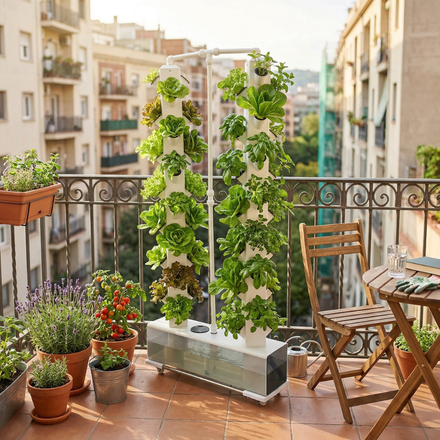
Growing tomatoes in a small space

You don't need a large garden to grow your own tomatoes. A balcony, a terrace or a corner of a conservatory is enough for a few plants, provided you choose suitable varieties and a vertical support. Cherry tomatoes and determinate varieties are particularly well suited to these small spaces.

The choice of support matters too. Grow beds filled with clay pebbles anchor the roots well and buffer fluctuations, but they take up floor space. The NFT growing tube answers the opposite constraint. A simple tube laid along a wall, a railing or a path holds a row of plants along its whole length, with almost no footprint.

In return, NFT calls for a little more rigour, since the nutrient film is thin and the slightest pump failure quickly dries out the roots. A reliable pump and regular checks are enough to remove that reservation, and vertical growing supports then let you multiply the productive surface. A small, well-planned space often produces more than a large, poorly organised one.

From seedling to transplanting, getting your plants off to a good start

Sowing begins under cover, between February and April depending on your region, in a neutral, rinsed grow medium such as rock wool or coco plugs. Avoid potting compost, which would dirty the water and eventually clog the pumps. Maintain a temperature of 20 to 24 °C for even germination in five to ten days.

Transplanting into the system takes place when the seedling reaches 10 to 15 centimetres and nights no longer fall below 10 °C. Rinse the roots thoroughly before the transfer so that no particles of grow medium enter the circuit, then wedge the stem base into the clay pebbles without burying the first leaves.

This stage deserves care, because a plant transplanted too early or too late falls behind and never really catches up. To fine-tune your calendar, see the guide to spring sowing.

The February to April window is aimed at a temperate climate. In southern Europe, sowing can start as early as January; in Scandinavia and central Europe, it is better to wait until March or April, unless you are using artificial lighting. The rule of thumb is the same everywhere: sow six to eight weeks before the date of the last frost where you live.

Bumblebee on a tomato flower, pollinating it, with pollen in suspension

Pollination, the forgotten step

Here is the point that explains many disappointing indoor harvests. The tomato flower is self-fertile, but its pollen needs to be shaken to fall onto the pistil. Outdoors, wind and insects take care of this, bumblebees in particular, whose vibration releases pollen far better than a draught. In a closed greenhouse or in a flat, this movement disappears and many flowers drop without setting fruit.

The most effective method is to reproduce this action and vibrate the flower truss. A daily flick is enough on a few plants, but the best tool remains the electric toothbrush, the back of which you hold against the stem for two seconds to release a cloud of pollen. Ideally, do this around midday, when the flowers are fully open.

Also keep an eye on humidity. Above 80 per cent humidity, pollen becomes sticky and is released poorly, and below 50 per cent it dries out too quickly, a critical point in the hot, enclosed conditions of summer. Repeated every other day, this small gesture dramatically increases the number of fruits set.

Fruit set and blossom-end rot: understanding fruit problems

Once the flower has been pollinated, the small fruit begins to form: this is fruit set. Several factors can compromise it, chiefly the extreme temperatures mentioned above and insufficient pollination.

The notorious blossom-end rot, or apical necrosis, is another great classic. This brown, leathery patch at the tip of the fruit is neither a contagious disease nor simply a lack of calcium in the water. It is a physiological disorder: calcium does not reach the tip of the fruit steadily enough, as the tip is always the last part the plant serves. The most frequent causes are irregular watering, water or heat stress, an excess of nitrogen that pushes too much foliage, or a pH that is too low and blocks uptake.

Prevention therefore relies on consistency, and on particular attention to calcium. This is precisely the element that drops fastest in an aquaponic system planted with tomatoes, especially during fruiting: Yang and Kim recorded an average of 18 mg/L of calcium in aquaponics, against 146 mg/L in hydroponics. Alternating a calcium-based pH corrector with a potassium-based one meets this need without overloading the water with a single element. In aquaponics, the main advantage remains the stability of the water, which naturally limits these swings. Well managed, this prevention makes the problem almost disappear.

Diseases and pests: prevention comes first

Tomatoes have their enemies, and the most dreaded remains blight, the fungus that blackens leaves and fruit in damp weather. The best defence is preventive. Foliage kept airy through training, watering that avoids wetting the leaves and good air circulation considerably reduce the risk. Powdery mildew lurks under the same conditions, as soon as the air becomes saturated.

As for pests, aphids, whiteflies and spider mites can turn up, especially in a greenhouse. In aquaponics, no conventional chemical treatment is an option, as the slightest toxic molecule ends up in the fish's water. We therefore favour biological control, using beneficial insects that regulate populations naturally, a very dilute black soap applied well away from the pond, or simply a jet of water.

The golden rule remains observation. Regularly inspecting the underside of the leaves lets you step in early, before the problem takes hold. The guide to limiting pests details strategies that are compatible with a living ecosystem.

Clusters of red cherry tomatoes on the plant in the garden Organic fertiliser for aquaponics Aquaponic Mix, NPK 0-0-4

From flower to fruit, harvest and yield

Finally comes the reward. In good conditions, the first tomatoes can be harvested around 50 to 70 days after the young plants are set out, a little longer for the large varieties. Pick them when fully coloured, when the fruit gives slightly under gentle pressure, ideally in the morning.

Regular harvesting encourages the plant to produce more, so it is better to pick often rather than wait for one big harvest. A well-managed indeterminate plant keeps fruiting for as long as light and warmth allow, sometimes until the first frosts.

Yield depends on the variety and the conditions, but a well-trained plant in aquaponics can produce generously over several months. To support this marathon, a regular supply of minerals during fruiting helps the plant go the distance without exhausting itself.

Staking and pruning, supporting vigorous plants

A well-fed indeterminate tomato can reach several metres in height in a single season. Without support, the stem bends, snaps or trails on the ground, which encourages disease. Staking is therefore not optional but a necessity that you plan for from planting. Several methods exist, from a simple spiral stake to string stretched upwards. The key is to tie loosely, without strangling the stem as it thickens.

Pruning is the task that puzzles beginners most, and yet it changes everything. At the axil of each leaf a side shoot appears, known as a sideshoot. On indeterminate varieties, remove them regularly between thumb and forefinger when they are a few centimetres long, so as to channel the sap towards the fruit. Gradually remove the leaves below the first ripening trusses as well, without stripping the plant excessively, because the leaves remain the plant's sugar factory.

Determinate varieties, by contrast, need very little pruning, if any at all. Identifying your type of tomato before reaching for the secateurs avoids many mistakes, since pruning a determinate like an indeterminate would sacrifice a good part of the harvest. You will find everything you need to equip your plants in the range of horticultural accessories.

Extending the season and following one crop with another

The strength of aquaponics under cover is that it lets you stretch the season well beyond the traditional vegetable garden. By starting seedlings early indoors and protecting the plants in late autumn, you easily gain several weeks of production either side of summer. Supplementary lighting and water kept at a good temperature do the rest.

To avoid ever leaving a bed empty, plan the succession ahead. While your tomatoes finish their cycle, start young plants alongside, ready to take over. This succession keeps the system productive and balanced, as plants in full growth steadily consume the nutrients produced by the fish.

By varying the varieties and sowing dates, you also spread out the harvests and avoid big peaks followed by lean spells. That is the beauty of a well-orchestrated aquaponic garden: continuous production rather than a single season.

Conclusion: a crop that proves your system

Growing tomatoes in aquaponics is no small matter, and that is precisely what makes the exercise so rewarding. The plant alone brings together almost all the skills of the aquaponic grower: water balance, fine management of nutrition, oxygenation, training the plant and health vigilance. Succeeding with it means confirming that your setup is running smoothly.

Remember the essentials. A system that is already mature, at least two to three months old, a variety suited to your level, a pH kept between 6.4 and 7.5, ideally below 7.0, a nutrition programme that shifts towards potassium at flowering, diligent hand pollination and regular irrigation to avoid blossom end rot. None of these tasks is difficult on its own; it is their consistency that makes the difference.

Start small, observe, adjust, and you will see your trusses grow more generous season after season. The first tomato picked from a plant fed by your fish will remain a real moment of pride, and the best encouragement to keep going.

Sources

Oregon State University Extension, Blossom-End Rot of Tomatoes: Causes and Prevention, Physiological origin of blossom end rot and the role of irrigation

Purdue University Extension, BP-13-W Blossom End Rot of Tomato Fruit, Excess nitrogen, salinity and water consistency

Mississippi State University Extension, Tomato Troubles: Common Problems with Tomatoes, Pollen sterility thresholds, flower drop, cracking

University of Maryland Extension, Growing Tomatoes in a Home Garden, Determinate varieties, side shoots, staking and harvesting

Frequently asked questions

Allow plenty of room rather than packing plants in. The FAO guide gives 4 to 8 fruiting vegetable plants per square metre; for indeterminate tomatoes, stay at the low end of that range. In a home-sized bed of about 1 m², four well-fed plants, fed on 50 to 80 g of fish feed per day, will almost always yield more than eight cramped ones.

Only partly. A small oscillating fan set to low speed and aimed at the foliage for two to three hours a day shakes the flower stems and clearly improves fruit set under cover. It also stirs the air around the clusters, which helps when humidity climbs and makes the pollen sticky.

However, it is not enough on large-flowered varieties, whose pollen is stickier and needs a firm vibration. The best compromise is to combine the two: gentle ventilation running constantly in the background and a manual pass every other day during peak flowering.

It all depends on the pattern the yellowing takes.

  • Uniform yellowing of the lowest, oldest leaves is often simple senescence, as the plant draws its reserves back towards the fruit
  • Yellowing between the veins on older leaves usually points to a magnesium shortage, a symptom that American extension services report very frequently on tomatoes
  • Yellowing of the young leaves at the top with the veins still green is the classic sign of iron deficiency
  • Yellow lower leaves marked with concentric brown spots suggest a fungus, so remove them without delay

If in doubt, take off the affected leaves below the first ripening truss and watch the new growth for about ten days. A healthy plant picks up again in a clearly deep green.

Yes, on one condition. Your plants must come from fixed varieties, known as open-pollinated, and not from F1 hybrids. The seeds of a hybrid germinate very well but produce uneven offspring, often disappointing in both flavour and vigour. Heirloom varieties, on the other hand, come true from one year to the next.

Collecting the seeds involves a small step that many people overlook: fermentation. Scoop out the pulp and seeds of a fully ripe fruit and leave the mixture for three to four days in a glass of water at room temperature. A whitish film forms on the surface, a sign that the gelatinous coating that inhibits germination is breaking down. Then rinse thoroughly with clean water, keep only the seeds that sink to the bottom, and leave them to dry flat on a plate for a week.

Stored dry, away from light and in an airtight container, they stay viable for four to six years. Always note the variety and the year, because tomato seeds all look alike once dry.

Much less. Most cherry tomatoes are indeterminate but cope very well with being trained on two stems, which multiplies the trusses without exhausting the plant. Above all, remove the side shoots at the bottom and let the plant fill out.

Splitting almost always results from a sudden resumption of fruit growth, when the water supply suddenly becomes generous again after the skin has already begun to harden. Horticultural extension literature cites three main triggers: irregular watering, overly rapid growth and wide temperature swings between day and night.

In aquaponics, the continuous circuit naturally limits the first factor, which explains why the problem is less common there than in open ground. When it does occur, look instead at a pump stoppage, a very cool night after a scorching day, or a fruit left on the plant too long.

  • Harvest as soon as the colouring is well under way, without waiting for full ripeness on the plant
  • Provide light shade during the hottest hours in midsummer
  • Favour thin-skinned varieties if you are growing under very sunny cover

A split fruit remains perfectly edible if eaten quickly, but the wound soon becomes infected, so do not leave it on the truss.

Read next

Growing pots for aquaponics

Growing pots for aquaponics

The net pot is an unassuming but decisive accessory in aquaponics: it supports the plant, houses the grow medium and allows water and oxygen to circulate freely. This guide explains how to choose the

Read the article
Growing lotus in aquaponics

Growing lotus in aquaponics

The lotus is an aquatic plant whose flowers are emblematic of the most beautiful ornamental ponds. In aquaponics, in an ornamental system (a pond with goldfish or koi carp) that does not need to

Read the article
What to sow in autumn in aquaponics

What to sow in autumn in aquaponics

Autumn is not the end of the growing season — it is the start of the most peaceful one. Here is what to sow, when to do it and how to achieve leaf harvests

Read the article
Aquaponics and Summer Holidays

Aquaponics and Summer Holidays

You're going away for two weeks in July and your aquaponics system will be running without you : this thought rightly makes you anxious, because heatwaves, evaporation, and fish feeding raise practical questions. Good

Read the article
Growing without soil in hydroponics

Growing without soil in hydroponics

Hydroponics is not a trend but an agronomic revolution thousands of years old, using up to 90% less water and supporting faster plant growth. Understanding its principles, methods and limitations is becoming essential for

Read the article

Discover our aquaponics greenhouses and kits:

View all
Produits du rayon Kits d'aquaponie chez Univers Aquaponie

Aquaponics kits

Aquaponics kits ready to install in the garden, on a patio or in a greenhouse, with fish tank, grow beds and pump.

Discover
Produits du rayon Univers Plantes chez Univers Aquaponie

Plants

Seeds, grow media, fertilisers and aquatic plants for successful growing in aquaponics, hydroponics and the vegetable garden.

Discover
Produits du rayon Univers Équipements chez Univers Aquaponie

Equipment Universe

The equipment that keeps a system running: soilless growing, water circulation and aeration, filtration, temperature, plumbing and lighting.

Discover
Produits du rayon Serres d'aquaponie chez Univers Aquaponie

Aquaponics greenhouses

Greenhouses designed for aquaponics, supplied with their fish tank and grow towers.

Discover
Produits du rayon Univers Poissons chez Univers Aquaponie

Fish

Feed, monitor the water and care for your pond, aquarium or aquaponic fish.

Discover
Produits du rayon Univers Formation chez Univers Aquaponie

Learning

Books and practical courses on aquaponics, hydroponics and food self-sufficiency.

Discover