





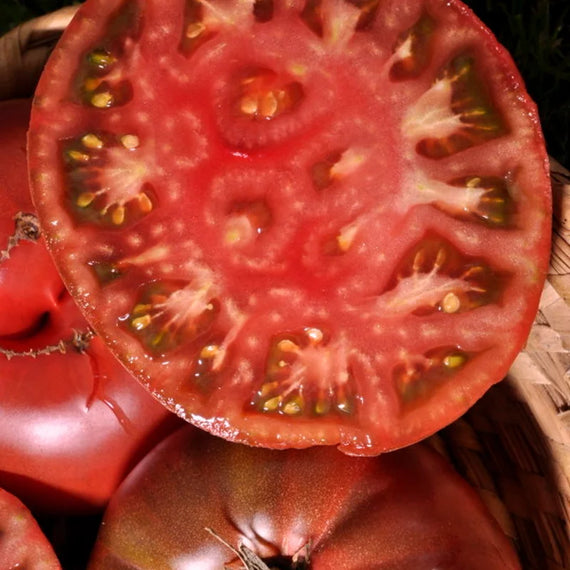
Crimean Black Tomato Seeds
Regular price
$5.00
Regular price
Sale price
$5.00
Unit price
/
per
An old purple tomato with green shoulders, Noire de Crimée produces fruits of 150 to 500 g, with dense flesh and almost no acidity, best eaten raw in thick slices.
The packet contains 35 seeds, organic and open-pollinated, from farmers' seed stock. Sow from February to April, for a harvest from mid-July to October.
 Customer support 7 days a week by email
 Delivery within 2 to 15 business days
100 % secure payment
The summary
- What you receive: 35 organic, open-pollinated seeds of Noire de Crimée, a free-to-use heirloom variety.
- Sowing: from February to April under cover, at a depth of 5 to 7 mm, at 16 to 20 °C. Germination in 8 to 15 days.
- Harvest: about 70 to 80 days after transplanting, i.e. from late July to October depending on the sowing date.
- The fruit: round and ribbed, 150 to 500 g, green shoulders, dense, sweet, low-acid flesh.
- How to choose: this one for raw flavour, the Jupiter for cooking, the Corbarino for nibbles.
- How much effort: sturdy staking, a weekly visit to tie in the stems, genuinely regular watering.
Purple heritage tomato, 35 open-pollinated seeds, greenhouse or aquaponics
The Tomate Noire de Crimée seeds from the Association Kokopelli are a traditional, farmer-bred and open-pollinated variety, to be grown under cover or in aquaponics on a bed of clay pebbles or coconut fibre. The packet contains 35 organic seeds. The plant produces fruits of 150 to 500 g, with dense, low-acid flesh that can be eaten raw.
The Noire de Crimée is an heirloom tomato from the shores of the Black Sea, known in the English-speaking world as Black Krim. Its skin turns purplish brown as it ripens, its shoulders stay green, and its dense flesh gives an almost acid-free flavour, mild and slightly sweet. You eat it raw, in thick slices.
🌿 Sowing, transplanting, training
Tomatoes are sown in the warm before being planted out in their final position: a nursery stage of about 5 weeks in small pots, under a bright shelter, then transplanting the whole root ball once the risk of frost has passed. Noire de Crimée is an indeterminate variety, with a stem that keeps growing until the first cold weather, so it needs a sturdy support and weekly pruning. The growing calendar gives the detail month by month.
In a nursery
Sow at a depth of 5 to 7 mm, in a warm spot at 16 to 20 °C. Germination takes 8 to 15 days.
At transplanting
Plant one every 50 cm at least, buried up to the first leaves so that it develops roots.
In season
Check once a week to tie in the stem and remove the side shoots.
🍅 A heirloom seed to save and resow
This packet contains farmers' seeds that breed true, from an heirloom, open-pollinated variety. The plant that grows at your place will produce seeds identical to those you sowed: you harvest, dry and resow from one year to the next. Other varieties to sow at the same time of year can be found among the seeds and seeds for sprouting. If you are looking for a red tomato that is more versatile in the kitchen, Rouge Jupiter is grown in the same way.
A deep-bed tomato
A mature Noire de Crimée reaches 1.80 m and takes up 50 to 60 cm of ground. It needs a stake or a support string, and a bed filled with clay pebbles or coconut fibre, which holds the weight of the plant and its roots better than a deep water culture raft. In aquaponics, set the plant on a system that has been running for at least 2 to 3 months, as recommended in the guide to growing tomatoes in aquaponics.
Watering, sowing date, harvest
Irregular watering is the main fault of this variety: heavy watering after a dry spell makes the skin split. Water little but often, at the base, never over the foliage. The second mistake is sowing in January behind a window: the seedling grows leggy and never makes up for lost time, as the guide on germination failures explains. The third is putting plants out before mid-May.
🐝 Fruit set in the greenhouse
In a closed greenhouse or tunnel, the tomato flower does not release its pollen without air movement, and the trusses drop without setting fruit. You replace the wind by tapping the flowering trusses every day, around midday, or by running a fan at low speed for 2 to 3 hours a day. Also keep an eye on humidity: above 70%, the pollen becomes sticky and fruit set drops, which you correct by ventilating the greenhouse from late morning. At peak flowering, combine the two: the fan running in the background and a manual pass every 2 days.
Technical specifications
The sachet
- Number of seeds
- 35Enough to plant around ten specimens, including germination losses.
- Seed origin
- Kokopelli associationOrganic seeds, royalty-free.
- Treatment
- NoneNo GMOs, no coating, no chemical treatment.
- Storage
- 4 to 6 yearsKeep dry, cool and dark. Beyond that, sow more densely.
The variety
- Botanical name
- Solanum lycopersicumKnown as Black Krim in the English-speaking world.
- Variety type
- Heritage, traditional, non-hybridReproducible: seed from your own harvest will give the same variety.
- Shipping
- IndeterminateThe stem keeps lengthening until the first frosts.
- Adult height
- 1.20 to 1.80 mTo be trained up a stake or a string.
- Fruit weight
- 150 to 500 gRound, ribbed fruit, one or two slices are enough.
- Colour at maturity
- Purplish brown, green shouldersGreen shoulders are not a sign of immaturity.
Seedling
- Sowing period
- February to April, under coverAbout 5 weeks before transplanting.
- Seedling depth
- 5 to 7 mmCover lightly, then firm down.
- Germination temperature
- 16 to 20 °CIn a small pot, under a well-lit shelter.
- Germination time
- 8 to 15 days
- Transplanting
- From mid-MayOnce the last frosts have passed.
- Spacing
- At least 50 cmAllow 60 cm if you want to walk between the plants.
Growing and harvesting
- Aspect
- Full sunA minimum of six hours of direct sunlight per day in season.
- Size
- Side shoots removed every weekTop the stem at the end of August, above the last set truss.
- Pollination
- By hand under a closed shelterOne vibration of the flower stem per day during flowering.
- Harvest period
- From late July to OctoberPick as soon as the flesh yields under your thumb.
- Cycle
- 70 to 80 daysFrom transplanting to the first harvest.
- Observed yield
- 3 to 6 kg per plantA rough guide over the season, for a well-trained plant.
In aquaponics and soilless growing
- Water pH
- 6.4 to 7A compromise between fish, bacteria and plants.
- Nights above
- 13 °CBelow that, fruit set drops sharply.
- System maturity
- 2 to 3 monthsThe time the system needs to supply enough for a fruiting plant.
- Nutritional needs
- Nitrogen, potassium, calciumSignificantly higher than those of a lettuce.
To budget for separately
- Stake or string
- Training up to 1.80 m
- Growing medium
- Clay pebbles or coco fibre
20 further specifications are available in the detailed view.
In the box
- 1 packet of 35 organic Noire de Crimée tomato seeds
Pack size, fruit, sowing depth and temperature: data sheet from the seed supplier Kokopelli (ref. P7311), taken on 11/10/2026. Height, yield and storage life are orders of magnitude for mainland France.
Manufacturer and product safety
- Manufacturer
- Association Kokopelli (SIREN 433481124, TVA FR80433481124)
- Postal address
- 7 route de Sabarat, Forêt de Castagnès, 09290 Le Mas-d'Azil, France
- Contact
- Formulaire de contact : https://kokopelli-semences.fr/fr/faq/ (aucune adresse e-mail publique) ; téléphone 05 61 67 69 87
- Website
- kokopelli-semences.fr
Information provided under Regulation (EU) 2023/988 on general product safety.
Compare the three varieties
Three Kokopelli tomatoes, in the same packet format. What changes is the fruit, how early it crops and how it is used in the kitchen.
Three heritage varieties, three uses that cannot replace one another
A large, dense-fleshed fruit is not cooked like a sauce tomato, and a cherry tomato is not eaten in slices. Start with the plate, and the growing follows.
| Size | Colour at maturity | Best use | Earliness | Growth | Variety origin | Seeds per packet | Open-pollinated seeds | |
|---|---|---|---|---|---|---|---|---|
| Recommended Crimean Black Tomato SeedsYour choice | Large, 150 to 500 g | Purplish brown, green shoulders | Raw, sliced | Mid-season | Indeterminate | Black Sea | 35 | Yes |
| Red Tomato Seeds "Jupiter"Your choice | Medium to large, 80 to 230 g | Red | Cooking, sauces and preserves | Mid-season | Indeterminate | France | 35 | Yes |
| Grappoli Corbarino Cherry Tomato SeedsYour choice | Cherry type, in clusters of 7 to 10 | Dark red | Nibbles, salads and drying | Early | Indeterminate | Italy | 35 | Yes |
Crimean Black Tomato SeedsRecommended
The fruit
SizeLarge, 150 to 500 g
Colour at maturityPurplish brown, green shoulders
Best useRaw, sliced
The growing
EarlinessMid-season
GrowthIndeterminate
Variety originBlack Sea
The sachet
Seeds per packet35
Open-pollinated seedsYes
Red Tomato Seeds "Jupiter"
The fruit
SizeMedium to large, 80 to 230 g
Colour at maturityRed
Best useCooking, sauces and preserves
The growing
EarlinessMid-season
GrowthIndeterminate
Variety originFrance
The sachet
Seeds per packet35
Open-pollinated seedsYes
Grappoli Corbarino Cherry Tomato Seeds
The fruit
SizeCherry type, in clusters of 7 to 10
Colour at maturityDark red
Best useNibbles, salads and drying
The growing
EarlinessEarly
GrowthIndeterminate
Variety originItaly
The sachet
Seeds per packet35
Open-pollinated seedsYes
Size, colour, earliness, origin and seed count: data sheets from the seed company Kokopelli, recorded on 11/10/2026.
Help choosing
Which tomato to sow this year
Product videos
The Black Crimea tomato, a variety overview
Everything you need to know about the Black Crimea tomato
Successfully sowing tomatoes, then transplanting
Potting on tomato seedlings: when and how
Estimate your
delivery time
Your estimate
Delivery
Estimated time
It covers preparing your order and then the transit time quoted by the carrier, counted in working days.
It is not a guaranteed delivery date: public holidays, peak periods, customs or a carrier delay can extend it. The exact amount, in your currency, is worked out in the cart once your address is entered.
A packet of seeds ships as a small parcel, so it can be combined with the rest of your order at no extra cost. The exact amount is calculated at checkout.
Frequently asked questions
6 questions
6 key questions
Growing calendar
Reference points for mainland France, to be shifted by approximately two weeks depending on your region.
| Stage | ||||||||||||
|---|---|---|---|---|---|---|---|---|---|---|---|---|
| Seedlings under cover3 months | Seedlings under cover: no | Seedlings under cover in February | Seedlings under cover in March | Seedlings under cover in April | Seedlings under cover: no | Seedlings under cover: no | Seedlings under cover: no | Seedlings under cover: no | Seedlings under cover: no | Seedlings under cover: no | Seedlings under cover: no | Seedlings under cover: no |
| Transplanting2 months | Transplanting: no | Transplanting: no | Transplanting: no | Transplanting: no | Transplanting in May | Transplanting in June | Transplanting: no | Transplanting: no | Transplanting: no | Transplanting: no | Transplanting: no | Transplanting: no |
| Training and pruning4 months | Training and pruning: no | Training and pruning: no | Training and pruning: no | Training and pruning: no | Training and pruning: no | Training and pruning in June | Training and pruning in July | Training and pruning in August | Training and pruning in September | Training and pruning: no | Training and pruning: no | Training and pruning: no |
| Harvest4 months | Harvest: no | Harvest: no | Harvest: no | Harvest: no | Harvest: no | Harvest: no | Harvest in July | Harvest in August | Harvest in September | Harvest in October | Harvest: no | Harvest: no |
KeySeedlings under coverTransplantingTraining and pruningHarvest
This month
November
Growing guidance
- Seedling depth
- 5 to 7 mmCover lightly, then firm down, without burying any deeper
- Germination temperature
- 16 to 20 °C
- Germination time
- 8 to 15 days
- From transplanting to harvest
- 70 to 80 daysMid-season variety, from transplanting to the first harvest
- Spacing
- At least 50 cmBetween two plants, in the row as well as in the grow bed
- Adult height
- 1.20 to 1.80 mIndeterminate habit, the stem does not stop growing by itself
- Fruit weight
- 150 to 500 g
- Yield per plant
- 3 to 6 kgTypical yield over the whole season, for a well-managed plant
- Aspect
- Full sunA minimum of six hours of direct sunlight per day in season
- Nights above
- 13 °CBelow this, fruit set drops markedly
- pH in aquaponics
- 6.4 to 7The usual balance between fish, bacteria and plants
- Seed storage
- 4 to 6 yearsA common guideline for tomato: keep dry, cool and out of the light
What you need to know
- Fruit splitting is the most common fault with this variety, and it almost always comes from uneven watering. A heavy watering after several dry days swells the flesh faster than the skin can stretch, and the fruit cracks. Water little, but often.
- Bury the plant up to its first leaves when transplanting. The buried stem puts out new roots along its whole length, which gives a noticeably more anchored plant that is more drought-resistant for the rest of the season.
- Put the stake in on the day of transplanting, not three weeks later. Driven in late, it goes through the root system that has already established and causes a visible check to growth.
- In a greenhouse or indoors, the flower does not set fruit on its own: there is no wind or bumblebee to release the pollen. A daily vibration of the flower stem, with a fingertip, is enough to turn the flowering into fruit.
- In aquaponics, do not install a tomato plant on a system that has been running for less than 2 to 3 months. A fruiting plant consumes far more than a lettuce, and as long as the system does not supply enough, it yellows and stalls, whatever the variety.
- The green shoulders are not a sign of immaturity, they are the signature of the variety. Waiting for them to turn red means harvesting overripe fruit, which spoils within two days.
- Top the main stem towards the end of August, above the last set cluster. The plant then stops investing in new shoots that will not have time to produce, and concentrates everything on the fruits already formed.
- A mulch at the base solves two problems at once: it evens out soil moisture, and so reduces splitting, and it stops soil splashing onto the lower foliage, the main entry point for fungal diseases.
You may also like


Related articles

Crops

Technique
Pollinating your plants indoors
What light cannot do: carry pollen from one flower to another.
Read the article

Guide
Successful spring seedlings in aquaponics
When to start your seedlings, at what temperature, and how to move from the seed tray to the grow bed without losing plants.
Read the article

Troubleshooting
Germination failure: causes and solutions
Seeds that won't germinate, patchy germination, leggy seedlings: the six real causes and how to correct them.
Read the article

Equipment
Setting up an indoor seedling space
Heat mat, lighting, humidity: setting up a reliable seedling corner at home to start your tomatoes in February.
Read the article

Understanding
The nitrogen cycle in aquaponics
Why a fruiting plant yields nothing on a new system, and how to tell that the cycle is finally established.
Read the article

Schedule
A practical schedule for success with aquaponics
Month by month, the tasks to carry out on the system and on the crops, from the spring restart to overwintering.
Read the article

Equipment
Which grow medium to choose for aquaponics?
Clay pebbles, coco fibre, vermiculite: what will support a 1.80 m tomato plant and what will not.
Read the article
Let us talk about your project
A question about this product or your setup? Our team will answer and advise you.

Interest-free instalment payments
Offered depending on the cart amount, at checkout.

Delivery in 2 to 15 working days
Depending on the products and shipping sites. Estimate by destination in the estimator on this page.

After-sales service 7 days a week by email or chat
Our team answers all your questions.

Shop responsibly
Become part of the change.
