







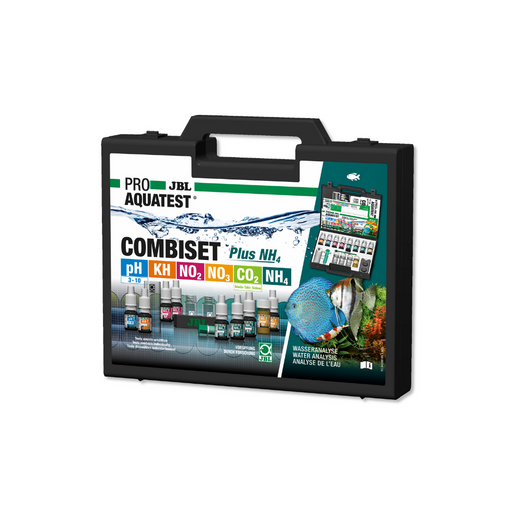
6-in-1 pond water analysis kit
Regular price
$61.00
Regular price
Sale price
$61.00
Unit price
/
per
$20.33 × 3 with no fees
Klarna.
This JBL PROAQUATEST kit brings together six drop tests for pond or aquaponic system water: pH, KH, GH, ammonium, nitrite, and phosphate. Reagents, glassware, and the colour comparison block all fit into a watertight case, and reagents can be repurchased individually.
 Customer support 7 days a week by email
 Delivery within 2 to 15 business days
100 % secure payment
The summary
- What you receive: the waterproof carry case, the reagents for all six tests, the glassware, the syringe, the measuring spoon and the colour comparator block.
- What you measure: pH, KH, GH, ammonium, nitrite and phosphate, all using drops.
- How long it takes: 2 minutes for carbonate hardness, 17 minutes for ammonium, waiting time included.
- How to choose: this kit is suited to a stocked ornamental pond, from the spring refill through to autumn.
- What runs out: the reagents only, nearly all available as separately sold refills.
- What's dispatched to you: the sealed case, reagents in their original compartments.
Six drop tests covering toxic nitrogen, mineral buffering, and phosphates.
The JBL PROAQUATEST 6 in 1 water analysis case is used to monitor the water of a pond or an aquaponic system with six drop tests: pH, KH, GH, ammonium, nitrite and phosphate. KH is read in 2 minutes, ammonium in 17 minutes, waiting time included. Everything fits in a watertight case, and the reagents can be bought individually.
Pond water can stay clear even though its ammonium or nitrite level has already risen. This kit brings together the six measurements that let you detect these deviations before they show up in the fish's behaviour, with drop reagents, test tubes and colour charts. Everything fits in a water-resistant case, which lets you work at the pond's edge rather than carrying samples back to the kitchen.
💧 Six readings for a pond
Of the six values in the test kit, KH is the one on which pH stability depends. It measures the water's buffering capacity, that is, its ability to neutralise acids without the pH shifting, and it falls on its own because nitrification consumes alkalinity. Below 5 °dKH, the pH can drop sharply overnight, which also slows the activity of the bacteria in the biofilter. That is why adjusting the pH always starts with a drop count on carbonate hardness.
The other five tests are grouped according to what they monitor. The pH reads from 3.0 to 10.0 across 14 colour fields, and it determines how much of the ammoniacal nitrogen is present as toxic ammonia. Total hardness is counted in drops, like KH, at one drop per 1 German degree in 5 ml of water, with no colour chart to compare against. Ammonium and nitrite are the two dangerous values in the nitrogen cycle: nitrite reads from 0.025 to 1 mg/L, and its target remains zero. Lastly, phosphate feeds algae as much as plants, and this kit measures it in the koi version, designed for high concentrations.
Rinse, take the sample and read it in daylight
Read your colour charts in daylight and never under warm lighting, because the pinks and oranges of the nitrite test shift under it. Rinse the test tube several times with pond water before filling it, as each instruction leaflet requires, so that no residue from a previous test mixes with the sample. Finally, take the sample from the middle of the water volume, never just below the surface or against the bottom. Several reagents are classified as hazardous: those for KH and nitrite cause severe skin burns and eye damage (H314, H318), and ammonium reagent 3 is highly flammable (H225). Work over a sink, wearing gloves and well away from any flame, and empty the used test tubes down the sink, never into the pond.
🌿 Water shared with plants
As soon as crops draw on the same water as your fish, two of these six figures change meaning. Phosphate stops being a mere indicator of algae and becomes a feed ration, since your plants take it up: a level that drops in mid-season therefore signals crops short of phosphorus rather than clean water. Total hardness, for its part, tells you about the calcium and magnesium the leaves need. Ammonium and nitrite, by contrast, keep the role they have in any ornamental pond, and they remain the two values to keep as low as possible for the fish. The full sequence is described in the article on the nitrogen cycle in aquaponics.
Binding dissolved phosphorus when phosphate levels remain high.
A phosphate level that stays high sets algae growing again with every hot spell. The anti-phosphate treatment for ponds binds the dissolved phosphorus, and you check its effect on the next reading. You then correct based on a dated figure rather than the colour of the water, and you know when to stop dosing.
🟢 A phosphate test for a heavily stocked pond
The phosphate test in this kit is the koi version, designed for the high levels found in a stocked, fed pond. It covers precisely the situation in which phosphate becomes a problem, that of water turning green in spring or a heavily stocked koi pond, and the comparator block compensates for the water's own tint. To follow traces of phosphate in clear water, or to fine-tune the balance between your crops and the algae, the Sensitive version reads low concentrations: it is included, alongside the koi version, in the 10-in-1 pond test case.
🧰 What gets used up, what remains
Only the reagents are consumed. The case, the test tubes, the syringe, the measuring scoop, the comparator block and the colour charts stay with you from one season to the next, and almost all the reagents can be bought again as a refill sold on its own. Your first purchase is therefore the equipment, and later ones cover only the bottles you have actually emptied. The nitrite and ammonium reagents run out first, because these two tests are repeated after every incident.
Technical specifications
The essentials
- Parameters measured
- pH, KH, GH, NH4, NO2, PO4Six drop-based tests, no instrument to calibrate
- Method
- Liquid reagents, colorimetric readingThe supplied comparator block accounts for the natural colour of the water at the time of the reading
- Covered water
- Garden pond, spring, well, tapUseful before a top-up, to find out what the make-up water brings to the pond.
- Manufacturer's reference
- JBL 2407000, PROAQUATEST rangeCode EAN 4014162240705
- Bottle safety
- Child-resistant capsThe case itself is water-resistant and closes securely
- What needs replacing
- Reagents onlyAlmost all are available as refills: the glassware and colour charts keep well
The six tests, one by one
- pH
- Wide range, 3.0 to 10.014 colour fields, in steps of 0.5 above pH 4.0
- KH, carbonate hardness
- Titration, 1 drop = 1 °dKHUsing 5 ml of water. At least 5 °dKH in a pond to keep the pH stable.
- GH, total hardness
- Titration, 1 drop = 1 °dGHAlso on 5 ml of water. The colour shift goes from red to green, the opposite of the carbonate hardness test
- NH4 and NH3, ammonium
- Colorimetric, using 3 reagentsThe genuinely toxic fraction of ammonia is derived from a table cross-referencing pH and temperature
- NO2, nitrites
- 0.025 to 1 mg/LThe target is zero. No readable value is acceptable for fish
- PO4, phosphates
- Koi version, elevated levelsWith reference test tube. Nutrient taken up by both algae and plants
The technique and the timing
- Water volume per test
- 5 or 10 mlSamples drawn with a sampling syringe, from mid-depth, never just below the surface.
- Waiting time
- 0 to 15 minutesNone for KH and GH, 5 minutes for nitrite, 10 for phosphate, 15 for ammonium
- The steps
- Rinse, fill, dose, shake, wait, readIn this order, shaking after each reagent added
- Reading
- Colour chart, in daylightA warm artificial light shifts the perception of pink and orange shades
To budget for separately
- The nitrate
- A nitrate NO3 testThis is the nitrogen taken up by crops, and it needs to be monitored separately.
- Reagent refills
- Reagents sold individuallyGlassware, sampling syringe, measuring spoon, comparison block, and colour charts can all be stored.
10 further specifications are available in the detailed view.
In the box
- 1 water-resistant plastic case
- The reagents for the 6 tests, in child-resistant cap bottles
- Glass test tubes
- 1 sampling syringe
- 1 measuring spoon
- 1 laboratory comparator block
- 1 set of colour charts
Parameters, box contents, reference and EAN code taken from the official JBL PROAQUATEST COMBISET POND datasheet on 20/09/2026. Ranges, protocols and waiting times taken test by test from the instructions of the same tests sold individually.
Manufacturer and product safety
- Manufacturer
- JBL GmbH & Co. KG
- Postal address
- Dieselstraße 3, 67141 Neuhofen, Allemagne
- Contact
- info@jbl.de
- Website
- www.jbl.de
Information provided under Regulation (EU) 2023/988 on general product safety.
Six tests, ten tests or five boxes?
All three use the same drop reagents and the same colour comparator block. What sets them apart is the range of parameters they cover and how you restock what runs out.
This kit covers toxicity, buffering capacity, and phosphates
It measures pH, KH, GH, ammonium, nitrite and phosphate. Answer two questions and the table will identify the format that suits you.
| Drop tests (tests) | pH, KH, ammonium and nitrite | NO3, nitrates | GH, total hardness | PO4, phosphates | O2, dissolved oxygen | pH, narrow range of 7.4 to 9.0 | PO4 at high concentration, koi version | Single kit with comparison block | Thermometer included | Each parameter in its own box | Price | |
|---|---|---|---|---|---|---|---|---|---|---|---|---|
| Recommended 6-in-1 kitYour choice | 6 tests | Yes | No | Yes | Yes | No | No | Yes | Yes | No | No | $61.00 |
| 10-in-1 water analysis kit for pondsYour choice | 10 tests | Yes | Yes | Yes | Yes | Yes | Yes | Yes | Yes | Yes | No | $137.00 |
| Pack of 5 aquaponics water tests: NH4, NO2, NO3, pH, KHYour choice | 5 tests | Yes | Yes | No | No | No | No | No | No | No | Yes | $73.00 |
6-in-1 kitRecommended
What you're measuring
Drop tests (tests)6 tests
pH, KH, ammonium and nitriteYes
NO3, nitratesNo
GH, total hardnessYes
PO4, phosphatesYes
O2, dissolved oxygenNo
pH, narrow range of 7.4 to 9.0No
PO4 at high concentration, koi versionYes
The form and restocking
Single kit with comparison blockYes
Thermometer includedNo
Each parameter in its own boxNo
Price
10-in-1 water analysis kit for ponds
What you're measuring
Drop tests (tests)10 tests
pH, KH, ammonium and nitriteYes
NO3, nitratesYes
GH, total hardnessYes
PO4, phosphatesYes
O2, dissolved oxygenYes
pH, narrow range of 7.4 to 9.0Yes
PO4 at high concentration, koi versionYes
The form and restocking
Single kit with comparison blockYes
Thermometer includedYes
Each parameter in its own boxNo
Price
Pack of 5 aquaponics water tests: NH4, NO2, NO3, pH, KH
What you're measuring
Drop tests (tests)5 tests
pH, KH, ammonium and nitriteYes
NO3, nitratesYes
GH, total hardnessNo
PO4, phosphatesNo
O2, dissolved oxygenNo
pH, narrow range of 7.4 to 9.0No
PO4 at high concentration, koi versionNo
The form and restocking
Single kit with comparison blockNo
Thermometer includedNo
Each parameter in its own boxYes
Price
Parameters, contents and references of the three test kits sourced from the official JBL PROAQUATEST datasheets on 20/09/2026, then cross-checked test by test against the instructions for the same tests sold individually.
Help choosing
Are six tests enough for your pond?
Estimate your
delivery time
Your estimate
Delivery
Estimated time
It covers preparing your order and then the transit time quoted by the carrier, counted in working days.
It is not a guaranteed delivery date: public holidays, peak periods, customs or a carrier delay can extend it. The exact amount, in your currency, is worked out in the cart once your address is entered.
Kit dispatched sealed within 48 hours, reagents in their original compartments, by Colissimo or Chronopost home delivery, as you choose at checkout. The exact cost is shown in your basket once you have entered your address. Once unsealed, this product cannot be returned under the right of withdrawal (article L221-28, 5° of the French Consumer Code), for reasons of hygiene and health protection.
Frequently asked questions
8 questions
6 key questions, 8 in the detailed view
You may also like




Related articles

Understanding
The nitrogen cycle in aquaponics
The nitrogen cycle, to read ammonium and nitrite together.
Read the article

pH
Regulating pH in an aquaponics system
pH regulation, once the measurement has been taken.
Read the article

Pond
Green pond water: 5 solutions
Five solutions for green pond water, once your measurements have been taken.
Read the article

Diagnosis
Understanding and correcting cloudy water in aquaponics
The causes of cloudy water in aquaponics, and how to correct it.
Read the article

Start-up
Getting started with an aquaponic system
Starting up an aquaponic system, to support your first measurements.
Read the article

Avoid
Common mistakes in aquaponics
Common mistakes in aquaponics, so you can spot them early.
Read the article
Let us talk about your project
A question about this product or your setup? Our team will answer and advise you.

Interest-free instalment payments
Offered depending on the cart amount, at checkout.

Delivery in 2 to 15 working days
Depending on the products and shipping sites. Estimate by destination in the estimator on this page.

After-sales service 7 days a week by email or chat
Our team answers all your questions.

Shop responsibly
Become part of the change.
