
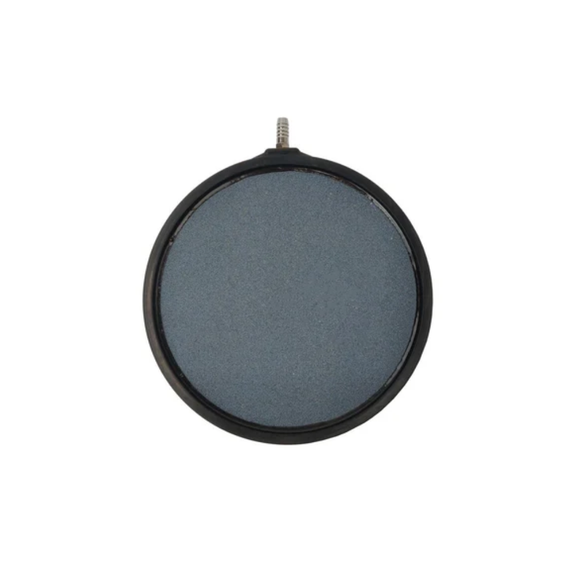
Porous stone diffuser disc, 20 cm
Regular price
¥3,800
Regular price
Sale price
¥3,800
Unit price
/
per
¥1,267 × 3 with no fees
Klarna.
This 200 mm microporous stone disc sits flat on the bottom of a pond or an aquaponic system. It breaks the air up into fine bubbles across its whole face, instead of from a single point.
 Customer support 7 days a week by email
 Delivery within 2 to 15 business days
100 % secure payment
The summary
- What it is: a 200 mm microporous stone disc, 15 mm thick.
- What it does: it breaks the air into fine bubbles across its whole face, instead of from a single point.
- How to choose: the disc covers a base, the 30 mm ball oxygenates a corner.
- What you need to connect it: a pipe of 9 mm inside diameter and a pond air pump.
A flat 20 cm diffuser, placed on the bottom of a pond or tank
The 20 cm porous stone diffuser disc is a flat air diffuser, 200 mm in diameter and 15 mm thick, designed to sit on the bottom of a pond or tank. It spreads the air across its whole face in fine bubbles of 1 to 3 mm, rather than from a single point. It connects to a pipe with a 9 mm internal diameter.
Most diffusers release air from a single point. This one releases it through a disc 20 centimetres in diameter, and the difference shows in the water: instead of a column of bubbles rising straight up in one corner, you get a veil that covers a surface. The stone is microporous and the body is only 15 millimetres thick, which means it can be laid flat on the bottom of a pond, a fish tank or a sump without getting in the way.
⭕ A 20 cm porous face
What you gain from this surface comes down to the size of the bubbles. A fine diffuser produces bubbles of the order of 1 to 3 millimetres, where a bare pipe produces bubbles several centimetres across, and two things follow from this: a mass of small bubbles offers far more exchange surface than a small number of large ones, and it rises more slowly, so it stays in contact with the water for longer. A wide disc combines these two effects, because it spreads the same air flow over a very large porous face.
🔧 The fitting and the pump
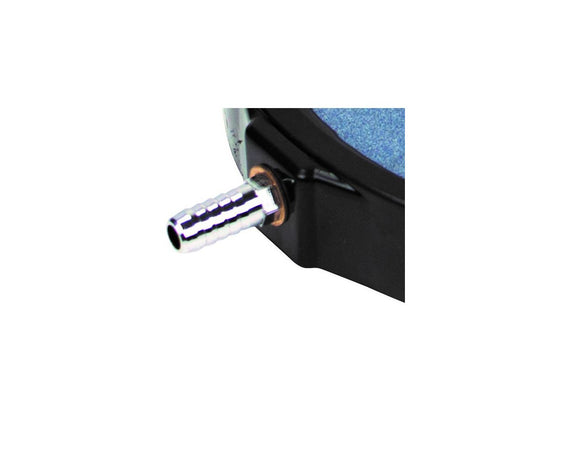
The air enters through a metal barbed fitting on the edge of the disc, with an outside diameter of 8 to 10 mm. This is a pond format: aquarium pumps come in 4/6 mm and need an adaptor, whereas a flexible pipe with a 9 mm inside diameter, which you slip straight onto the barbs, stays in place without a clip. As for the pump, the ACO-208 and ACO-318 models of the Hailea air pump for tanks and ponds deliver 35 and 60 L/min, and their splitter supplies several diffusers. Your pump is then chosen according to its flow rate and its pressure.
The fitting
The outlet measures 8 to 10 mm, a pond format rather than an aquarium one.
The pipe
A flexible 9 mm internal diameter pipe slips onto it without an adapter.
Installation
The disc sits flat on the bottom, porous side facing up, slightly raised on a support.
The pump
A large porous face needs a strong airflow to bubble properly all over.
The pipe that goes into the fitting
Order the clear 9 mm internal diameter pipe at the same time. It slides straight onto the outlet of this disc, with no reducer or adapter. Its transparency shows you whether the air is reaching the bottom properly, which you cannot see with an opaque pipe once the disc is submerged. If your line also serves a small tank, the 30 mm round air stone fills the role that this disc cannot.
Pressure matters as much as flow, because the air must overcome the depth of water above the disc before it escapes. Each metre of depth represents about 100 mbar, and the microporous stone adds its own resistance to the passage of air. A disc placed at the bottom of a 1.2 m pond therefore requires your pump to deliver more than 120 mbar before the first bubble appears. Pond pumps state their maximum pressure or immersion depth, which you compare with the depth of your pond: the 540 or 1,000 L/h pond aerator pushes air down to 2.2 or 2.8 m. Keep a margin between this figure and your depth, because the flow of a diaphragm pump falls as the back pressure rises.
🌡️ Oxygen in an aquaponic system
In your aquaponic system, three consumers share the dissolved oxygen in the same water: the fish, the nitrifying bacteria in the biofilter and the roots. Aim for at least 5 mg/L at all times, which becomes difficult in summer because water holds less oxygen as it warms: around 11.3 mg/L at 10 °C against 8.3 mg/L at 25 °C, at saturation. So place the disc in your fish tank, where demand is highest, or in the sump that feeds your grow beds. To find out whether the aeration is sufficient, the drop-based dissolved oxygen test is best carried out at first light, when the concentration is at its lowest after a night without photosynthesis.
🧼 Restoring the stone's pores
Your clogged disc can be cleaned and will regain its veil of fine bubbles. Two layered deposits block it: limescale, which crystallises in the pores, and biofilm, which settles on top. First brush the surface with a soft brush and rinse with clean water, then leave the disc to soak for 2 to 4 hours in an equal mix of white vinegar and water, which dissolves the mineral deposit. Finally, rinse thoroughly before putting it back in the water. Aquaculture professionals use a stronger acid and a shorter bath, but vinegar is perfectly adequate for a garden pond. Combine this soak with the other tasks of summer maintenance, since the disc comes out of the water anyway.
Technical specifications
The essentials
- What it is
- Flat porous stone diffuser
- Diameter
- 200 mm
- Thickness
- 15 mmIt lies flat on the bottom without taking up space.
- Material
- Microporous stone
The connection
- Outlet fitting
- 8 to 10 mm
- Suitable pipe
- 9 mm internalIt slides straight on, without a reducer.
Installation
- Orientation
- Lay flat, porous side facing up
- Height
- Slightly above the bottomPlaced in the sludge, it stirs it back up when it starts.
To budget for separately
- Air pipe
- 9 mm internal
- Air pump
- Outlet of 8 to 10 mmAquarium pumps come with 4/6 mm outlets and need an adapter.
2 further specifications are available in the detailed view.
In the box
- 1 porous stone diffuser disc, 200 mm
Diameter, thickness, material and fitting taken from the product description on 20/09/2026. Bubble sizes taken on the same date from a diffuser manufacturer; oxygen solubility: freshwater saturation tables.
Two diffusers, two surfaces
The same porous stone and the same principle. What changes is the surface that bubbles and the fitting that feeds it.
A large porous face calls for a high flow rate
The disc is worth its surface area, and that surface only gives its full effect if the pump keeps up. These three questions check that the two go together.
| Diameter (mm) | Shape | Air fitting | Fits in a pot or a small tub | Covers the bottom of a pond | Plugs straight into an aquarium pump without an adapter | Price | |
|---|---|---|---|---|---|---|---|
| Round blue porous stoneYour choice | 30 mm | Ball | 4/6 mm | Yes | No | Yes | ¥500 |
| Recommended Porous stone diffuser disc, 20 cmYour choice | 200 mm | Flat disc | 8 to 10 mm | No | Yes | No | ¥3,800 |
Round blue porous stone
The diffuser
Diameter (mm)30 mm
ShapeBall
Air fitting4/6 mm
Where it is placed
Fits in a pot or a small tubYes
Covers the bottom of a pondNo
Plugs straight into an aquarium pump without an adapterYes
Porous stone diffuser disc, 20 cmRecommended
The diffuser
Diameter (mm)200 mm
ShapeFlat disc
Air fitting8 to 10 mm
Where it is placed
Fits in a pot or a small tubNo
Covers the bottom of a pondYes
Plugs straight into an aquarium pump without an adapterNo
Diameters and fittings noted on 20/09/2026 from the AquaKing data sheet for the 30 mm ball and from the description of the disc.
Help choosing
A spot of bubbles or a film on the bottom
Estimate your
delivery time
Your estimate
Delivery
Estimated time
It covers preparing your order and then the transit time quoted by the carrier, counted in working days.
It is not a guaranteed delivery date: public holidays, peak periods, customs or a carrier delay can extend it. The exact amount, in your currency, is worked out in the cart once your address is entered.
Light parcel, sent to a pick-up point or to your home, as you choose during checkout. The exact cost depends on the option selected and is shown in the basket.
Frequently asked questions
8 questions
6 key questions, 8 in the detailed view
You may also like


Related articles

Maintenance
Maintaining your aquaponic system in summer
Warm water holds less oxygen: the summer settings, including the aeration to run day and night.
Read the article

Season

Troubleshooting
Understanding and clearing cloudy water
Brown, milky or green water: how to identify the cause of cloudiness and treat it in the right order.
Read the article

Understanding
The nitrogen cycle in aquaponics
The filter's nitrifying bacteria and the oxygen they need to convert ammonia.
Read the article

Getting started

Guide
Getting started with an aquaponic system
What to install first on a pond that is just starting up.
Read the article
Let us talk about your project
A question about this product or your setup? Our team will answer and advise you.

Interest-free instalment payments
Offered depending on the cart amount, at checkout.

Delivery in 2 to 15 working days
Depending on the products and shipping sites. Estimate by destination in the estimator on this page.

After-sales service 7 days a week by email or chat
Our team answers all your questions.

Shop responsibly
Become part of the change.
