Controlling pests in aquaponics

Written by Tristan Ulrich · December 16, 2025
Protection des cultures aquaponiques contre les ravageurs

Aquaponics has a reputation for being a clean, ecological, and naturally protective method of cultivation. However, like any living system, it can be affected by pests : aphids, gnats, mites, invasive algae, or unwanted larvae.
Even in a perfectly balanced system, humidity, heat, and abundant vegetation sometimes create an environment favorable to certain opportunistic species.

The difficulty in aquaponics is to solve these problems without pesticides, since any toxic substance would endanger the fish and the biofiltration.

Why do pests appear in an aquaponic system?

They take advantage of an imbalance, often invisible, that creates ideal conditions for them to establish themselves. Aquaponics combines warmth, constant humidity, vigorous plants and the absence of natural predators. Humidity is also one of the biggest attracting factors. An area where the surface of the grow medium remains constantly wet becomes a perfect habitat for fungus gnats and their larvae. Conversely, a part of the system exposed to dry heat encourages mites. Internal microclimatic variations — a warmer corner of the greenhouse, a less well-ventilated zone — are enough to trigger a concentration of insects.

Plant stress plays an equally central role. A calcium deficiency, excess nitrogen, insufficient light or stagnant air all weaken plant tissue. A stressed plant alters its chemical composition, producing attractive signals for certain insects. Finally, aquaponics in a greenhouse or indoors eliminates almost all natural predators (ladybirds, hoverflies, parasitoid micro-wasps). In this enclosed environment, the slightest accidental introduction of a pest — on footwear, via a purchased plant, or through an open vent — can be enough to trigger a rapid infestation.

Aphids: the fastest pests to colonise your plants Fine mesh insect netting for vegetable gardens

Aphids : the fastest pests to colonize

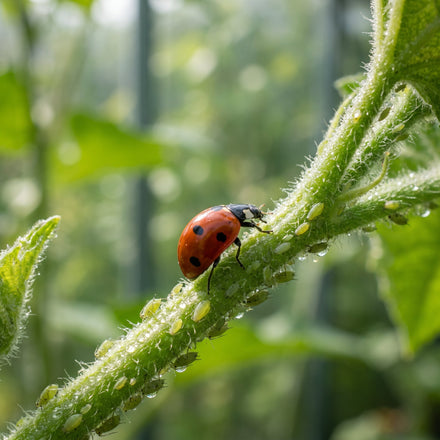
Aphids are the most explosive pests in aquaponics. Their reproduction is lightning-fast : a single female can produce dozens of live clones… every day. In a heated greenhouse, an infestation can double every 24-48 hours.

They suck the sap, causing leaf deformities, stunted growth, sticky leaves, and sometimes the development of sooty mold (black fungus). They primarily target basil, peppers, tomatoes, and all young shoots rich in nitrogen.

In aquaponics, a poorly managed infestation can ruin an entire crop in a matter of days.

Fungus gnats: a clear sign of excess

Midges : a clear sign of excess

Fungus gnats do not appear dangerous at first glance, but their presence is a valuable indicator : it reveals that the surface of the growing bed remains too wet or that organic matter is beginning to accumulate.

The problem lies with the larvae. They live in the top few centimeters of the substrate, where they feed on fine roots. Affected plants exhibit slow growth, slight wilting despite adequate moisture, and sometimes premature yellowing.

The proliferation of midges accelerates when air circulation is poor, plants are too crowded, or evaporation is insufficient. Their presence is a clear signal that the climate needs adjusting.

Spider mites: invisible pests

Dust mites : invisible pests

Mites, especially spider mites, are extremely difficult to detect with the naked eye. Their presence is only visible through the damage they cause : speckled, discolored, dry leaves, sometimes covered in fine webbing. They almost always appear in areas that are too hot and too dry.

In aquaponics, paradoxically, this problem occurs mainly in poorly ventilated greenhouses : overall humidity is high, but the leaves remain dry on the surface because the air doesn't circulate. Mites also thrive on stressed plants, especially when the plant suffers from a calcium or magnesium deficiency.

A severely attacked plant experiences a disrupted metabolism. It expends its energy repairing damaged tissues instead of growing, which significantly affects the overall productivity of the system.

Slugs and caterpillars: typical physical pests Slug trap

Slugs and caterpillars : typical physical pests

Slugs and caterpillars are less common in indoor aquaponics, but very frequent in outdoor systems. The constant humidity of the tanks, the shade under the structures, and the natural shelters created by the vegetation make it an ideal environment for them.

Their damage is immediate : leaves are perforated, edges are severed, and young shoots disappear overnight. In a system where each plant plays a role, the physical destruction of a crop can lead to a temporary decrease in nutrient absorption, altering the system's balance.

Slugs are attracted to the moisture in garden beds and are particularly active at night. Caterpillars, on the other hand, often hatch from eggs laid on leaves or are attracted to outdoor lighting.

Larvae in the water: a sign of a problem

Larvae in the water : an indicator of a problem

The presence of mosquito larvae indicates an area of ​​the system where the water is stagnant. In a well-designed system, the water should always be in motion. Mosquitoes only lay their eggs in still or very slightly agitated water.

Even though these larvae are not dangerous to fish, they indicate a lack of oxygenation or flow, which can also harm nitrifying bacteria.

In systems with poorly inclined return lines, partially covered tanks, or excessively still barrels, this stagnation can occur. The solution is to improve circulation or cover attractive areas.

Natural solutions: how to eliminate pests without disrupting the ecosystem

In aquaponics, the best strategy works in three stages. First, reduce the pest population before it gets out of hand. Then, address the underlying cause that made the system favourable to the infestation. Finally, put simple preventive measures in place to stop it coming back.

The most common mistake is reaching for a "miracle product". In aquaponics, the most effective solutions rarely look like treatments at all.

Using integrated biological control

Using integrated biological control

Beneficial insects are the cleanest, most sustainable, and most consistent approach with the spirit of aquaponics. In a greenhouse, a pest thrives because it has no predators.

For aphids, ladybugs and especially lacewing larvae are very effective. They quickly attack colonies and prevent regrowth. For mites, specialized predatory mites are used, which are particularly useful when the plant is already infested.

This method works particularly well if the infestation is treated early. The earlier you intervene, the faster the balance is restored and the less likely you are to have to "save" the plants.

Reducing pressure quickly

Reduce the pressure quickly

Before even considering treatment, the quickest solutions often involve removing a large portion of the pests by hand. For aphids, a targeted rinse of the leaves (away from the pond) or a gentle wiping can immediately reduce the colony. For heavily infested leaves, the best course of action is sometimes to cut off and remove the affected part.

In the case of caterpillars, manual collection is very effective, especially if the plants are inspected in the morning or late afternoon. Outdoors, slugs can also be managed through nighttime inspection and regular removal, which reduces their impact before the population explodes.

Using black soap

Use black soap

Black soap is one of the few "treatment" tools usable in aquaponics, but it must be used with surgical precision. It acts on contact against aphids and mites by disrupting their external defenses. It is very effective, but it becomes dangerous if any droplets run into the pond.

The best method is to treat only the affected leaves, protecting the growing bed and water, and avoiding any spraying above the tanks. In an aquaponics system, the challenge is not just to eliminate the insect : it's to do so without disrupting the nitrogen cycle.

When the treatment is precise and limited, black soap is an excellent one-off solution to regain control.

Ventilation: the most underrated solution 360° digital thermometer and hygrometer

Ventilation : the most underestimated solution

Many infestations disappear simply by correcting the air and humidity. Gnats thrive when surfaces remain wet and air doesn't circulate. Dust mites proliferate when localized heat rises and the air stagnates.

Gentle but constant air circulation makes all the difference : it reduces stagnant humidity, evens out the temperature, and creates a less favorable environment for pests. It's also an indirect measure of health : a plant that breathes better is more resilient.

In many systems, a simple, well-placed fan or more regular ventilation cuts the problems in half within a few days.

Tackle the cause

Addressing the cause

Pests thrive where they can hide. In aquaponics, plants can become very dense, especially in well-nourished systems. This density creates shaded and humid areas where insects find shelter and breed.

One of the most effective levers is to aerate the plant mass. Light pruning, spacing out certain crops, removing lower leaves, and eliminating plant debris immediately reduces hiding places.

A clean growing bed, free of decaying leaves, attracts far fewer fruit flies. A well-maintained greenhouse, without unventilated damp areas, greatly reduces the risk of new colonies emerging.

Eliminating mosquito larvae Pond pump : Universal 1200-3400 L/h

Remove mosquito larvae

If larvae appear in the water, the solution isn't a product, but a circulation diagnosis. You need to identify where the water is stagnating : tank corner, secondary tank, slow return channel, area under the lid. Once the area is identified, increasing water movement or oxygenation is usually enough to eliminate the problem.

Mosquitoes do not lay eggs in a moving pool. This means that a well-designed system, with proper circulation and a well-mixed surface area, is almost naturally protected against this type of pest.

Conclusion: in aquaponics, the best defence against pests is stability

Managing pests in aquaponics is not about "treating" as you would in a conventional garden. It is first and foremost about learning to read the signals of the ecosystem and identifying what makes the environment favourable to parasites. In the majority of cases, an infestation reveals an imbalance: inadequate ventilation, excessive plant density, stagnant humidity, or plant stress.

By combining early intervention, biological control, system hygiene, and microclimate management, results are often rapid and lasting: healthier plants, a healthier greenhouse, and a system that is overall less attractive to pests.

It is worth noting that no aquaponic system is entirely free of pests, whether in domestic aquaponics or at the scale of professional farms. These organisms are present in all growing systems. However, they are never invincible: every pest has its weaknesses and can be controlled with the right management strategy.

To go further and discover solutions suited to aquaponics, we invite you to visit our dedicated page on integrated biological control.
Sources

Oklahoma State University Extension, Principles of Small-Scale Aquaponics, Rules out most chemical methods in the presence of fish and points towards integrated pest management and sticky traps.

University of Connecticut IPM, Biological Control of Aphids, Beneficial insect species, temperature and humidity ranges, and time before visible effect.

University of Connecticut IPM, Insecticidal Soaps, How fatty acids work, temperature and sunlight precautions, and preliminary testing on a small area first.

University of Connecticut IPM, Damping-off of Ornamental and Vegetable Seedlings, Damping-off agents, tray disinfection, and bottom heat at the seedling stage.

Oklahoma State University Extension, Nitrification and Maintenance in Media Bed Aquaponics, A reminder of how the biofilter works and why any intervention on the plants must preserve it.

New Mexico State University, Aquaponics Circular CR-680, Water parameters to monitor after any intervention in the system.

Frequently asked questions

No. The aquaponics extension sheets are clear on this: most chemical methods should be avoided as they can be harmful to the fish.

The principle is simple to state and demanding to follow: not a single drop must reach the system. In practice, the best approach is to remove the plant from the system when it is in a pot or basket, treat it away from the setup, let it drain completely, then replace it once the leaves are dry. When the plant cannot be moved, slide a sheet of plastic film or cardboard under the foliage to cover the entire surface of the grow bed and the water below, and spray directing the jet upwards, under the leaves — which is precisely where aphids and mites tend to be found anyway.

Timing matters as much as the precautions taken. University technical data sheets on insecticidal soaps recommend avoiding applications in hot weather, above around 32 °C, in full sun or in dry conditions, and treating early in the morning or in the late afternoon. They also advise testing a small area of foliage and waiting twenty-four hours before treating the whole plant, as phytotoxicity varies considerably from one species to another. Aim for complete leaf coverage without excessive run-off — which is precisely the opposite of the broad, generous spray one instinctively tends to use.

One final point: switch off the pump during treatment if your setup allows it, and wait until everything is dry before restarting it. An isolated splash in a large volume is rarely catastrophic, but the habit of spraying over tanks will always end up costing you fish.

Releases are not treatments — they are populations to establish. The University of Connecticut fact sheets give fairly clear ranges.

  • Parasitic wasps of the genus Aphidius work between approximately 18 and 25 °C, at a relative humidity of 70 to 85%.
  • Predatory aphid midges tolerate a wider range, roughly 16 to 27 °C, at a humidity of 50 to 85%.
  • Lacewings lose their effectiveness when the greenhouse exceeds 35 °C.
  • Allow two to three weeks before seeing results from parasitoids, and around two weeks for lacewings.

In other words, a release decided on the day the colony explodes comes too late. It is also why applying a treatment — even a mild one — immediately after a release is simply wasting money on beneficial insects.

We prefer to err on the side of caution. The aquaponics extension documents we have consulted recommend integrated pest management, mechanical methods and beneficial insects, but do not cite Bacillus thuringiensis among the solutions validated for use in the presence of fish. Until you have an explicit technical source covering your specific product — and its adjuvants — treat it as any other potentially risky input, meaning keep it out of the water circuit.

For caterpillars, hand-picking and an insect-proof mesh resolve the issue without raising this concern, and the main article explains why a morning inspection is so effective.

Yes, but not as a control method. Small-scale aquaponics guides mention them as a monitoring tool, and that is their real value. A trap checked every week tells you whether the population is rising, holding steady, or falling, well before any damage becomes visible on the leaves.

Yellow attracts mainly whitefly and winged aphids; blue attracts thrips. Place them at canopy height, record the number of insects caught, and use the trend to decide when to release beneficial insects at the right moment.

No, it is almost always damping off, a complex of soil-borne fungi including Pythium, Rhizoctonia, and Fusarium. The seedling emerges normally, then collapses at the base of the stem. Fungus gnats make things worse by damaging fine roots, but they are not the primary cause.

The University of Connecticut's recommendations come down to three steps. Disinfect reused trays and pots, never reuse a grow medium that has already supported a crop, and provide bottom heat of around 21 to 24 °C to shorten the period during which the seedling is vulnerable. A seedling that germinates quickly spends far less time at risk.

Read next

Aquaponics and Summer Holidays

Aquaponics and Summer Holidays

You're going away for two weeks in July and your aquaponics system will be running without you : this thought rightly makes you anxious, because heatwaves, evaporation, and fish feeding raise practical questions. Good

Read the article
Recognizing deficiencies in aquaponics

Recognizing deficiencies in aquaponics

In aquaponics, plants can show signs of weakness even when the system appears balanced. Pale leaves, slowed growth, or deformities are often linked to subtle yet critical micro-deficiencies. These deficiencies involve essential elements such

Read the article
A practical calendar for success in aquaponics

A practical calendar for success in aquaponics

In aquaponics, the success of a season depends mainly on good upstream calendar management : periods of sowing, planting, ramp-up… and times when it is better not to intervene. Unlike a traditional vegetable garden,

Read the article
Plant deficiencies in aquaponics

Plant deficiencies in aquaponics

Aquaponics relies on a precise balance between fish, plants and bacteria. When that balance is disrupted, plants can quickly show signs of nutritional deficiencies, even in a system that appears stable. Understanding the cause

Read the article
Aquaponics in businesses and schools

Aquaponics in businesses and schools

We picture aquaponics in a garden or a greenhouse. Rarely in a school playground, a hospital's shared garden or the lobby of a corporate headquarters. And yet, that is where it produces some of

Read the article