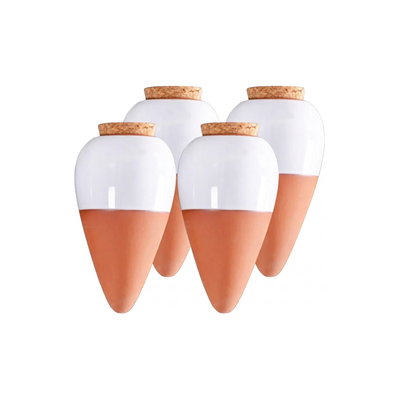
The flow rate of an olla is not a fixed property of the product; it is the outcome of an interaction between a wall and a soil. Measurements published in 2004 in the journal Canadian Biosystems Engineering by Abu-Zreig and Atoum, covering fourteen porous vessels, gave flow rates ranging from 600 to 3700 mL per day, for wall hydraulic conductivities of between 0.219 and 2.37 mm per day and a mean wall thickness of 6.5 mm. The sixfold difference between two vessels of the same type therefore comes down primarily to the ceramic itself.
Soil and climate account for the rest. A review published in 2024 reports olla flow rates rising from approximately 190 mL to 1040 mL per day as evaporation increases from 1 to 16 mm per day, with the same vessel throughout. This is precisely the behaviour the system is designed for — uptake follows demand — but it also means that no figure in any product leaflet will hold true for your garden.
The only measurement that matters is your own. Fill the olla to the brim, note the time, measure the volume needed to top it up after seven days, and you will know the actual flow rate of your installation. Repeat the exercise in July and again in September; the difference will tell you whether the wall is beginning to become clogged.