





Learning-speed extraction controller, 2 x 7 A
Regular price
$235.00
Regular price
Sale price
$235.00
Unit price
/
per
$78.33 × 3 with no fees
Klarna.
The RAM Air-Pro II adjusts the speed of an extractor fan and an air intake fan according to the temperature read by its 2 m remote probe. It finds the right speed to hold the chosen set point and negative pressure, then settles there, which spares the motors in a closed greenhouse or grow room.
100 % secure payment
The summary
- What you receive: a RAM controller with a digital display, its 2 m probe and its mains lead.
- What it controls: the speed of an extractor fan and an air inlet, according to the temperature you want.
- How it works: it finds the speed that holds the set point and settles there, without sudden jolts.
- In an aquaponic greenhouse: heat removed, CO2 renewed, humid air drawn out to the exterior.
- What to plug in: two duct fans of 100 to 315 mm, 7 A at most each.
- What it does not measure: humidity, which is monitored with a separate hygrometer.
Extraction and air intake controlled by temperature, with negative pressure, for a greenhouse or grow room
An extractor running at full speed all the time wears out its motor, makes noise and often cools more than necessary. The RAM Air-Pro II entrusts this adjustment to a digital controller: you set the temperature you want and the balance between air intake and extraction, then it works out the speed that holds this setpoint by itself, and settles there rather than constantly varying your fans. It controls two devices at once, an extractor and an air intake fan, for a closed greenhouse, a seedling room or a grow room.
⚙️ A speed that is learned, then held
A conventional thermostat works on an on/off basis: it starts the extractor fan above the set point and switches it off below it, so the temperature swings and the motor keeps cycling on and off. The Air-Pro II takes a different approach. Its software first calculates a rotation speed, observes the effect on the temperature read by the probe, then gradually reduces the speed until it finds the single speed that holds the set point. Your fans then spend most of their time running below maximum speed, at the point where the ratio of electricity consumed to air moved is most favourable, which extends motor life and keeps noise down.
A 2 m probe
Remote on its cable, it can be placed where the temperature really matters.
Accurate to 1 °C
The reading is accurate to within plus or minus one degree.
Two 7 A sockets
One for the extractor fan, one for the air intake fan.
A digital display
It shows the measured temperature and the current settings.
🌬️ Setting the negative pressure
The second setting, the balance between the two fans, creates the negative pressure: the air inlet runs slightly slower than the extraction, so the room draws in fresh air through the intended opening instead of letting warm, humid air escape through gaps. In a grow room, the fabric dips slightly inwards when the negative pressure is right. In a greenhouse, this gentle suction stops the humid greenhouse air from passing into the neighbouring room or the plant room. The probe should be placed at crop height, in the shade and away from the air inlet, so that it measures the air your plants actually breathe.
Monitor the CO2 and humidity in the greenhouse
The Air-Pro II regulates on temperature alone. The CO2, temperature and humidity monitor, placed near the crops, also shows you what the ventilation changes in the air: the CO2 returning towards the outdoor level when the extractor is running, and the humidity rising on the nights when it slows down. You then know whether the chosen setpoint is also enough to refresh the air, or whether it needs to be lowered by a degree.
Seven amps per socket, no more
Each socket accepts a maximum of 7 A. Check the current rating on the plate of your fans before plugging them in, never connect a power strip loaded with other appliances to it, and plug the controller into an earthed socket protected by a 30 mA residual current device. Finally, mount the unit where it is sheltered from watering, tank splashes and condensation.
🌱 In an aquaponic greenhouse
A closed aquaponic greenhouse must get rid of the heat of sunny days while looking after both of its populations. The FAO guide puts the comfort range of warm-water fish and nitrifying bacteria at 22 to 29 °C and that of lettuce at 18 to 26 °C, and caps trout at 18 °C: an air set point of around 25 °C therefore suits most tilapia or carp systems stocked with leafy vegetables. With the Air-Pro II, extraction speeds up as soon as the temperature rises above this value and slows down when it drops, without ever cutting off the aeration, which softens the swings that the tank water then passes on to the biofilter. The guide on looking after your aquaponic system in summer details how to manage the hot season.
Ventilation also regulates two quantities that the thermometer cannot see. Plants consume the CO2 in the air during photosynthesis: in a closed greenhouse, its level can fall to 150 or 200 ppm during the day, compared with about 400 ppm outside, and growth slows down. Each air change brings it back towards the outdoor value. The fish tank and the grow beds also evaporate a great deal of water, and saturated air encourages botrytis, or grey mould, as soon as humidity exceeds 93% for 8 to 12 hours. An extractor that never stops completely, even at low speed, limits both of these drifts, particularly in the early morning, when the cooled air approaches saturation.
🔧 Installing and adjusting
Connect the extractor to the extraction outlet and the air intake fan to the second, then plug the controller into the mains using its 2 m cord. If a fan has its own speed selector, leave it on the high setting: it is the controller that modulates the speed. Fix the probe at the point most sensitive to temperature, generally at foliage level, away from the lamps and the incoming airflow. Set the desired temperature, then the balance between the two fans, and give the controller time to find its cruising speed: during the first few hours it varies the speed before settling. If your room lacks suction, reduce the air intake until you see the fabric or the ventilation louvres flex inwards slightly.
The controller performs best with duct fans of 100 to 315 mm, the sizes in the RAM range, and can also be used with fans from other brands of equivalent diameter. Before buying, add up the current drawn by each appliance connected to the same socket and check that it stays below 7 A. For a greenhouse larger than two duct fans can ventilate, circulation fans mix the air inside without going through the controller, and a sound-insulated box reduces the noise of a 125 or 150 mm extractor fan installed near a lived-in room.
📦 In the box
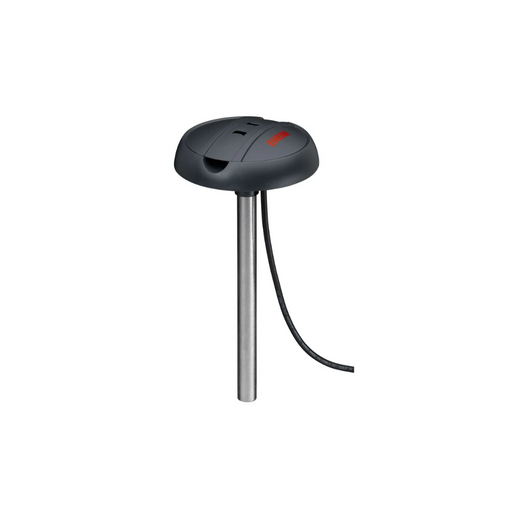
You receive the RAM Air-Pro II controller with digital display, its temperature probe on a 2 m cable and its 2 m power cord. The fans plug straight into the two sockets on the unit, with no wiring to do. Fix it to the wall or to an upright, at eye level so you can read the display, and away from water splashes, as with any electrical appliance installed in a greenhouse where the air is humid.
⚡ Load and electrical safety
Seven amps per socket is about 1,600 W at 230 V, but an extractor fan motor draws considerably more at start-up than its running current. Keep a margin of about 20%, that is 5.6 A per socket, which duct extractor fans of 100 to 315 mm, for which the controller is designed, meet without difficulty. Connect AC motors to it, those whose speed is adjusted by voltage, and not an extractor fan with an EC motor, which receives its setpoint through a control wire. The enclosure is mounted in a dry spot, on a wall of the plant room or outside the grow room, like an indoor appliance, and only the probe goes into the humid air. Its cable plugs into an earthed wall socket, on a circuit protected by a 30 mA residual current device, which the NF C 15-100 standard requires for all circuits in a dwelling. Before any work on a fan or on the ducting, unplug the controller: a motor that is running slowly can restart at full speed as soon as the temperature rises.
Technical specifications
Regulation
- Controlled variable
- Air temperatureWith a balance between intake and extraction
- Probe
- Remote, 2 m cable
- Accuracy
- Plus or minus 1 °C
- Adjustment mode
- Speed learned, then stabilisedThe motors run below their maximum speed
The device
- Outlets
- 2 sockets, 7 A eachOne for the extractor, one for the air inlet, with a recommended 20% margin
- Recommended fans
- Ducting from 100 to 315 mm
- Display
- Digital
- Feeding
- Mains-powered, 2 m cord
- Compatible motors
- AC motors, adjustable by voltage
- Fan selector
- In the high positionThe controller adjusts the speed by itself
2 further specifications are available in the detailed view.
In the box
- 1 RAM Air-Pro II controller
- 1 temperature probe on a 2 m cable
- 1 2 m power cable
Manufacturer values (product page) and retailers. Temperatures from the FAO guide, CO2 from Oklahoma State University, botrytis from the University of Connecticut.
Manufacturer and product safety
- Manufacturer
- RAM
Information provided under Regulation (EU) 2023/988 on general product safety.
Which controller will leave you with the fewest settings to adjust?
Three two-output controllers: two with dials, one that learns its speed.
A controller that learns, or dials?
The Air-Pro II finds the speed that holds the setpoint by itself; the other two are adjusted with a dial, and one also measures humidity.
| Measures humidity | Temperature only | How to adjust the speed | Probe length (m) | Load per outlet | Display | Price | |
|---|---|---|---|---|---|---|---|
| Extraction controller for temperature, humidity and negative pressureYour choice | Yes | No | Dials for minimum speed and negative pressure | 4 m | On the label, 2 A by default | Indicator lights | $286.00 |
| Extraction controller for temperature and negative pressure, 2 outletsYour choice | No | Yes | Dials for minimum speed and negative pressure | 4 m | On the label, 2 A by default | Indicator lights | $194.00 |
| Recommended Learning-speed extraction controller, 2 x 7 AYour choice | No | Yes | Speed learned, then stabilised | 2 m | 7 A | Digital display | $235.00 |
Extraction controller for temperature, humidity and negative pressure
Regulation
Measures humidityYes
Temperature onlyNo
How to adjust the speedDials for minimum speed and negative pressure
Probe length (m)4 m
The connection
Load per outletOn the label, 2 A by default
DisplayIndicator lights
Extraction controller for temperature and negative pressure, 2 outlets
Regulation
Measures humidityNo
Temperature onlyYes
How to adjust the speedDials for minimum speed and negative pressure
Probe length (m)4 m
The connection
Load per outletOn the label, 2 A by default
DisplayIndicator lights
Learning-speed extraction controller, 2 x 7 ARecommended
Regulation
Measures humidityNo
Temperature onlyYes
How to adjust the speedSpeed learned, then stabilised
Probe length (m)2 m
The connection
Load per outlet7 A
DisplayDigital display
Manufacturers' values (product pages and instructions).
Buying guide
Which one will leave you with the fewest settings to adjust?
Estimate your
delivery time
Your estimate
Delivery
Estimated time
It covers preparing your order and then the transit time quoted by the carrier, counted in working days.
It is not a guaranteed delivery date: public holidays, peak periods, customs or a carrier delay can extend it. The exact amount, in your currency, is worked out in the cart once your address is entered.
The controller ships in its original box from a distributor's warehouse in France. The exact shipping cost is shown in the basket.
Frequently asked questions
10 questions
6 key questions, 10 in the detailed view
You may also like





Related articles

Season
Looking after your aquaponic system in summer
It shows how a well-adjusted extraction keeps the greenhouse bearable in summer.
Read the article

Winter
Protecting your aquaponic system in winter
Ventilate a closed greenhouse without cooling it down.
Read the article

Winter
Heating your greenhouse in winter
It helps you balance supplementary heating and low-speed aeration in winter.
Read the article

Plant health
Keeping pests down in aquaponics
It explains how renewing the air keeps diseases and pests in check.
Read the article

Greenhouse

Hydroponics
Getting started with indoor hydroponics
It presents an indoor growing room, from the lighting to the controlled ventilation.
Read the article
Let us talk about your project
A question about this product or your setup? Our team will answer and advise you.

Interest-free instalment payments
Offered depending on the cart amount, at checkout.

Delivery in 2 to 15 working days
Depending on the products and shipping sites. Estimate by destination in the estimator on this page.

After-sales service 7 days a week by email or chat
Our team answers all your questions.

Shop responsibly
Become part of the change.
